The Majorana System
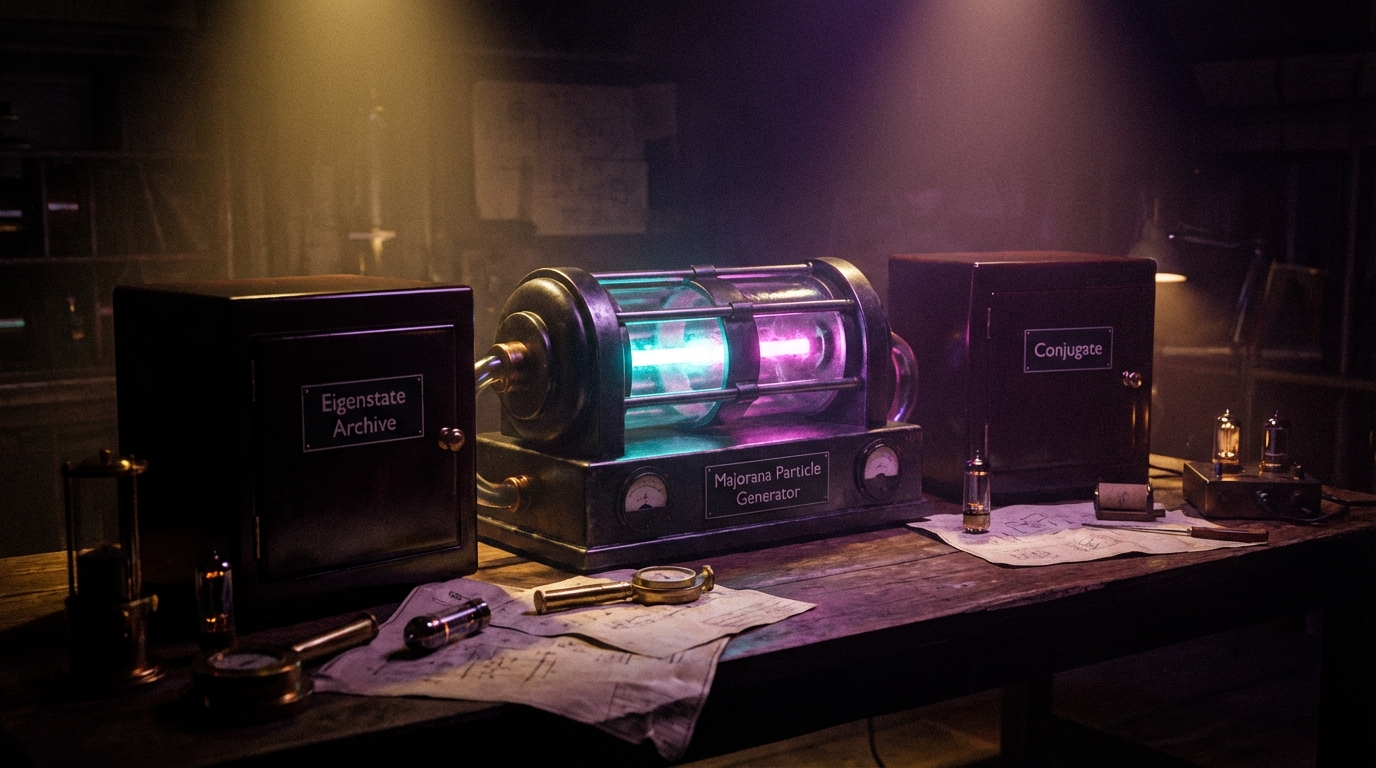
The Majorana System is the technological foundation of Portal Pirate operations, enabling unregulated inter-dimensional travel independent of Guardian infrastructure. Invented by physicist Ettore Majorana following his recruitment in 1938, the system comprises four core components: The Majorana Twins for capturing portal locations, a Majorana Particle Generator, The Eigenstate Archive for storing coordinates, and The Conjugate for opening portals. Unlike Guardian technology, which restricts each group to their own recorded locations, the Majorana System aggregates access across all captured networks—making its users far more mobile and dangerous than any single Guardian group.
Origins: The Pirate Problem
For over nine hundred years before the Majorana System existed, Portal Pirates survived through raids alone. Founded in 1017, the settlement of Xolldo grew from a band of desperate outcasts into an organised society—but one trapped entirely within Clivilius. The pirates were born in Clivilius, had no Portal Keys, and no means of travelling to Earth. They were confined to a single dimension whilst Guardians moved freely between worlds.
Early pirates made their living by ambushing Guardian settlements. When a Guardian activated their Portal Key on Earth and stepped through to their fixed Clivilius location, they often carried supplies, trade goods, or valuable items. Pirates would scout active Guardian settlements, wait for arrivals, and strike before the Guardians could react. It was dangerous work. Guardian groups protected their settlements fiercely, knowing that a successful pirate raid could cripple their community's access to Earth resources.
This arrangement—pirates as raiders, Guardians as targets—persisted for centuries. The pirates developed sophisticated intelligence networks, tracking which Guardian settlements were active, which were vulnerable, and which were too well-defended to risk. They became experts in ambush tactics and rapid extraction. But they remained fundamentally limited. They could steal what Guardians brought through, but they could never go through themselves. They could raid settlements in Clivilius, but they could never reach Earth.
The Majorana System changed everything.
Ettore Majorana: The Inventor
Ettore Majorana was born on 5 August 1906 in Catania, Sicily, to a family of prominent intellectuals. His exceptional aptitude for physics became evident early, and by his mid-twenties he had established himself as one of the most brilliant theoretical minds of his generation. Studying under Enrico Fermi at the University of Rome, Majorana made significant contributions to quantum mechanics, particularly regarding particles that would later bear his name.
In March 1938, Majorana boarded a ship from Palermo to Naples and was never seen again. His disappearance became one of science's great mysteries. The truth, unknown to the wider world, was that Majorana had been recruited by agents working on behalf of the Portal Pirates.
How exactly the pirates made contact with Majorana, and what convinced him to abandon his former life, remains a matter of speculation. What is certain is that Majorana spent the remaining decades of his life in Xolldo, applying his genius to a singular problem: how to give the pirates independent access to portals.
The work consumed him. Majorana had to develop not just one breakthrough but several interconnected innovations—a way to capture portal coordinates, a method to generate the exotic particles required, a system to store and retrieve location data, and finally a device to open portals on demand. He worked largely alone in the early years, with limited resources and no institutional support. Later, as his concepts proved viable, Xolldo's craftsmen and technicians joined the effort, translating his theoretical designs into functional equipment.
Majorana completed a fully functional prototype of his system before his death on 12 April 1975. He was sixty-eight years old and had spent thirty-seven years in Xolldo. The technology that bears his name transformed the Portal Pirates from opportunistic raiders into a genuine power capable of challenging Guardian dominance across both dimensions.
The Four Components
The Majorana System comprises four core components, each essential to its function.
The Majorana Twins
The Majorana Twins are paired devices used to capture portal locations. The name is deliberately ambiguous—those unfamiliar with pirate technology might assume the term refers to people rather than equipment.
The Twins work only in conjunction with an active Guardian portal. One device is held by a pirate positioned in Clivilius, the other by a pirate on Earth. When a Guardian opens a portal and both pirates activate their devices simultaneously, the Twins transmit Majorana particles through the open gateway. This transmission records the dimensional coordinates of the portal route—capturing, in effect, a copy of the location data that allows the portal to function.
Using the Majorana Twins is extraordinarily dangerous. Pirates must position themselves at both ends of an active Guardian portal without being detected. Guardians are well aware that pirates seek to capture their locations, and they will kill any pirate caught in the attempt. A successful capture compromises the Guardian settlement permanently, opening it to future pirate raids. Guardians therefore treat any suspected pirate activity near their portals as a lethal threat.
The danger creates a grim calculus. Every new location in The Eigenstate Archive represents a mission where pirates risked their lives—and often lost them. The Archive grows slowly, paid for in blood.
Majorana Particle Generator
The Majorana Particle Generator produces the exotic particles that make the system function. Majorana particles possess unique properties—they act as their own antiparticle—that enable the coordinate capture and portal activation processes.
Before Majorana's invention, generating these particles outside laboratory conditions was considered impossible. His breakthrough was developing a compact, reliable generator that could be manufactured with the resources available in Xolldo. The generators are complex devices requiring skilled maintenance, but they have proven robust enough for field operations spanning decades.
The Eigenstate Archive
The Eigenstate Archive is the database storing all captured portal locations. Every successful use of the Majorana Twins adds a new entry—coordinates for an Earth location, a Clivilius location, or both ends of a captured route.
The Archive represents the Majorana System's greatest strategic advantage over Guardian technology. Guardian groups are siloed: Group A cannot access locations recorded by Group B, and vice versa. Each group maintains its own limited set of Earth locations, restricted to places where their own members have activated Portal Keys. The Eigenstate Archive, by contrast, aggregates locations across all captured Guardian networks. If pirates have successfully captured routes from ten different Guardian groups, they can access any location from any of those ten networks.
This aggregation makes experienced pirate operatives far more mobile than individual Guardians. A Guardian might have access to a dozen Earth locations. A pirate with full access to The Eigenstate Archive might reach hundreds.
The Archive is maintained in Xolldo's underground facilities, with access protocols determining which operatives can utilise which locations. The most sensitive entries—routes to high-value targets or locations where capture resulted in significant casualties—carry restricted access.
The Conjugate
The Conjugate is the activation device that opens portals to locations stored in The Eigenstate Archive. The user selects a destination from the Archive's records, and The Conjugate establishes a portal to that location.
The Conjugate must be operated from a recorded Clivilius location—pirates cannot open portals from arbitrary points, only from coordinates already captured and logged in the Archive. This limitation means that expanding pirate reach requires ongoing use of the Majorana Twins to capture new locations, a process that remains as dangerous as it was in Majorana's time.
The device's name reflects its function in quantum mechanical terms, though most pirates simply know it as the tool that gets them where they need to go.
Operational Capabilities
The Majorana System enables two types of travel:
Clivilius to Earth: Pirates can open portals from recorded Clivilius locations to recorded Earth locations. This allows raids on Earth-side targets, extraction of goods and personnel, and access to resources unavailable in Clivilius.
Clivilius to Clivilius: Pirates can also travel between recorded locations within Clivilius itself. This enables rapid movement across the dimension, bypassing geographic barriers and allowing coordination between distant pirate cells.
The system does not enable Earth-to-Earth travel. Pirates on Earth must return to Clivilius before travelling to a different Earth location.
Strategic Implications
The Majorana System fundamentally altered the balance of power between pirates and Guardians.
Before its invention, Guardians held all the advantages. They could travel freely between dimensions whilst pirates remained trapped in Clivilius. They could choose when and where to arrive, controlling the terms of any engagement. Pirates could only react to Guardian movements, never initiate operations on Earth.
The Majorana System reversed several of these advantages. Pirates can now reach Earth independently, conduct operations on their own schedule, and target Guardian assets across multiple networks. A pirate cell with sufficient Archive access can strike at locations no Guardian would expect them to know about—because the Guardians assume their location data is siloed and secure.
This creates constant pressure on Guardian security. Every active Guardian portal is a potential capture opportunity. Every Guardian settlement must assume that pirates may already have their coordinates. The old confidence that comes from controlling portal access has eroded significantly.
However, significant limitations remain. Pirates can only access locations already captured, and capturing new locations remains a deadly undertaking. Guardians can also sever compromised routes by destroying the physical Earth location—if a portal was anchored to a door, destroying that door severs the connection permanently. This gives Guardians a defensive option, though exercising it means losing their own access to that location as well.
The result is an ongoing strategic contest. Pirates work to expand The Eigenstate Archive whilst minimising casualties. Guardians work to identify and eliminate capture attempts whilst protecting their most valuable routes. Each side adapts to the other's tactics, driving continuous evolution in both pirate operations and Guardian security.
The Capture Process
Capturing a new location for The Eigenstate Archive remains the most dangerous operation Portal Pirates undertake.
A successful capture requires pirates positioned at both ends of an active Guardian portal—one in Clivilius, one on Earth. Both must carry their half of a Majorana Twin set. Both must activate their devices simultaneously whilst the portal remains open. If either pirate is detected before activation, the mission fails. If the Guardian closes the portal before capture completes, the mission fails. If either pirate is killed, the mission fails.
Guardians are trained to recognise the signs of a capture attempt. Many Guardian groups post sentries specifically to watch for suspicious activity near their portals. Some employ counter-surveillance measures, others vary their activation schedules unpredictably. The most security-conscious groups will abort a portal transit entirely if they suspect pirates are present.
The pirates who specialise in capture operations are among the most skilled and experienced in Xolldo. They study Guardian patterns for months before attempting a capture, learning schedules, identifying vulnerabilities, and planning extraction routes. Even so, casualty rates are high. The Eigenstate Archive's growth is measured in years and decades, not weeks and months.
Location Destruction
A captured location can be severed by destroying the physical anchor point on Earth.
Guardian portals bind to specific physical features—a doorway, a clearing, a particular room. If that physical feature is destroyed, the recorded connection is lost. This affects both Guardian access (they can no longer use that location) and any pirate copies in The Eigenstate Archive.
This creates strategic options for both sides. Guardians who discover their location has been captured can "burn" it—destroy the Earth anchor and sever access permanently. This denies pirates future use of that route, though it also denies the Guardians themselves. Pirates, conversely, can destroy Guardian Earth locations to deny enemies access, disrupting Guardian operations even when raiding isn't the goal.
The destruction must be thorough. Partial damage may not sever the connection. Guardians and pirates alike have learned through experience exactly what level of destruction is required—and both sides have developed techniques for achieving it quickly when circumstances demand.
Legacy and Continuing Development
Ettore Majorana died in 1975, but his system continues to evolve. Subsequent generations of Xolldo technicians have refined his original designs, improving reliability, reducing component size, and expanding the system's capabilities within its fundamental constraints.
The workshops of Xolldo manufacture all four components of the Majorana System. Quality control is rigorous—equipment failures during portal operations can have catastrophic consequences. The technicians who maintain and improve the system occupy honoured positions in Xolldo society, their skills passed down through apprenticeship and carefully guarded documentation.
Majorana himself left extensive notes on both the theoretical foundations and practical implementation of his system. These documents, preserved in Xolldo's archives, continue to inform development efforts. Some of his theoretical work suggested possibilities that his prototype never achieved—capabilities that future generations may yet unlock.
The Majorana System transformed Portal Pirates from desperate raiders into a sophisticated operation capable of projecting power across dimensions. Whatever ethical judgements one makes about their activities, the technological achievement is undeniable. A lone physicist, working with limited resources in a hidden settlement, solved problems that the greatest scientific institutions on Earth never knew existed.
His legacy lives in every activation of The Conjugate, every entry in The Eigenstate Archive, every successful mission that would have been impossible before 1938. The Portal Pirates may operate outside conventional law, but they do so using technology that represents one of the most remarkable engineering achievements in the history of either world.







