4105.112 · April 22, 1785 AD
The Lion's Head Knocker
When Elizabeth Jeffries's labour begins in the small hours, her exhausted dockworker husband must swallow his pride and race through Portsmouth's class-divided streets, from the cramped cottages of Hanover Street to the gleaming brass doors of the High Street gentry—knowing that the help his wife desperately needs lies in the hands of men who barely see him as human.

"Never ran so fast in all my life. Never been so frightened neither."— Edward Jeffries
The bells of St Thomas's Church had not yet struck five when Portsmouth began to stir. Along the harbour, lanterns still burned aboard the great ships of His Majesty's Navy, their hulls creaking against the tide as the first grey light crept across the Solent. The air hung thick with the smell of tar and brine, that particular perfume of England's greatest naval port, mingled now with woodsmoke curling from a hundred chimneys as the town roused itself to another day.
It was the two-and-twentieth day of April, and spring had come late to Hampshire. The previous fortnight had brought nothing but cold rain and bitter winds sweeping in from the Channel, but this morning promised something different. The clouds had parted during the night, revealing a sky washed clean and pale, tinged at the eastern horizon with the faintest blush of rose and amber.
In a modest cottage on Hanover Street, set back from the bustle of the dockyard in a lane where working folk made their homes, Elizabeth Jeffries lay awake in the darkness. She had not slept. For hours she had lain still beside her husband, listening to the steady rhythm of his breathing, feeling the warmth of his body against hers, whilst her own body had begun its ancient and inexorable work.
The pains had started sometime after midnight—a dull ache low in her back that she had at first dismissed as the familiar discomfort of these final weeks. But as the hours crept past and the ache sharpened into something more insistent, Elizabeth had known. After nine months of waiting, of hoping, of fearing, the time had come at last.
She pressed her palms against her swollen belly, feeling the tautness of her skin, the subtle movements within. The child had been restless these past days, shifting and turning as though impatient to enter the world. Elizabeth understood that impatience now. She shared it, even as she dreaded what lay ahead.
Nineteen years old, the daughter of a shipwright who still laboured in the naval dockyards, Elizabeth had grown up surrounded by the rhythms of maritime industry. Her father, George Whitehall, had shaped the timbers of ships that carried British interests across the globe, his skilled hands earning enough to keep his family housed and fed, though luxury had always remained beyond their reach. Her mother, Mary, had supplemented his wages with seamstress work, her nimble fingers transforming plain fabric into garments for merchants' wives throughout Portsmouth.
It was at her mother's knee that Elizabeth had learned the trade that now helped sustain her own household. She could still hear Mary's patient voice guiding her through those early lessons—how to cut fabric to best advantage, how to set a seam that would hold through years of wear, how to mend so cleverly that the repair became invisible. These skills had served Elizabeth well since her marriage, her needle and thread contributing essential shillings to the household economy.
She was the second of four children. Her elder brother Thomas had followed their father into the shipyards, apprenticing to the trade as soon as his age permitted. Margaret, younger by three years, had married a chandler's assistant and moved to modest comfort of her own. Samuel, the youngest, had gone to sea as a merchant sailor, his letters arriving sporadically from ports whose names read like poetry—Madras, Lisbon, Kingston. Elizabeth missed them all, though she saw Thomas and Margaret often enough. The Whitehall bonds, forged in shared childhood, had stretched but not broken as its members scattered into their separate adult lives.
Another pain gripped her then, stronger than before, and Elizabeth bit down hard upon her lip to keep from crying out. She would not wake Edward. He needed his rest—needed it desperately, for in a few hours he would have to return to the docks for another shift, another day of backbreaking labour that would leave him spent and hollow-eyed.
Elizabeth turned her head upon the pillow to look at her husband. Even in sleep, his face bore the marks of exhaustion—the hollows beneath his eyes, the deep lines that bracketed his mouth. He had come home from the docks scarcely four hours ago, his clothes stiff with salt and his hands raw from hauling rope, and had fallen into bed without even troubling to wash.
She loved him. God help her, she loved him with a fierceness that sometimes frightened her. Edward Jeffries was not a handsome man, nor a clever one, nor possessed of any of those qualities that young women were taught to value in a husband. He was a dockworker, the son of a dockworker, born to labour and destined to die labouring, his body broken by the endless toil of loading and unloading the ships that were England's lifeblood.
But he was good. That was the word that came to Elizabeth whenever she thought of him—good. Good in the way he treated her, with a tenderness that still surprised her after nearly two years of marriage. Good in the way he gave what little he had to those who had even less, sharing his bread with the beggars at the dock gates, carrying firewood to the elderly widow who lived alone at the end of their lane. Good in the way he never raised his hand to her, never raised his voice, though she knew well enough that other men did both without a second thought.
But as the pain receded, leaving her breathless and trembling, Elizabeth knew she could not endure this alone. The time for silence had passed.
The cottage they called home was small—two rooms only, with a hearth that smoked when the wind blew from the east and a roof that leaked in heavy rain despite Edward's best efforts to patch it. The bedroom held little more than their bed, a battered chest that had belonged to Elizabeth's grandmother, and a cradle in the corner that Edward had built himself during the long winter evenings.
Elizabeth's gaze lingered on that cradle now as another contraction began its slow tightening. Edward had worked on it for weeks, saving scraps of wood from the dockyard, trading favours with the carpenter who lived two streets over, sanding and smoothing each piece until the wood gleamed like silk. He had carved a simple pattern of leaves along the headboard—clumsy work, for Edward had no gift for such things, but made beautiful by the love that had guided his hands.
She had wept when he showed it to her, and he had looked so alarmed, so certain he had done something wrong, that she had wept all the harder. How could she explain to him that no gift had ever meant so much? That this rough cradle, fashioned from salvaged timber and hope, spoke more eloquently of his devotion than any fine piece from a London craftsman ever could?
The pain crested and broke, and Elizabeth gasped aloud before she could stop herself. Beside her, Edward stirred.
"Lizzy?" His voice was thick with sleep, confused. "What is it? What's wrong?"
She reached for his hand in the darkness, found it, held it tight. "The babe," she whispered. "Edward, the babe is coming."
For a long moment he did not move, did not speak. Then he was up, flinging back the thin blanket, his bare feet hitting the cold floor with a thump that seemed to shake the whole cottage.
"Now?" His voice cracked on the word. "But you said—the midwife said—another week at least, she said—"
"Babies do not consult the calendar, my love." Elizabeth managed a smile, though another pain was already building. "Light the candle. And for heaven's sake, put on your breeches before you go running through the streets."
Edward's hands shook as he fumbled with the tinderbox. It took him three attempts to strike a spark, and when the flame finally caught and the candle guttered to life, Elizabeth saw the fear written plain upon his face. He looked, she thought, like a man who had just been told the world was ending and he alone had been tasked with saving it.
"Mrs Hawkins," he said, more to himself than to her. "I must fetch Mrs Hawkins. And the doctor—should I fetch the doctor? Can we afford the doctor? Lord, Lizzy, I don't know what to do."
"Mrs Hawkins first." Elizabeth kept her voice steady, though it cost her dear. "She will know if we need Dr Whittaker. Go now, Edward. Quickly."
He pulled on his breeches and shirt with the haste of a man whose house was afire, not bothering with stockings or neckcloth, shoving his feet into boots that he did not trouble to lace. At the bedroom door he stopped, turned back, crossed to the bed in three quick strides. He bent and kissed her forehead, her cheeks, her lips, his breath warm against her skin.
"I love you," he said. "God help me, Lizzy, I love you more than my own life. You'll be all right. You'll both be all right. I won't let anything happen to you."
And then he was gone, the cottage door banging shut behind him, his footsteps fading into the grey morning.
Edward ran.
He ran through streets that were only now beginning to wake, past shuttered windows and barred doors, past the chandler's shop and the cooperage and the sail-loft where men would soon be working. His unlaced boots slapped against the cobblestones, and more than once he nearly turned his ankle on the uneven pavement, but he did not slow. Could not slow. Behind him, in that cramped cottage, his wife laboured to bring their child into the world, and every second he wasted was a second she suffered alone.
The air was sharp in his lungs, carrying the familiar salt-tang of the harbour and something else beneath it—the green scent of growing things, of spring finally breaking through winter's grip. Somewhere a rooster crowed, and a dog barked in answer. A cart rumbled past, laden with barrels destined for the dockyard, its driver hunched against the early chill.
Constance Hawkins lived on Oyster Street, in a neat little house with a blue door and window boxes that in summer overflowed with herbs. She had been delivering babies in Portsmouth for nigh on thirty years, had brought half the children in the parish into the world, and was known to be steady-handed and kind-hearted—two qualities that mattered more than any physician's learning when it came to the mysteries of childbirth.
Edward reached her door breathless and dishevelled, his hair standing on end, his shirt half-untucked. He hammered on the blue-painted wood with his fist, too frantic to worry about propriety or the early hour.
"Mrs Hawkins!" he called. "Mrs Hawkins, please! It's Edward Jeffries—my wife—the baby—"
The door opened before he could finish, revealing a stout woman in her middle years, her grey hair plaited for sleep but her eyes sharp and alert. Constance Hawkins had the look of someone who had been roused from her bed many times before and had long since ceased to resent it.
"Mr Jeffries." She took in his wild appearance with a single glance and nodded, as though confirming something she had long suspected. "The little one's decided to make an appearance, has it?"
"Yes, ma'am. She's—the pains are coming fast, she said, and I don't know—I didn't know what else to do—"
"You did exactly right, coming to fetch me." Mrs Hawkins was already reaching for the shawl that hung beside the door, already bending to retrieve the worn leather bag that sat ready on the hall table. "How long has she been labouring?"
"I don't know. Hours, maybe. She didn't wake me until—" Edward's voice broke, and he had to swallow hard before he could continue. "She didn't want to trouble me. Lord help me, she was lying there suffering, and she didn't want to trouble me."
Something softened in the midwife's weathered face. "That sounds like your Elizabeth," she said gently. "Strong as an oak, that one, and twice as stubborn. Now—" She stepped past him into the street, pulling the door shut behind her. "You go and fetch Dr Whittaker. Tell him Constance Hawkins sent you, and that I would be grateful for his assistance. First babes can be unpredictable, and I would rather have him there and not need him than the other way round."
"The doctor?" Edward felt his stomach clench. Dr Cornelius Whittaker was a gentleman, a man of education and refinement who lived in a fine house on the High Street and counted naval officers and their families among his patients. The fee for his services would be more than Edward earned in a week. "Mrs Hawkins, I'm not certain we can—"
"Leave the matter of payment to me," the midwife said firmly. "Dr Whittaker is a good man, Mr Jeffries. He'll not see a woman suffer for want of coin. Now go. Quickly. I'll see to your wife."
She was already walking away, her sturdy figure moving with purpose through the brightening streets, before Edward could think to thank her.
The High Street was another world entirely.
Here the houses stood tall and proud, their brick facades scrubbed clean, their windows gleaming with expensive glass. Here the streets were swept daily by servants, the cobblestones even and well-maintained, the gutters clear of the refuse that choked the lanes where Edward and his kind made their homes. Here lived the merchants and the masters, the naval captains and the ship's surgeons, the men who gave the orders rather than taking them.
Edward had always felt out of place on the High Street. He felt it now more keenly than ever, acutely aware of his dishevelled appearance, his unlaced boots, the rough wool of his workman's shirt. A gentleman emerging from one of the fine houses cast him a look of undisguised contempt as he passed, and Edward felt his face flush with shame.
But he thought of Elizabeth lying in their bed, her face pale with pain, and the shame dissolved into something fiercer. Let them look. Let them sneer. His wife needed him, and he would crawl through the streets on his hands and knees if that was what it took to help her.
Dr Whittaker's house was the grandest on the street, a handsome Georgian townhouse of red brick with white-painted trim and a gleaming brass knocker shaped like a lion's head. Edward hesitated at the gate, suddenly uncertain. What if the doctor refused to come? What if he laughed at the presumption of a common dockworker seeking his aid?
He thought of his father.
The memory rose unbidden, as it so often did in moments of fear—a grey autumn morning four years past, the shouts of alarm from the merchantman they had been unloading, the terrible grinding creak of shifting timber. Edward had been twenty yards distant when the load gave way, close enough to see his father's face in that final instant, close enough to hear the single cry of surprise before the logs came crashing down. Richard Jeffries had been crushed in the time it took to draw a breath, killed by the very labour that had sustained his family for three generations.
Edward had carried that image with him every day since. It haunted his dreams and shadowed his waking hours, a constant reminder of how quickly everything could be taken away. He had watched his mother Martha crumple with grief, had held her whilst she wept, had sworn upon his father's grave that he would care for her until her own death. And he had made another vow, silent and fierce: that when his own time came to be a father, he would not leave his child as he had been left. He would be there. He would endure. Whatever it cost him, whatever it took, he would not abandon his family to face the world alone.
The docks claimed lives with brutal regularity. Every man who worked the wharves knew this, accepted it as the price of employment. But standing here now, on the threshold of fatherhood, Edward felt the weight of that knowledge as never before. He could not control the loads that shifted, the ropes that frayed, the thousand accidents waiting to happen. But he could control this moment. He could swallow his pride and knock on a rich man's door and beg for help if that was what his wife required.
He opened the gate and strode up the path, and when he reached the door he lifted the lion's head knocker and brought it down with all the force he possessed.
The door was answered by a servant in immaculate livery, whose eyebrows rose at the sight of Edward's disordered state. "Yes?" The single word carried a wealth of disapproval.
"I need to see Dr Whittaker." Edward forced the words out through a throat tight with anxiety. "Please. My wife is in childbed, and Mrs Hawkins—the midwife—she said I should come. She said the doctor would help."
For a moment the servant simply stared at him, and Edward felt his heart sink. Then a voice came from somewhere within the house—a deep, cultured voice, but not unkind.
"Who is it, Meadows?"
"A workman, sir." The servant did not trouble to hide his disdain. "Says his wife is in labour and Mrs Hawkins sent him."
There was a pause, and then Dr Cornelius Whittaker himself appeared in the doorway. He was a tall man, distinguished in appearance, with silver threading through his dark hair and a neatly trimmed beard that gave him an air of benevolent authority. His eyes, grey and intelligent, took in Edward's appearance without any trace of the contempt his servant had shown.
"You're Edward Jeffries, aren't you?" the doctor said. "I've seen you at the docks. Your wife is Elizabeth—came to see me a few months past about the pregnancy."
Edward nodded, too surprised to speak. He had not expected the doctor to remember them—two more poor souls among the hundreds who must pass through his surgery each year.
"And Constance has sent for me." Dr Whittaker was already turning back into the house, already calling for his coat and his medical bag. "That's unlike her—she usually manages well enough on her own. The babe must be presenting some difficulty."
The words struck Edward like a blow. "Difficulty? What do you mean? Is something wrong?"
Dr Whittaker paused in the act of shrugging on his coat and looked at Edward with something like compassion. "I mean only that first labours can be unpredictable, Mr Jeffries. Constance is being cautious, as any good midwife should be. It is nothing to alarm yourself over." He took up his bag and stepped past the still-disapproving Meadows. "Come. My carriage will get us there faster than going on foot."
The carriage was a modest affair by the standards of the High Street, but to Edward it seemed impossibly grand—all polished wood and leather seats, with a matched pair of chestnuts stamping impatiently in the traces. He climbed in after the doctor, feeling as though he had stumbled into someone else's life, and sat rigid on the edge of his seat as the driver flicked the reins and the carriage lurched into motion.
Through the window Edward watched the streets of Portsmouth slip past—the grand houses giving way to more modest dwellings, the clean cobblestones becoming rougher and more uneven, the air growing thick with the familiar smells of tar and fish and honest labour. They were drawing closer to Hanover Street, closer to Elizabeth, and with every turn of the wheels Edward felt his heart beat faster.
"You work the night shift at the docks, I understand," Dr Whittaker said, breaking the silence.
Edward nodded. "Yes, sir. Unloading the merchantmen, mostly. Whatever needs doing."
"Hard work." It was not a question.
"It's honest work, sir. It keeps a roof over our heads and food on the table. Can't ask for more than that."
Dr Whittaker studied him for a moment, and Edward thought he saw something like respect in the older man's eyes. "No," the doctor said quietly. "I suppose you cannot."
The carriage turned onto Hanover Street, and Edward was out the door before the wheels had fully stopped, his feet hitting the cobblestones at a run. Behind him he heard Dr Whittaker calling for him to wait, but he could not wait, would not wait—not when Elizabeth was so close, not when she needed him.
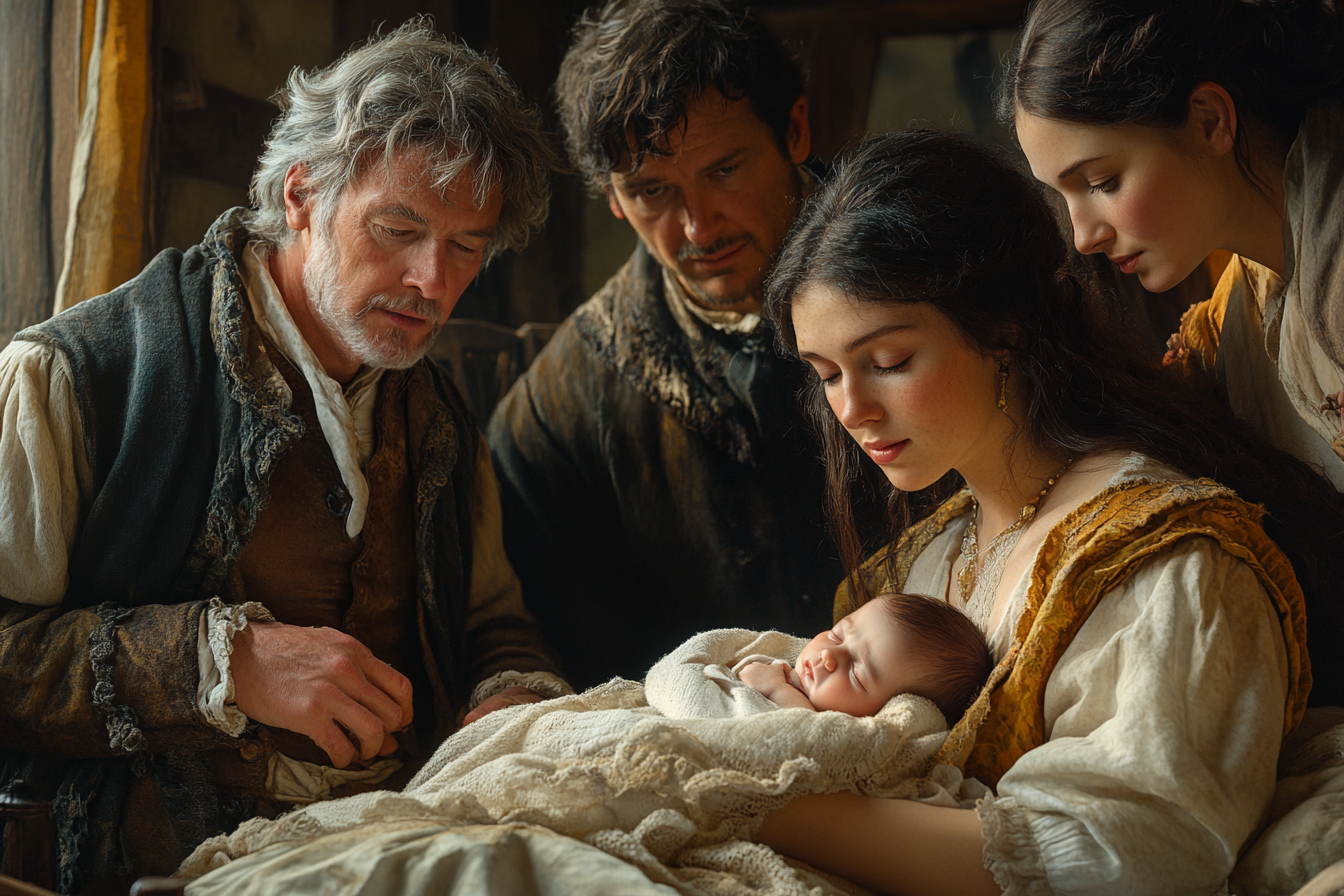
He burst through the cottage door and into the small bedroom, and there she was—his Lizzy, his love, his life—propped against the pillows with Mrs Hawkins at her side, her face flushed and damp with exertion, her chestnut hair dark with sweat.
She looked up when he entered, and despite everything—despite the pain that tightened her features, despite the fear that he knew must be clutching at her heart as it clutched at his—she smiled.
"There you are," she said, as though he had merely stepped out for a moment rather than run halfway across Portsmouth in a blind panic. "I was beginning to think you'd got lost."
Edward crossed to the bed and took her hand, and felt her fingers close around his with desperate strength. "I'm here," he said, his voice rough with emotion. "I'm here, Lizzy. I'm not going anywhere."
Behind him, he heard Dr Whittaker enter the cottage, heard the doctor's calm voice greeting Mrs Hawkins, heard them conferring in low tones about dilation and presentation and other words that meant nothing to him. But Edward did not turn to listen. His world had narrowed to the woman before him, to her pale face and bright eyes, to the grip of her hand in his.
Whatever came next, they would face it together.
Outside, the sun was rising over Portsmouth, painting the rooftops gold. Somewhere a church bell began to toll, marking the hour, calling the faithful to morning prayers. And in a small cottage on Hanover Street, surrounded by the smells of lavender water and woodsmoke, Edward Jeffries held his wife's hand and waited for his child to be born.







