4308.265 · September 21, 1988 AD
The Letter at Dawn
Woken by an unease she can’t explain, Violet finds a mysterious letter waiting in the family’s old tin mailbox—its frantic scrawl warning of hidden truths and dangers in Silverton. Torn between fear and fascination, she hides the message, even as Jasmine’s innocent questions threaten to pull the secret into the light.
"Secrets have a way of finding the people least prepared to keep them." — Jasmine Dallow
The house stirred quietly. Her father had already risen before dawn, his heavy boots thudding against the boards as he left for the mines; her mother would soon be busy with her sewing, the hum of the machine filling the house as it always did. But Violet, restless and wakeful, slipped out into the early morning before the day fully took hold.
The air outside carried the coolness of night’s retreat, sharp and clean against her skin. She breathed it in, savouring the faint scent of eucalyptus drifting from the trees at the edge of the yard. Across the wide street, the red dust still lay undisturbed, as though the whole world was holding its breath. A few birds trilled from the telephone wires overhead, their bright notes startling in the otherwise hushed stillness. Somewhere far off, the groan of a goods train dragged itself into motion, fading into the desert vastness.
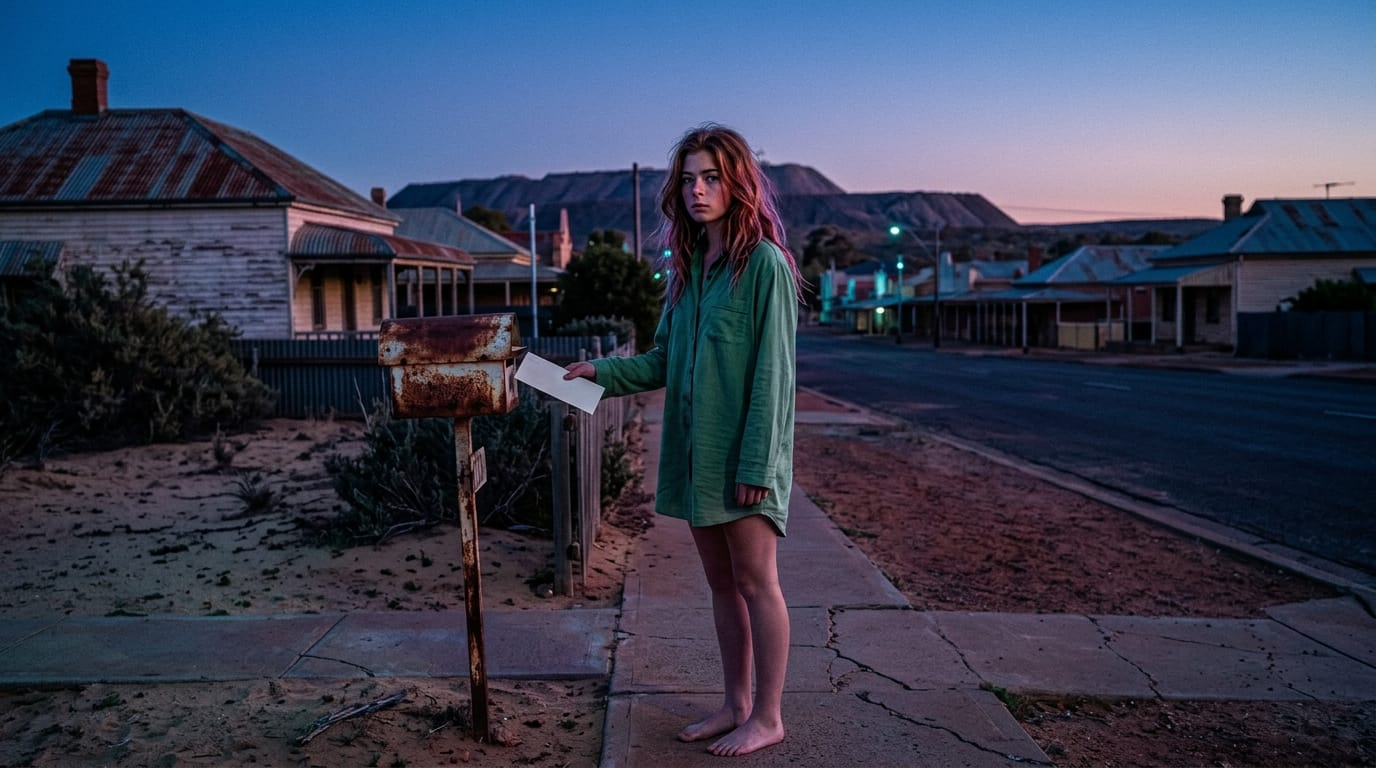
She wandered towards the front gate, bare feet brushing against the dew-damp grass, content for a moment simply to stand in the pale wash of dawn. That was when she noticed it.
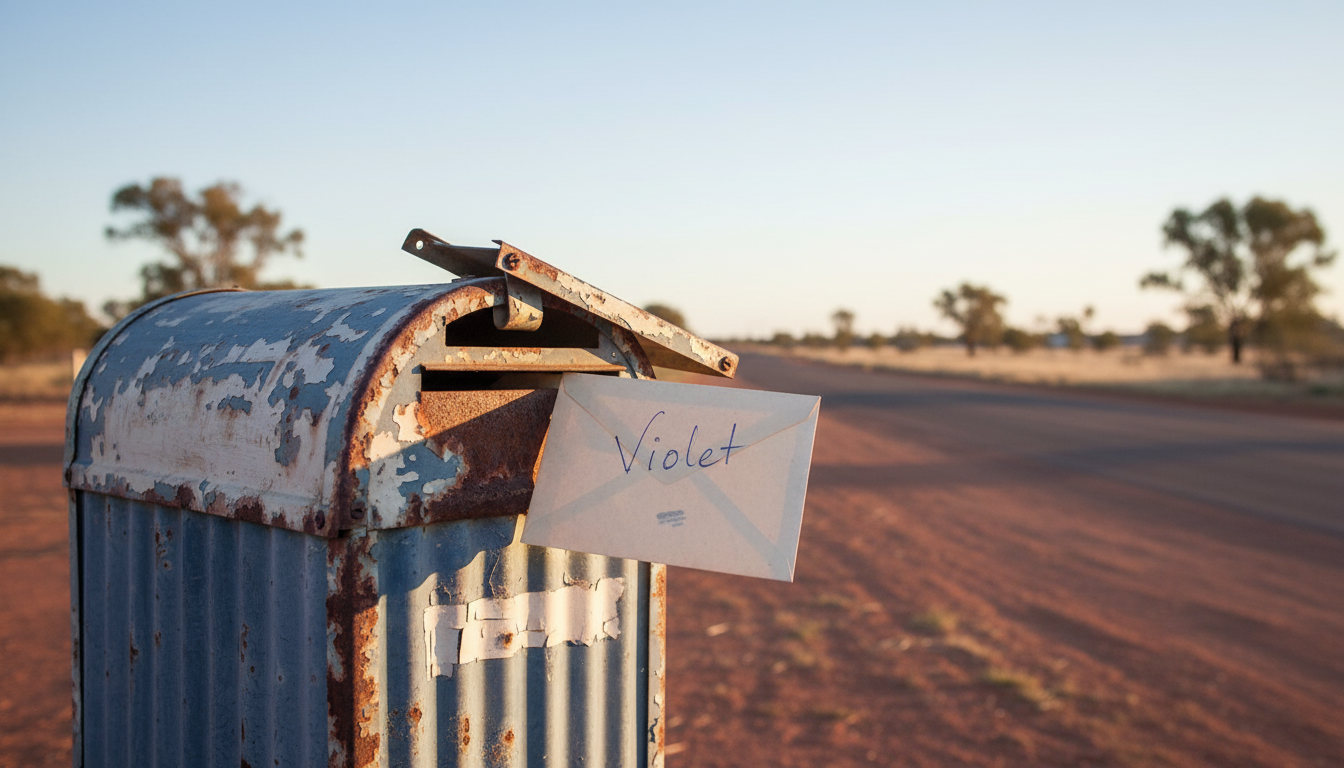
The letterbox—a weathered, lopsided tin relic that had long lost its paint—sat ajar. Its crooked lid hung open as if disturbed, though there was no sign of the postman yet; it was far too early for his rounds to begin. Something pale protruded from the slot, catching the light.
A letter.
Violet frowned, her stomach tightening as she stepped closer. The box held no bundle of bills, no glossy catalogues—just this single envelope jutting out, as though placed there in haste. She tugged it free and felt at once how wrong it seemed. No stamp, no neat printing. Only her name scrawled across the front in hurried, uneven strokes of blue ink, the letters slightly smudged as if the writer’s hand had trembled.
The paper was creased and faintly crumpled, carrying none of the clean, impersonal feel of ordinary mail. It seemed almost… deliberate, as though it had been left for her to find, and her alone.
For a long moment she stood at the gate, the sun not yet risen above the low rooftops, clutching the letter in both hands. A faint breeze stirred, lifting the hem of her nightie, and she shivered despite the lingering warmth of the Outback morning.
Something about it pressed on her chest like a warning. She hadn’t opened it yet, but she already knew—instinctively, deeply—that whatever was written inside was not meant to sit quietly with the rest of the household’s mail.
It was meant for her.
Back inside, Violet sat at the kitchen table, the wooden surface scarred with faint knife marks and burn rings from years of use, the pale envelope balanced carefully in her hands. She held it delicately, as though it might disintegrate under too much pressure.
For a while she didn’t open it. She simply stared at her name, scrawled with such hurried insistence that the ink had bled into the fibres. It unsettled her. Nobody in her circle—family, friends, neighbours—would have addressed her like this. There was no stamp, no return address, no sign of the careful routines that accompanied the usual post. Just this frantic inscription. Just her name.
A draught stirred through the half-open window above the sink, rattling the lace curtain so that it brushed faintly against the glass. Violet jumped despite herself, clutching the envelope tighter, the paper crackling in protest. She glanced towards the back door, reassured by the familiar sight of the yard beyond—the clothesline empty, the corrugated fence unmoving in the morning stillness. Yet the unease lingered, threading through her chest.
Drawing a breath, she slid her finger beneath the flap and began to tear it open, slowly, cautiously. The sound of paper ripping seemed indecently loud, echoing against the walls, almost daring her mother to come in and ask what she was up to. But no one came.
Inside was a single sheet of paper, folded once, its edges slightly ragged as though torn hastily from a notebook. She unfolded it with care.
The handwriting that greeted her was wild—urgent, sprawling across the page as if the writer’s hand had struggled to keep pace with their thoughts. Words crowded into one another, letters slanting at uneven angles, ink blotched and smeared in places as though folded before it had dried. The effect was unsettling, almost desperate, as though whoever had written it had not paused to think, only to warn.
The paper trembled faintly between her fingers. She hadn’t even read the words yet, but already Violet felt them pressing at her, carrying a weight that seemed disproportionate to the fragile scrap she held.
Violet’s breath caught in her throat as her eyes traced the first uneven lines.
Violet,
I hope this reaches you in time. There’s so much to say and so little time…
Her pulse thudded against her ribs, each word dragging her further from the safety of the kitchen and deeper into something far darker. She read on, the sentences tumbling one after the other in a fevered rush:
Sally Harlow’s disappearance—it’s not what everyone thinks. There are secrets buried in Silverton, deeper than the old mines. Penrose Park holds a key, but beware the shadows there after dusk. The abandoned Silver Queen Mine—it’s not as abandoned as people believe. Trust no one, especially not those in uniform. They’re watching, always watching. The truth about Sally is intertwined with the past—Emily Sullivan wasn’t the first, and Sally won’t be the last if this isn’t stopped. Be careful, be very careful. They’ll come for anyone who gets too close to the truth. I’ve already said too much. Burn this letter after you’ve memorised it. Your safety depends on it.
A Friend.
The words blurred for a moment as Violet’s hands trembled. She blinked hard, dragging the page closer to the faint light spilling across the table. The ink, blotched and hurried, seemed almost alive, each line marked with a kind of frantic desperation that made her stomach twist.
She read it again, slower this time, each word dragging like a stone across her thoughts. Her lips parted unconsciously, shaping the sentences in a whisper, as though giving them voice might anchor them to something solid.
Silverton.
Penrose Park.
The Silver Queen Mine.
Familiar places, embedded in the soil of her childhood, yet the names felt different now—hollowed out, tinged with menace. Silverton, with its ghost-town silence and sun-baked ruins that breathed history like an open wound. Penrose Park, where the Girl Guides campfires left embers glowing in the ash pits long after the laughter had faded, its cracked swings groaning in the night breeze. And the Silver Queen Mine—its gaping, collapsed shaft like the throat of something that had swallowed too many secrets. Her father’s voice echoed faintly in memory, stern and warning: “Never go near there, Violet. Those tunnels are treacherous.”
She tightened her grip on the letter, her thumb smudging a corner of ink. Her heart hammered, not just with fear, but with something sharper—an electric thrill, as though the writer had thrown her a key to a locked door she’d been circling for days.
The implications unfurled with dizzying speed. Someone knew more about Sally Harlow’s disappearance than the police, more than the whispers in shops and on verandahs. Someone had pieced together what others ignored, and now they had entrusted her—a schoolgirl, a restless wanderer of mines and myths—with their secret.
The weight of it pressed on her chest, both terrifying and exhilarating. She felt the room closing in, the air thick with the scent of varnished wood and old lemon oil. The clock on the wall ticked with unnerving clarity, each beat hammering the words deeper into her mind: secrets buried in Silverton… beware the shadows after dusk… trust no one in uniform.
Her breath hitched. A creeping dread slid through her, cold and heavy, but beneath it something fiercer burned: determination. If this was real—if even half of it was real—then she was standing on the edge of something far greater than rumours.
“Emily Sullivan,” she murmured, almost to herself, her voice fragile in the empty kitchen. The name clung to the air like dust motes in the sunlight. Images from that history lesson flickered across her mind: a lone woman in the 1880s, vanishing into the desert near Silverton, her story lost to brittle newspaper clippings and fading oral tales. Violet’s pulse quickened.
“So she really is connected to all this,” she breathed, eyes narrowing at the frantic scrawl. “But how?”
The question hung in the air, unanswered, as the shadows in the corners of the room seemed to deepen.
The cryptic nature of the letter did not deter Violet—it gripped her tighter, pulling her in with invisible threads. Each jagged line of ink seemed to whisper directly to her, daring her to look closer, to push past the veil of silence that had smothered Broken Hill since Sally Harlow’s disappearance. Instead of fear hollowing her resolve, it sharpened it. The mystery was no longer something she circled from afar, half speculation, half adolescent bravado. It was here, in her hands, breathing against her skin.
Her mind darted restlessly from thought to thought. Silverton’s sun-baked ruins no longer seemed like the backdrop to her childhood dares—they loomed suddenly as possible crossroads of truth. Penrose Park, where the air at dusk always felt thick and uneasy, now pulsed in her imagination as a place that held more than abandoned swings and dusty pavilions. And the Silver Queen Mine—its broken timbers, its slumping mouth—was no longer a cautionary landmark whispered about by parents, but a doorway, half-concealed, to something far darker.
A thrill ran through her, heady and dangerous. She felt almost feverish with it, as if the letter had set a match to dry tinder she hadn’t realised was waiting inside her. She was being asked to do more than wonder, more than gossip with her friends or pore over clippings in the library. She was being asked—no, trusted—to act.
And yet, threaded through the excitement, a shadow curled. The writer’s desperation clung to every hurried stroke of ink. Their insistence—trust no one, especially not those in uniform… burn this after you’ve memorised it… your safety depends on it—gnawed at her. Whoever had left this was frightened, pressed for time, hunted perhaps. That fear seeped into Violet’s own bones, a cold counterpoint to her fire.
She pressed her palm flat against the letter, as though she might absorb its secrets more deeply by touch alone. For the first time that morning, the light flooding through the kitchen window felt intrusive rather than gentle. The room was changed, charged with a strange electricity, as though the walls themselves were waiting for her to move, to decide.
Slowly, carefully, Violet folded the page along its creases and slipped it back into the envelope. She held it for a moment, weighing it in her hands, before setting it down on the table beside her. The paper seemed to pulse there, alive with possibility and peril.
Her chest rose and fell with quick breaths. The mystery of Sally Harlow had shifted from whispers on the wind to something undeniable, something that demanded her full attention. She wasn’t merely a curious schoolgirl now. She was part of it, tangled in its threads, and the letter had ensured there was no going back.
Violet rose slowly, the legs of her chair scraping against the floorboards with a muted groan that seemed to echo louder than it should have in the stillness. She drifted towards the small window above the sink, clutching her arms across her chest as though to shield herself from the cool air that crept through the cracks.
Outside, the backyard stretched in its familiar sprawl—the battered corrugated fence patched in places with wire, the line of eucalyptus trees swaying gently in the early breeze. Their leaves shimmered and hissed like a thousand voices murmuring secrets she couldn’t quite make out. Beyond them, the red earth rolled outward towards the horizon, a canvas she had grown up running across, now altered in her mind. It was no longer just home—it was a landscape riddled with mystery, its shadows suddenly deeper, its silence charged. The morning sun painted long slashes across the yard, yet the light only seemed to sharpen the darkness between the trunks, as if the earth itself was guarding something hidden.
Her thoughts coiled tighter, the words of the letter still alive against her skin. Silverton. Penrose Park. The Silver Queen. She pressed her forehead briefly against the cool glass, closing her eyes, her chest heavy with the knowledge she could not share. Not yet.
Footsteps padded softly across the hallway, and Violet spun around, startled. Jasmine lingered in the doorway, her hair tousled from sleep, the hem of her nightdress trailing behind her. She rubbed at her eyes with the back of her hand, blinking against the light.
“Morning, Vi,” she mumbled through a yawn, her voice thick with the weight of dreams. Then, squinting, she frowned. “What are you doing up so early? You look like you’ve seen a ghost.”
The words landed with an uncomfortable accuracy. Violet’s chest tightened, guilt flickering sharp and fast. Jasmine—still caught between childhood and the edges of something older—looked so unguarded, so unknowing. How could Violet protect her from the shadows hinted at in the letter when she herself felt swallowed by them already?
She forced a small, careful smile, smoothing the crease between her brows with the back of her hand. “Just sorting through the mail,” she said lightly, angling her body so that the table—and the envelope lying there like a loaded secret—was hidden from Jasmine’s direct line of sight. Her voice came out steadier than she felt, each word measured as though she were rehearsing them for an audience. “There’s something I need to look into.”
Jasmine lingered in the doorway, her expression sharpening despite the sleep still clinging to her. She frowned, tilting her head the way she often did when she sensed her sister wasn’t telling the whole truth. “Is everything okay? You’re acting weird.”
The question pricked at Violet’s chest. For a moment she thought of blurting it out—spilling the whole thing, showing Jasmine the frantic scrawl and telling her about Silverton, the mine, the warnings. But the image of her sister’s wide, uncertain eyes stopped her. Jasmine was thirteen. She still collected stickers in a scrapbook, still plaited her hair in front of the mirror, still called out for their mum when nightmares clawed too deep. The shadows hinted at in that letter didn’t belong anywhere near her.
So Violet lifted her shoulders in a shrug, forcing another smile that felt brittle in her cheeks. “Yeah, just some things I need to figure out,” she said softly. “Don’t worry about it. How about I make us some breakfast?”
Jasmine studied her for a moment longer, her gaze lingering, then gave a small nod. Still, the concern in her eyes didn’t fade. “Alright,” she said, her voice quieter now. She slipped into a chair, tucking her legs up beneath her. “But if you need help with anything, just let me know. We’re sisters, Vi. We’re supposed to help each other.”
The words landed heavier than Jasmine could have known. Violet turned quickly towards the counter, blinking back the sting in her eyes. She busied herself with the simple tasks of breakfast—clattering bread into the toaster, filling the kettle from the tap, setting cups down on the scarred wooden bench. The ordinary sounds filled the silence, but they didn’t banish the image of the letter burning a hole in her thoughts.
As the scent of toasting bread began to fill the kitchen, Violet’s mind spun restlessly. She needed to talk to someone—someone who could grasp the gravity of the letter, who wouldn’t dismiss it as fancy or panic. The faces came to her instantly: Mandy, Michelle, Rebecca. Her circle. The girls who had stood with her in laughter and in fear, who understood the way stories could cling to the bones of a place.
She spread butter onto the toast automatically, her hands working while her mind raced ahead to them, to how she would tell them, to what they might discover together.
Jasmine ate slowly, still half-drowsy, her fingers picking at the edges of her toast more than biting into it. Violet hovered at the counter, her own plate untouched, the kettle hissing softly beside her. The ordinary clink of crockery should have been comforting, grounding—but instead it only made the letter in her pocket seem louder, more dangerous, as though it might shout its secrets into the room if she didn’t keep moving.
“So what’s this big thing you’ve got to figure out?” Jasmine asked suddenly, her voice clearer now, her eyes sharper than they’d been when she first wandered in. She watched Violet with the same piercing curiosity she always had as a younger sister, always tugging at loose threads.
Violet forced a laugh, too light, too thin. “Oh, just boring schoolwork. Mr Clarke wants us to do some research for history—group project and all that.” She pulled the excuse from memory, grateful it had some truth to it, though it twisted in her stomach to say it now. “I’ll be meeting the others later to get started.”
Jasmine frowned, chewing slowly, crumbs dusting her plate. “You’re on holidays though. Who does homework on holidays?”
“Exactly why I need to,” Violet replied quickly, turning away so her sister couldn’t see her expression. She reached for her schoolbag hanging on the back of the chair, her fingers already sliding the letter deep inside between a dog-eared notebook and a bundle of loose pens. The canvas rustled faintly as if in protest, the paper hidden but far from forgotten.
She tugged the strap over her shoulder and marched towards the door, determination in every step. But before she could reach it, Jasmine’s voice rang out, edged with a laugh.
“Vi! You can’t go out like that—you’re still in your nightie!”
Violet froze, glancing down at herself. The faded cotton hem of her nightdress brushed against her knees, ridiculous in its pink flowers and frayed lace trim. A sudden flush rose to her cheeks.
“Oh, for heaven’s sake,” she muttered, half-amused, half-exasperated. She spun back on her heel, tossing her hair over her shoulder with mock drama. “Thanks for the warning. I’d have given half the town a good laugh.”
Jasmine grinned, shaking her head as she bit into her toast. “You’d better hurry if this project’s so important. Don’t want to show up looking like you’ve just rolled out of bed.”
Violet shot her sister a playful glare, but the warmth in Jasmine’s smile tugged at her chest. For a fleeting second, the moment almost felt ordinary again—two sisters teasing over breakfast, nothing lurking in the shadows.
She disappeared into her room, quickly trading the nightdress for jeans and a worn T-shirt, tugging on her scuffed trainers with hurried hands. Yet when she emerged a few minutes later, her bag slung once more over her shoulder, it was as though the weight of the hidden envelope pulled at her steps.
“Better?” she asked dryly from the doorway, lifting her brows in mock challenge.
“Much,” Jasmine replied, a small grin breaking across her face before softening into something gentler. Her eyes lingered on Violet, searching, as though she could sense there was more unsaid. “Don’t be gone too long, alright?”
Violet hesitated, her chest tightening. For a heartbeat she considered saying something real—warning her, confiding in her—but instead she crouched slightly and ruffled Jasmine’s hair, holding the gesture a fraction longer than usual. “You’ll be fine,” she said softly, though her throat ached with the effort of keeping her voice light. “Promise.”
Jasmine leaned into the touch, a faint, contented smile flickering across her face.
Then Violet turned away. The screen door clapped shut behind her, leaving Jasmine with her toast and Violet with the secret pressed tight against her side.







