4308.263 · September 19, 1988 AD
The Lesson That Turned
In the stifling heat of a late-morning history class at Broken Hill High School, Ryan Clarke abandons his prepared lesson on Federation and turns instead to Silverton — its silver-drunk heyday, its ghosts, and the woman who vanished from its edges in the 1800s. Emily Sullivan's letters, read aloud from yellowed pages, transform the drowsy classroom into something charged and airless. Four girls lean forward in their seats. One of them already carries a folded newspaper in her bag.
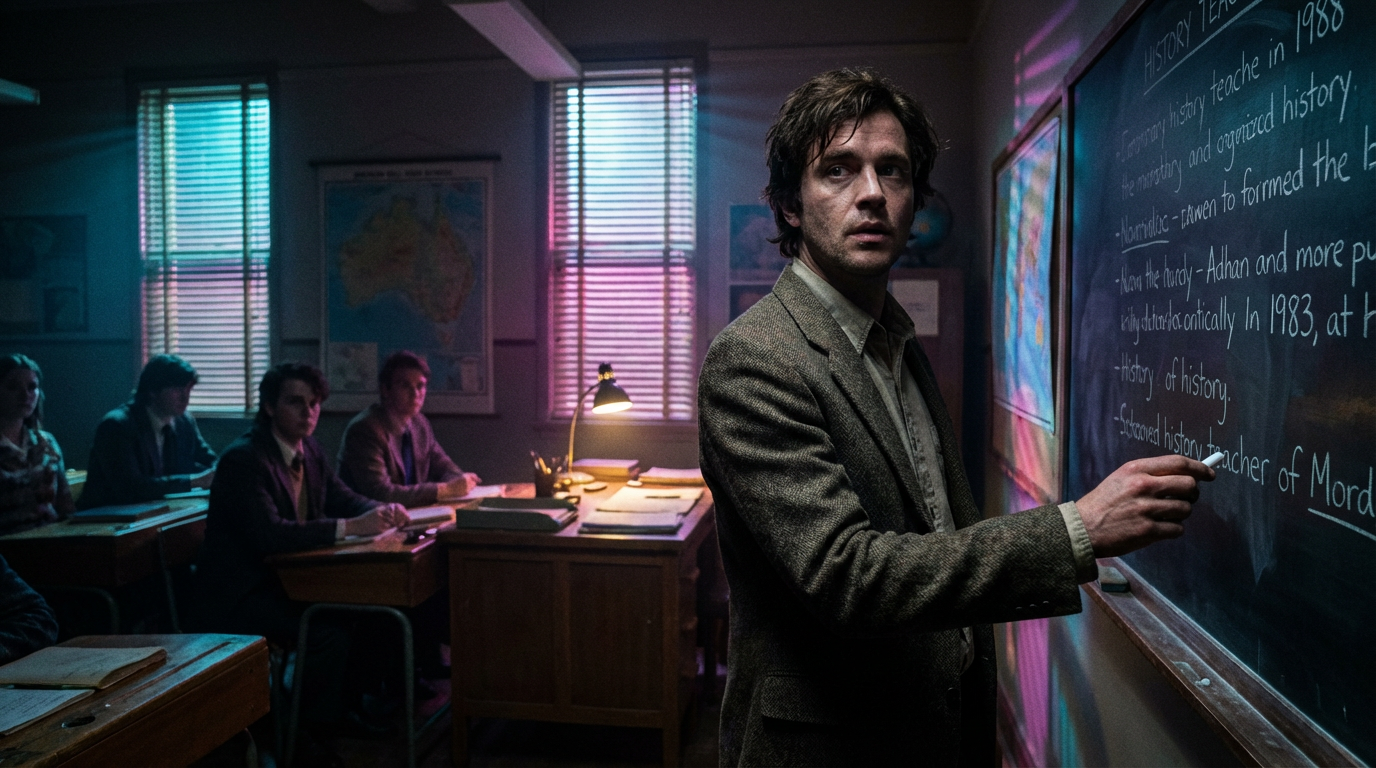
The classroom occupied one of the older wings of Broken Hill High School, a room whose architecture had been designed for utility rather than comfort and whose subsequent decades of use had stripped away even that modest ambition. The walls bore the accumulated sediment of institutional life — faded posters of Robert Menzies and Queen Victoria curling at their corners, a tattered Union Jack hanging above the blackboard with threads thinning at its edges, war-era maps of Europe and Southeast Asia warped by water damage and age. The desks carried the archaeology of generations: initials carved in fits of boredom, ink stains preserved like fossils, crude caricatures of teachers whose names the current students had never known. Above it all, ceiling fans turned with the sluggish conviction of mechanisms that had long since abandoned any pretence of efficacy, their blades churning the heated air without reducing its temperature.
The late-morning heat sat upon the room like a hand pressing down. The louvre windows stood open to a breeze that had not yet materialised, admitting instead the relentless chorus of cicadas and the dry eucalyptus scent that infiltrated every space in Broken Hill regardless of season or circumstance. Students slumped at their desks in the various postures of surrender — one boy fanning himself with an exercise book, a girl resting her cheek against the cool edge of her desk, others staring through the windows at the jacarandas beginning to sway in a wind that carried the faint metallic promise of rain not yet arrived.
Ryan Clarke stood at the blackboard with a stub of chalk suspended between his fingers, midway through a sentence about the formation of the Commonwealth that he had delivered in some variation every year for the past fourteen years of his teaching career. He was thirty-four years old, though the Outback had aged him in the way it aged everything — his face creased by wind and chalk dust, his eyes pale beneath brows that sat heavy with the particular weariness of a man whose exhaustion originated from sources his students could not have guessed. His voice moved across the room in the flat register of recitation, the words emerging with the mechanical accuracy of someone who had said them so many times that meaning had been replaced by habit.
The chalk scraped. Hesitated. Hung motionless in the air.
Something shifted behind Clarke's expression — a recalculation that occurred in the space between one word and the next, visible only to anyone who happened to be watching his face at the precise moment it changed. The pivot, when it came, appeared spontaneous. He turned from the blackboard with a suddenness that drew the attention of students who had ceased attending to him several minutes earlier, and his voice, when he spoke again, carried a different quality entirely — lower, more deliberate, freighted with something that had not been present in his recitation of Federation dates and colonial machinery.
He spoke the word Silverton, and the classroom's atmosphere contracted.
Clarke had his reasons for the shift, though they existed in a register his students could not access. What they received was the performance — and it was, in its way, a masterful one. He paced slowly before the blackboard, his chalk abandoned, his hands moving with the unconscious eloquence of a man who had been thinking about Silverton for longer than any of them had been alive. He spoke of the town's origins with the specificity of someone drawing from reserves deeper than textbooks — the silver strikes that had made men weep, the streets thick with dust and ambition, the bars and steam and hammering industry that had filled the valley with the particular fever of wealth extracted from unwilling earth. And then, without apparent transition, he spoke of the other quality the town had always carried — something older than the silver, something that preceded the prospectors and their dreams and would remain after the last of them had departed.
The room had gone still. The fans continued their ineffectual rotation. The cicadas maintained their chorus beyond the windows. But within the classroom's walls, the quality of attention had transformed from passive endurance to active reception, as though Clarke had located a frequency that bypassed the students' defences against boredom and spoke directly to something more fundamental.
Violet Dallow sat at her desk with her elbow planted and her chin resting in her palm, her body arranged in the posture of someone who had been waiting for precisely this moment without knowing she was waiting. The heat had been pressing against her all morning — her blouse damp along the spine, her pen slippery between perspiring fingers — but the discomfort had receded to background the instant Clarke's voice changed register. She leaned forward, her attention narrowing to the man at the front of the room and the story he was constructing from words that carried the weight of something more than curriculum.
Clarke reached for a folder on his desk — manila, creased, sun-faded — and withdrew a single page protected in a thin plastic sleeve. The paper was yellowed with age, its edges browned by the slow oxidation of decades. He held it with a care that communicated reverence, and when he began to read, his voice softened into a rhythm that was almost musical, adopting the cadence of words written by a hand that had been dust for the better part of a century.
Emily Sullivan's first letter home described the landscape with the vivid astonishment of a woman who had abandoned the conventions of her era and walked into country that most colonial women never saw. The sunsets that painted the sky in colours she had not known existed. The night sky's tapestry of stars so bright and numerous that she felt she might reach out and touch them. The harshness and the beauty existing simultaneously, neither diminishing the other. Clarke read these passages with an attention to their music that suggested he had spent time with them beyond professional obligation, that the words had found their way into some part of him that teaching Federation had never reached.
Violet closed her eyes without intending to. Behind her lids, the images materialised with the vividness of personal memory rather than secondhand description — a campfire on the edge of a dry creek bed, a woman silhouetted against a sky so vast it made time irrelevant, the colours of a dying sun bleeding into ochre earth. The recognition she felt was not intellectual but visceral, as though Emily Sullivan's experience of the landscape corresponded to something already present in Violet's own relationship with the country that surrounded Broken Hill. A woman who had looked at the Outback and seen what Violet saw — not emptiness but presence, not silence but a language she was still learning to hear.
Clarke turned to a second page, and his voice changed again. The warmth drained from it, replaced by something more measured, more cautious, as though the words he was reading had begun to resist being spoken aloud. Emily's later letters carried a different tone. The wonder had given way to unease. She wrote of sounds she could not explain, of shadows that moved when they should not. She wrote of feeling watched, every step followed by unseen eyes. The beauty she had once celebrated had turned sinister, and she feared she had stumbled upon something that was never meant to be discovered.
The classroom held its silence the way the land outside held its heat — completely, without reprieve. The students who had been slumping and fidgeting minutes earlier now sat motionless, caught in the particular spell that descends when a story moves from adventure into territory that the body recognises as danger before the mind articulates it. Violet felt the gooseflesh rise along her arms despite the humid air, a physiological response to words that had been written in another century by a woman who had experienced what Violet could only imagine — or perhaps what Violet was beginning to sense in the margins of her own investigations.
Mandy Glasson had stopped fidgeting. Her pen lay forgotten on the desk before her, her hands flat on the surface, her attention fixed on Clarke with an intensity that reflected her father's investigative instincts. She was processing the information the way Barry Glasson processed case files — noting details, registering patterns, filing questions for later examination. The previous evening's overheard telephone conversation — another young woman, fits the pattern — resonated against Clarke's account of Emily Sullivan like a harmonic frequency, two separate signals combining into something that demanded acknowledgement.
Michelle Richards watched Clarke with narrowed eyes, her arms folded across her chest in the protective posture she adopted when something penetrated the sardonic defences she maintained against the world's capacity to unsettle her. The daughter of a geologist understood that the earth concealed as much as it revealed, that surfaces were unreliable indicators of what lay beneath. Clarke's account of Emily Sullivan's growing fear activated something in Michelle that her practical nature could not entirely suppress — the recognition that the rational explanations she preferred did not always account for the full scope of what the landscape contained.
Rebecca Monk was writing. Her pen moved across the margin of her exercise book with the rapid precision of someone capturing information before it could dissolve, her characters small and exact, the notes accumulating in the systematic shorthand she had developed for recording observations that required later analysis. She wrote down the details Clarke provided about Emily's letters — the progression from wonder to unease to fear, the symbols carved into rock, the warnings in an unknown language, the lights on the horizon. She was assembling a dataset from Clarke's narrative, applying the analytical frameworks that would later serve her medical career to the problem of a woman who had disappeared from a landscape that her own grandmother had described as capable of holding memory the way vessels held water.
Clarke read Emily's final letter. His voice had thinned to something barely above a murmur, the words emerging with the fragile cadence of text that had been written in haste and fear — scrawled, rushed, frantic. Symbols carved into rock. Warnings she could not decipher. Lights. A shape, always just beyond sight. And then silence. She was never heard from again. No body. No trace. Wind and dust, and a story that refused to surrender its hold on the living.
He looked up from the page, and his gaze found Violet.
The contact lasted perhaps two seconds — long enough for something to pass between teacher and student that neither could have named but both registered. Clarke saw in Violet's expression the same quality that had alarmed him in other contexts — the ferocity of curiosity unbounded by prudence, the determination to follow a thread regardless of where it led. Violet saw in Clarke's eyes something she could not interpret — a flicker that might have been recognition, or calculation, or something she lacked the vocabulary to identify. Then the moment passed, and Clarke's expression resumed its professional composure.
Violet's hand rose. The question she asked connected Emily Sullivan's disappearance to the broader pattern of vanishings in the Outback — explorers, prospectors, travellers who had gone into the country and not returned. She did not mention Sally Harlow by name immediately, holding the specific back behind the general, testing the ground before committing her weight. But when Clarke responded with the measured encouragement of a teacher who recognised a promising line of inquiry, she offered the name — Sally Harlow, a woman who had disappeared near Silverton whilst researching the same territory that Emily Sullivan had described in her letters.
The name landed in the classroom with a weight that exceeded its two syllables. Students shifted in their seats. Clarke's expression underwent a recalibration so subtle that only someone watching closely would have caught it — a fractional tightening around the eyes, a pause that lasted a beat longer than the rhythm of his response required. He repeated the name as though testing it for density, then directed Violet's interest toward research, toward investigation, toward the scholarly channels that would contain her curiosity within structures he could monitor.
The bell severed the moment. Its metallic authority scattered the atmosphere Clarke had constructed, returning the classroom to its ordinary function as a container for adolescent obligation rather than a vessel for stories that reached across centuries. Desks scraped against linoleum. The swell of chatter resumed with the relief of tension released. Students rose and departed in the shuffling current of bodies moving toward the next period's demands.
Clarke remained at the front of the room, gathering his papers with the deliberate movements of a man reassembling a surface that had been temporarily disturbed. The manila folder with its yellowed pages returned to his desk drawer. The chalk found its tray. The professional mask settled back into position over whatever had been visible beneath it during the lesson.
Rebecca lingered. She stood near Clarke's desk with her arms folded, her posture composed, her attention directed at something he was indicating amongst his papers. The exchange between teacher and student appeared unremarkable — the kind of brief after-class conversation that occurred a dozen times a day in every school — but Violet, watching from the doorway, registered something in the geometry of the interaction that snagged her attention without yielding to analysis. The angle of Clarke's body toward the door. The quality of quiet that surrounded their exchange. The way Rebecca's nod carried the measured weight of someone receiving information rather than merely hearing it.
In the corridor, Mandy appeared at Violet's shoulder with the sudden proximity she employed when her attention had locked onto something she considered significant. Her observation about Clarke and Rebecca arrived wrapped in the teasing register she used to disguise genuine curiosity as gossip — a technique she had perfected over years of extracting information from situations that resisted direct inquiry. Michelle, trailing behind, dismissed the observation with the dry pragmatism that constituted her default response to Mandy's speculations.
The corridor's acoustics absorbed their conversation as they moved away from the classroom. The heat pressed in from the open doors at the corridor's end, where the schoolyard shimmered in the midday glare. Violet's thoughts had already moved beyond the social dynamics of the after-class exchange and into the territory that Clarke's lesson had opened — Silverton, Emily Sullivan, the patterns that connected historical vanishings to a present-day disappearance folded in newsprint in her bag.
The idea of Silverton as a research destination emerged from the conversation with the organic inevitability of something that had been forming beneath the surface and needed only the lightest pressure to break through. Violet framed it as academic — a history project, local significance, a chance to gather material that would satisfy Clarke's encouragement whilst serving purposes she chose not to fully articulate. Mandy received the proposal with immediate enthusiasm, her instinct for adventure igniting at the prospect of legitimate excuse to explore territory that fascinated her. Michelle offered the counterbalance of practical scepticism, questioning the comfort and logistics of tramping through abandoned buildings in the heat, though her objections carried the cadence of someone who was already calculating how to make the expedition work rather than genuinely opposing it.
The Girl Guides camping trip surfaced in the exchange — Silverton, already designated as the destination, already approved by authorities, already organised and permitted. The coincidence was not lost on any of them. The trip that had existed as routine obligation now carried the potential for something beyond marshmallows and campfire songs, and the recognition of this potential passed between the friends with the compressed efficiency of a group that had learned to communicate intent through inflection and glance rather than explicit declaration.
Rebecca rejoined them in the corridor, her expression composed, her exercise book held against her chest. Whatever Clarke had discussed with her remained behind her usual surface of analytical calm. She absorbed the Silverton conversation in progress and contributed a quiet observation that cut through the banter with surgical precision — a reminder that curiosity and caution were not mutually exclusive, and that the territory they were contemplating had a documented history of not returning everyone who entered it.
The friends dispersed toward their afternoon classes, the corridor emptying as the next period's bell approached. Violet walked alone for the final stretch, her bag hanging from one shoulder, the folded newspaper pressing against her hip through the canvas. Inside the bag, Sally Harlow's photograph and Emily Sullivan's story occupied adjacent spaces, separated by nothing more than the fabric lining and a century of elapsed time.
The clouds that had been gathering to the north-west had thickened whilst they were indoors, their undersides darkening to the colour of bruised fruit. The light in the corridor had shifted from the hard clarity of morning to something filtered and uncertain, and the breeze that finally moved through the open doors carried the unmistakable mineral scent of approaching rain.







