The Learning Grove, Bixbus
The Learning Grove was Bixbus's first educational facility, established in August 2018 in four modified shipping containers near the settlement's centre. Founded by Jenny Triffett, Emma Thompson, and Greta Smith, it pioneered community-integrated learning — mornings for ability-based academics, afternoons for practical placements at community sites. Rapid population growth forced ad hoc expansion into a sprawling campus of temporary structures serving thousands by mid-2019. It was decommissioned in December 2019 when students transferred to the purpose-built Bixbus School. The original four containers were preserved as a public garden.
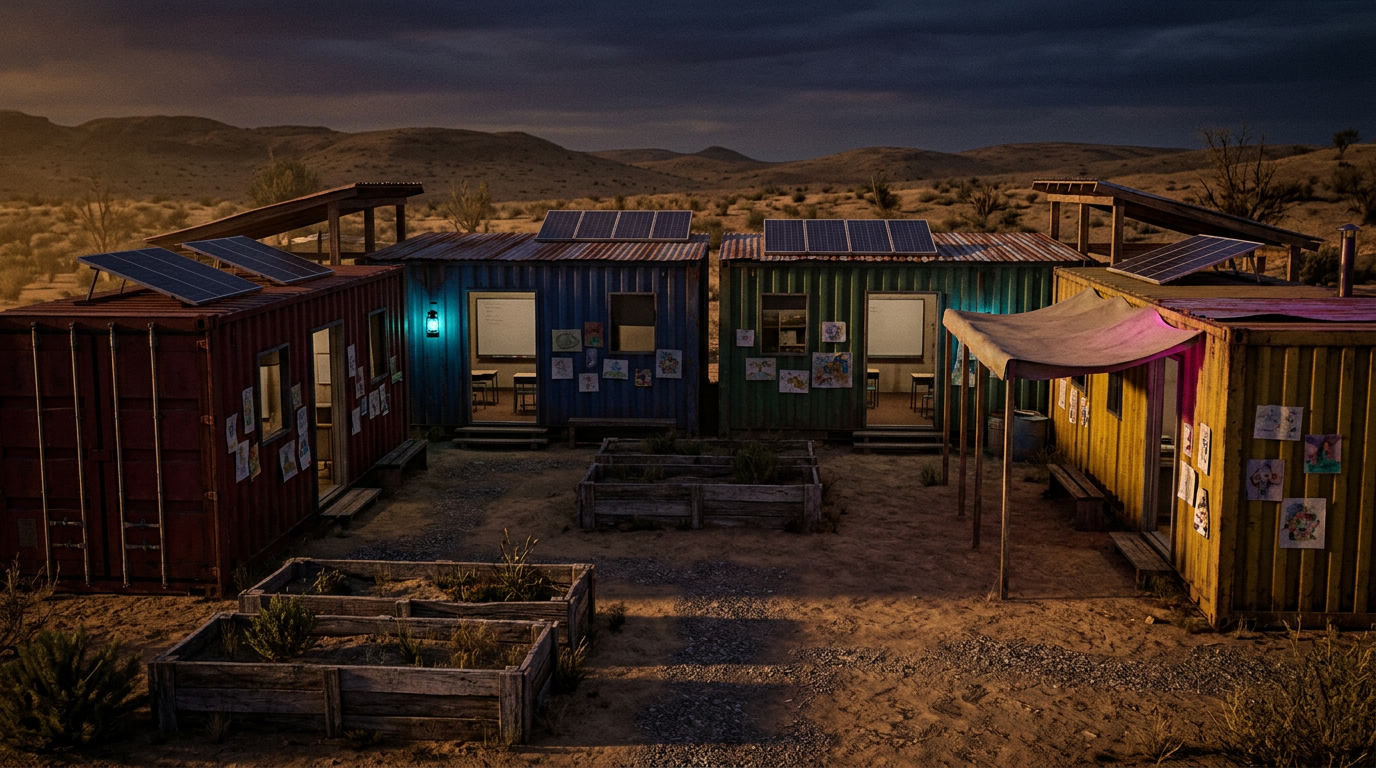
Four Containers
The Learning Grove began in August 2018 with four modified shipping containers, three women with teaching experience, and a settlement that had existed for barely a month. Paul Smith, still establishing Bixbus's governance framework, recognised that a community with children was not a community at all unless those children were being educated. The initial planning committee — Jenny Triffett, a drama teacher from Hobart; Emma Thompson, who had taught at Brisbane Grammar School before arriving in Bixbus during the Brisbane School Bus Tragedy; and Greta Smith, the mother of founders Paul and Luke Smith — met on 6th August 2018 to choose a site. They selected a flat clearing near the settlement's emerging centre, walking distance from the tent community and the first permanent structures, and began clearing rocks by hand the same afternoon.
Construction started on 8th August. The four shipping containers were arranged in a U-shape around a central courtyard. Settlement engineers volunteered their expertise to complete the modifications. Solar panels went up. Parents painted interior walls, installed carpet offcuts, and mounted whiteboards over the following days. By mid August, the Learning Grove opened with fewer than fifty children seated on cushions and salvaged furniture inside metal boxes that smelled of paint and possibility.
Jenny Triffett led the first days with the theatrical energy and organisational instinct that had made her an award-winning drama teacher in Tasmania. She ran morning staff meetings, devised the first timetable, and established the tone — firm, warm, creative — that would define the school's culture long after she moved on. Emma Thompson managed the primary-age students with the methodical competence of someone who had run classrooms at one of Brisbane's most demanding schools. Greta Smith handled pastoral care, parent liaison, and the quiet diplomacy of keeping anxious families informed and reassured.
The courtyard served as playground, outdoor classroom, and assembly area. The main container, twenty feet long, was divided into zones for different ability groups. A second housed arts and crafts, its walls soon layered with student artwork. A third became a makeshift science laboratory where microscopes revealed cellular structures to children who had never looked through an eyepiece. The fourth held the library — an eclectic collection of textbooks, young adult novels, outdated encyclopaedias, and technical manuals — alongside six tablets and four laptops loaded with educational software, scheduled in thirty-minute rotations.
Beyond the Metal Walls
Four containers could hold perhaps eighty children at a time. By November 2018, the settlement's population had grown into the low thousands, and the Learning Grove's enrolment was climbing past two hundred. By December it passed four hundred. The containers that had felt spacious in the first week became impossibly crowded within months, and the expansion that followed was driven not by planning but by the daily reality of more children arriving than the existing space could absorb.
The first additions were canvas marquees erected in the courtyard and on adjacent cleared ground, providing shade and shelter for outdoor classes when the weather cooperated and damp, flapping frustration when it did not. Volunteer builders — parents with construction experience, settlement workers diverted from other projects — threw up timber-framed structures with corrugated iron roofing, each one designed for immediate use rather than longevity. A second batch of shipping containers arrived in November 2018, then a third in December. Prefabricated panels salvaged from warehouse construction were repurposed into classrooms that leaked in heavy rain but kept the dust storms at bay.
By the end of 2018, the Learning Grove bore little resemblance to the tidy U-shaped campus of its first month. It had sprawled across a city block and into an adjacent one, a patchwork of containers, timber sheds, canvas shelters, and open-air teaching areas linked by gravel paths and the shared conviction that education mattered more than aesthetics. More than a thousand children were enrolled, taught by a growing roster of qualified and unqualified educators drawn from the settlement's expanding population. The four original containers remained at the heart of the site, their painted walls and carpeted floors now worn by months of use, but they constituted a small fraction of the infrastructure.
The growth did not slow. Through the first half of 2019, Bixbus's population surged into the tens of thousands as arrivals through the Portal accelerated and the settlement's reputation as a functioning community drew people from across the region. The Learning Grove's enrolment exceeded three thousand by March, five thousand by June. New structures went up as fast as materials and labour allowed — some built to last years, others clearly temporary, all pressed into service the day they were finished. Parent volunteers staffed entire classrooms. Retired professionals taught subjects they had not practised in decades. University students barely older than the senior pupils took charge of reading groups.
The site, by mid-2019, occupied the better part of four city blocks near Bixbus's original centre. It was loud, crowded, perpetually under construction, and unapologetically functional. Nobody pretended it was adequate. It was simply all they had.
Mornings and Afternoons
The Learning Grove's educational approach, formalised during planning sessions on 28th and 29th August 2018, rejected traditional grade levels and standardised curriculum out of necessity that became philosophy. With children aged three to fourteen, drawn from dozens of countries and carrying educational backgrounds that ranged from advanced to nonexistent, the founders developed what they called community-integrated learning.
Mornings focused on core academics — literacy, numeracy, sciences, humanities — with students grouped by ability rather than age. A six-year-old reading at an advanced level sat with ten-year-olds for literature discussions. A twelve-year-old struggling with mathematics received foundational instruction alongside younger children without stigma, because the school's culture had been built from the beginning on the understanding that everyone had arrived with different knowledge and that gaps were circumstances, not failures. Individual learning plans, created for each student from mid-September 2018, tracked progress through continuous assessment rather than examinations.
Afternoons took students out of the classrooms and into the settlement. Children aged eight and above spent three afternoons per week at community sites across Bixbus, matched to their interests and aptitudes. The Bixbus Wildlife Sanctuary offered placements in animal care, behavioural documentation, and veterinary observation. The Verdant Nursery taught horticulture, soil science, and the mechanics of commercial growing. The Orchard of Abundance demonstrated agricultural cycles, seasonal planning, and the particular patience required to wait for a tree to fruit.
This model emerged from necessity — there were not enough classrooms to hold every student all day, and the settlement needed children contributing to its work — but it proved so effective that it outlasted the conditions that created it. Students learned mathematics by calculating harvest yields and construction angles. They practised writing by maintaining detailed observation logs at the sanctuary. They studied science by testing soil samples and monitoring water chemistry. The community became the curriculum, and the curriculum gave children a stake in the community that was building around them.
The learning garden, established between 22nd and 25th August 2018, was the model in miniature. Raised beds built from salvaged materials allowed children of different heights to work comfortably. Each class maintained specific sections. Failures became lessons in scientific method; the first successful tomato harvest in October 2018 became a celebration that the entire settlement attended.
The Drama Teacher Steps Aside
Jenny Triffett had never intended to be an administrator. She was a drama teacher — a woman who had won the 2016 Tasmanian Arts Educator Award for her work at St. Michael's Collegiate School in Hobart, whose instinct was to put children on a stage rather than file reports about them. She had helped establish the Learning Grove because she was there, she was capable, and nobody else had stepped forward. But as the school grew from eighty children in four containers to hundreds and then thousands spread across a sprawling campus of temporary buildings, the role demanded administrative capacity that did not align with her talents or her temperament.
By late 2018, Emma Thompson had quietly assumed most of the operational leadership. Thompson's experience at Brisbane Grammar School had given her fluency in timetabling, staff coordination, and institutional management that Triffett neither possessed nor wanted to acquire. The formal handover — such as it was, in a school that had no formal anything — happened in early 2019. Triffett continued teaching drama, running workshops, and directing the student performances that had become some of the Learning Grove's most anticipated community events. Thompson became the head teacher, responsible for the daily logistics of educating thousands of children in structures that were barely fit for purpose.
The transition suited both women. Triffett's drama classes and theatre workshops gave students creative outlets that proved essential for processing the trauma of displacement. Her productions — improvised from whatever scripts, costumes, and staging materials the settlement could scrounge — drew audiences from across Bixbus and gave the community shared cultural experiences at a time when shared experiences were rare. Thompson, meanwhile, managed the staffing rosters, coordinated with community placement sites, oversaw the parent-teacher council, and fought daily battles over resources with a settlement leadership that had a hundred competing priorities. She was not charismatic in the way Triffett was. She was effective in ways that kept the school functioning.
Greta Smith remained in her pastoral and administrative role throughout, managing parent liaison and student welfare with the steady presence of someone who had raised the settlement's founders and understood, better than most, that children needed consistency above all else.
Teaching a Settlement's Children
The Learning Grove's teaching staff grew from three founders and a handful of parent volunteers in August 2018 to more than a hundred educators by mid-2019. The quality varied enormously. Some were qualified teachers from Earth schools, carrying decades of experience into classrooms built from shipping containers and corrugated iron. Others were parents with relevant knowledge but no pedagogical training, pressed into service because the alternative was classes of sixty with a single teacher. A retired geologist taught science in a canvas tent. An accountant from Melbourne taught mathematics in a timber shed that flooded in heavy rain.
Triffett's "community consequences" approach to discipline — misbehaviour addressed through additional service rather than punishment — became school policy and survived the transition to mass scale. A student who disrupted a lesson might spend extra time helping younger children, transforming negative behaviour into positive contribution. The approach worked because the Learning Grove's culture had been established by its founding cohort, children who understood that everyone was dealing with something and that patience was not weakness.
Health challenges required coordination with the settlement's limited medical facilities. Dr Raj Patel, the settlement's paediatrician, held weekly clinics at the Learning Grove, assessing physical ailments and watching for signs of deeper psychological distress. His reports informed adjustments to individual learning plans, recognising that children processing acute grief needed different approaches than those who had begun to settle. As the school grew, so did the complexity of its pastoral needs — new arrivals appeared monthly, carrying fresh trauma and speaking dozens of languages, each requiring integration into a system already stretched beyond its limits.
The curriculum evolved organically from available resources and immediate necessity. Reading instruction used whatever books were available — picture books alongside technical manuals, outdated encyclopaedias alongside young adult novels. Mathematics emphasised practical application: students calculated construction angles for real buildings, determined concrete-mixing ratios, and computed harvest yields. Science education used Clivilius itself as a laboratory. History and social studies focused on the settlement's founding, governance, and cultural preservation, with students interviewing adult settlers and documenting oral histories that would become primary sources for future historians.
Across the City
By mid-2019, with the Learning Grove serving more than five thousand students in a campus that had never been designed for five hundred, the Clivilius Lead Council approved the construction of the Bixbus School — a purpose-built educational facility on a scale that matched the settlement's trajectory. The site chosen was several kilometres from the Learning Grove, in a district where Bixbus's urban planning had allocated space for major civic infrastructure. The distance was deliberate: the Learning Grove's central location, essential when the settlement was a cluster of tents and early buildings, had become a liability as the area around it developed into commercial and administrative use.
The transition, when it came in December 2019, was not a walk across the road. It was a logistical operation involving thousands of students, hundreds of staff, and a fleet of vehicles and trams moving children, equipment, furniture, and supplies across a city that had grown far beyond walking distance. The transfer happened in stages over several weeks, with the youngest students moving first and the oldest last, each cohort arriving at a campus so new that the paint was still drying in some corridors. Thompson coordinated the operation from the Learning Grove end, working with the Bixbus School's new leadership to ensure that no student fell through the gaps between the institution they were leaving and the one they were entering.
The final day of instruction at the Learning Grove was 6th December 2019. There was no grand ceremony — Thompson was not given to theatrics, and the school was too large and too busy for sentimental indulgence. The last students collected their belongings, said goodbye to classrooms that had never been classrooms in any conventional sense, and boarded trams for a school that had proper walls, proper roofing, and enough space to sit down without touching the person beside them.
The Courtyard That Remained
The Learning Grove was fully decommissioned in the weeks following the transfer. The temporary structures — the timber sheds, the canvas marquees, the prefabricated panels, the later shipping containers — were dismantled and their materials repurposed for construction projects across the city. The site returned to the urban planners, who allocated it for the civic and commercial development that the growing city centre demanded.
The four original shipping containers remained. They had been the first classrooms in Bixbus, the place where education had begun, and the settlement's leadership — several of whom had children who had learned to read inside those metal walls — chose to preserve them. The containers were repainted, stabilised, and incorporated into a small public garden on the original courtyard site: a nature garden and quiet space, open to the public, with planted beds that echoed the learning garden of August 2018. Benches were placed where the morning circle had once gathered. A modest plaque recorded what had happened there.
The educational philosophy developed during those sixteen months — community integration, practical application, ability-based grouping, individualised learning — became the foundation for every school that followed. The Bixbus School adopted the morning-academic, afternoon-practical model directly. Other settlements across the region requested consultation from educators who had worked at the Learning Grove, spreading methods that prioritised resilience alongside arithmetic. The Department of Education, when it was established in 2020, codified principles that had been invented in shipping containers and refined in canvas tents.
Students who passed through the Learning Grove during those sixteen months displayed characteristics that their teachers recognised in later years: adaptability, comfort with resource limitation, natural collaboration across age and cultural boundaries, and an instinct for practical problem-solving. These traits were not unique to them — a rapidly growing city full of displaced people produced an entire generation shaped by improvisation — but the Learning Grove's earliest alumni carried them with the particular confidence of people who had been there first, who remembered when education in Bixbus was four metal boxes and a woman from Brisbane Grammar who refused to let chaos become an excuse for ignorance.







