4307.302 · October 29, 1987 AD
The Itch You Can't Name
After a long day on the farm, Cody heads to the Kingsford Smith Pub looking for nothing more than a cold beer and familiar faces. But when a group of strangers rolls in and the evening takes an unexpected turn, one of them — a young bloke with sharp eyes and the right questions — starts pulling at threads Cody didn't know were loose.
“The land’s got its own kind of gravity. Keeps you close, keeps you honest. But some nights, even gravity loosens its grip.”
The sun was sinking low over Gawler, casting long shadows and turning the sky into a fiery blend of amber and crimson. It caught the dust hanging over the road and lit it from behind, the way it did behind the ute of an evening, out on the home track. The roofs of the old weatherboard cottages lit up like tin dipped in gold, and the front gardens—no matter how humble—flared with bursts of late-spring colour. Jacarandas spilling purple across fence lines, roses climbing up verandah posts, beds of agapanthus leaning into the last of the warmth.
I steered the ute—my battered old blue one—down the familiar back roads, one hand on the wheel, the other resting on the windowsill, letting the warm breeze roll in. The truck rattled over a pothole near the old mechanics' shed on Murray Street, but she held steady, like always. Every dent and scrape on her paint had a day behind it. Broken fences, bogged paddocks, the midnight scramble to shift stock off the Main North before somebody came through in the dark and hit one. She wasn't pretty, but she was ours.
My hands still stung from the day's work, that deep, dry soreness you get after wrestling with fenceposts and heaving bales. Dirt clung under my nails and in the creases of my knuckles. I could still smell the lanolin from the shearing shed mixed with the sharper tang of fertiliser from the wheat field. My shoulders ached in that slow, grinding way that told me I'd pushed it too far again—hauling irrigation lines through the cracked western paddock, then spending the last two hours of daylight fighting a busted gate hinge out near the boundary. I'd stripped the skin off the heel of my left palm getting the thing to seat properly, and every time I shifted my grip on the steering wheel, the raw patch caught and stung.
The farm's always been home. Ever since I was a little bloke chasing dogs and dodging cattle, the place had worked its way into me the way dirt works into a callus—there for good, and not worth picking at. The wheat ran gold and unbroken to the fence line behind me, still shifting a little even with the wind dropping off, and the cattle lowed lazy as I passed. I could still see the top of the windmill turning slowly against the sky if I squinted in the rearview mirror.
But as I rolled closer to town, I felt that old, familiar tug in my gut—the one that said maybe, just maybe, there was more out there waiting. Not that I knew what “more” looked like. I just knew I'd feel it when I found it.
And tonight, that tug had led me towards the Kingsford Smith.
I rolled into the carpark, the tyres crunching over the gravel in that way that always seemed louder when you were arriving alone. Let the engine idle for a second before cutting it, the old ute giving one last cough before falling quiet. The place looked the same as it always did—low and square against the last of the light, no grander than the day it went up and in no hurry to be. Worn at every edge, and somehow the better for it.
The front was weathered, the paint on the timber walls faded to the colour of old parchment, and there were rusted beer signs nailed up that hadn't been touched since before I was born. One for West End Draught still hung lopsided near the door, its colours bleached nearly white. The red gum doors were propped open, the brass kick plate at the bottom scuffed to dull bronze from decades of drinkers shoving through.
I climbed out and gave a slow stretch, arms overhead, feeling the tight pull through my shoulders and across my lower back. Bloody fencing wire. The smell of the farm still clung to my clothes—earth, wheat, sheep, and that hint of lanolin that never quite washes out. I didn't mind it. That scent was part of who I was, same as the dirt in the lines of my palms or the slight squint from too many sunburnt afternoons.
The breeze had picked up—warm still, but softer now, turning the page towards evening. I ran a hand through my hair, still dusty from the day, and looked up at the pub. That old wooden sign above the door creaked as it moved in the wind. Sir Charles Kingsford Smith's painted face looked down over us all, calm and serious, like he was still flying over the Pacific. Funny thing—he'd never even set foot in Gawler, but somehow he'd ended up watching over the place all the same.
I shoved my hands into my jeans pockets and started towards the entrance.
Inside, it hit me all at once. The warmth. Not just the temperature, but the feeling. That quiet hum of voices mixing with the creak of floorboards underfoot, the glow of old lamps throwing golden halos over the tables and corners.
My Blundstones thudded softly against the timber floor. The boards were scuffed and worn smooth in places—decades of stories, fights, reconciliations soaked into every plank. I could feel the weight of all that under me, and it wasn't heavy so much as steadying—the way any solid floor felt good underfoot after a day spent riding the tray of a truck over rough paddock.
Then the smell got to me. Meat pies straight from the oven, flaky and steaming, mingled with the tang of tomato sauce. The yeasty pull of fresh beer. Rosie's shepherd's pie—I could pick that out anywhere, the browned mash and the slow-cooked lamb underneath. It was Thursday, after all. Thursday was always shepherd's pie.
The bar dominated the room—a long stretch of Tasmanian blackwood darkened with age and varnish and decades of spilt drinks. The pressed-tin ceiling caught the lamplight and threw it back in soft patterns, and the old mirror behind the taps reflected the whole room back at itself in patches where the silvering hadn't faded.
Behind it stood Alfie Harris, wiping down a glass with that striped rag he always had in hand. Dark hair going grey at the edges, a few days of stubble, sleeves rolled to the elbow. He moved like he knew exactly where everything was without needing to look—like the whole place was an extension of himself.
I stepped up, and his face lit up.
“G'day, Cody! Usual for you, mate?”
“Cheers, Alfie. Been a long one.”
He gave one of those knowing nods. While he reached for the tap, I glanced around. Ben was already at the dartboard—I could hear him before I saw him, that laugh of his cutting through the noise like a kookaburra at dawn. A few locals were near the jukebox—“Khe Sanh” had just finished, and someone was arguing it was bloody sacrilege to follow it with anything soft. Pool balls clacked from the far side. Mr Bradbury was in his corner with young Sean from the post office, the two of them locked in their Thursday chess match like the winner'd get his name in the Bunyip come Friday.
Alfie slid the pint across—never spilled a drop. “First one's on the house tonight. You look like you could use it.”
I raised an eyebrow. “What's the occasion?”
“Good day at the races. Thought I'd spread the luck around.”
I lifted my glass towards him and took the first sip. Cold, smooth, exactly what I needed. That local brew from out near Lyndoch—citrus sharpness, a grassy bitterness that tasted like it had come straight up out of the paddock. It was the land in a glass. Dry ground and early frosts.
“Oi, Jennings!” Ben's voice carried across the room. “Get your arse over here. We need someone who can actually hit the board.”
I shook my head, grinning, and pushed off the bar.
The darts crowd had gathered in that loose, easy way it always did on Thursdays—Ben, Mick Harrow from the sawmill, a couple of younger lads I knew by face but not by name, and Dave somebody-or-other who worked with the council and always wore the same faded jumper regardless of the season.
Ben thrust a set of darts into my hand before I'd even set my glass down. “Right, you're on my team. Mick's been talking shit all night and I need someone to shut him up.”
“Piss off, Henley,” Mick said, not looking up from chalking the scoreboard. “I've been talking truth, and you can't handle it.”
I liked the feel of the darts in my hand, even with the raw patch on my left palm still smarting where the gate hinge had won its round earlier. Something honest in the weight of them—small, precise, and with no second chances once they left your grip. I lined up, exhaled slow, and flicked.
Dead centre. Solid thunk.
The crowd broke into a mix of whistles and groans. Ben slapped the bar top like he'd won the lottery himself.
“Bloody hell,” Mick muttered. “Right. Best of five, then.”
We played. I threw well—not perfectly, but well enough to keep Ben crowing and Mick swearing under his breath. Between throws, the banter flowed the way it always did. Who'd had the worst day. Whose crop was struggling. Whether the Tigers had any bloody chance this season or if we were kidding ourselves again. The usual.
Sandra passed by at some point, laughing with someone from the council office. She caught my eye and smiled—a real one, the kind that lingers a second longer than it needs to. She always smelled faintly of warm bread and vanilla, even here, and the scent cut through the heavier pub air like it had drifted in from some other year.
I was lining up my next throw when the front door groaned open and a burst of cooler air pushed through the room. I didn't turn straight away—you don't, in a pub, not when you're mid-throw—but I heard the shift. Conversations didn't stop, but they adjusted. The way a flock changes direction without any single bird deciding to.
A group had walked in. Five or six of them. Not from around here—that much was obvious in the way they moved, the way they scanned the room before committing to it. Most of them looked like they were passing through on their way to somewhere else. Barossa tourists, maybe, or workers from one of the vineyards up the road.
But one of them caught my eye.
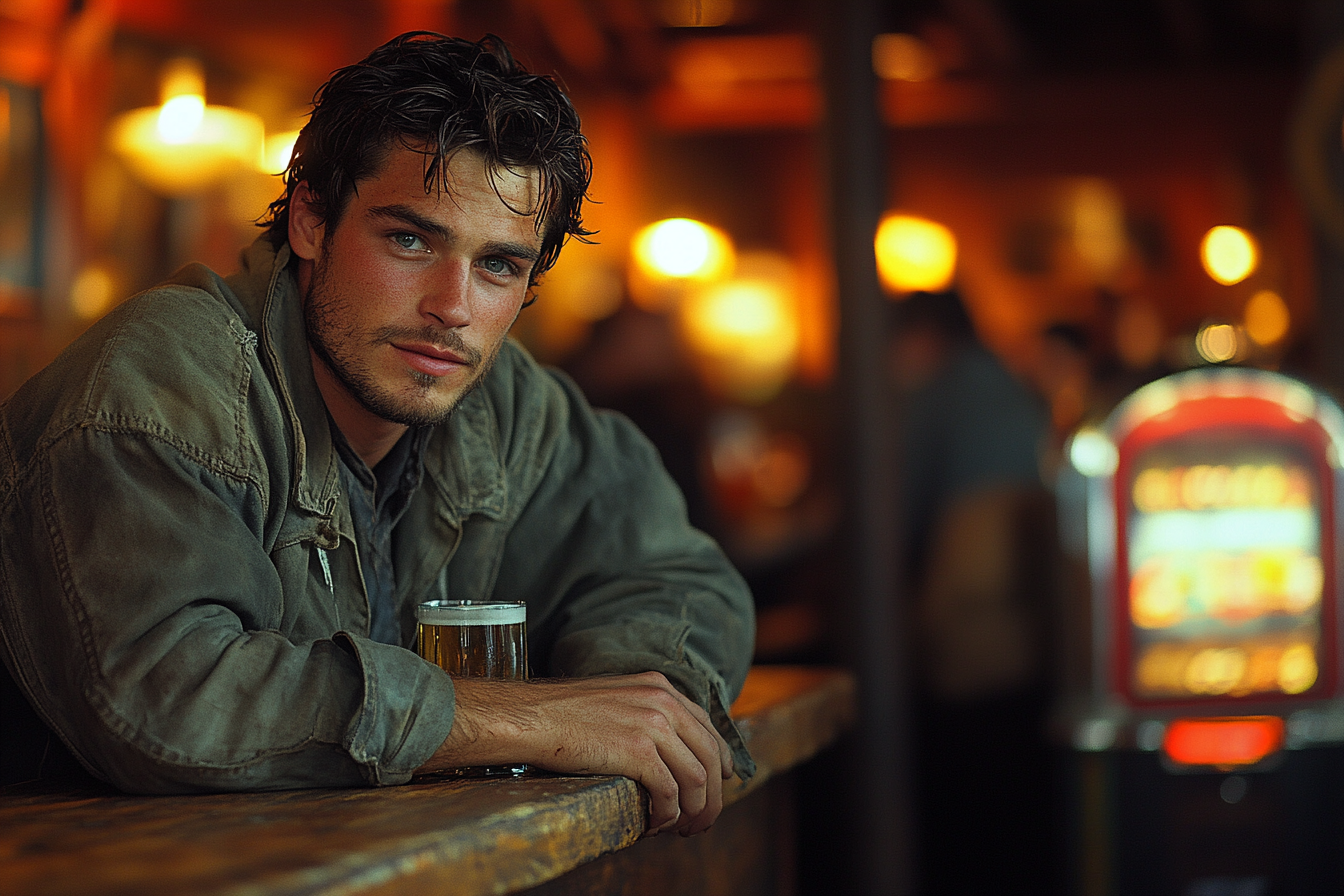
He was younger than I'd first thought from across the room—late twenties, at a guess, though he had the kind of face that might've been carrying a few more years than it let on. Lean, but with a solidity to him that said he used his body for more than just carrying it around. He wore a leather jacket that looked like it had earned every crease and scuff—not a fashion piece, a survival one. His face had a sharpness to it, cheekbones and jawline cut clean, and there was a scar—thin, pale, running from his temple down towards his jaw—that you might miss in dim light but that caught the lampglow as he turned his head.
He moved with a quiet certainty. Not arrogance—more that he'd already taken the measure of the room before he was properly through the door, and found nothing in it that needed watching.
My dart hit the outer ring. Not where I'd been aiming.
“Oi, you right?” Ben said, nudging me with his elbow. “That's the worst throw you've had all night.”
“Yeah, fine. Slipped.”
It hadn't slipped.
The out-of-towners settled at the bar, and within ten minutes, the way these things work in small pubs, the boundary between their group and ours had already started to blur. One of them—a big bloke with red hair and an easy laugh—got talking to Mick about cricket, and that was that. The two mobs folded into one the way they always did once somebody turned up a gripe worth sharing. People shifted, regrouped. The room settled itself around the newcomers.
It was Ben who pulled Jeremiah into the darts game. Ben, who never met a stranger he couldn't convert into a drinking partner within three sentences.
“Oi, mate—you any good at arrows?” Ben called across the bar, pointing a dart at the bloke in the leather jacket. “We need a fourth.”
He looked over. Those eyes—sharp, assessing—flicked between Ben and me and the board, and then he smiled. Not a big smile. Just a slight lift at one corner that said he'd weighed the invitation and found it worth accepting.
“Been a while,” he said, picking up the darts Ben offered. “But I'll give it a go.”
His voice had an accent I couldn't place. Not quite English, not quite anything. Like it had been worn smooth by too many countries to settle on one.
“I'm Ben,” Ben said, shaking his hand. “That's Cody, Mick, and Dave.”
“Jeremiah,” the stranger said. Just the one name, offered without a surname, which in a Gawler pub was either very casual or very deliberate. I couldn't tell which.
He threw. The dart landed clean in the treble twenty—not dead centre, but close enough to raise eyebrows.
“Been a while, has it?” Mick said dryly.
Jeremiah shrugged. “Misspent youth.”
That got a laugh from the group. And just like that, he was in.
The game continued—loose, competitive, fuelled by pints and escalating trash talk. Jeremiah held his own without dominating. He threw well when it mattered and missed when it didn't, which was its own kind of skill—knowing when to win, and when to let the other bloke walk away thinking he had. Whether he was doing it on purpose, I couldn't say. But the thought crossed my mind.
Between rounds, he talked. Not a lot—less than Ben, less than Mick, less than almost anyone—but when he did, people listened. He had this way of asking questions that made you want to answer them. Not intrusive questions. The kind that seemed casual but opened doors you hadn't realised were closed.
“So what do you do out here, Cody?” he asked, leaning against the wall while Mick took his turn. Like he was just making conversation. Like it didn't matter.
“Farm,” I said. “Cattle and crops. Family place, out past the edge of town.”
“Big operation?”
“Big enough. Been in the family since the 1880s. Four generations now.”
He nodded, slow. “That's a rare thing these days. Most people can't hold onto anything for that long.”
“Yeah, well. It's not always easy. But it's what we do.”
“And you?” he asked. “Is it what you do? Or what you were born into?”
The question landed differently than I expected. Not sharp, not pointed—but precise. Like he'd found a bruise I didn't know I had and pressed his thumb into it, gently, just to see what happened.
“Bit of both, I reckon,” I said, and heard myself laugh in a way that sounded thinner than I meant it to.
He held my gaze for a beat longer than was comfortable, then looked away, reaching for his pint. “Nothing wrong with that,” he said lightly. “Long as you've chosen it.”
I didn't answer. Wasn't sure I had.
Ben appeared at my elbow, fresh pint in hand, and leaned in close enough that I could smell the beer on his breath. “Making a new best mate, are we?”
There was a grin on his face, but underneath it, something else. Not jealousy—Ben didn't do jealousy—but awareness. A comment dressed up as a joke.
“Just talking,” I said.
“Yeah, right. You've said more to that bloke in twenty minutes than you've said to me all month.”
I shoved him lightly. “Piss off.”
He laughed and moved on, but the comment stuck. He wasn't wrong.
The night thickened. The crowd ebbed and flowed—some faces leaving, new ones arriving, the pub cycling through its evening like a lung. The jukebox worked through its catalogue. Cold Chisel gave way to The Angels, then something softer I didn't recognise, then back to something with grunt.
Jeremiah moved through it all with an ease that was hard to pin down. He bought a round for the darts group without being asked—just caught Alfie's eye, nodded, and it appeared. He listened to Mick's story about the time he accidentally reversed a forklift into the sawmill boss's new ute and laughed in all the right places. He asked Dave about the council's road repair plans and actually seemed interested in the answer, which was more than most people managed.
But underneath it—and I kept catching this, like light glancing off water—he was watching. Not the room, exactly. The people. The way they talked about their lives, what they complained about, what they dreamed about when the beer loosened them up enough to admit it. He listened to all of it with an attention that had nothing to do with being polite.
At one point, when the conversation had drifted to Dave griping about the same patch of road that'd been promised repair funding three years running, Jeremiah leaned forward and said, “So what would you do if money was no object? If someone walked in here tonight and said you could fix anything in this town—what would it be?”
The question stopped the group for a second. Dave blinked, thrown by the shift from griping to hypothetical. Then he laughed and said something about a swimming pool, and the moment passed into banter.
But I'd seen Jeremiah's face before Dave answered. That flicker of genuine intent. The way he'd leaned in, like the answer actually mattered.
He was testing people. I didn't know for what. But he was testing them.
The walls were crowded with old aviation memorabilia—propellers, dusty model planes, photos in glass frames. Above the hearth, the mural: Kingsford Smith's trans-Pacific flight, painted by Eleanor Whitfield back in '36. The colours had dulled, but the golden stars of the Southern Cross still caught the lamplight. Something about the image—a man flying towards the unknown, the whole world spread out below him—landed differently tonight.
I glanced at Jeremiah and found him looking at the mural too.
“Jack O'Connor built this place,” I said, not quite sure why I was offering it. “Named it for his mate Kingsford Smith. They served together in the first war.”
Jeremiah's eyes moved across the painting slowly, reading it the way you'd read a page. “He was searching for something, wasn't he?” he said. “Kingsford Smith. Not just records or fame. Something else.”
I didn't know if he was right, but it felt right.
“My old man reckons you can take the pulse of Gawler just by sitting in here for an evening,” I said. “All of life passes through these doors, sooner or later.”
Jeremiah looked at me then. Something in his expression shifted—not warmth exactly, but recognition. Like I'd passed a test I didn't know I was taking.
“Sounds like your old man's a wise bloke,” he said.
I thought about Dad—his calloused hands, his economy with words, the way he could make you feel like a sentence was a gift if he chose the right one. I thought about Anne at the kitchen table, surrounded by textbooks, telling me she was going to drag us all into the next century. I thought about the farm at dawn, the mist on the wheat, the windmill turning against a pale sky.
“Yeah,” I said. “He is.”
Jeremiah held my eye a moment past easy, then turned back to the darts and asked whose round it was.
But something had shifted. I felt it the way you feel a change in the wind—not in your head, but in your skin.







