4344.36 · February 5, 2024 AD
The Historian's Daughter
A Monday morning in the Karaköy conservation lab, where Deniz Kaya restores a Byzantine manuscript and Mira Osman digitises correspondence from the 1840s, is interrupted by a telephone call from Ankara. Elif and Kemal Osman — librarian and historian, parents whose professional lives orbit the very disciplines their daughter practises in secret — confirm Saturday's family dinner, enquire about her career, and mention a university position that would make her life legible to them. Professor Kemal Osman, who has spent four decades studying Ottoman administrative history, does not know that his mother spent fifty years in the building where his daughter now stands, or that the materials she handled would have rewritten his understanding of everything he teaches.
The Karaköy facility's conservation lab occupied the second floor's north-facing side, where Mehmet Bey's original 1820s design had positioned tall windows to admit steady, cool light — the kind of illumination that allowed conservators to distinguish foxing from intentional pigment, to identify hairline fractures in clay before they became catastrophic, to see what needed seeing without the distortion that direct sun or artificial warmth introduced. The windows had been replaced three times across two centuries, but the proportions had been maintained each time, the architectural logic of the original design outlasting the glass that expressed it.
Deniz Kaya had arrived before anyone else, as she always did. Twenty-two years at the facility had established rhythms that no amount of institutional disruption could dislodge — the conservation bench prepared by seven-thirty, the environmental monitors checked, the day's materials laid out with the surgical precision of someone who understood that the objects in her care were irreplaceable and that carelessness, however momentary, could destroy in seconds what millennia of transmission had preserved. She was fifty-three years old, trained at the Süleymaniye Manuscript Library before The Preservation recruited her in 2002, and she addressed damaged manuscripts with the patient authority of a surgeon speaking to an anaesthetised patient — murmuring assessments, identifying problems, narrating the interventions she intended to perform as though the documents could hear and be reassured.
The morning's patient was a Byzantine manuscript fragment whose left margin had been entirely lost and whose previous repair — fish glue, applied at some indeterminate point in the past by someone whose intentions had exceeded their expertise — had created adhesion damage that Deniz intended to reverse with the methodical care that constituted her particular form of devotion. Japanese tissue and wheat starch paste sat ready on the bench beside her. The work would take hours. She showed no sign of minding.
Mira Osman arrived early and was directed to the kitchen for börek before she was permitted to touch any materials. The facility's small staff — Deniz, the semi-retired Handan who came three days a week, Mira as the most consistent of a rotating cast of junior Archive Keepers — operated with the informal hierarchy of any small workplace, but the informality disguised an operational seriousness that the conservation lab's steady rhythms sustained. The digitisation project continued: every document photographed, catalogued, entered into the central system. The work was years from completion. It proceeded regardless, one letter at a time, one shutter click at a time, with the particular patience that Preservation work demanded and that the conservation lab's soundscape — camera shutter, environmental hum, the whisper of Deniz's brush against parchment — seemed designed to cultivate.
The morning's materials were Ottoman-era correspondence from the 1840s — letters between Mehmet Bey and Archive Keepers at other facilities, discussing the logistics of consolidating materials into the newly established Karaköy operation. The letters revealed the particular anxieties of people who understood that fragile documents being transported across continents in an era before climate-controlled shipping were vulnerable to every hazard that distance and weather could produce. Mehmet Bey's handwriting was precise, his Ottoman Turkish elegant, his frustrations with colleagues whose cataloguing standards failed to meet his expectations familiar enough to make Deniz remark, when told of one such complaint, that she and the facility's founder would have got along.
The routine held for ninety minutes before the phone call from Ankara arrived.
Elif Sevda Osman rang with the domestic authority of a woman who had spent thirty-one years managing a household whose other adult occupant approached even the selection of a tradesperson with the rigorous methodology of Ottoman historiography. The conversation lasted six minutes and forty-three seconds. Its substance was straightforward: Saturday's family dinner was confirmed, Sevgi Teyze was coming from Kayseri, the mantı was non-negotiable, Mira was too thin, and Aylin Demir had spoken to Kemal about concerns regarding Mira's eating habits. The subtext was more complex. Elif Osman was a librarian trained in manuscript preservation — a professional whose daily work involved cataloguing, conservation, and the maintenance of institutional memory. She had accepted her daughter's explanation of private collection work for wealthy families because it was plausible and because her daughter held a doctorate from SOAS and was clearly not engaged in anything criminal. But Elif had a librarian's instinct for when the catalogue did not match the shelves, and the gaps in Mira's account had been accumulating for seven years.
Professor Kemal Bey Osman took the phone with the measured cadence of a man who had spent four decades lecturing on Ottoman administrative reform and who modulated his voice for maximum clarity with minimum volume. He mentioned a position — ancient Near Eastern languages, part-time with potential for permanence, at Ankara University where he had taught since 1991. He presented this as information rather than pressure, a distinction he maintained with the intellectual honesty of someone who genuinely believed the two were separable. The position would have placed his daughter in the academic world he understood, producing publications he could read, building a career he could describe to colleagues at departmental functions without the particular pause that currently preceded his explanation of what Mira did for a living.
He mentioned Ayşe. Casually, fondly — the grandmother who would have enjoyed the detective aspect of Mira's current work, who had always had opinions about everything. Kemal Osman was the son of a woman who had served as the Karaköy facility's primary Archive Keeper for approximately thirty years, whose knowledge of the collection's idiosyncratic organisation was irreplaceable, whose tenure represented one of the longest continuous residences the facility had experienced. He did not know this. Had never known it. Ayşe had navigated fifty years of Preservation work without disclosing its existence to her own son — a historian whose professional life was dedicated to understanding the very archival systems and administrative structures that The Preservation had operated within and alongside for centuries.
The irony was structural rather than personal. Kemal Osman studied Ottoman institutional history. His mother had been embedded within an institution that predated the Ottoman Empire by three thousand years, operating beneath the administrative surface that her son mapped in his lectures and publications. The materials she had handled in the Karaköy sub-levels — documents from Uruk and Babylon, Byzantine texts copied before Constantinople fell, fragments that had survived Alexandria's burning — would have transformed his understanding of archival transmission, of institutional continuity, of the relationship between knowledge preservation and civilisational survival that his own research circled without ever quite reaching.
He had spoken at Ayşe's funeral about her love of genealogy, her fondness for antique manuscripts, her retirement hobby that had kept her sharp into her eighties. The eulogy had been accurate in every particular and false in its entirety — the difference between describing a building's facade and understanding its foundations. The gathered relatives had nodded. Mira had stood among them carrying knowledge that recontextualised everything her father believed about his own mother and could not share a syllable of it.
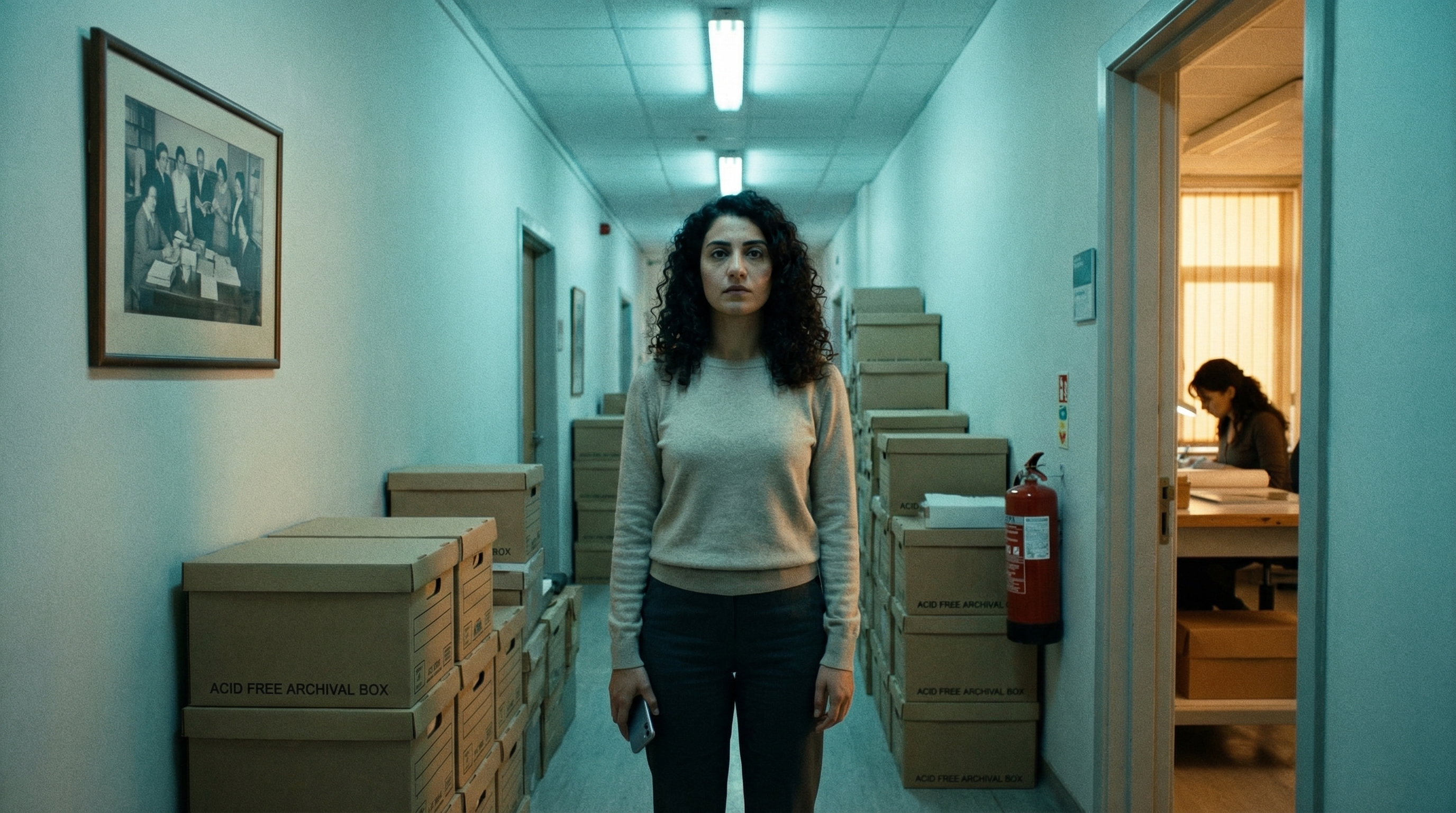
The phone call ended as it always did — Kemal hanging up first, a small assertion of control in a household where Elif managed virtually everything else. Mira stood in the fluorescent-lit corridor of the facility her grandmother had worked in for three decades and her father had never visited, surrounded by acid-free boxes and conservation supplies, processing the particular exhaustion of having performed, for six minutes and forty-three seconds, the daughter her parents believed they had raised. The performance was not dishonest in its affection — the love was unperformed, the warmth genuine, the family jokes about heating repairs and mantı and her father's methodological approach to domestic tasks as authentic as anything in her life. What was performed was the context. The career that was not what she described. The grandmother who was not what anyone had eulogised. The building she stood in, which was not what anyone outside The Preservation knew it to be.
Deniz Kaya did not ask for details when Mira returned to the bench. She offered the observation that mothers who made mantı for homecoming daughters were making statements rather than meals, and returned to the Byzantine manuscript with the focused steadiness that twenty-two years of conservation work had cultivated. She understood. She was Preservation herself — had been recruited two decades ago by methods she described as persuasive in the way earthquakes were persuasive — and she knew the particular weight that phone calls from outside carried when you were inside. The conservation lab's soundscape resumed: camera shutter, environmental hum, the whisper of brush against parchment. The work continued at the pace of preservation, which was the only pace the materials permitted and, on days like this, the only pace that felt survivable.
The correspondence from the 1840s waited under the camera lights. Mehmet Bey's complaints about cataloguing standards in the eastern facilities read, at a distance of nearly two centuries, like a minor-key echo of frustrations that every Archive Keeper in every era had experienced — the gap between what the organisation's mission demanded and what its scattered, inconsistently maintained infrastructure could deliver. The letters were institutional archaeology of the most mundane kind, and they were also evidence that the Karaköy facility had been built by someone who cared about the same things the people working in it now cared about: precision, thoroughness, the understanding that what seemed tedious today might prove invaluable to someone, someday, trying to piece together a story that the conventional record had forgotten.
Mira clicked the shutter. Moved to the next letter. The morning's routine reasserted itself around her — the lab's steady light, Deniz's murmured assessments, the distant haze of Karaköy's streets filtering through walls thick enough to contain the silence that The Preservation had maintained for four thousand years, and that the Osman family had maintained, without knowing they were maintaining it, for three generations.







