4127.105 · April 15, 1807 AD
The Gavel and the Storm
As a violent storm breaks over Portsmouth, Elizabeth and Edward Jeffries sit amongst neighbours who were once friends, watching their twenty-two-year-old son stand trial for a theft that will define the rest of their lives—whilst in the gallery, whispered certainties clash with quieter doubts about what really happened that day.
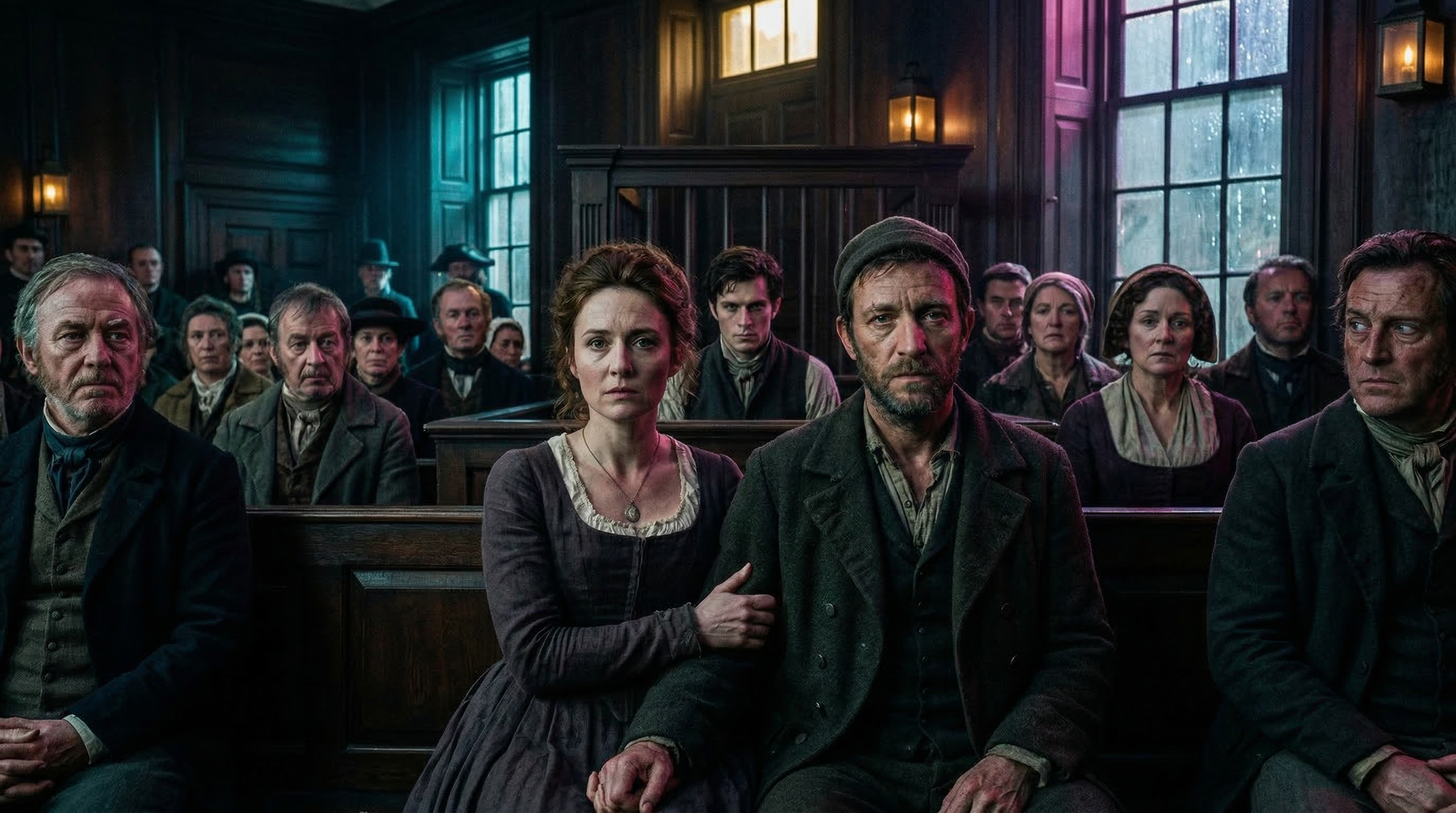
"Keep your head high, son. Remember who you are."— Edward Jeffries
Elizabeth Jeffries had not slept. She had lain beside Edward through the long hours of darkness, listening to his breathing and knowing from its rhythm that he too was awake, though neither of them spoke. What was there to say? The words that might have passed between them—words of comfort, of reassurance, of hope—had all been exhausted in the fortnight since the constables came. Now there remained only the waiting, and the terrible knowledge of what this day would bring.
She rose before dawn and dressed in her Sunday clothes, though it was only Wednesday. The dark wool dress had been her mother's, taken in twice over the years as Elizabeth's frame had grown thinner with age and worry. She pinned her hair with trembling fingers, tucking away the grey strands that had multiplied so rapidly these past weeks, and regarded herself in the small looking-glass that hung beside the door. The face that gazed back at her belonged to a stranger—hollow-eyed, drawn, aged beyond its one-and-forty years.
Edward was already at the table when she emerged, though he had not touched the bread she had set out the night before. He sat with his hands folded before him, staring at nothing, his weathered features arranged into that mask of rigid composure he had worn since the arrest. In all their years of marriage, Elizabeth had never seen him weep. She wondered if he even knew how.
They walked to the guildhall together as the first light broke grey and threatening over the harbour. The April morning carried a chill that cut through Elizabeth's shawl, and overhead the clouds massed thick and dark, pressing low against the rooftops as though the sky itself were bearing down upon the town. Other folk were abroad despite the early hour—fishwives heading to market, sailors making for the docks, tradesmen opening their shutters—and Elizabeth felt their eyes upon her as she passed. Some nodded in awkward sympathy. Others looked away. A few whispered behind their hands, and she caught fragments of words that landed like blows: thief, trial, transportation.
She had known these streets all her life. Had walked them as a girl with her father, the shipwright, learning the names of the vessels in the harbour. Had walked them as a young bride on Edward's arm, giddy with the promise of the life they would build together. Had walked them as a mother, her hand wrapped around William's small fingers, pointing out the sights and sounds of the bustling port. Now the familiar cobblestones felt foreign beneath her feet, as though she were traversing some hostile country where she no longer belonged.
The crowd had already begun to gather when they arrived at the guildhall. Elizabeth had expected this—word of the trial had spread through Portsmouth like plague—but the sight of so many faces, so many strangers come to witness her son's fate, sent a wave of nausea through her that she barely suppressed. She gripped Edward's arm more tightly, and he covered her hand with his own, the only acknowledgement he could offer.
Portsmouth society had turned out in force. Elizabeth recognised merchants she had sewn for, their wives adorned in silks and bonnets that her own needle had helped to trim. She saw dockworkers who had laboured alongside Edward for years, men who had once clapped William on the shoulder and praised his strong back and willing hands. She saw neighbours from their own street, women who had borrowed sugar from her kitchen and shared gossip over the back fence, now gathered to watch her family's destruction with expressions that mingled pity with something darker—a hungry curiosity, a satisfaction that the misfortune had fallen upon someone else's house and not their own.
The gallery filled quickly. Elizabeth and Edward found seats near the front, close enough that she would be able to see William's face when they brought him in. She clutched her handkerchief in her lap, twisting the worn linen between her fingers, and fixed her eyes upon the empty dock where her son would soon stand.
Around her, the air grew thick with whispered speculation. She heard snatches of conversation, opinions offered with the casual certainty of those who had nothing at stake. The evidence was clear, they said. Caught with the watch in his hand. What more proof did anyone need? A few voices murmured dissent—he had always seemed such a decent lad, hard to believe he would do such a thing—but these were drowned beneath the tide of assumption that had already rendered its verdict before the trial had even begun.
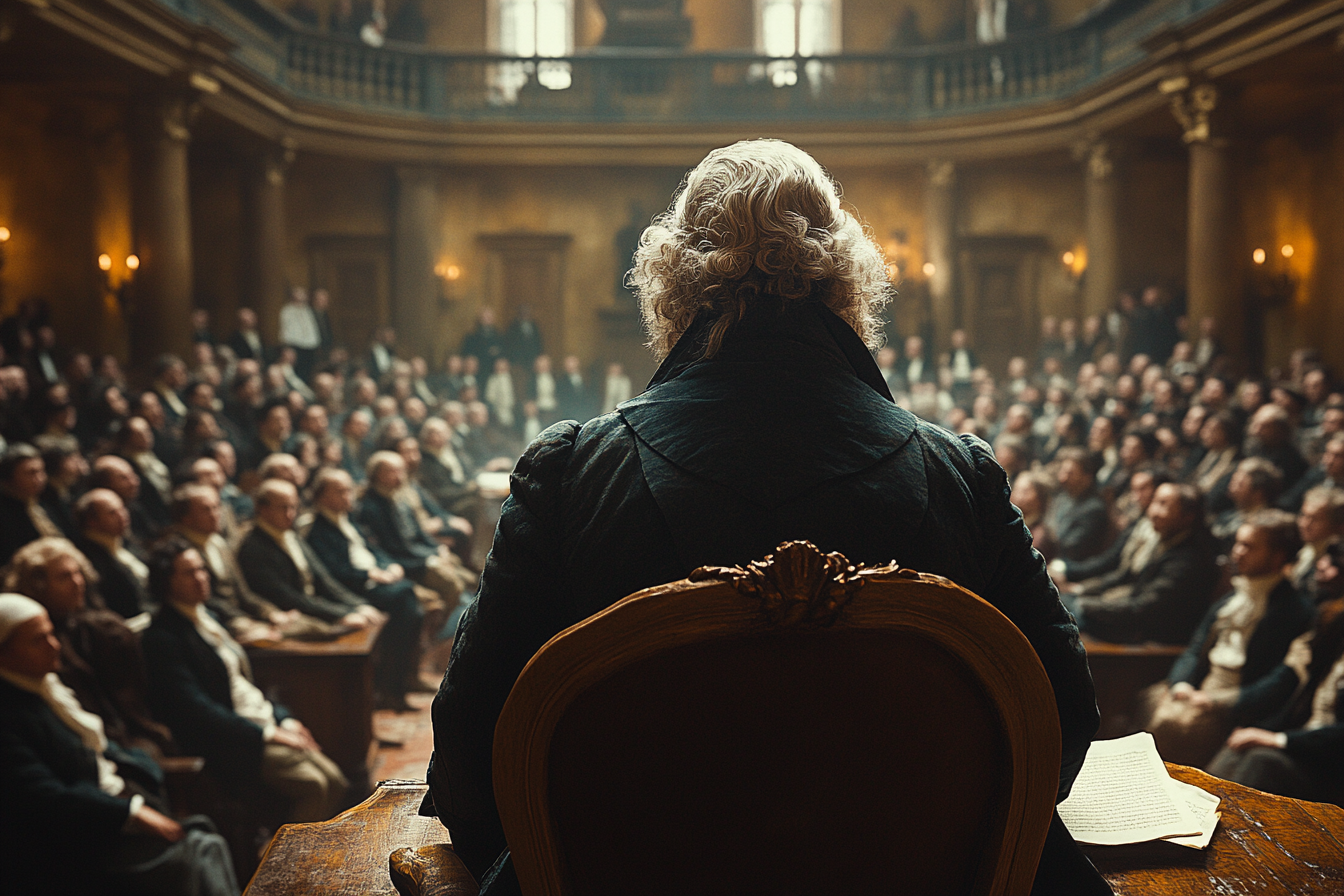
Thunder rumbled in the distance, a low growl that seemed to emanate from the very foundations of the building. Through the tall windows, Elizabeth watched the sky darken further, clouds roiling and churning like the sea before a squall. The first drops of rain began to strike the glass, tentative at first, then with growing insistence. By the time the bailiff called for all to rise, the storm had announced itself in earnest, and the guildhall seemed to shake with the force of it.
The proceedings that followed would remain in Elizabeth's memory as a series of impressions rather than a coherent narrative. She heard the words spoken by the lawyers—the prosecutor's confident accusations, the defence attorney's impassioned appeals—but they seemed to reach her from a great distance, muffled by the pounding of her own heart and the relentless drumming of rain against the windows.
She watched the constable take the stand, a grizzled man whose weathered face bore the marks of decades spent walking Portsmouth's streets. He spoke of what he had seen, what he had done, and his words painted a picture of guilt so vivid that Elizabeth wanted to rise from her seat and cry out that it was wrong, all wrong, that he did not know her son as she knew him. But she remained silent, her fingernails cutting crescents into her palms, because what good would it do? What good had any of it done?
The merchant testified next—Josiah Blackwell, a prosperous man whose fine clothes and well-fed frame spoke of a life Elizabeth could scarcely imagine. He described his stolen watch with a grief that seemed excessive for a mere timepiece, however valuable, and Elizabeth found herself wondering what it must be like to mourn an object with such passion when she was about to lose her only child.
Throughout it all, William sat motionless in the dock. Elizabeth's eyes returned to him again and again, hungry for any sign of the boy she had raised, the child who had once run laughing through these same streets, who had brought her wildflowers from the fields beyond the town, who had sat at her knee while she taught him his letters by candlelight. But the young man in the dock seemed a stranger—hollow-eyed, diminished, as though something essential had already been stripped away from him.
Once, his gaze lifted to the gallery, and their eyes met. Elizabeth tried to pour all her love, all her faith, all her desperate hope into that single glance. For a moment, something flickered in his expression—recognition, gratitude, grief—before his attention was pulled away by some movement at the rear of the chamber. His jaw tightened almost imperceptibly, and Elizabeth turned to see what had caught his notice, but the crowd was too thick, the shadows too deep. She saw only the usual assortment of spectators: merchants and workers, the curious and the idle, all come to witness the machinery of justice grinding another soul beneath its wheels.
Edward had not moved since taking his seat. He sat with the stillness of a man carved from stone, his eyes fixed upon some point beyond the courtroom walls, his hands folded in his lap with a composure that might have been mistaken for calm by anyone who did not know him. But Elizabeth knew. She knew the effort it cost him to maintain that rigid posture, to keep his face arranged in lines of stoic acceptance when everything within him must be screaming.
He had been this way since the night the constables came. Had spoken barely a dozen words in the fortnight since, retreating into a silence so complete it frightened her more than any outburst could have done. She had tried to reach him—had spoken to him of hope, of lawyers, of appeals—but he had only shaken his head, once, and turned away. He knew, as she knew, that hope was a luxury they could not afford. The wheels of justice, once set in motion, did not easily reverse their course.
She thought of the boy Edward had been when she first knew him—young and strong and full of quiet certainty that hard work and honest dealing would see them through whatever trials life might bring. She thought of the father he had become, teaching William to tie knots and read the weather, carrying the child on his shoulders through the market crowds, sitting up through long nights when fever struck. All those years of labour and love, all those small sacrifices made in the hope of building something better—and now this. A courtroom. A crowd of strangers. A son in chains.
Lightning split the sky beyond the windows, flooding the chamber with harsh white light. In that instant, Elizabeth saw her husband's face fully illuminated, and what she saw there nearly broke her. Behind the mask of composure, behind the rigid set of his jaw and the steadiness of his gaze, she glimpsed something that looked very much like a man watching his own heart being cut from his chest.
The jury withdrew, and the waiting began. Elizabeth counted the minutes by the rhythm of water dripping from some crack in the ceiling—a steady plink, plink, plink that seemed to mark the passage of time with cruel deliberation. Around her, the gallery buzzed with whispered speculation, but she heard none of it. Her entire being was focused on the door through which the twelve men had disappeared, willing them to return with the words that would set her son free.
They were gone for less than half an hour. When they filed back into the chamber, not one of them looked toward the dock where William stood.
Elizabeth felt Edward's hand close over hers, his grip so tight it bordered on painful. She did not pull away. She could not have moved if her life depended upon it. The foreman rose, a merchant she vaguely recognised, and the words he spoke seemed to come from very far away, distorted by the roaring in her ears and the thunder that chose that moment to shake the very walls of the guildhall.
Guilty.
Elizabeth heard gasps, murmurs, a few sounds that might have been satisfaction. She heard the rain hammering against the windows with renewed fury. She heard the magistrate's voice intoning something about the severity of the crime, the demands of justice, the necessity of punishment.
Seven years' transportation to New South Wales.
The gavel fell, and something within Elizabeth shattered.
She was on her feet before she knew she had moved, her voice tearing from her throat in a cry that silenced the murmuring crowd.
"No! My boy—my poor boy!"
The words seemed to come from somewhere outside herself, raw and ragged, stripped of all dignity and restraint. She pushed forward, fighting against the hands that reached to hold her back, her slight frame possessed of a desperate strength she had not known she still possessed. The faces around her blurred into a sea of colour and shadow—shocked expressions, pitying glances, a few turned away in embarrassment at such an unseemly display of emotion.
She reached the barrier that separated the gallery from the well of the court, her hands closing around the polished wood as though she might tear it apart through sheer force of will. Beyond it, William had turned toward her, his composure cracking at last, his face twisted with an anguish that mirrored her own.
"Please!" she cried, her eyes finding the magistrate's impassive face. "Please, Your Worship—have mercy! He's all we have! He's our only child!"
Two bailiffs moved to intercept her, their hands firm but not unkind as they guided her back from the barrier. She struggled against them, still crying out, still pleading, though she knew even as the words left her lips that they would change nothing. The verdict had been rendered. The sentence had been pronounced. All the tears in the world could not wash away what had been done.
Then Edward was beside her, his arms closing around her with a gentleness that undid her completely. She collapsed against his chest, her sobs muffled against the rough wool of his coat, and felt him trembling—felt, for the first time, the cracks in that wall of silence he had built around himself.
The magistrate, in what might have been an act of mercy or merely impatience to conclude the proceedings, permitted them a moment with their son before he was led away. Elizabeth did not remember crossing the distance to the dock. She remembered only William's hands reaching through the bars to clasp her own, cold and rough and achingly familiar.
She tried to speak, tried to tell him all the things a mother should say to a son she might never see again, but the words tangled in her throat and emerged only as broken sounds, fragments of love and grief that language could not contain. She pressed her lips to his knuckles, tasting salt—whether from her tears or his, she could not tell.
Edward stepped forward then, and Elizabeth moved aside to let him pass. Father and son regarded each other in silence, a lifetime of unspoken words hanging in the air between them. Edward's hand rose to rest upon William's shoulder, the gesture steady despite the tremor that ran through him.
"Keep your head high, son." His voice was rough, barely more than a whisper, yet it carried clearly in the sudden hush. "Remember who you are."
William's hand came up to cover his father's, and something passed between them that Elizabeth could not name—an understanding, perhaps, forged in the particular silence that had always defined their bond. Then the bailiffs were there, drawing William away, and the moment was over.
"I'll come home," William called over his shoulder, his voice cracking on the words. "I swear it. I'll come home."
The door closed behind him, and Elizabeth felt the last thread of hope snap within her chest.
The storm had reached its peak by the time they emerged from the guildhall. Rain fell in sheets so thick Elizabeth could barely see the buildings across the square. Thunder rolled continuously overhead, a ceaseless barrage that seemed to mock the grief churning within her. She stood on the steps, heedless of the water soaking through her clothes, and stared at nothing.
Edward guided her forward with a hand at her elbow, as gentle as if she were made of glass. They walked home through the deluge, past the market stalls that were hastily closing against the weather, past the taverns already filling with men who would spend their time discussing the trial over pints of ale. Elizabeth heard snatches of conversation as they passed—speculation about the evidence, opinions about the sentence, the casual cruelty of strangers passing judgement on matters they did not understand.
She did not respond. She did not look up. She simply walked, one foot before the other, letting Edward steer her through the familiar streets that had become so foreign.
The house was cold when they returned. The fire had gone out hours ago, and neither of them moved to rekindle it. Elizabeth stood in the doorway of the small room that had been William's since he was a boy, staring at the narrow bed with its threadbare blanket, the shelf where he kept his few treasured possessions, the hook on the wall where his work coat still hung.
Seven years. The number tolled in her mind like a funeral bell. Seven years before she might see her son again—if he survived the voyage, if he survived the labour, if he survived at all. She had heard stories of the convict ships, of the conditions that claimed so many lives before they ever reached those distant shores. She had heard stories of the colony itself, that brutal wilderness at the bottom of the world where men were worked like beasts and treated worse.
William would be twenty-nine when his sentence ended. A man grown, shaped by experiences she could not imagine, hardened by years she would not share. The boy she had raised, the child she had loved with every fibre of her being—that boy was already gone, lost to her as surely as if the sea had swallowed him whole.
She sank onto the edge of his bed, her hand smoothing the blanket in a gesture that was pure habit, and let the tears come at last. They fell silently, streaming down her cheeks and dropping onto the rough wool, darkening the fabric in small, spreading stains. She wept for the son she had lost, for the future that had been stolen, for all the small ordinary moments—meals shared, stories told, laughter exchanged—that would now never come to pass.
Edward appeared in the doorway, a shadow against the grey light. He stood watching her for a long moment, his face unreadable. Then, slowly, he crossed the room and lowered himself onto the bed beside her. He did not speak. He did not reach for her. He simply sat, his presence a quiet anchor in the storm of her grief.
Outside, the rain continued to fall, and the thunder gradually receded, rolling away across the harbour toward the open sea where, somewhere in the weeks to come, a ship would carry her son to the far side of the world.
In the days that followed, Portsmouth talked of little else. The trial of William Jeffries became a fixture of conversation in every tavern and parlour, every market stall and churchyard gathering. Opinions were offered with the confident certainty of those who had witnessed the proceedings firsthand, and with equal confidence by those who had not. The evidence had been clear, most agreed. The constable had seen it happen. The watch had been found in his hand. What more was there to say?
And yet, among the working folk of the docks and the narrow streets near the harbour, a different sort of talk circulated—quieter, more cautious, spoken in low voices that fell silent when strangers approached. Some said they had seen another man near Blackwell that day, a fellow with copper-coloured hair who had melted into the crowd moments before the constable seized young Jeffries. Some said William had always been a decent lad, that the whole business seemed wrong somehow, that there was more to the story than had been told in court. These voices were few, and they were careful, but they persisted nonetheless, a current of doubt running beneath the surface of the town's certainty.
The truth, whatever it was, would not be found in the verdict that had been rendered or the sentence that had been pronounced. Courts dealt in evidence and testimony, in the words of witnesses and the arguments of lawyers. They could not see into men's hearts, could not know the silent calculations and hidden motives that drove human action. They could only weigh what was presented before them and render judgement accordingly.
And so William Jeffries was guilty—guilty in the eyes of the law, guilty in the records that would follow him to the ends of the earth, guilty in the minds of all who had watched the proceedings and nodded their heads in satisfaction at justice being done. Whether he was guilty in fact, in the deeper sense of having committed the act of which he stood accused, was a question the court had answered and the town had accepted.
Only William himself knew the truth. And William was no longer in Portsmouth to speak it.
The prison hulks lay at anchor in the harbour, their dark silhouettes visible from the waterfront like monuments to human misery. They had once been warships, proud vessels that had carried British colours into battle, but age and obsolescence had reduced them to floating gaols, their gun ports sealed, their decks converted to cells where the condemned awaited transportation to the colonies.
Elizabeth walked to the harbour every morning in the weeks that followed, though she was not permitted to see her son once he had transferred to the Hulks. She simply stood at the water's edge, gazing out at the hulks, trying to imagine which one held William, what conditions he endured, whether he was cold or hungry or afraid. Sometimes she brought food she had prepared, hoping to find someone who might carry it to him, but the guards turned her away with varying degrees of sympathy and indifference. Rules were rules. Prisoners were prisoners. The machinery of the penal system did not bend for a mother's love.
Edward returned to the docks the day after the trial. He worked with a grim determination that alarmed his fellow labourers, throwing himself into the heaviest tasks as though he might exhaust the grief out of his body through sheer physical effort. He spoke to no one of what had happened. He did not need to. Everyone knew. Everyone had heard. And if some of them whispered behind his back, wondering whether the son's crime reflected some hidden flaw in the father, Edward gave no sign of noticing or caring.
The modest dwelling near the dockyards, once filled with the sounds of family life—conversation over meals, laughter at small jokes, the comfortable silence of people who knew each other well—fell quiet as a tomb. Elizabeth moved through the rooms like a ghost, performing the necessary tasks of cooking and cleaning and mending, but the heart had gone out of her.
She was merely existing now, counting the days until the ship departed, dreading the moment when even the thin comfort of proximity would be taken from her.







