4344.40 · February 9, 2024 AD
The Fourth Floor
The stairwell light has clicked off. Mira is standing between floors, still carrying the warmth of Halil Bey's tea and the ghost of a sixty-year-old melody, when a door opens above her. Not Halil Bey's door. The other one — the flat that has been empty for four years. The man who comes down the stairs knows the building well enough to navigate it in the dark. He also owns it. And he has a few things he'd like to discuss with Mira about what good neighbours do and don't do.
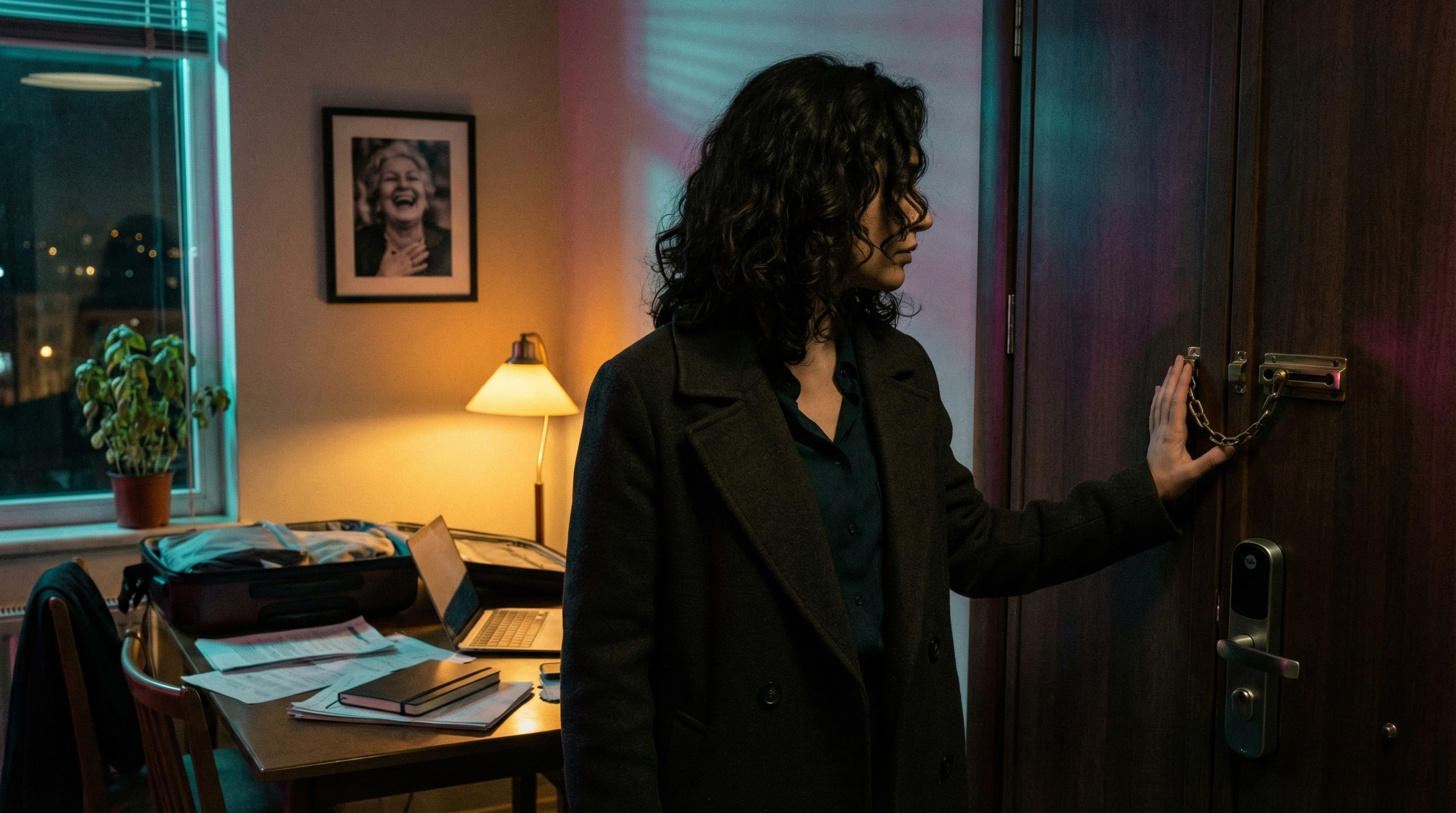
"A chain on a door is not security. It is the decision to admit you need it."
The stairwell was dark. The timed light had clicked off during my last few moments on the landing and I hadn't pressed the switch again. I was standing between the third floor and the second, one hand on the banister, Halil Bey's music now barely audible behind his closed door — just the ney, a thin thread of it, like someone humming in another room.
The door that opened was on the fourth floor. I could tell from the acoustics — the particular echo of a hinge in the upper stairwell, where the ceiling was lower and the sound bounced differently off the narrower walls. It was the flat directly above Halil Bey's. Number 7. The flat that had been empty for as long as I'd lived here — no name on the letterbox downstairs, no shoes outside the door, no cooking smells, no water running through the pipes, none of the small audible evidence of habitation that you learned to read unconsciously when you shared a building with other people. I'd walked past that door hundreds of times in four years. It had always been closed. Always silent. I'd assumed it was being held vacant by the building's owner — perhaps waiting for renovation, perhaps simply sitting there the way investment properties sometimes did in Cihangir, bought and held and forgotten whilst the plaster cracked and the value appreciated.
The door opened and closed. Not slammed — controlled. The particular sound of someone pulling a handle gently and then pressing the latch back into its frame with their thumb to avoid the click. The kind of closing you did when you didn't want the sound to carry.
Then footsteps on the stairs. Coming down.
I stayed where I was. Not deliberately hiding — there was nothing to hide from — but the light was off and I was motionless and whoever was descending hadn't turned it on either. They were moving in the dark. Confidently. Not fumbling for the switch, not hesitating at the turns where the stairs changed direction. Moving the way someone moved through a space they knew well enough to navigate blind — which step was wider, which section of banister was loose, where the marble had a chip you could catch your toe on if you weren't careful.
The footsteps reached the landing above me. Then came around the turn and a shape materialised in the dim light — a man, medium height, dark coat, moving quickly until he registered my presence on the landing below and stopped.
"Ah—"
A sharp intake of breath. A fractional stiffening through the shoulders that lasted perhaps half a second before it was replaced by something else — a loosening, a rearrangement, the practised relaxation of someone shifting from one mode to another.
"Mira. Mira Hanım. Hello."
Farhad Rezaei. The building's owner. I'd met him perhaps five times in four years — once when I'd signed the lease, once when the bathroom plumbing had failed catastrophically and I'd had to call the number on the rental agreement, and three times in the stairwell in passing, brief exchanges conducted in the broken English that was our only shared language. He was Iranian — mid-fifties, well-dressed in the particular way of men who wore expensive clothes without appearing to notice them. A dark wool overcoat, leather shoes that were too good for a building without a lift, a watch I'd glimpsed once that looked like it cost more than my annual rent. He didn't live in the building. He didn't live in Istanbul full-time, as far as I knew. I had no idea how many properties he owned or where else he spent his time, and I'd never had reason to think about it.
He was standing one step above me. The stairwell was narrow — barely wide enough for two people to pass — and he was positioned centrally, not against the wall the way you'd stand if you were simply navigating past someone. He was between me and the fourth floor. Between me and the door he'd just come through.
"Good evening," I said.
"Yes, good evening, good evening." He said it twice, the repetition filling space, buying a moment. His eyes moved over me — not threatening, not leering, just registering. The kind of assessment that catalogued what you were wearing, what you were carrying, where you'd come from, what you might have seen. "You are visiting Halil Bey? The music, yes?" A sympathetic shake of the head. "Always too loud. I tell him many times."
"He turned it down."
"Good, good. He is nice man. Old. The ears are not working so well." He tapped his own ear in an echo of the gesture Halil Bey had made twenty minutes earlier, and the mimicry was so precise it felt borrowed rather than coincidental.
He still hadn't moved. We were standing in the dark stairwell, close enough that I could smell him — not cologne, or not only cologne. There was something underneath it. Sharp. Chemical. Not a cleaning product, not paint, not anything I could name from my experience of ordinary domestic smells. It was faint but present, clinging to the wool of his overcoat or to his hands or to whatever air had followed him out of the flat above.
"I am checking the building," he said, as though I'd asked. "Some maintenance. The flat upstairs, number 7 — some problems with the pipes. The water." He gestured upward with his left hand. His right hand stayed at his side, slightly behind his hip, resting against his coat pocket or inside it — I couldn't tell in the dim light, and I didn't want to look closely enough to find out.
There were no water problems on the fourth floor. I was certain of this in the way you were certain of things you lived with daily — the particular sounds your building made, the patterns of its plumbing, the way water moved through old pipes and announced itself at every junction. A leak on the fourth floor would have manifested on the third — in Halil Bey's flat — and Halil Bey hadn't mentioned water damage. His flat had been dry, warm, immaculate. And Farhad Rezaei did not do his own maintenance. On the single occasion I'd needed emergency repairs, he'd sent a man — a different man, not himself — who'd arrived two days later and fixed the problem without speaking to me once.
"I see," I said.
The silence that followed was small — three seconds, maybe four — but it had a texture. The building filled it with its usual sounds: the creak of old wood, the distant murmur of traffic, the faint pulse of Halil Bey's music through his door. And from above — from the fourth floor, from behind the closed door of number 7 — something. Not a voice. Not a clear sound. Something closer to the absence of sound, the held-breath quality of a space where someone was being very, very still.
Farhad smiled. It arrived on his face the way a picture arrives on a screen — all at once, fully assembled, every element in its correct position. Teeth, crinkled eyes, the slight tilt of the head that was meant to communicate warmth. It was technically perfect. It was also the kind of smile that made you aware of your own body in a way that had nothing to do with attraction and everything to do with proximity — how close he was, how narrow the stairwell was, how far away your own front door suddenly seemed.
"Mira, I am glad to see you actually. I want to talk about the situation. The rent."
The rent. Of course. I was three weeks late. Not the first time — I'd been late twice before, once by a week and once by ten days, both times paying the full amount plus an apology that Farhad had received with the benign indifference of a man for whom the amount I paid monthly was less than what he spent on dinner. But three weeks was different. Three weeks was the point where indifference became attention, where a landlord who never thought about you suddenly remembered you existed.
"I know I'm behind," I said. "I'll have it to you by the end of the month."
"Three weeks is long time." His voice was gentle. Reasonable. The voice of a man who was being very patient and wanted that patience noted. "I have expenses also. The building, the taxes, the maintenance—" He gestured upward again, toward number 7, and the gesture served double duty: it referenced the fictional plumbing problems and simultaneously reminded me that he owned every surface I was standing between, every wall, every door, every lock. "You understand."
"I understand. I'll transfer it as soon as I can."
He studied me. The smile remained but the eyes were doing something separate — assessing, calculating, filing. I'd seen this look before, in different contexts: officials deciding whether to stamp a form, border agents deciding whether to ask a second question, anyone who held a small piece of power over your daily life and was determining how much of that power to display.
"End of month," he repeated. Not a question. A date. "This is okay. We are good neighbours, yes? We help each other." A pause. The smile holding. The eyes steady. "We don't make problems."
He said we don't make problems the way you'd say nice weather today — casually, conversationally, as though it were filler rather than content. But it wasn't filler. The sentence had weight. It pressed against the air between us with an insistence that was completely at odds with the lightness of its delivery, and I understood — not in the front of my mind where thoughts were organised and rational but somewhere lower, somewhere physical, in the part of the brain that predates language and deals in the raw currency of threat — that this was not a statement about neighbourly conduct. It was a condition. An exchange. I won't press you about the rent. You won't think about what you saw on the fourth floor. We are both reasonable people who understand how buildings work.
"We're good," I said. My voice came out steady, which surprised me. My hands, had he been able to see them properly in the dim stairwell, were not.
"Good." The smile widened fractionally. "Very good. You are nice tenant, Mira. Quiet. No trouble. I like this." He moved past me on the stairs — close, too close for the width of the stairwell to require, close enough that the chemical smell sharpened for a moment and then faded as his overcoat brushed my arm. His expensive shoes barely made a sound on the marble. "End of month. No problem."
He continued down the stairs without turning on the light. I listened to his footsteps descend — second floor, first floor, entrance hall. The front door opened with its familiar resistance, the frame sticking and then giving way. The door closed. The building swallowed the sound and returned to its usual night frequency: old stone, old wood, the distant hum of a city that was still awake, the nearly inaudible thread of Halil Bey's music somewhere above.
I stood on the landing.
The timed light switch was on the wall beside me. I pressed it. The fluorescent tube flickered twice before committing to full brightness, and the stairwell materialised around me in flat, clinical white — the worn marble, the ornate banisters, the cracked plaster mouldings, Halil Bey's jasmine plant two floors below with its leaves curling inward. Everything normal. Everything as it always was. A 130-year-old building in Cihangir doing what 130-year-old buildings did at ten-thirty at night — settling, creaking, holding the lives of its inhabitants in compartments separated by walls and floors and the particular Turkish understanding that what happened behind a closed door was not your concern.
I looked up. The stairs continued above me to the fourth-floor landing. From here I could see the bottom of the door to number 7 — dark wood, same as every other door in the building. No light beneath it. No sound. Nothing to indicate that anyone was inside, that the flat was anything other than what I'd always assumed it was: empty, waiting, held in the particular suspended animation of investment property.
But the absence of evidence wasn't the same as the evidence of absence, and my body knew what my mind hadn't yet decided to acknowledge. My pulse was elevated. My palms were damp. The back of my neck had that prickling sensation that came from being watched or from believing you might be — the ancient primate response to the possibility of threat, operating independently of rational assessment, caring nothing for logic or evidence or the reassuring normality of a well-lit stairwell in a residential neighbourhood.
I turned away from the fourth floor. Walked downstairs. Reached my door. Unlocked it. Stepped inside.
Locked it behind me.
The chain was hanging loose against the doorframe — a small brass chain attached to a metal plate that was itself attached to the wood by three screws, two of which I'd noticed months ago were slightly loose, the threads no longer gripping properly in wood that had been drilled and re-drilled over decades of successive tenants and successive locks. I'd never used the chain. It was a gesture more than a mechanism — the kind of security measure that would delay an intruder by approximately two seconds and which existed primarily to make the person on the inside feel like they'd done something.
I put it on anyway.







