The Forgotten
The camp empties in every direction — hunters, healers, grievers — each following their own desperate mission into the dust. When the last footsteps fade, Paul turns around to find the only ones who stayed: two dogs standing where the chaos left them, watching him with eyes that don't understand why everyone walked away. In the stillness that follows, Paul discovers that the smallest forms of grief can be the hardest to witness — and the easiest to overlook.
"Nobody tells you that the worst part of being in charge isn't the decisions — it's noticing what everyone else was too busy to see."
I spun around, half expecting to find Charity returned with new instructions, or another member of our dwindling camp preparing to announce their departure. Instead, my gaze fell on Henri and Lois.
They stood exactly where the chaos had left them — two dogs in the dust, looking up at me with expressions that managed to be simultaneously confused and hopeful. The camp had emptied around them like water draining from a basin, and they'd been too small, too low to the ground, too fundamentally irrelevant to anyone's urgent plans to register as something that needed attending to.
In the frantic procession of departures — Beatrix cresting the dunes with Duke's body, Jamie screaming and sprinting after Charity, Glenda stuffing clothes into a backpack because Clivilius had told her that her dead father was alive somewhere in these hills, Karen and Chris heading off to assess concrete bases — not one of us had spared a thought for the dogs. Not one of us had paused long enough to notice that two small creatures had been standing in the middle of our disintegrating camp, watching every person they trusted walk away in a different direction.
The forgotten ones. Left behind by everyone, including me.
I crouched down, my knees pressing into warm dust, and something about the gesture — making myself small, lowering my centre of gravity to meet them where they were — opened a crack in whatever I'd been using to hold myself together.
Henri edged toward me. This was the dog whose default response to chaos was to wedge himself into the nearest corner and wait it out. Timid by nature, lazy by conviction, a creature whose entire philosophy of existence could be summarised as avoid unnecessary exertion and never miss a meal. But he came to me now with a cautiousness that felt nothing like laziness — his small body trembling beneath my hand as I reached for him, a fine vibration running through his fur that I could feel in my fingertips, in my wrist, in the bones of my forearm.
When I wrapped my arms around him, he let out a series of tiny yaps. Not his usual theatrical protests about being handled — higher, softer, threaded with something that bypassed the gap between species and went straight to the place behind my ribs where I'd been storing everything I couldn't afford to feel.
His heartbeat hammered against my palm. Rapid and fragile, like something small trapped inside something smaller.
He's a dog, Paul. He's hungry and confused and you're anthropomorphising because it's easier than dealing with your own shit.
Maybe. Probably. But the trembling was real. And the way he pressed into me instead of pulling away — that was real too. I'd seen Mack do the same thing during thunderstorms when he was four. That wordless press of a small body against a larger one, the instinct that says I don't understand what's happening but if I hold on to you perhaps it will stop.
Lois held her ground a few feet away. No trembling. No yapping. She watched with the steady, unblinking composure of a golden retriever who'd apparently decided someone needed to keep their head while everyone else lost theirs. Her tail was still. Her body angled toward us with a quiet vigilance that felt almost protective — not of me, but of the moment itself, as though she understood it was fragile and needed guarding.
I gathered myself up, Henri still pressed against my leg, and ushered them both toward the tent. In the catalogue of things I could actually control this morning — a catalogue that had been shrinking by the minute since dawn — this was what remained. I couldn't find Joel. I couldn't bring Duke back. I couldn't stop Jamie from chasing a killer or Glenda from chasing a ghost. But I could put two dogs somewhere safe and quiet, and that pathetic scrap of usefulness was going to have to do.
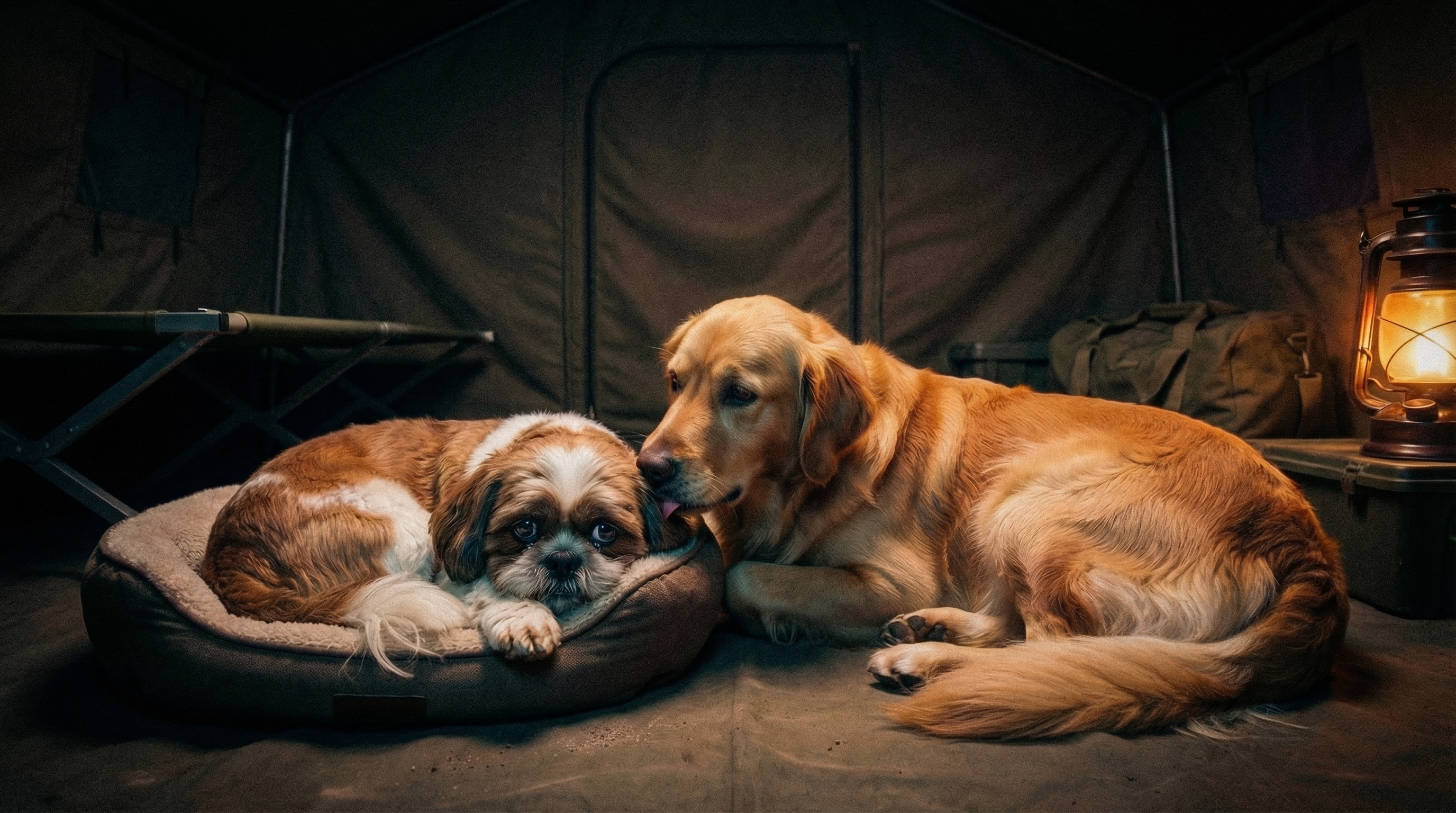
Inside, Henri found his bed. Worn at the centre, frayed at the edges, carrying the scent of every nap he'd taken since arriving in a world that had no right to contain Shih Tzus or dog beds or any of the mundane domestic objects that kept washing up on the shores of this impossible place. He began his ritual — the circling, precise and deliberate, pawing at the fabric with the intense concentration of a creature performing surgery on its own comfort. Three rotations. Four. A fractional adjustment so small it couldn't possibly have mattered to anyone except Henri, for whom it apparently mattered enormously. Then the settling. The compact curl. The contented snort that said this, at least, is where it should be.
I'd found that ritual funny before. Endearing, in a domestic, aren't-dogs-ridiculous sort of way.
Now it nearly broke me. The insistence on routine when nothing was routine. The stubborn performance of normality in a world where normal had been murdered in its sleep and buried in the dust outside.
Lois lowered herself beside him — no ceremony, no circling, just a quiet folding of limbs. She rested her head against the edge of Henri's bed, not on it but touching it, maintaining contact without intrusion. The whine she released was barely audible, pitched low and soft, less communication than presence. I'm here.
Henri's nose lifted toward her. Cautious. The careful investigation of a dog who'd recently learned, without understanding how or why, that the world sometimes took things away and didn't bring them back. He sniffed once, twice, whiskers brushing golden fur. Lois responded with slow, unhurried licks — the kind of grooming that had nothing to do with cleanliness and everything to do with the oldest language living things possess.
A few contented snorts from Henri. His eyes softened. Closed.
I stood in the entrance of the tent, watching them, and felt the lump in my throat swell until my jaw ached from clenching against it.
Duke. I couldn't not think about him now. The shrouded body in Beatrix's arms. The brightness of the cloth against ochre dunes. The diminishing figure carrying him away over the hill, back toward the Portal and a world that would never know what he'd survived before the end found him anyway. Duke, with his alert intelligence and his fierce devotion and that ridiculous wiggly tail that communicated more than most people managed with their entire emotional vocabulary. Duke, who'd sensed the shadow panther approaching while the rest of us slept. Whose last conscious act had been the thing he'd always done best — standing guard over the people he loved.
Henri had slept through all of it. That was the thing. His laziness — his absolute, defining, unshakeable commitment to unconsciousness — had saved his life. He'd been curled beneath blankets in his perfect little spiral while something tore through the darkness and took his brother. By morning, Duke was cold and still, and Henri had wandered toward the promise of breakfast with the puzzled, slightly offended expression of a dog whose world had developed a gap he couldn't quite account for.
Henri had endured so much loss — his brother, his father — gone in the span of a single, devastating day. The weight of such loss on his small shoulders was more than any creature should bear. I couldn't help but hope, perhaps naively, that his simple mind was shielded from the full impact of our grim reality. That in his dreams, he roamed free and unburdened, chasing the shadow of his lost brother in fields where the sun never set.







