4344.40 · February 9, 2024 AD
The Footer Section
Deniz has been watching Mira not-work all week. The inbox refreshes have become a rhythm of their own — open, nothing, close, repeat — while Ottoman letters sit unread under the camera lights and condition reports go unfinished. When the rhythm finally breaks on a Friday morning, Mira's hands start trembling over a photograph of damaged clay, and by the time Deniz looks up from her manuscript, Mira is reaching for her coat.
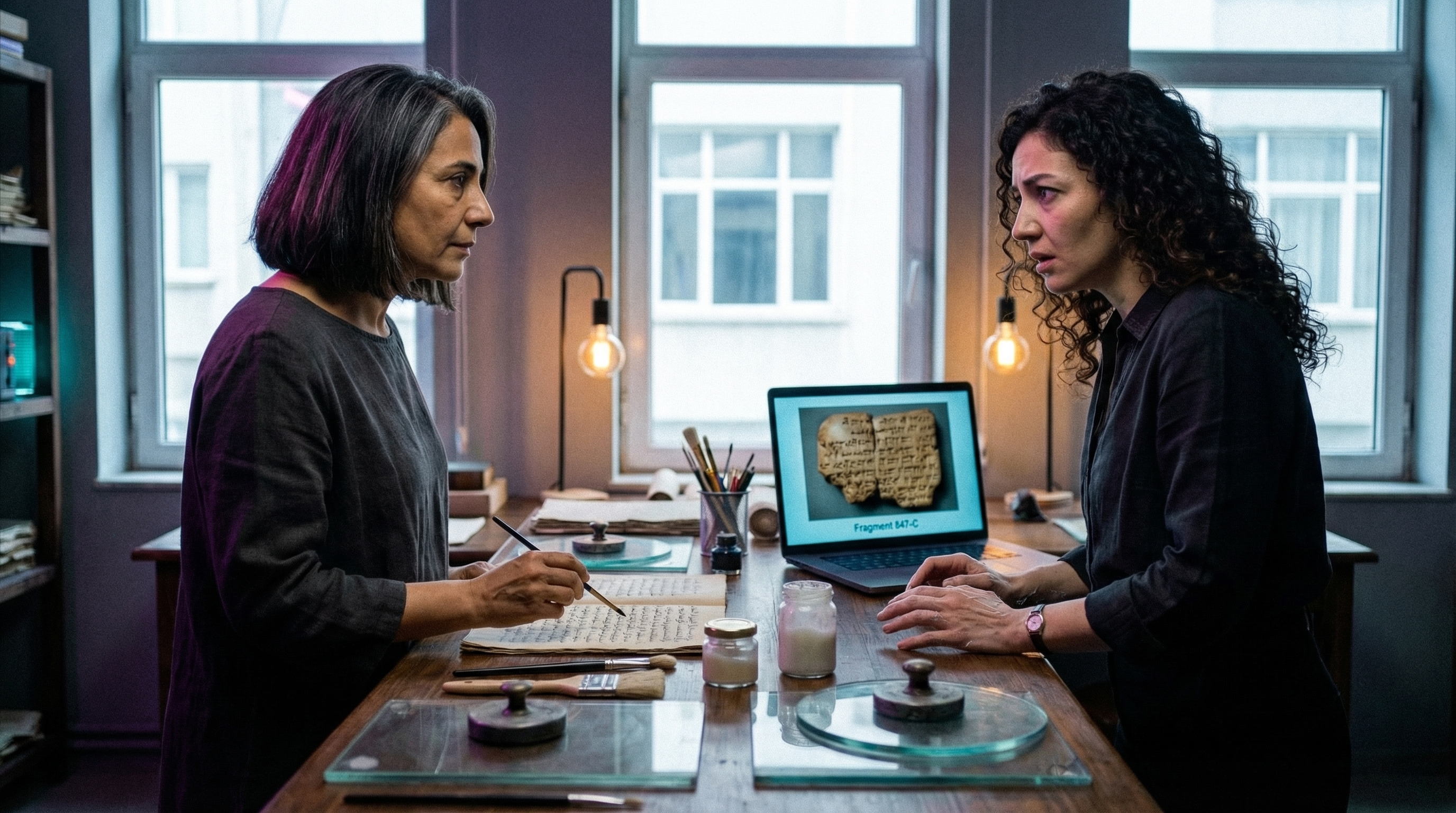
"You learn someone's handwriting the way you learn a voice — not from any single word but from the whole of it."
Six days.
Six days of checking my phone in the morning before my eyes had fully adjusted to the light. Six days of refreshing my inbox during lunch breaks, during tea breaks, during the small pauses between photographing one Ottoman letter and positioning the next. Six days of telling myself that Tariq al-Rashid was a busy man running one of the largest Preservation archives in the world and that a request for photographs of a fragment his own catalogue described as having no historical significance was unlikely to be sitting at the top of his priorities.
Six days of knowing all of that and checking anyway.
Deniz had noticed. Of course she had. She hadn't said anything directly—Deniz's approach to other people's preoccupations was to observe them with forensic precision and then offer tangentially relevant commentary that let you know you'd been observed without requiring you to explain yourself.
"You're holding that letter too close to the edge," she said on Wednesday, without looking up from the papyrus she was humidifying.
I adjusted my grip.
"And you've photographed that page twice," she said on Thursday, still without looking up. "The same page. From the same angle. Unless you're testing whether Ottoman Turkish changes when you're not paying attention."
I deleted the duplicate and moved on.
By Friday morning I'd stopped pretending I wasn't distracted. I arrived at the facility at eight—earlier than usual—and went straight to the conservation lab, where Deniz was already set up, working on a different manuscript fragment from the one she'd been restoring earlier in the week. This one was Arabic, fourteenth century, a treatise on astronomical observation that had suffered water damage at some point in its history and now looked like a topographical map of somewhere unfortunate.
"Sabahlar hayırlı olsun," she said. "Börek's finished but there's simit in the kitchen. Handan brought sesame."
"Thanks."
I set up my workstation. Camera, laptop, metadata spreadsheet, the next batch of Ottoman correspondence waiting in their acid-free folders. I opened my email. Nothing from Tariq. The most recent message was from a conservation supply company confirming an order for archival tissue paper.
I closed the email. Opened a folder. Positioned the first letter under the lights.
Clicked the shutter.
Opened my email again.
Nothing.
"Mira." Deniz's voice was gentle but firm. "Whatever you're waiting for, it will arrive whether or not you watch the door."
"I know."
"Do you? Because you've opened and closed your laptop four times in ten minutes and you haven't actually photographed anything yet."
I looked down. She was right. The letter was under the lights, perfectly positioned, and I hadn't taken a single image. I'd just been going through the motions of setting up whilst my attention circled endlessly around my inbox.
"I'm waiting for photographs from another facility," I said. "Something that might be connected to a project I'm working on."
Deniz nodded. She didn't ask which facility, which project, what the photographs were of. That was the unspoken code of the Karaköy staff—you shared what you chose to share, and nobody pressed for more. Everyone who worked here understood that the materials we handled existed within webs of significance that weren't always visible, that a single fragment could matter enormously for reasons that weren't immediately obvious, that patience and discretion were as essential to the work as steady hands and good eyesight.
"Then do something useful while you wait," she said. "The batch from Shelf 14 needs condition reports before we can photograph them. That's detail work. It'll keep your hands busy and your brain occupied."
She was right. Condition reports required focused attention—examining each document under magnification, noting tears, stains, areas of fragility, insect damage, previous repairs. The kind of work that demanded you look closely, that punished inattention, that left no room for obsessive email-checking because both hands were occupied and your eyes were on the material.
I pulled the Shelf 14 box towards me. Opened it. Lifted the first document—a Persian administrative record from the sixteenth century, its margins decorated with faded floral motifs that someone had painted with a brush so fine the individual petals were smaller than sesame seeds.
I began the report. Date. Physical dimensions. Support material: laid paper, chain lines visible. Ink: iron gall, brown-black, some areas of corrosion where the acid had eaten through. Marginalia: floral decoration, pigments faded but intact. Condition: three tears along fold lines, minor foxing upper right quadrant, previous repair to lower edge using animal-skin adhesive, now brittle.
The work absorbed me. Not completely—nothing could do that this week—but enough. I moved through the documents methodically. Deniz worked beside me, her brush making the faintest sound against the Arabic manuscript, like someone breathing very carefully. The environmental control system hummed. Outside, the Friday morning traffic along the Karaköy waterfront was building—horns, engines, the distant blast of a ferry—but inside the lab the world stayed small and quiet and manageable.
I was on the seventh document—a land deed from the Mamluk period, badly mouse-eaten along the left margin—when my phone buzzed.
I didn't reach for it immediately. I was holding the deed with both hands, the paper so fragile that shifting my grip too quickly could extend the mouse damage into the text block. I set it down carefully. Placed the weighted glass over it. Removed my gloves.
Then I looked at the screen.
New email: Tariq al-Rashid — Re: Fragment 847-C query
My heart rate did something unnecessary.
I picked up the phone. Opened the email.
Mira — Apologies for the delayed response. Took longer than expected to locate 847-C; it was in a subsection that's been awaiting reorganisation for some years. Attached are high-resolution images from six angles, plus detail shots of the readable sections. The fragment is in worse condition than the catalogue entry suggests — significant damage to the central text block and most of the seller identification is lost. However, the footer section is in better condition than I expected. You'll see what I mean. Let me know if you need anything further. — Tariq
Six attachments. I opened the first.
Fragment 847-C appeared on my screen—a clay tablet roughly twelve centimetres by nine, broken along the upper-left corner, the surface pitted and scored in a pattern consistent with fire exposure followed by centuries of uncontrolled storage. The Akkadian cuneiform was visible but degraded, the wedge-shaped impressions softened by whatever had happened to the tablet between the day it was inscribed and the day someone in Cairo had decided it merited a catalogue entry and nothing more.
I expanded the image. Moved through it systematically, the way I'd been trained—upper left to lower right, reading the surviving text where I could, noting the gaps where the clay had flaked or crumbled or been damaged beyond legibility.
The bill of sale header was partially intact. I could make out the formulaic opening—let it be known that—followed by a gap where the buyer's name should have been, then fragments indicating a transaction involving multiple human beings. Slaves. The word was clear even in the damaged text, the cuneiform signs for slave and purchased unmistakable.
The central text block was heavily damaged, as Tariq had warned. Partial names. Fragments of physical descriptions—the standard practice in slave sales, where the merchandise was catalogued like livestock. Height, visible marks, approximate age. Clinical. Bureaucratic. The language of people being reduced to inventory.
I moved to the second image. A different angle, raking light across the surface to emphasise the depth of the cuneiform impressions. Some signs became clearer. A price—three shekels of silver per head—and a quantity that might have been four or might have been seven, the numeral partially obscured by a deep gouge in the clay.
Third image. Close-up of the seller identification. Damaged, as the catalogue said. I could see merchant and what might have been the first syllable of Larsa, but the name itself was lost.
Fourth image. The edges of the tablet, showing the break pattern.
Fifth image. The reverse side—blank, as was typical for routine commercial documents.
Sixth image.
The footer section.
I stopped breathing.
Tariq had photographed it in high resolution with raking light that threw every surviving cuneiform sign into sharp relief. The footer was the most protected part of the tablet—positioned at the bottom edge, it had been partially shielded from whatever had damaged the upper sections. The clay here was more intact, the signs more legible, the text more complete than anything else on the fragment.
I could read the standard closing formula. Transaction witnessed and recorded in the presence of—then a gap where witness names had been—by the hand of—
And there it was.
The scribe's identification. Four cuneiform signs. Partially damaged but legible—the first sign clear, the second slightly worn, the third and fourth unmistakable to anyone who had spent three weeks memorising the handwriting on the Kisura contract.
Azariel.
Not the full name. Not Azariel Tiberius Voshtar, the way it appeared on the employment contract. Just the personal name, the way a scribe might sign a routine document—without the full formal identification required for contracts and legal agreements, just the working signature of someone who was recording a transaction, not entering into one.
But it was his hand. I knew it the way you know a friend's handwriting on an envelope before you read the return address—not from any single letter but from the whole of it, the spacing, the pressure, the particular way the stylus met the clay. The Azariel who had signed the Kisura contract and the Azariel who had witnessed this slave sale in Larsa pressed their reed stylus into clay with the same distinctive angle, the same depth, the same slight leftward drift on horizontal strokes that suggested a scribe who was left-handed or had learned from one.
I set the phone down on the bench. Carefully. The way you set something down when your hands are trembling and you don't want anyone to notice.
The conservation lab was exactly as it had been thirty seconds ago. Deniz at her bench. The hum of the environmental control. The muffled sounds of Karaköy traffic. The Persian deed under its weighted glass. The ordinary Friday morning continuing around a moment that was not ordinary at all.
Two documents. Two different cities. Two different types of transaction. The same hand.
Azariel had worked in Kisura recording grain storage for Ea-nasir. And at some point during those same wandering years—perhaps before Kisura, perhaps after—he had stood in a marketplace in Larsa and recorded the sale of human beings. Had watched people being purchased like grain or pottery, had pressed his stylus into clay to document the transaction, had written down the prices and the quantities and whatever fragments of physical description the buyer required.
Had witnessed slavery. Had recorded it in his own hand. And had eventually walked away from that world and built a city where slavery didn't exist.
I picked up the phone again. Not the email this time. I opened the dialler and typed in the number from Tariq's email signature.
It rang four times. Five. I was preparing for voicemail when he answered.
"Al-Rashid." His voice was lower than I'd expected, unhurried, with the slight rasp of someone who'd been talking all morning or hadn't been talking at all.
"Tariq, it's Mira Osman. From Karaköy."
"Mira. I assumed I'd be hearing from you today." A pause that might have been amusement. "You've seen the footer section."
"I've seen it."
"And?"
"It's him. The same hand as the Kisura contract. I'm certain of it."
Silence on the line. Not scepticism—consideration. The careful quiet of someone weighing the implications of what he'd just been told.
"You understand what you're claiming," he said.
"I do."
"A second document from the wandering years. Independently preserved, independently catalogued, in a different facility on a different continent. Both bearing the same scribe's identification."
"Yes."
"Fragment 847-C has been in our holdings since at least the 1940s. The catalogue entry was written by Mahmoud Farid, who ran the Mesopotamian section for thirty years. He was meticulous. Difficult, but meticulous."
"He listed it as having no historical significance."
"Because he didn't know what he was looking at. He couldn't have. The Kisura contract hadn't been found yet. There was nothing to connect this fragment to."
"But now there is."
Another pause. Longer this time. I could hear something in the background on his end—the echo of a large space, footsteps on stone.
"What do you need from me, Mira?"
"Access. To your Mesopotamian holdings. The full collection, not just what's been digitised. If two documents survived independently, there may be more. Your facility holds materials from Alexandria, from Baghdad, from collections that were consolidated over centuries. If any other fragments of his trail exist, Cairo is the most likely place."
"That's a significant request. Our Mesopotamian section alone contains over four thousand catalogued items, and there are uncatalogued materials we haven't had the resources to process."
"I know. That's why I need to come in person. I can't do this through photographs and catalogue entries. I need to handle the materials. See the storage context. Understand how the collection is organised and where things might have been overlooked."
Tariq was quiet for a moment. "When?"
"Tomorrow."
"Tomorrow." Not a question. An observation. The kind of word that carries its own raised eyebrow.
"I know it's soon. But—"
"It's not soon that concerns me. It's Saturday. The facility is technically closed on Saturdays."
"Technically."
"I'll be here," he said. "I'm always here on Saturdays. Come to the main entrance on Sharia al-Falaki. Ring the bell twice. I'll let you in."
"Thank you, Tariq."
"Don't thank me yet. Four thousand catalogued items and an unknown quantity of uncatalogued materials. You're going to be here for a while."
"I know."
"Good. Bring comfortable shoes." A beat. "And Mira—bring the Kisura contract photographs. All of them. If we're going to do this, I want to see the comparison for myself."
The call ended. I stood in the conservation lab holding my phone, the screen still showing the call duration—three minutes and twelve seconds. Deniz was watching me. Not obviously—she was still holding her brush over the Arabic manuscript—but her eyes had moved, and she was doing that thing where she appeared to be working whilst actually paying complete attention to something else.
"I need to take the rest of the day," I said.
She looked at me properly then. Whatever she saw in my face, she didn't question it.
"The Shelf 14 reports can wait until Monday."
"Thank you, Deniz."
"Go. Do whatever it is you need to do."
I packed up my workstation. Saved the condition reports. Logged out of the digitisation system. Put on my coat and scarf and gloves and walked out of the conservation lab into the narrow corridor with its shelves of archival supplies and its flat fluorescent light.
In the small office near the entrance that served as both break room and administrative hub, I sat down at the shared computer and opened a browser. Istanbul to Cairo. Tomorrow. Saturday 10 February.
There were three flights. The earliest departed Sabiha Gökçen at 6:40 AM and arrived at Cairo International at 8:55. EgyptAir. One stop in... no, direct. Three hours and fifteen minutes.
I entered my details. Passport number. Contact information. The mechanical process of turning a decision into a booking, a thought into a ticket, an impulse into an itinerary.
The confirmation appeared on the screen.
Booking confirmed. Istanbul (SAW) → Cairo (CAI). 10 February 2024. Departure 06:40. Arrival 08:55.
I stared at it. Tomorrow morning I'd be at the airport before dawn. By nine o'clock I'd be in Cairo. By mid-morning I'd be standing in an archive I'd never visited, looking through a collection of four thousand Mesopotamian artefacts for traces of a man who'd been dead for four and a half millennia.
I printed the booking confirmation, folded it into my bag, and walked out of the Karaköy facility into the bright cold February morning.







