4140.274 · September 30, 1820 AD
The First Pour – 1st Annual Brierly Harvest Festival
The first wine made entirely from Brierly-grown grapes was ready after five years' labour, and the whole settlement came down to the town square to drink it. George Henry Whitmore broke the seal on the season's first cask and drew the first cup before the assembled settlers, the first performance of the rite known as the First Pour. The wine passed from hand to hand was the first thing Brierly had made purely for itself, and in the drinking of it the settlement passed from bare survival into a place that had begun to draw something from its land.
The first wine made entirely from Brierly-grown grapes was ready, and the whole of the settlement came down to the town square to drink it. The gathering was the first Brierly Harvest Festival, and the act at its centre — George Henry Whitmore breaking the seal on the season's first cask and drawing the first cup before the assembled settlers — was the first performance of the rite known as the First Pour.
What the cask held was not the first wine Brierly had produced, but it was the first that was wholly its own. Earlier seasons had yielded sour, thin, unfinished batches, drunk for what they were and never celebrated. This was the first vintage grown, pressed, fermented, and aged entirely on Clivilian ground, from vines the settlement had planted with its own hands, and that distinction was the whole reason the town stopped its work to mark it.
The wine was the end of five years' uncertain labour. Whitmore had come to Clivilius out of a family of small Somerset vintners, and of the founding party he alone carried the craft of wine in his hands. He had spent the settlement's early years walking the southern slopes and testing the ground against everything he knew, persuaded that the Brierly Plains were country made for vines where others saw only grass and the long memory of barren crust.
The work had not gone smoothly. The grape varieties he had carried from Earth answered the alien soil in ways no vintner could have predicted: some withered in their first season, some grew and bore fruit that would not ripen, some had to be grafted and coaxed and replanted before they took at all. Every row he gave to grapes was a row the settlement did not give to grain, and in a colony still uncertain of its own survival the decision to plant vines at all had been a gamble argued over more than once.
Two seasons before, the settlers had finished cutting the channels that carried the river to the higher rows, freeing the vineyard from its dependence on the weather and letting the vines climb the slope in earnest. From that point the harvests had grown surer, and the fruit had come in heavier and riper each year. The cask broached in the square was the proof that the gamble had been the right one. The slopes had given Brierly a wine, and the wine was good — young and rough, but unmistakably the settlement's own, carrying in it the mineral edge the reclaimed ground had put into the fruit.
The square in which they gathered was itself a record of the settlement's first decade. Robert Aldridge had laid it out and raised the stone and timber buildings that framed it, and the cottages and the hall around it had been built, course by course, by the same hands that now crowded into it. It was the civic heart of Brierly, the one open ground large enough to hold the whole community at once.
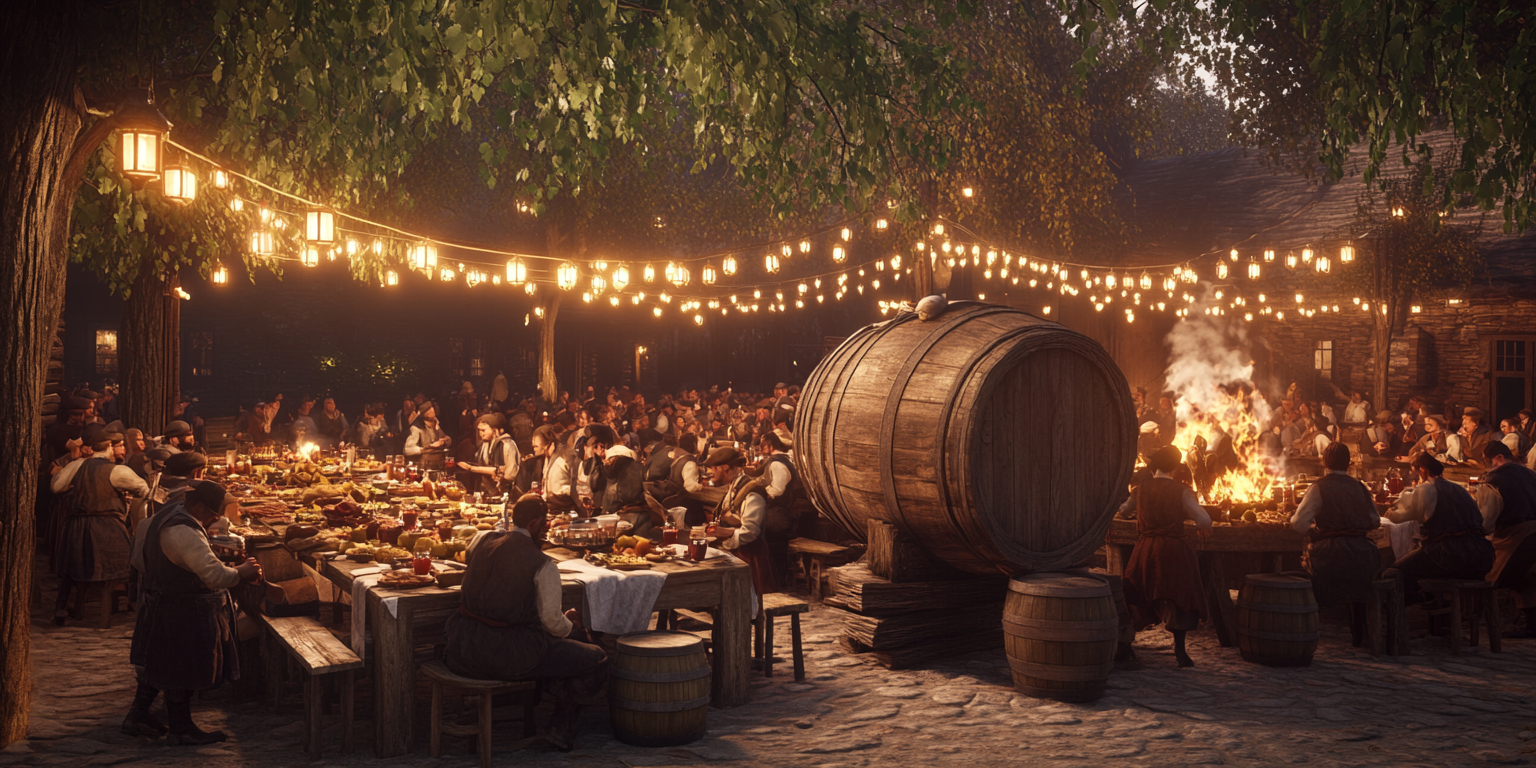
For the gathering the settlers strung lanterns across the square and set long trestle tables down its length. The cask was carried up from the cellar and set where everyone could see it. The evening itself was a plain thing — a barrel, a crowd, a fire to sit by, and the wine at the centre of it.
Everyone Brierly then contained came to the square that evening. The five founding Guardians who had opened the settlement out of nothing stood among the crowd, and the cup that passed between them carried, in a sense none of them needed to say aloud, the sum of all their separate labours.
Thomas Edward Ainsworth, who had led the colony through ten precarious years and held it together when its survival was anything but assured, was there to see it produce something at last that was not merely food and shelter. Elizabeth Carrington was there, and the wine owed more to her than to almost anyone: it was her work that had turned the dead crust into living soil and the lifeless river into a watered artery, without which no vine would have grown at all. Mary Ellen Fairchild, who had carried the settlement through its first sicknesses and delivered its first children, stood among the families she had kept whole. Robert Aldridge stood in the square he had built, watching it used for the first time as something more than a thoroughfare.
With them were the settlers they had drawn through from rural England a decade earlier, and, threaded through the crowd, the first children to have been born in Clivilius rather than carried into it — a generation that had never seen Earth and for whom Brierly was simply the world. The wine in the square was the first thing their own home had made for them to taste.
Charles Joseph Bennett, a brewer and Whitmore's close friend from the founding, set his own dark beer on the tables beside the new wine, so that the two drinks stood together from the very first night. His wife, Sarah Ellen Bennett, whose gardens and husbandry had done much to feed the settlement through its leanest years, had a hand in the food that covered the boards. The festival, from its first hour, was a thing the whole community had made together rather than any single family's gift.
When the settlement had assembled, Whitmore broke the seal on the cask. He drew the first measure into a plain pewter cup of his own, raised it before the gathering, and drank. Then the cup went out into the crowd, and the wine was carried from hand to hand and refilled and passed again until every soul in Brierly, old settler and native-born child alike, had tasted the vintage their land had given them.
No ceremony had been written for any of this. No one had set out to inaugurate an annual festival or to compose a rite. The settlers had gathered to mark a harvest and to drink the first wine that was truly theirs, and the shape the evening took — the breaking of the cask, the first cup drawn and shared, the feast and the music that followed — was settled in the doing of it rather than decided in advance. The form of the First Pour was made that night by the simple fact of its being done.
What followed was the first true celebration the settlement had allowed itself. The tables were heaped with roasted meats, fresh bread, cheese, and the fruits of the season, and the new wine and Bennett's beer went round without restraint. After ten years in which nearly every gathering had been called to meet a need — to plan, to ration, to bury, to decide — the town came together for no reason but gladness.
The music came out as the light went. The settlers had carried the fiddle tunes and ballads of England and the British Isles across with them, and these surfaced now in the square, played on whatever instruments the colony had managed to make or keep, and sung by people who had learned them at home a world away. They danced on the beaten ground of the square late into the night.
The night recorded more than a good harvest. For ten years Brierly had laboured only to last — to wring food from hostile ground, to keep its people alive and housed, to hold together a community that had arrived with no certainty it would survive its first winter. Everything the settlement had made until then, it had made because it had to.
The wine was the first thing it had made purely for itself. It served no need; it kept no one alive; it was, in the plainest sense, a luxury, and the settlement's capacity to produce one at all was the proof that it had passed beyond bare survival. Brierly had not merely endured its land. It had begun to draw something from it, and to take pleasure in what it drew.
That was the meaning folded into the first cup, and the settlers felt it even if they did not name it. By its own reckoning, Brierly came into its own on the night of the First Pour.







