
4338.208 · July 27, 2018 AD
The Evening Bixbus Found Its Voice
Eight people, three dogs, and Indian takeaway around a fire pit. Tensions surface over who should manage what, a road is proposed that nobody has the tools to build, and Karen demonstrates for Luke the impossible thing his accidental seeds have done. Then a boy who has barely spoken since returning from death begins to hum, a violin joins a melody it has never heard, and strangers become something else entirely.
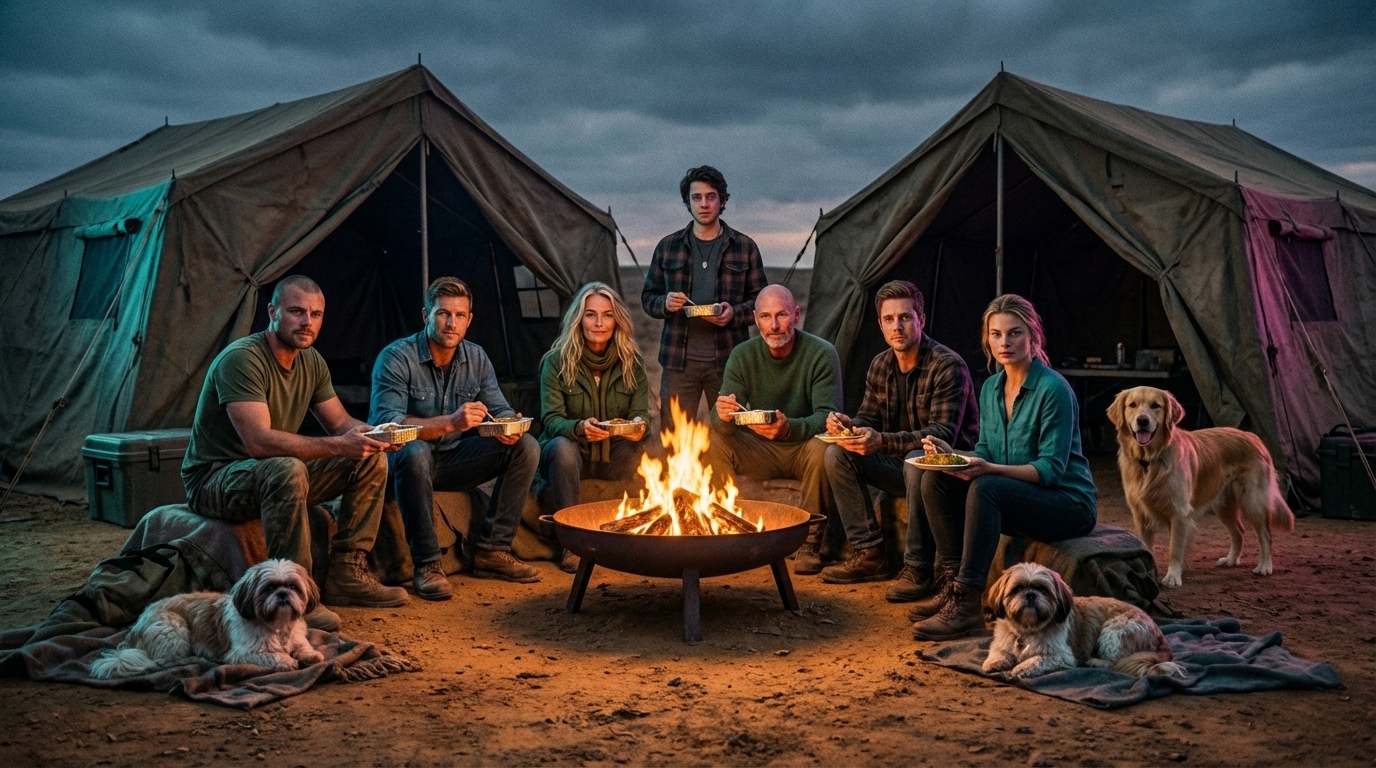
Luke Smith had returned from Earth carrying Indian takeaway in plastic containers still warm enough to steam. The food was distributed around a fire pit that served as the settlement's only communal space, meals allocated according to preferences that were still being learned: chicken tikka for Karen, butter chicken for Jamie, the rest parcelled out to hands that accepted what was offered without complaint. Eight people arranged themselves on roughly-hewn logs and flat stones around the flames. Three dogs attended the gathering. Lois, Glenda's golden retriever, tracked Luke's every step with the singleminded devotion of a creature who believed proximity to food containers constituted a moral right. Duke lay in dignified stillness at Jamie's feet. Henri, having been denied further opportunity for theft since the morning's bacon incident, sulked in his bed with the performance discipline of a professional victim.
The meal settled the group in ways conversation alone had failed to achieve throughout the day. The scent of turmeric and cumin carried associations that transcended the alien landscape: Friday-night takeaways, crowded kitchen tables, the ordinary comfort of food shared among people who did not yet know each other well enough to eat in silence but were learning. Karen sat beside Chris on a log whose rough surface bit into her palms and felt nothing like the vinyl bus seats she had been complaining about twenty-four hours earlier. The distance between her old life and this one could be measured in spice and woodsmoke, in the contrast between a Hobart commute and a fire pit in a dimension that should not have existed.
The ease did not last. Paul cleared his throat with a deliberateness that shifted the atmosphere before he spoke. He proposed that everyone check the Drop Zone regularly for belongings Luke might have transported from Earth. The suggestion was reasonable in principle but landed poorly in practice. Karen, whose day had been consumed by soil experiments and tent construction, declared she was too busy to walk that distance for speculative errands. Jamie, who had spent most of the day tending his son in the tent, offered the same assessment with characteristically less diplomacy. Paul's frustration ignited at Jamie's refusal. The accusation that Jamie had done nothing but sit in a tent for two days drew an explosive response, a profanity delivered with sufficient force to launch a piece of chicken from fork to lap, and for a charged moment the campfire circle held the particular silence of people wondering whether the conflict would escalate or collapse under its own absurdity.
It collapsed. Luke suggested Paul take formal responsibility for the Drop Zone, a role that aligned with Paul's need for purpose and his emerging talent for logistics in a community where everyone else possessed skills more obviously suited to physical survival. Glenda endorsed the appointment with the diplomatic warmth that had become her signature contribution to group dynamics. Kain observed, not quite under his breath, that Paul was not much good at building things, a remark that cut the tension with the precision of someone who understood that the best medicine for wounded pride was honest laughter. Paul accepted the role with the grudging resignation of a man who recognised he was being managed but could not argue with the logic.
The proposal that followed was more ambitious. Paul declared that if he was to traverse between camp and the Drop Zone repeatedly, something needed to be done about the dust. He wanted a road. The suggestion drew the range of responses the group had come to specialise in: Chris volunteered with immediate enthusiasm, Kain offered conditional support, Joel spoke for the first time in the gathering to say he would help, Karen silently resolved that her skills were better deployed elsewhere, and Jamie said nothing at all. Glenda agreed that the idea had merit, and the matter was left hanging in the warm air alongside the smoke, neither resolved nor abandoned, a plan that belonged to the future rather than the evening.
After the meal, as the group dispersed into the routines of cleaning and settling, Karen drew Luke aside. She led him to the tent where she and Chris had planted the coriander seedlings earlier in the day, their small green forms barely visible in the fading light but unmistakably present. She produced a few remaining seeds she had discovered clinging to the corners of her pocket and pressed one into the soil in front of him. Luke watched the shell crack, the root descend, the stem rise, the leaves unfurl in the span of seconds, and the expression on his face confirmed what Karen had suspected: he had not known what the soil could do.
The demonstration opened a channel that Karen had been waiting for. She told Luke about the dust problem, the depth of it, the impossibility of clearing it with a single shovel and human effort alone. She requested heavy machinery. Luke, to her surprise, did not dismiss the idea but accepted it with a quiet conviction that suggested he was already calculating how to deliver. Karen pressed further. She wanted her ducks relocated to Clivilius, housed by the river with fencing and reeds. She wanted her chickens brought through with their henhouse. She wanted Luke to care for her animals on Earth until the settlement was ready to receive them, and she wanted his promise that none of them would suffer or die in the interim. Luke gave it. The word carried weight that both of them understood extended beyond poultry. It was a commitment to preserve something of the life Karen had lost, to maintain continuity between the woman who had tended a Collinsvale property for twenty years and the woman who now knelt in alien dust watching herbs grow at impossible speed.
The evening's final transformation arrived without announcement. The sun had retreated behind the distant ridgeline, painting the sky in gradients of burnt orange and violet, and the fire had become the settlement's sole source of warmth. The group had reassembled around it, conversations softening into the murmur that accompanies full stomachs and fading light. Joel Greyson, who had communicated primarily through silence and gesture since his return from whatever state of death or near-death the settlement still could not adequately explain, began to hum.
The humming found words. They emerged raspy and tentative from a throat that bore the physical evidence of trauma no one in the group discussed openly, but they carried a melody that seemed to have been waiting for the right conditions to surface, the way the coriander seeds had waited beneath the crust for contact with soil.
Let us celebrate our story, the words we've yet to write. How we all wound up with glory, in the world we fought to right.
The lyrics were simple. Their resonance was not. They spoke to the circumstance of every person seated around that fire with a precision that felt less like composition and more like prophecy, as though the song had existed before Joel found it and had simply been waiting in the Clivilian air for a voice damaged enough to carry it honestly.
Glenda rose without explanation and disappeared into her tent. She returned carrying a violin. No one had known she played. The instrument had been among the belongings Luke transported from Earth, and Glenda had not mentioned its presence until this moment, as though she too had been waiting for the right conditions. She positioned it beneath her chin, drew the bow across the strings with the tentative authority of a musician reacquainting herself with an instrument after absence, and began to play.
She did not know the song. She had never heard it before Joel began to sing. But the melody she wove around his voice found its way without hesitation, as though the violin understood something the player had not yet caught up with. The two lines of music, one vocal and one stringed, twined together with the organic inevitability of ivy climbing stone, neither leading, neither following, both arriving at harmonies that seemed inevitable only after they had been reached. The sound was unpolished and deeply affecting, raw in the way that only unrehearsed sincerity can achieve.
The settlement fell quiet. The fire crackled. The dogs settled. Eight people who had been arguing about Drop Zones and road construction and the politics of dust removal sat in the darkness and listened to a boy and a violin produce something that none of them could have planned or predicted. For the duration of the song, the accumulated tensions of the day released their grip. The friction between Jamie and Paul, the gulf between Karen's expectations and the settlement's reality, Kain's private grief for the life growing inside Brianne on the other side of a Portal he could not reopen, Paul's aching awareness of his own uselessness, Chris's quiet absorption in soil that answered questions no one had thought to ask — all of it suspended, held in the amber of a melody that belonged to Clivilius rather than to Earth.
When the song ended, Luke raised his voice above the silence. To Joel. The toast was taken up around the circle, each voice adding itself to the recognition that what had just occurred was not merely musical but foundational. The settlement had possessed a name before that evening. After that evening, it possessed something more difficult to quantify and more essential to survival than any road or Drop Zone or germinating seed. It possessed a shared memory. A moment in which strangers had sat together in firelight and heard, in the damaged voice of a boy who should not have been alive to sing, the sound of something beginning.
They called themselves Clivilians now. Not because anyone proposed it. Because after that night, no other word fit.


