4338.10 · January 10, 2018 AD
The Envelope’s Contents
Nathan books the smallest meeting room on the fourth floor and shuts the door. Inside the envelope are five small objects that weigh more than they should, a security card, and a letter in Seth's handwriting asking him to believe several impossible things before three o'clock. But it is the ordinary facts that undo him: a disconnected number, and the realisation that in ten years he never learned where his friend lived.
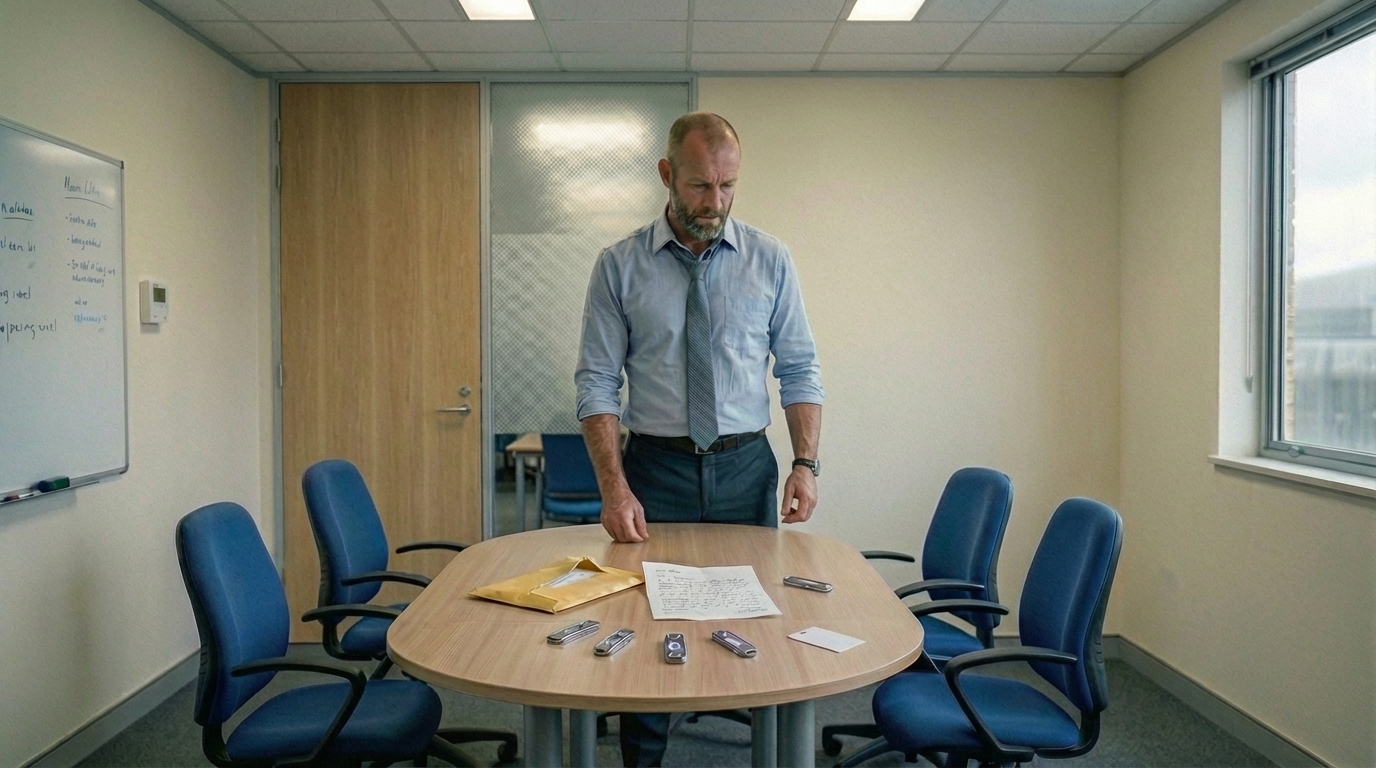
"I had spent ten years being the sensible one in that friendship. It turned out I had simply been the one who was wrong."
The cobblestones of Purdy's Mart felt different beneath my feet as I walked away from Cornerstone—the same worn stones I had crossed barely half an hour earlier, yet somehow altered, as though the ground itself had registered the change in my circumstances. The envelope lay flat against my chest inside my shirt, its weight both negligible and immense, the paper gone warm from my skin.
I emerged onto Collins Street and turned towards the office, joining the flow of pedestrians with what I hoped was unremarkable purpose. The lunch crowd had thickened while I'd been in the laneway, suited workers and summer tourists filling the footpaths with the ordinary choreography of midday commerce. I scanned faces without meaning to, my eyes sliding across each approaching stranger with a paranoid attention that had become second nature in the space of twenty minutes.
Was that man walking too close behind me? Had that woman glanced my way with more than passing interest? Every white vehicle that passed drew my eyes with magnetic force, my shoulders tightening until I had confirmed it wasn't the van coming back.
The heat had not broken. It sat over the city like a hand held flat above it, the cloud lid unshifted, the air so still that the exhaust from a passing bus simply hung where it was born. My shirt clung to my back. The caffeine from Blackwood & Co and Cornerstone had metabolised into a jittery residue that amplified everything—the glare too white, the sounds too sharp, the envelope against my chest too present to ignore.
I passed Constitution Dock without seeing it, the harbour reduced to peripheral glitter as my mind turned over and over what I was carrying. Seth's face followed me. The hollowed eyes. The trembling hands. And the thing he had said, which I could not put down.
You were the only one I could think of. I'm sorry about that.
Not a farewell in the ordinary sense. An apology. He had apologised to me for choosing me, and then he had walked away, and the apology sat in my chest now, heavier than the envelope.
The office building rose ahead, its glass façade a dull, sunless grey against the sandstone. I had walked this route thousands of times across my years of employment, the journey so familiar I could have navigated it with my eyes shut, and today it felt entirely foreign to me, as though I were approaching it for the first time, or possibly—and I did not care for the thought at all, and could not make it go away—for the last.
The automatic doors parted with their usual pneumatic whisper, and the lobby's artificial coolness closed around me like a membrane between two realities. The transition had never felt so pronounced—the recycled air, the cleaning products, the fluorescent buzz. My reflection slid across the polished marble, a distorted figure I barely recognised.
I should go home, I thought. Claim illness. Take this thing somewhere with a locked door.
But the bus to Battery Point would take twenty-five minutes and I hadn't twenty-five minutes of patience left in me. The envelope was against my skin. It had been against my skin since the laneway, and I could not carry it one stop further without knowing.
I crossed the open-plan floor towards my desk and it felt like crossing a stage.
"You all right, Nathan?" Sal, from her fortress of colour-coded folders. "You've gone a bit pale."
"Fine." The word came out steadier than I deserved. "Something I ate. I've got a call to prep."
She nodded and went back to her work, entirely satisfied, because Sal was a kind and straightforward woman who had never in her life had occasion to suspect anybody of anything, and I had always liked that about her, and had never once been grateful for it until that moment.
Verity said nothing at all.
She was at her desk with her head down and she did not lift it, and I understood with perfect clarity, walking past her, that she had watched me come in through the door; that she had registered the pallor, and the bag held in against my body rather than slung off my shoulder, and the fifty-five minutes I had been absent on a lunch break that had begun thirty minutes early; that she was, at that very moment, filing every one of those observations away in whatever meticulous internal ledger she kept for such things; and that she had no intention whatsoever of asking me about any of it.
I felt her not asking me about it on my back the whole length of the office, and it was worse than any question she could have put to me.
I sat, opened the booking system, and let the mundane administrative machinery of it steady my hands. Available rooms presented themselves with cheerful efficiency—green blocks for vacant, red for occupied, the whole afternoon laid out in a grid as though the world were still a thing that could be scheduled. I chose the smallest room on the floor. Meeting Room 4B, tucked into the corner, one wall of frosted glass to the corridor and the rest solid plasterboard. Minimal visibility. Maximum privacy. Somewhere I could open an envelope without half the department observing me do it.
I took my bag and stood, and did not look at Verity, and felt her not look at me.
Outside 4B I stopped with my hand on the door, and my fingers went to the flap of the bag as though the envelope might somehow have got out of it on its own. Whatever this was—and my mind kept insisting, right up to the very last second, that it was nothing, that it was a breakdown, that it was simply Seth being Seth—I had the creeping sense that once I had seen it I was not going to be able to un-see it, and that it would get into my life the way water gets into a wall, quietly, and without any fuss at all, and permanently.
I slid the heavy frosted door closed behind me with rather more force than it needed.
Then I turned the thermostat down four degrees, because I always turned the thermostat down, and the sheer ordinariness of the gesture very nearly undid me.
It was ingrained muscle memory by then, that ritual—the first thing I did in any meeting room, every single time. There was nothing on this earth more insufferable than a stuffy room in a Hobart January, the heat pooling under the ceiling while somebody talked about governance frameworks, and but for individual temperature control in every meeting room I would certainly have slept my way through a decade of my own career. But today I needed the cold for another reason entirely. Damp patches had spread beneath my arms. The morning was written on my skin in sweat—the Post-it note, the crawling hours, Verity's arithmetic laid out on the carpet between us, the white van, Seth grey-faced and standing and refusing to sit.
The room was clinical and small and it offered privacy without offering any sense of safety at all. The frosted glass was a veil rather than a wall. Every so often a shadow slid along it, distorted and formless, someone passing or someone slowing, and my breath caught every single time.
Through the external window, Mount Wellington sat where it had always sat, its peak swallowed to the shoulder by the cloud that had been gathering all day. Kunanyi. Entirely unchanged, entirely unmoved, and entirely uninterested—which I found, in the circumstances, obscurely comforting, since it was at that moment the only object within my field of vision that had not begun very quietly to tilt.
I thought about the barista at Blackwood & Co. The dimple. The rosetta. The absurd private happiness of a man who did not want to learn a name.
Had that really been this morning?
He seemed impossibly naïve to me now, that man—bouncing along the waterfront with a pop song in his head and nothing more pressing on him than an unnamed crush and a requirements document. I had been him for something like four hours, and I did not expect to be him again.
I sat down in the padded chair, took the envelope from my bag, and held it in both hands.
The yellow paper was creased from being pressed against my body, still warm. My name on the front in Seth's hand. Nothing else. No address, no stamp, no explanation. Those familiar letterforms now carrying the weight of everything that had happened in that laneway.
I felt it arrive in my chest and in the accelerating knock of my pulse and in the way my fingers hesitated at the sealed edge: that once this was opened, none of it was ever going to be returnable to ignorance.
My finger went into the corner and I hacked the thing open with a good deal more force than finesse.
The contents clattered out across the desktop, and the noise was obscene in the silence, and I glanced at the door half-expecting somebody to come and investigate the disturbance.
My head tilted before I knew it was tilting.
Several small objects, each cocooned in bubble wrap. An unmarked white plastic card, hotel-key sized. A single folded letter.
They looked like office supplies. They looked entirely harmless and entirely generic, and there was something wrong with them that I could not for the life of me have named—not dangerous, exactly, just significant, as though the ordinariness of them were a costume that had been put on for my benefit.
True to form, I ignored the letter.
My lifelong contempt for instructions has produced more than one regrettable outcome, the most memorable being a flatpack pantry that somehow finished up taller than the fridge and left me with three substantial pieces of timber for which I have never been able to account. Seth refused to let me live it down. He demanded photographs. He produced that particular delighted laugh of his—the one that started as a wheeze somewhere low down and built from there—and he brought that pantry up at every single lunch we had for a year afterwards, without fail, with enormous and undiminished joy.
I sat in a cold meeting room with his handwriting on the table in front of me and thought: will there ever be another one of those?
Then I picked up the bubble wrap.
The plastic crackled with a volume that seemed disproportionate, every pop ricocheting off the plasterboard as though the room objected to what I was doing in it. I peeled one free and held it up.
"Bizarre," I said aloud, and the word was hopelessly inadequate.
It was not a USB stick. It was not, as far as I was able to establish in that first minute, anything at all.
It was about the size of my thumb, and it was grey, and it had no seams on it. No screws, no join, no moulding line, no manufacturer's mark, no country of origin—nothing whatever to indicate how it had been made, or by whom, or in what century. Near one end there was a tiny indent, barely perceptible, the sort of detail that would have been missed entirely by anybody who was not examining the object with the obsessive attention of a man who had comprehensively run out of other things to do.
And there was something else wrong with it, and it took me some minutes to work out what.
There was no gleam on it.
Every object I had ever picked up in my life had a bright spot on it somewhere—a little patch where the light of the room came back at me—and when I turned the object, that bright spot travelled across the surface as it turned, and the travelling of it was a great deal of how my eye worked out the shape of the thing I was holding. Where it curved. Where its edges were. I had been doing that every day since I was old enough to reach for anything, and it had never once occurred to me that I was doing it.
There was nothing on this to travel. I rolled it over and over between my fingers under a ceiling full of fluorescent tubes, and it gave me back precisely the same flat grey face at every angle I put it at, and my eye could get no purchase on it whatsoever, and after a while of that I began to feel faintly ill and had to set it down on the table and look at the wall instead.
And then there was the weight.
That was the part I kept going back to, over and over, the way a tongue goes back to a broken tooth. It was heavier on the inside than its outside gave it any right to be. I picked it up again and turned it over and the mass of it kept insisting on a volume that simply was not there, and my hand—that part of me which had picked up ten thousand objects in its time and knew, without troubling to consult me, roughly what each of them ought to weigh—my hand kept quietly filing a report to the effect that this was not possible.
The surface was smooth but not plastic. Warm but not metal. It was something I could not place at all, and I have handled a very great many materials in a life spent largely among the manufactured.
I put it down carefully with its four companions and picked up the letter.
Seth's handwriting again, more hurried than his usual meticulous script, the pen pressed hard enough in places to raise the paper on the reverse. I turned it over and ran my thumb across the back and could feel the words through it, embossed by urgency.
Nathan,
I'm sorry to do it this way. I have started this letter four times, and each time I have told myself I would be able to say it to your face instead, and each time I have been wrong. So you are getting the fourth one.
I am being followed. I don't know by whom. I believe it is because I have found something that was never meant to be found by anyone like me.
What you are about to learn will contradict everything you have ever believed about the world. You will not be able to take it in all at once. Don't try. It comes in its own time.
There are three things in this envelope. This letter. Five Portal Keys. And a security access card.
First, the Portal Keys. They are built from a technology belonging to an advanced and ancient civilisation that hid itself from the rest of the world. Aim one at a blank wall and press the button on the top. When it activates, it opens a doorway into another world. You will come to know that world as Clivilius.
The first time you do this, the Portal Key binds itself to you, and you become a Portal Guardian. A Guardian Clan is five people. You must choose your other four wisely. When you first step through, you will arrive in a place that has been allocated to your Clan and to no one else. It will be yours to do with as you see fit.
Choose your actions wisely as well. Both matter.
Clivilius has a long and dark history, and I fear it has a long and dark future ahead of it unless something can be done. Many Guardians have gone before us. There are other factions with their own agendas and it is hard to know who can be trusted. Guardians have been hunted and murdered, and most of those still alive have gone into hiding. They have learned my identity now. So must I.
Clivilius has a caretaker: an artificial intelligence called CLIVE. There is very little reliable knowledge of what CLIVE actually does, and whether it means us well or ill I genuinely cannot tell you. It exists as a network, replicated across many undisclosed locations around the globe in order to protect itself. But I have recently discovered that Killerton Enterprises may hold blueprints identifying at least one of those locations. The security card enclosed should get you into the archive vault at their headquarters in San Francisco. It will not be easy. It can be done.
Now the most important part.
For centuries a prophecy has been handed down: that one will come who unites Clivilius and Earth. Clive has been searching for that individual for a very long time without success.
Until now.
The name being circulated is Luke Smith. I have uncovered something about him that changes everything, and I have not been able to verify it, and I am out of time to try.
You must find Luke Smith. You must stop him. Whatever it takes.
I have to close. There is so much more I needed to tell you.
Choose wisely. Every action has an impact. Every decision has consequences.
Be safe, my friend. I'll find you again soon.
Seth
The letter slipped out of my fingers and settled on the table.
I'll find you again soon.
I read that line four or five times, because it was not what he had said to me. In the laneway, ninety minutes earlier, with his hands shaking around mine, he had not said I'll find you again soon. He had said sorry, and he had said it in the manner of a man closing a door behind himself.
Which meant that the letter had been written first. Written by a Seth who still believed there was going to be an afterwards.
And something had happened in between the writing of it and the handing over of it—something in the last day, or possibly in the last hour—and whatever that something had been, it had taken away the part of him that thought he was coming back.
The room seemed to recede—the glass, the mountain, the murmur of the office beyond. A buzzing filled my ears that had nothing to do with the fluorescent lights.
Portal Keys. Clivilius. Guardian Clans. The words tumbled through me like foreign currency, words that belonged in the paperbacks Seth was forever pressing on me and not in a letter from a man I had known for ten years. And my rational mind went to work immediately and efficiently, doing what it had always done, which was to construct the alternatives. He was joking. He had suffered a break. He had finally fallen all the way into one of his own rabbit holes, the late-night theories metastasising at last into something that had eaten him from the inside.
Every single one of those explanations was more plausible than the letter in front of me. I could have defended any of them in a meeting. I could have put them in a paper.
And not one of them accounted for the van.
That was where my rational mind kept stubbing its toe. If Seth were simply delusional, then who were those two men? What had they been looking for in the windows of a café in a back laneway at midday? Why had they gone at a run when the driver waved a phone out of the window at them? A man coming apart inside his own head did not summon into existence a second, independent, entirely corroborating team of professionals to follow him about the city.
Somebody was hunting my friend. That was not one of Seth's theories. That was a thing I had sat and watched happen with my own eyes, over the top of a cold cup of coffee, forty minutes ago.
I read the last section again. Find Luke Smith. Stop him. Whatever it takes. The name meant nothing to me at all—common enough to belong to a thousand men, unremarkable enough to disappear into any crowd in the country. And whatever it takes sat there at the bottom of the page and refused to be looked at directly. I had spent my entire working life turning vague instructions into precise ones. That was not a figure of speech; it was the literal content of my job description and I had been doing it for eleven years. And here was the vaguest instruction anybody had ever put in front of me, written by the least vague man I have ever known, and there was a shadow in it that I did not want to name.
I looked up and caught myself in the frosted glass—pale, wide-eyed, hair pushed about. Beyond it, the office carried on. People walked past with coffees. Somebody laughed. A printer engaged, somewhere, in the ordinary business of the afternoon.
Five Portal Keys. Five Guardians. Which meant that I had to choose four.
And a face came to me instantly, before I could stop it, before I had even finished framing the question properly.
Verity. Sitting forty metres away with her head down. The sharpest mind in that building and quite possibly in that city, the one person I knew who could look at something impossible and simply begin taking it apart, who would have told me to my face and entirely without cruelty that I had lost my grip on reality—and who would then, because she was who she was, have gone away and checked anyway.
She was the first name that came to me, and when I went looking for a second one I discovered, with a certain amount of dismay, that there wasn't one.
And I had stood in front of her at twenty to twelve that morning and lied to her, and she had watched me do it, and she had stepped aside and let me go.
I put the thought back down where I had found it, because I had spent whatever I had with her that morning, and I hadn't the smallest right to ask her for anything at all.
My phone buzzed against the table and I jumped hard enough to hurt my knee on the underside of the desk. A calendar reminder. Stakeholder meeting, three o'clock, in a room two doors down from this one. The mundanity of it was very nearly insulting—that whole world of agendas and attendees and apologies-for-absence, carrying on precisely as though nothing had happened, when everything had.
And then, because I could not think what else to do, I rang him.
His contact photo filled the screen as it dialled: Seth at the Christmas in July pub night, a paper crown crooked on his head and a tinsel scarf flung round his neck, mid-laugh, entirely delighted with himself. The Christmas cracker jokes had been atrocious. The mulled wine had been far too sweet. He had spent forty minutes constructing an elaborate case for hidden messages in the Queen's Christmas broadcast, absurd from beginning to end, delivered with such radiant conviction that by closing time I had been about half persuaded, and we had gone out into the July cold laughing at nothing whatsoever with our breath white in the air.
Five months. That was the entire distance between the man in that photograph and the man who had stood over me in the laneway with a cut on his jaw.
"I'm sorry, the number you have dialled has been disconnected."
The automated voice was calm and female and pleasant, and it went through me like a slap.
I rang again. Same words, same cadence, same clinical courtesy.
Disconnected. Not unavailable. Not switched off. Not out of range. Disconnected. As though Seth Holder had ceased to exist as a thing the telephone network was any longer prepared to acknowledge.
The cold, dense weight that had been forming in my stomach all morning finished forming. Either my friend was in genuine danger or my friend had come apart, and there was no third option available, and neither of the two on offer gave me anything at all to hold on to.
Call the police. That was what the rational part of me said, and it said it loudly, and I sat there and drafted the conversation in my head—my friend gave me five interdimensional transport devices and a security pass for a corporation in San Francisco and then he disappeared, and also there was a van—and I watched the constable's face change, in my imagination, from polite concern into that other, more careful sort of concern which a police officer keeps in reserve for the man standing in front of him rather than for the man he is being told about.
So, no. Not the police.
I began shoving everything back into the envelope, my hands clumsy with adrenaline.
I'll go to him, I thought, and I was already standing, already reaching for my bag. I'll go to his house and I'll knock on the door until he opens it.
And then I stopped, halfway out of the chair.
"I don't know where he lives," I said, out loud, to an empty meeting room.
Ten years of lunches in that laneway. Ten years of pub nights and hiking trips and photographs of my own catastrophic flatpack carpentry. Ten years of conspiracies and cover-ups and confidences, of him knowing about every job I had ever taken and every relationship I had ever wrecked—and I had never once been to his home. I had never known the suburb. I must have asked, surely; I must have asked at some point; and he had turned it aside with a joke every time, so smoothly and so cheerfully that I had never once noticed the turning.
It had always looked like a quirk.
Standing in that cold little room with the envelope in my fist, it did not look like a quirk any longer. It looked like a professional habit. It looked like a man who had taken very considerable care to ensure that his friend could not lead anybody at all to his door.
Which meant that he had been expecting this. Not today, perhaps. But someday. For years.
And what else hadn't I known? Had any of it been real—the lunches, the theories, the delighted wheezing laugh—or had I spent a decade being carefully and affectionately managed by a man who was always, always keeping one door shut?
I sank back into the chair.
There was no phone number. There was no address. There was no police report I could file that would not end with somebody quietly telephoning my brother. Every ordinary road to Seth Holder had been closed off—some of them by whoever was hunting him, and the rest of them, I now understood, by Seth himself, years in advance, deliberately, and with a good deal of care.
And that left exactly one road that was still open.
I looked down at the envelope in my hand, and at the five small grey objects inside it that weighed rather more than they had any business weighing.







