4338.10 · January 10, 2018 AD
The Empty
Nathan steps out of a wall in a government building and onto a red plain under a sun that looks exactly like his own, which is somehow the worst part. There is no wind. There is no sound. There is nothing alive as far as he can see in any direction. And the doorway he came through is going out.
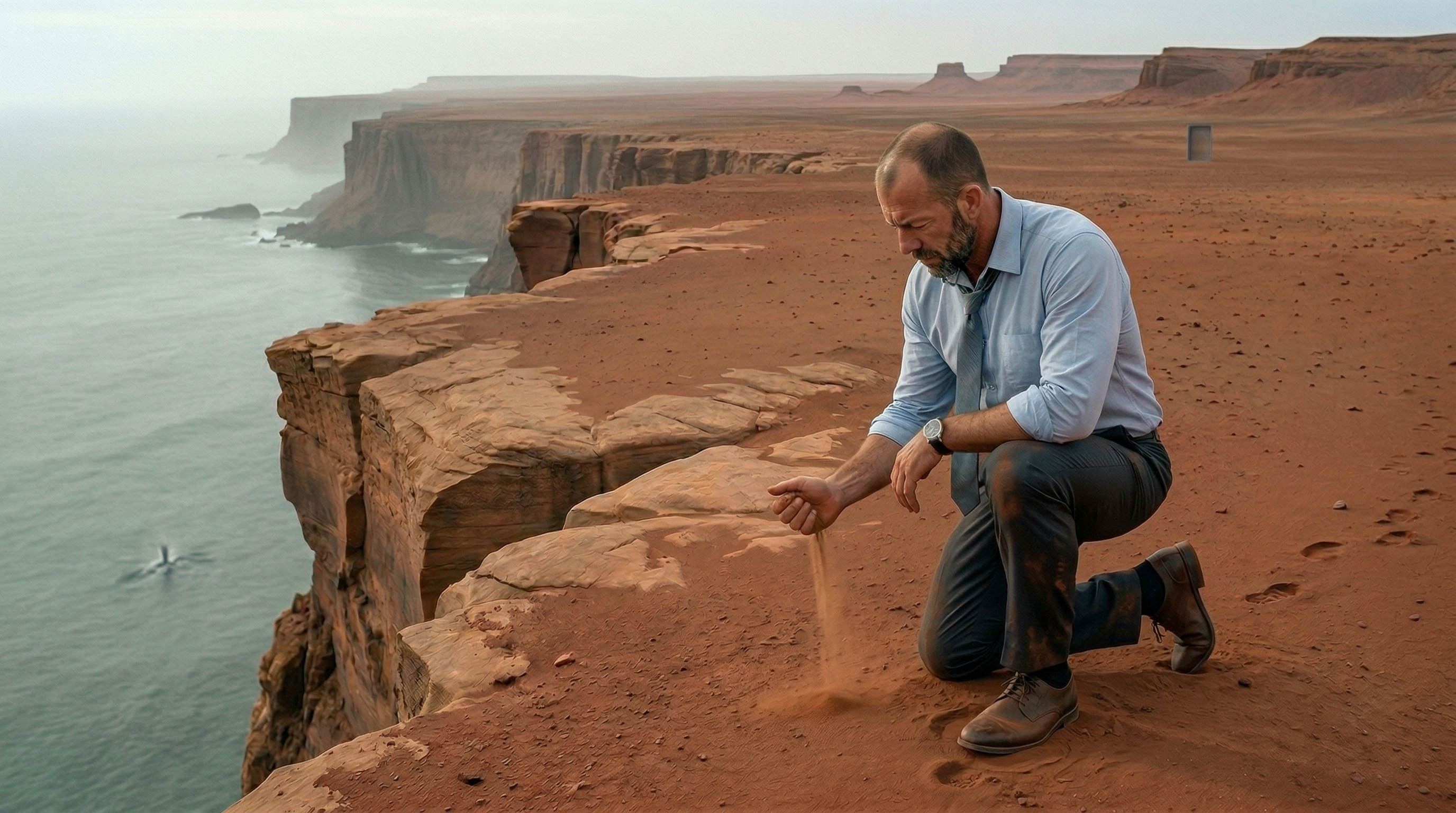
"I had spent my whole career describing things that already existed. Nobody had ever stood me in front of nothing and asked me what it should become."
The first thing was the light.
I came out of the portal squinting, one arm already coming up to shield my eyes, and stood there blinking at a world I could not yet see. And when my vision cleared enough to be of any use, I looked up—because my body wanted to know where the light was coming from and had not thought to consult me about it first—and there it was.
A sun.
Not a red sun, or a double sun, or a great swollen thing filling half the sky. Just a sun, high and slightly behind me, sitting in a pale sky exactly where a sun ought to sit at about one o'clock on a summer afternoon.
I stood in a place that was not Earth and looked at a sun that could have been ours.
And that, more than anything else, was the thing that frightened me. Not strangeness. Familiarity. If the sky had been wrong—if it had been green, if there had been two of them, if the light had come from nowhere at all—I could have filed the whole business under impossible and kept my footing. But it looked like home. It looked like a Wednesday. And it was not.
The air came next.
Thinner. I noticed it in my chest before I noticed it anywhere else, in exactly the way I had once noticed altitude on a walking track above Cradle Mountain—a breath that went in and did not quite fill me, so that I took another, and then a third, and found myself standing on a red plain in leather office shoes doing the breathing of a man who has walked up a hill. My heart worked harder for it. And it was cool, properly cool, ten or fifteen degrees down from the trapped and stormy swelter of Hobart I had been standing in ninety seconds earlier, and the sweat on my back went instantly and unpleasantly cold.
And it was still.
There was no wind. Not a light wind. Not even the faint sort that I would have had to go looking for by watching a leaf move. There were no leaves. There was no movement of air at all, anywhere, in any direction, and the total absence of it made my skin crawl in a way I could not immediately account for. Something in the animal part of me had been listening to moving air for thirty-three years and had just had the sound switched off.
Then the silence arrived, and it was worse.
"Hello?"
I heard myself say it. And then I heard nothing. No echo. Not a soft echo, not a distant one—nothing, the word simply gone the instant it had left me, absorbed into the dust and the air and the enormous open nothing of the place as though it had never been made at all. I have stood in anechoic rooms. This was not that. An anechoic chamber deadened sound. This place did not deaden it. This place took it.
"HELLO!"
Gone. As though the world had declined to acknowledge that I was in it.
I turned, slowly, all the way round.
A plain ran away from me in every direction, flat and red and vast, the colour of an old brick left out in the weather. Rock formations broke it at long intervals, standing in ones and twos, worn round and smooth and headless, the shapes of them suggesting broken columns, or the ends of enormous bones. Far off in one direction the ground rose. Far off in another it seemed to fall away.
And over all of it, over every square metre of it, lay dust.
It was extraordinarily fine. Finer than sand, finer than flour—it was talc, it was ash—and when I lifted my foot it rose in a small red cloud around my ankle and then settled again with a slowness that was almost ceremonial. Unhurried. Patient. The dust of a place where nothing had disturbed the dust in a very long time.
My footprints sat behind me, perfectly formed, sharp-edged, a neat line of them running back to where I had come from.
The only marks on the entire visible world.
I knelt down and pushed my hand into it. It went in to the wrist, and past. Cool. Dry. It had no smell whatsoever—and I only realised that because I was kneeling with my face close to it, breathing it, and my nose kept reporting nothing at all. No earth. No rot. No green. No salt, no dung, no pollen, no smoke, not one of the ten thousand background notes that a human nose has been reading for as long as there have been human noses. Just mineral. Just cold, clean, empty red.
I dug.
I could not have said exactly why, except that I have spent my working life being handed a surface and asked what is underneath it, and my hands simply got on with the job while the rest of me was still standing about being appalled. I scraped the dust aside with both palms, a widening bowl of it, twenty centimetres, thirty—
—and hit something hard.
Not rock. I had dug into a fair quantity of rock in my life, on building sites and in the garden and once, memorably, through a driveway, and rock had always been lumpy and contrary and inclined to argue with the hand. This did not argue with anything.
This was a floor.
It ran flat and even beneath the dust in every direction I cleared it, dense and greyish and entirely uniform, and when I scraped along it with the edge of my hand it did not chip or crumble or vary. I widened the hole a metre, and then another metre, following it, and it simply went on going—the same substance, the same depth, the same absolute regularity, underneath all of it.
I sat back on my heels with my hands red to the elbow.
The plain had a lid on it.
Nothing I had ever seen in the ground had behaved like that. Sediment did not do that. Erosion did not do that. This was uniform, and uniform meant designed, and designed meant that somebody had done the designing—and there was nobody here, and there had been nobody here for a good deal longer than that dust had been settling.
Somebody had made the ground.
Welcome to Clivilius, Nathan Cowdrey.
I came up off my knees so fast I nearly went over backwards.
The words had not come through the air. They had appeared, whole and complete, in the middle of my head—the same voice from the meeting room, the same patient nothing-voice, neither man nor woman, neither near nor far, arriving like a thought I had failed to have myself.
"Who's there?" I shouted, and the shout died the instant it was born, and I stood alone in eight or ten kilometres of red dust with my heart going like a bird in a box, turning and turning, looking for a speaker I already knew perfectly well did not exist.
Nothing answered.
And then I remembered the portal, and I turned round, and my stomach dropped straight through the floor of that impossible world.
It was fading.
It stood behind me with its base in the red dust—a doorway, out on open ground, its bottom edge resting on the plain exactly as a door rests in a floor, and no wall anywhere around it. That was what made it wrong, and cartoonishly wrong, and difficult to look at directly: a doorway standing entirely by itself in the middle of eight kilometres of nothing, with no house on either side of it. And the light was going out of it. The colours had pulled inward. The edges had thinned. What had been a wall of restless brilliance in Meeting Room 4B was now, out here, an ember.
I stared at it and my whole body went cold.
Then I estimated.
Twenty per cent down on what it had been when I arrived, and I had been here—what? Four minutes? Five? Which gave me, if the decay was linear, something in the order of twenty minutes before it went out entirely; and I had absolutely no way of knowing whether it was linear, or what happened at the end of it, or whether the thing would take me with it or leave me standing on a dead plain under a borrowed sun for the remainder of a life that would be measured in days.
Twenty minutes. Call it fifteen, and be wrong on the safe side.
Some other man might have stood there and howled. I stood there and set a budget, because a budget was the only thing I had, and because the arithmetic was a handrail and I was going to hold it.
Fifteen minutes. Use them.
I chose the rise—the higher ground, the direction that would show me the most—and I went fast, and the dust came up around my knees in slow red plumes with every stride and hung there behind me, refusing to disperse, because there was no wind to take it anywhere.
The plain lifted gradually, then more steeply, and my breath went ragged in the thin air and my ridiculous shoes filled with grit, and then quite suddenly there was a line ahead of me where the ground simply stopped.
I slowed. I approached the edge with the exaggerated care of a man who has been afraid of heights since he was nine, and I looked over.
The cliff went down about fifty metres, and it was beautiful, and it was made of the same stuff as home.
Sandstone. Red sandstone, laid down in bands—ochre, rust, a pale cream running through it like a seam of fat in meat—the strata as clean and legible as a diagram, cut open by erosion and left standing there to be read. I had walked past that rock every working day of my adult life. It was the material of Salamanca Place. It was the material of every colonial façade on Collins Street. Somebody had built my city out of it.
And here it was, on another world, doing precisely what it had always done at home.
Below it lay the sea.
Grey. Grey shading to a deep cold green in the troughs, with pale mist lying on it in torn patches, moving slowly, revealing and concealing. It was not the sea I knew. There was nothing Australian about that water at all. It was the sea of a Scottish loch, of a Norwegian fjord—northern, freezing, ancient.
And it was moving.
Long slow swells came in and lifted and dropped and broke white against the base of the cliff, fifty metres below my shoes, in complete and absolute silence.
That was when I understood where I was.
Not the dust. Not the voice. Not the ground with a lid on it. That. A sea in motion, breaking on rock, and making no sound whatsoever—no boom, no hiss, no drag of shingle, nothing at all reaching the clifftop. I stood there and watched a wave collapse into white and heard my own pulse instead, and every hair on my arms stood up.
This was not Earth.
The sun could look like our sun, and the rock could be sandstone, and the water could be water, and none of it mattered in the slightest, because the sea was breaking and I could not hear it, and no world I had ever belonged to had done that.
I stayed there a good deal longer than my budget allowed.
And then, far out and far down, something moved.
I went very still.
Under the surface—shapes. Dark, indistinct, drifting in a loose, coordinated way that no rock has ever drifted. They were a long way down and the mist kept taking them, but they held together and they turned together, and my brain supplied the word before I could stop it.
Fish.
I could not have sworn to it. They were too deep and too far off and the water was too dark, and I stood there straining after them like a man trying to read a sign at the end of a long street. But something in that water was alive, and it was moving with purpose. Closer in, against the rock, the submerged ledges carried a fine collective rippling that was far too regular for current—as though something anchored down there were feeding.
Life.
Not on the land. I turned and looked behind me at eight or ten kilometres of red nothing under a blue sky, and there was not one green thing in the whole of it—not a blade, not a lichen, not an insect track, not a bird, not so much as a fly.
But in the water, something had got a foothold.
The land was empty in a way that felt deliberate. The sea was not. And whatever was down there had come from somewhere.
Which raised a question I had no way of answering and could not stop asking.
I knelt at the very edge of the cliff, closer than was sensible, and put my hand down to steady myself—and my fingers did not find rock.
They found something cold.
I brushed the dust away. Then more of it, quickly, with the flat of my hand.
Underneath was glass.
Not glass exactly—but a smooth, glazed, vitreous skin lying over the sandstone in a patch perhaps a metre across, its surface catching the light in a way that no natural rock has ever caught it. It was cold to the touch, markedly colder than the stone around it, as though it were remembering the water.
And where my hand had swept it, it lit.
A faint blue-white luminescence bloomed up out of the material, following the exact path my palm had taken—a glowing smear of my own gesture lying in the surface like a handprint left in frost—and it did not go out at once. It hung there. It held. My swipe, recorded, glowing quietly at me on a cliff at the edge of a silent sea.
I was on my feet and three metres back before I knew I had moved, and my heel came down half over the edge, and for one white instant I felt the drop take hold of me—and I threw myself flat and forward and lay in the dust with my heart slamming and my face in the red and both hands full of it.
I lay there for a while.
When I lifted my head, the glow was still there. Dying back now, slowly, like a coal at the end of an evening. My own handprint, luminous, on another world.
It had responded to me. The ground here had noticed me.
This place is yours, said the voice. Saint Phillis. Build wisely, Guardian.
I sat up in the dust and laughed. It came out of me quite involuntarily and it was not a good laugh, and the plain swallowed it exactly as it had swallowed everything else.
Mine.
I looked at it. I made myself look at all of it, turning where I sat—the cliffs running north and south, the sea to the west with its silent breakers, the plain running east into a distance that shimmered and gave nothing away. Ravines cut it somewhere off to either side. Call it eight square kilometres. Call it two thousand acres of dust with a manufactured floor underneath it and not one living thing standing on any of it.
Mine. To build on.
And I sat there in my office trousers with red dust to the elbow, and I did the only thing I have ever known how to do with an impossible brief.
I did a gap analysis.
Water: unknown, untested, and fifty metres down a cliff I could not climb. Power: none. Shelter: none, and the temperature was already dropping. Food: nothing was growing here and nothing was living here, so every mouthful of it would have to come through a doorway the size of a wall. Materials: everything. Every single thing would have to come through. Transport, sanitation, communications, medicine—everything, out of a world in which I could not tell one living soul where any of it was going.
And I could not do one hour of it on my own. Not one hour.
Josh.
His name arrived before I had finished framing the question, exactly as Verity's had in the meeting room, and it arrived with a kind of relief that startled me. Josh, who took things apart to find out how they worked when he was six and never really stopped. Josh, who would look at a Portal Key and want to know its power source before he wanted to know what it did. Josh, who had spent his entire life being the one who checked.
He would not believe me. He would look at me with enormous care, and he would be very gentle about it, and he would be watching my hands the whole time.
So I would not tell him. I would show him. I would put the thing into his palm and let him aim it at a wall himself, and I would stand back, and I would not say one word.
That made two of us, then.
Two of us, and eight square kilometres, and a doorway that was going out.
And then, unbidden and entirely unwelcome, the third name. The one I had already put down once that day.
Verity, who would have been standing here with a notebook. Verity, who would already have asked me nine questions I had not thought of, and who would have been the first person alive to walk out onto that plain and say, flatly and with no drama in it whatsoever, Nathan, what's under the dust?
I had lied to her at twenty to twelve that morning and she had let me go.
I stood up.
The air moved.
It was almost nothing—a breath of it across the back of my neck, off the sea, cool and faintly briny—and after that stillness it went through me like a shout. I turned into it and stood with my eyes shut and let it come, and it lifted the dust off the cliff edge in a thin red drift and carried it inland, and somewhere out over the water the mist began, very slowly, to move.
So there was wind here. It had simply not been blowing.
The whole vast still hush of the place had not been a permanent condition after all. It had been a held breath. And the world had been holding it, apparently, for precisely as long as it took me to arrive and stand in it and understand where I was.
Then I ran.
I ran back across that plain with my chest burning in the thin air and my shoes full of grit and the dust hanging behind me in a long red wake, certain with every stride that I was going to come over the last rise and find nothing there at all—nothing but empty sky and red ground and the rest of my life to be spent alone on the most beautiful and most silent piece of country in the universe.
I came over the rise.
It was there. Standing exactly where I had left it, its base in the dust, turning over on itself, throwing its impossible colours out across the plain.
I stopped in front of it with my hands on my knees, hauling in air that would not come, and I looked at it properly for the first time since I had arrived.
It looked stronger than I had left it.
I put that down to the light, or to the distance, or to plain hope—I had just run a kilometre and a half in thin air and I was in no condition whatever to be trusted about anything I could see—and I did not stand about in the freezing dust interrogating my one route home.
I looked back, once.
My footprints ran away across the plain to the rise and out of sight, and beyond them, out of sight too, the silent sea was breaking on a cliff with a glowing handprint on it, and none of it was going anywhere. It had waited a very long time already. It could wait a few days more.
Then I stepped through, into recycled air and fluorescent light and the sound—the sudden, absurd, overwhelming sound—of a printer running in an office in Hobart.







