4307.302 · October 29, 1987 AD
The Edge of the Map
As the Kingsford Smith empties and the evening narrows to two, Cody finds himself drawn deeper into conversation with a stranger who asks questions nobody else thinks to ask. What begins as pub talk becomes something harder to walk away from — and when the moment comes to say goodnight, Cody makes a choice he can't fully explain, even to himself.
"I'd never said any of it out loud before. Funny how a stranger can unlock a door your own family doesn't even know is there."
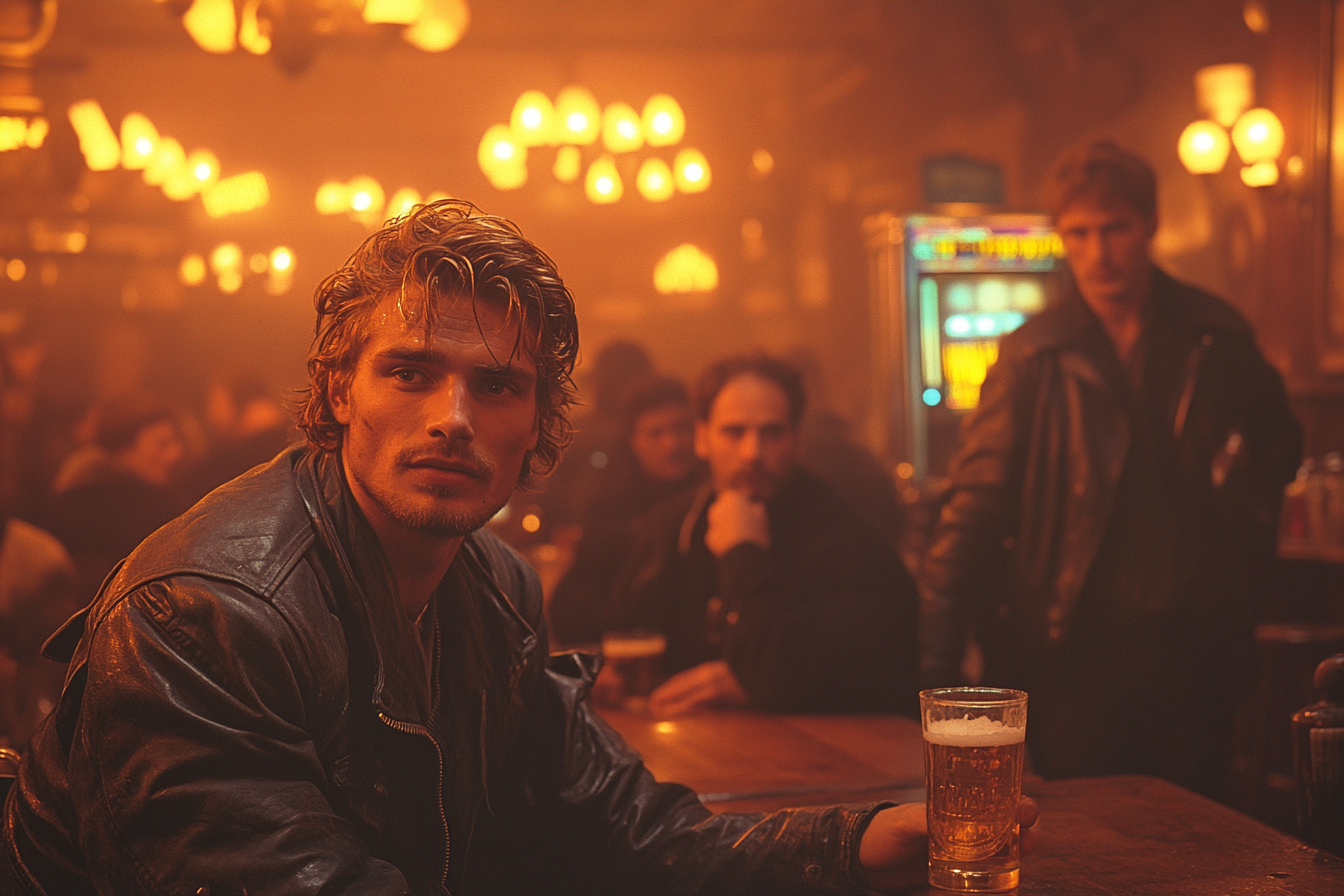
The darts wound down the way things did in a pub late on—not with a clean ending but a slow unravelling. Mick conceded after the fifth game with a grunt and a handshake that was more competitive than friendly. Dave checked his watch, swore, and said something about his wife having his guts if he wasn't home by ten. Ben bought one last round—his shout, which meant he'd either had a good week or was about to have a bad one—and then the group started to fracture.
The red-haired bloke from Jeremiah's lot was the first of the out-of-towners to leave, clapping Mick on the shoulder like they'd known each other for years instead of ninety minutes. A couple of others followed, pulling on jackets, fishing for keys. The usual slow bleed of a Thursday night. By half nine the dartboard crowd had scattered to different corners of the pub or out into the carpark, headlights sweeping across the gravel as engines turned over and utes rumbled off into the dark.
Ben lingered. He always did—never wanted to be the first to leave but never wanted to admit he was staying for the company. He leaned against the bar and watched me talking to Jeremiah from across the room with an expression I couldn't quite read. Not disapproval. Something closer to puzzlement. Like he was trying to work out a joke he'd missed the setup for.
"You right to get home?" he asked when he finally wandered over, shrugging into his jacket.
"Yeah, mate. I'll head off soon."
He glanced at Jeremiah, then back at me. Opened his mouth like he was going to say something, then thought better of it. Just gave me a nod—the kind that carried more meaning than it should've—and headed for the door.
"See you Saturday, Jennings."
"Yeah. See you, Ben."
The door groaned shut behind him, and the pub felt different. Smaller. Quieter. Like a room that had been holding a crowd and was now remembering what it sounded like with just a few voices in it.
I turned back to Jeremiah, who'd been watching Ben leave with that quiet attentiveness he had—the kind that noticed everything and commented on nothing. He was sitting across from me at the table we'd drifted to after the darts, two half-finished pints between us, the blackwood bar stretching out behind him in the lamplight. Alfie was down at the far end, working through his nightly routine—wiping taps, rinsing glasses, the rhythm of it steady and unhurried.
"Good mate?" Jeremiah asked, tilting his head towards the door Ben had just disappeared through.
"Ben? Yeah. Known him since primary school. He's a bloody pest, but he's solid."
"Seems like it." A pause. "He wasn't sure about me."
It wasn't a question. I looked at him, a bit taken aback by the directness of it. Most people wouldn't have said it out loud.
"Ben's not sure about anything until he's had six beers and a meat pie," I said. "Don't take it personally."
Jeremiah smiled at that—a proper one, not the measured half-smiles he'd been giving all night. It changed his face. Made him look younger. Less careful.
"Fair enough," he said, and took a sip of his beer.
The jukebox had shifted to something slower—a country ballad, all steel guitar and long vowels. Love and loss, regret, roads not taken. It fit the air. The pub had that late-night feel now—the hour when talk goes either very honest or very stupid, and I couldn't yet tell which way ours would tip.
"So where are the rest of your lot headed?" I asked, nodding vaguely towards the door where his group had filtered out over the last half hour.
"Up to the Barossa tomorrow. Couple of them have work at a vineyard near Tanunda."
"And you?"
He turned his glass slowly on the table, leaving a wet ring on the scarred wood. "I'm less fixed in my plans."
I waited for more. It didn't come. That was something I'd noticed about Jeremiah—he could say a sentence that sounded like an answer but was actually a wall. Smooth enough that I wouldn't have known I'd been deflected if I hadn't been watching for it.
"So you're just... travelling?" I pressed, more out of curiosity than suspicion. "No particular destination?"
"Something like that." He looked up. "I go where things feel right. Where the people are interesting."
"And Gawler qualifies, does it?"
"More than you'd think."
There it was again—that quality in his voice. Like the words had more behind them than what they said. I let it sit. Didn't push. But I filed it away, the way I'd clock a fence post leaning a few degrees off true. Didn't mean it would fall. But I'd keep half an eye on it after that.
The conversation shifted. I'm not sure which of us steered it, but we ended up talking about the town—not just the facts of it, but the feel of it. The stories lodged in its corners like dust in the grain of old wood.
"You see that building across the street?" I said, nodding towards the window, though we could barely make out the shape of it through the glare and shadow. "That's the old courthouse. Built in 1859. They say the ghost of Judge Boothby still haunts the place, passing sentence on the guilty from beyond the grave."
Jeremiah raised an eyebrow. "Have you seen this spectral judge yourself?"
"Can't say I have. But old Mrs Fitzgerald swears blind she saw him one night, wig and all. Mind you, she'd had a few too many sherries at the time."
He laughed. A real laugh—short, surprised, like it had escaped before he could catch it. And something eased between us. Not dramatically. Just the point where he stopped performing and was simply there in the room with me.
"This pub," he said, looking round the room slow, taking its measure. "There's a weight to it. You can feel the decades in the walls."
"You said O'Connor built it for Smithy." He glanced towards the mural above the hearth. "When?"
"Thirty-two," I said. "Had that mural done the year after Smithy went missing. Those golden stars are still the originals—fifty years, and nobody's ever repainted them."
He looked at the mural for a long moment. The Southern Cross picked out in metallic gold, catching the lamplight the way it had for half a century.
"Interesting bloke, O'Connor," he said quietly. "Building something permanent to honour something that was always in motion."
I hadn't thought of it that way before. But he was right. There was something in that—in anchoring a friendship to a building, in making a fixed point out of a man who'd spent his life trying to fly beyond every horizon.
We talked about the farm after that. Not because he asked—or maybe because he'd been asking all night in ways I hadn't clocked, laying groundwork with questions that seemed casual but kept circling back to the same territory. What mattered to me. What I was proud of. What I wanted.
I told him about the dawn. The way the mist clung to the crops like gossamer when the sun first broke the horizon—for a second it was like standing at the edge of creation. I told him about the time Anne and I flooded the shearing shed rigging up a sprinkler system—she must've been ten, maybe eleven, and I was supposed to know better—and Dad found us ankle-deep in muddy water, both of us laughing so hard we couldn't breathe, and he just stood there in the doorway with that face of his where you couldn't tell if he was furious or trying not to crack up.
"You should see it," I said, and I didn't know where the openness was coming from, but the words kept arriving. "Dawn on the farm. Makes you feel connected to something bigger."
"Sounds like poetry," Jeremiah said. "You ever thought of putting pen to paper?"
I chuckled. "Nah, I leave the fancy words to the city folk."
"Don't," he said. And the way he said it—direct, no smile—caught me off guard. "Words like that are rare. Don't give them away to people who'll use them worse than you would."
I didn't know what to say to that. So I just drank my beer and let it sit.
After a while, I told him about Anne properly. Sixteen, still at school, but already sharper than the rest of us put together. Heart set on agricultural science. The way she talked about the farm's future like it was a problem she'd already half-solved in her head.
"She'll be at uni in Adelaide next year," I said. "No doubt about it. She's got this fire in her—this drive. Me, I'm just..."
I trailed off. The sentence didn't have an ending I was willing to say out loud.
"You're the one who stays," Jeremiah said. Not unkindly. But not gently either. Just factually, the way you'd read a map.
"Someone has to."
"Has to? Or chooses to?"
"What's the difference?"
"All the difference in the world."
The silence that followed wasn't empty. It hummed. The pub had thinned to almost nothing now—just us, Alfie moving through his closing routine at the far end of the bar, and old Tom in his corner, nursing the last of something amber and muttering to himself about needing to feed his cat.
"If the world beyond those boundaries was waiting for you," Jeremiah said, voice low enough that I had to lean in to hear him over the jukebox's last tired song, "what would you want to see?"
The question should have felt strange. Coming from a bloke I'd known for a few hours, in a pub on a Thursday night, it should have bounced off me like rain off tin. But it didn't. It landed somewhere deep, in a place I usually kept locked.
"I'd want to see the great wheat fields of Canada," I said slowly. "Stand in the middle of a sea of grain that stretches to the horizon. I'd want to visit the rice paddies of Asia—see how they've been working the same land for thousands of years." I paused. "And Africa. I've read about farmers in Kenya using new techniques to grow crops in places they never could before. Reckon there's a lot we could learn."
I stopped. Surprised at myself. I'd never said any of that out loud—not to Ben, not to Anne, not to anyone. And here I was, spilling it to a stranger in a half-empty pub like it was the most natural thing in the world.
Jeremiah leaned back. Something moved behind his eyes—not surprise, not satisfaction, but something more complicated. Like he'd been looking for a specific thing and had found it in a place he hadn't expected.
"There's more of the dreamer in you than you've let yourself believe," he said.
I picked at the edge of a beer mat, tearing the damp cardboard in a slow strip. "Maybe. But dreams don't fix fences or pay bills."
"No," he said. "They don't. But they keep you alive while you're doing those things."
The clock above the bar struck. Not loudly—just a low chime that seemed to carry further than it should in the empty room. Alfie was stacking chairs now, that steady thud-scrape rhythm of his. The jukebox had gone quiet.
The pub was closing around us like a hand slowly making a fist, and I could feel the moment approaching where we'd have to stand up, shake hands, say goodnight, and walk in different directions.
But something about that picture didn't sit right.
I'd noticed it across the evening—the way Jeremiah deflected questions about where he was staying. Someone in his group had mentioned a motel near Nuriootpa, but Jeremiah hadn't confirmed he was going with them. He'd just let the conversation move on. And now they were gone, and he was still here, and I was fairly certain he didn't have anywhere to sleep tonight.
I could feel the sensible part of my brain—the part shaped by Mum's kitchen, by Dad's steady routines, by the farm's predictable demands—pushing back against what I was about to do. I'd known this bloke for several hours. I didn't know where he was from, didn't know his last name, didn't know why half his answers felt like locked doors with the key hidden somewhere just out of reach. And I was about to invite him into my family's home.
Dad would have questions. Janice would have that look—the one that could peel paint off a wall at twenty paces. Mum would set an extra place without blinking, because that's who she was, but even she'd wonder.
And yet.
I thought about Dad spending half a week rebuilding old Mrs Carter's fence after the storm in '81, even though it meant we fell behind on our own planting. About Mum putting a spare plate out every time someone knocked on the door around dinner, regardless of who they were. About the way this town worked—the way it had always worked—which was that you helped people when they needed it and sorted the rest out later.
I thought about the way Jeremiah had listened to me tonight. Really listened. Not the polite, half-distracted listening you get from mates who are already thinking about their next sentence. The kind that made you feel like what you were saying actually mattered.
And I thought about that itch. The one I'd walked in here with. The one that had been buzzing under my skin all evening, getting louder every time Jeremiah asked a question that cut a little closer to the bone.
"Listen," I said, and the word came out rougher than I intended. "Where are you actually staying tonight?"
He looked at me. Held my gaze. Something flickered in his expression—not surprise, not quite. More like a recalculation, some weight shifting and resettling before he answered.
"Haven't sorted that out yet," he said. Evenly. Like it didn't bother him.
"Right." I nodded. Rubbed the back of my neck. Felt the flush start to creep up from my collar. "Look, this might sound a bit mad, but—we've got room at the farm. Spare bed in the back room. If you need somewhere for a night or two, you're welcome to it."
I said it fast, like if I slowed down I'd lose my nerve. Which I probably would have.
Jeremiah didn't answer straight away. He sat very still, and for a moment I couldn't read him at all. His jaw tightened slightly. His thumb rubbed against the rim of his glass. I watched him run something through his head—weighing, measuring—and I had the strange, fleeting sensation that whatever he was turning over was bigger than whether or not to accept a spare bed.
"That's generous of you, Cody," he said carefully. "But you don't know me."
"I know enough."
"Do you?"
It was a fair question. And an honest part of me—the part that noticed how smoothly he deflected, how precisely he asked questions, how that scar on his face told a story he'd never once referenced—wanted to say no, probably not. But another part of me, deeper and less rational, said something else entirely.
"My old man always reckoned a man's worth is measured by how he treats others," I said. "Not by what he owns or where he comes from. And out here, we look after people. That's just how it works."
I paused, then let a grin through. "Besides, there's always more to do on the farm than there are hands to do it. If you're staying, you're earning your keep."
Something shifted in his face. That guarded expression—the one I'd been watching all night, so well-built I'd sat across from it for hours and barely clocked it—gave way. Just enough. A flicker of something I hadn't expected. Not gratitude, exactly. Something closer to relief—and I watched his shoulders come down a fraction, the set of them easing like he'd been braced against something all night and had only just let it go.
"All right," he said. Quietly. "I accept. And thank you."
I nodded. The knot in my stomach—the one I hadn't realised was there until it loosened—eased off.
We stood. Gathered our jackets. Left the empty glasses on the table like the remnants of something that had run its course. I gave Alfie a nod and a quiet "Thanks, mate" as we passed the bar.
He returned it with a raised hand, cloth still draped over his shoulder. He didn't say anything. Just watched us walk towards the door with that expression of his—the one that said he'd seen something take shape tonight and wasn't sure yet whether it was good or bad, but knew it was real.
The heavy timber groaned as I pushed it open, and the night air hit us—cool, clean, carrying the faint scent of eucalyptus and dry grass. The sky was wide and black and thick with stars, the Southern Cross hanging low over the rooftops.
I fished the ute keys from my pocket and jingled them once.
"Right then," I said. "Let's go."
Jeremiah fell into step beside me, gravel crunching under the two of us. Neither of us spoke. The pub glowed behind us, warm and golden through the windows, getting smaller in the dark.
Somewhere out past the edge of town, the farm was waiting. Mum and Dad would be asleep. Anne would have a light on, probably still reading. The dogs would bark when we pulled in, and the cattle would shift in the paddock, and the windmill would be turning slowly against whatever sky was left.
I didn't know what I was bringing home. Didn't know what any of it meant, or what it would cost, or whether tomorrow morning I'd wake up and wonder what the hell I'd been thinking.
But my gut said go. And I'd never been much good at ignoring it.







