4338.10 · January 10, 2018 AD
The Dust
Nathan steps back out of the wall into an ordinary Wednesday afternoon and finds that he has brought another world home on his body — in his hair, under his nails, in the weave of his shirt, and across the carpet of Meeting Room 4B in a line of red footprints. The room is booked to somebody else at two. And what breaks him is not the dust at all.
"You can carry the biggest thing that has ever happened to anybody straight through a room full of people, and not one of them will look up."
I came out of the wall into the sound, and it was the sound, rather than anything else at all, that very nearly put me on the floor.
Not the light. Not the air. Not the fact that I had just walked out of a sheet of plasterboard in a Tasmanian government building. The noise.
A printer running somewhere off to the left, chewing its way through somebody's forty-page report. Two men laughing in a corridor. A telephone ringing and ringing on an empty desk with nobody going to answer it. The air conditioning I had turned down four degrees before I opened the envelope, labouring away above the ceiling tiles with a rattle in it that I had heard every working day for six years and had never once actually heard.
It was an assault. After that silence—after a world in which a sea broke on a cliff and made no sound at all—an ordinary open-plan office was a wall of noise coming at me from every direction at once, and I stood in the middle of Meeting Room 4B with my arms held slightly out from my sides like a man who has just been shoved, and could not process any of it.
Behind me, the portal shut.
I felt it go rather than saw it—a change of pressure at my back, the fine hairs on my neck lying down—and I turned round and there was nothing there. No colour. No churn. Off-white plasterboard, three metres of it, with a scuff by the skirting board where somebody had kicked it during an argument about scope, and the faint rectangular ghost of a whiteboard that had hung there and been taken down.
I put my hand flat on it.
Cool. Slightly gritty under the paint. A wall. The kind of wall a properly angry man could put his fist through, and men in that building had. I ran my palm across it and it did nothing whatsoever, and I stood there with my hand on the wall like a fool, waiting for it to admit what it had been.
It did not, of course. And I understood, standing there with my palm flat on the paint, that the world was simply going to carry on; that it was not going to acknowledge any of this; and that if I wanted the last half hour to have happened I was going to have to insist upon it myself, alone, for the rest of my life.
Then my legs went.
Not dramatically. There was no swoon. My knees simply stopped being interested in the job and I went down the wall and sat on the floor with my back against the leg of the meeting table, and the shaking started.
It came up from somewhere underneath my ribs and went out along my arms and into my hands, and my hands began to jump—actually jump, in my lap, like something with a current running through them—and then my jaw joined in and my teeth started going, a fast dry rattle that I could not stop by clenching. I have never been so cold. The sweat of a Hobart January was still in my shirt and it had been through fifteen degrees of alien afternoon and back again, and it lay against my skin like a wet flannel, and I had helpfully set the room's thermostat to sixteen with my own hand.
I sat on the carpet in a refrigerated meeting room and shook, and could not stop.
My head had a spike through it. Right behind the left eye, hard and bright—the sort of headache I had earned, presumably, by spending half an hour at altitude, dehydrated, breathing air that would not fill me and panting on a plain like a man who had run up a hill. My body was presenting the bill.
And I was hungry. Ferociously, stupidly, animally hungry. It arrived out of nowhere and it was enormous. I had eaten one biscuit all day, dunked in water from the cooler, and my body had since climbed a rise at altitude, dug a hole, sprinted a kilometre and a half in dress shoes and had a considerable quantity of adrenaline dumped into it, and it now wanted, with total sincerity, to eat.
So that was my condition: freezing, and starving, and shaking, with a spike behind one eye, sitting on the floor of a meeting room in a suit.
I had been to another world.
I lifted my hands to look at them, and that was when I saw the dust.
Red. My hands were red to the wrist, and the wrist was where my rolled cuffs began, and above the cuffs my forearms were red as well—red to the elbow, both of them, the fine ochre powder driven into every pore and every crease and every hair, packed solid and dark in the beds of my fingernails, printed into the whorls of my fingertips like something staining a document.
I looked down at myself.
My knees were red. Both of them, in two great crescent smears where I had knelt in it to dig. The front of my shirt was red from the collar to the belt, an even and comprehensive coating of it, because I had thrown myself flat on my face on a clifftop to stop myself going over the edge. There was red in the weave of my trousers.
I put a hand up into my hair and it came away rusty.
I ran my tongue around my teeth and there was grit in them, and I tasted it—dry, mineral, faintly metallic, a taste with absolutely no organic component to it whatsoever, the taste of a place where nothing has ever rotted because nothing has ever lived. It was in my mouth. It had been in my mouth the entire time. I had been breathing it.
My shoes were full of it. When I moved my foot, a little of it sifted out through the stitching and lay on the carpet in a small ochre drift.
The carpet.
I turned my head.
Running from the wall to the table leg where I was sitting, clear as a diagram, clear as evidence, was a line of red footprints across Tasmanian Government carpet tile.
Something happened in my chest that was half a laugh and half a retch and did not fully commit to either. I got up onto my knees—too fast, the room swung, the spike behind my eye went white—and I knelt in the middle of it with my hands spread on the floor and looked at what I had brought back with me.
It was not subtle. It was not faint. Somebody was going to walk in here and there was going to be red dirt all over the floor of a meeting room on the fourth storey of an office block in the middle of Hobart, four hundred metres from the water, where the nearest red dirt of any description was somewhere out past Ouse.
The wall clock said twenty-six minutes to two.
The room was booked to me until two.
I started by trying to brush it, and this was a mistake, and I understood that it was a mistake within about four seconds, because the dust was not sand and did not behave like sand. It was finer than flour. It was closer to talc, or to ash, and when I swept my hand across the carpet it did not gather into a heap; it went in. It went down between the fibres and took hold, and the leading edge of my sweep pushed a red bloom out ahead of it into clean carpet that had been perfectly grey a moment before, and I had, in one confident gesture, doubled the size of the problem.
I sat back on my heels and said a word my mother would not have cared for.
Right. Water. Paper towels. Kitchen.
I stood up and got as far as the door and stopped, because I was about to walk out into an open-plan office wearing a business shirt the colour of Uluru.
There was a manila folder on the table, left behind by whoever had used 4B before me—somebody's printed agenda, half a ream of stapled nothing—and I picked it up and held it against my chest with both arms, in the manner of a man who was Very Busy and Going Somewhere, and I opened the door and walked out into the department.
Nobody looked up.
I went forty metres across a working office with another planet's soil in my hair and up my arms and driven into the fibres of my clothes, holding a folder against my sternum like a shield, with a headache that was making my left eye water; and Craig from Digital Services said "Nathan" at me in the flat neutral way he had said it every working day for six years, and I said "Craig," and that was the entire transaction.
Nobody looked up.
The kitchen was empty. The linoleum with its geometry of light, the fridge with its low note, the tap with its patient drip, and the biscuit tin sitting on the bench with its faded tartan scene worn to ambiguity by twenty years of hands.
I caught my reflection in the microwave door—the same curved glass, the same slight distortion—and the man in it was filthy. There was a rust-coloured smear along one cheekbone that I had not known was there. His eyes were doing something I did not like.
I tore off a fistful of paper towel, ran it under the tap, and went back.
Wet was worse. Wet turned it to mud.
I understood this the instant I applied the first damp wad to the carpet, and by then I had a smear of red clay a foot long worked into government pile, and I knelt over it in a locked meeting room with a headache and a rising sense of hysteria, laughing at nothing, alone, in a way that I would not have wanted anybody to see.
Dry, then. Dry and patient.
I made three trips. Head down, folder against the chest, past Craig again, past a woman from Procurement whose name I had never known and who had worked eleven metres from me for four years. On the third trip Sal was at the photocopier and she said, without turning round, "There's a jam in this thing, don't bother," and I said "Right," and she said "It's the third time this week," and I said "Right," and I carried on holding a folder against a shirt full of Clivilius.
Nobody looked up.
I lifted what I could. I blotted, and pressed, and rolled the towel to pick up what the pressing lifted, and worked outwards from the centre so as not to spread it, and I got the footprints, and I got the drift from my shoes, and I got most of the bloom that my own idiot brushing had created.
Most of it. Not all of it.
When I sat back for the last time there remained—faint, but perfectly visible to anybody who knew to look for it—a pale rust shadow in the carpet in front of that wall. Perhaps a metre across. The ghost of a place that did not exist.
I looked at it for a while.
Then I got up and moved the meeting table eighteen inches to the left, and put two chairs where the shadow was, and stood back, and it was gone, and I felt like a man hiding a body.
Someone knocked on the door.
I have never in my life come so close to simply being sick on the floor. The knock went through me like a current; my whole body jerked; and I stood in the middle of that room with a fistful of red paper towel in my hand and could not for two full seconds produce a single word of English.
"Won't be a minute," I called.
"No rush, mate." A voice I didn't know. "Two o'clock booking. Take your time."
Take your time.
I stuffed the towels into my trouser pockets—both pockets, wadded, damp, absurd—and picked up the envelope from the table and put it in my bag, and buttoned my cuffs down over my forearms, and I stopped at the door with my hand on it and made myself breathe.
Then I opened it and smiled at a man I had never seen before and said, "All yours."
He thanked me. He went in. He looked round the room and saw a room.
He did not look up either.
I flushed another world down the second cubicle of the fourth-floor gents in three goes, because the towels were too much for it all at once and the last thing I needed was to block a government toilet with alien soil. I stood there and watched the water take it. Red, and then pink, and then clear.
Somebody came in and went into the cubicle beside me and started whistling something I half recognised from the radio. He whistled it flat and cheerfully, all the way through, twice.
I stood two feet away from him and looked at a cistern and thought: I could tell you. Right now. Through this wall. I could tell you that there is a world called Clivilius and that I have been in it, and that it has a sun like ours and a sea that makes no sound, and you would flush and wash your hands and go home and tell your wife about the bloke at work who's cracking up.
He flushed. He washed his hands. He left, still whistling.
I came out and stood at the basin, and the water off my hands ran red.
Not pinkish. Red—thick with it, an orange-brown silt spiralling round the plughole and away, and the more I rubbed the more came off, so that I stood there with the hot tap running and watched a planet leave me. My cuffs got wet. I rolled them back and did my forearms, and the water went red again. I did my face, and it went red again. I dug at my nails with the corner of a folded paper towel, one hand and then the other, ten fingers, and the beds of them stayed dark, and I scrubbed until the skin around them was pink and stinging and they were still dark, and I could not stop.
It was the whorls that finished me. I held my hand up under the light and my own fingerprints were picked out in red, every ridge and every valley of them, in perfect detail, as though somebody had inked them deliberately onto me.
I put both hands flat on the cold porcelain and leaned on them and breathed.
Then I bent and drank from the tap, three or four great swallows straight out of the spout, and it was the best thing I have ever tasted in my life and it hurt my head to swallow it.
When I straightened up I looked in the mirror.
Thirty-three years old. Senior business analyst, Tasmanian State Service. Grey around the mouth. Hair stuck to the forehead in dark points. A rust smear along the cheekbone gone streaky where he had wet it. A hundred and forty dollars of business shirt destroyed beyond any recovery, red dirt in the creases of his neck, and a hip going purple under the trousers where he had caught the corner of a meeting table getting away from something that had said his name.
"You've been to another world," I told him, out loud, in a public bathroom.
He didn't look like he'd enjoyed it.
I laughed. It came out wrong and I stopped it.
The department in mid-afternoon: keyboards, a kettle, somebody's radio down low, the murmur of a call being taken in the corner. Sal had got the photocopier going again and was standing over it with her arms folded, watching it work, in the manner of a woman keeping an eye on a machine that has recently disappointed her. Two graduates were arguing amiably about a restaurant. The light came in long and gold through the western windows now, the cloud broken up while I had been away, and it lay across the carpet in great warm slabs and made the whole floor look like somewhere pleasant to work.
Verity was at her desk with her head down.
She did not look up. Her pen went on moving. And I could not have said whether that was because she had not seen me, or because she had.
I sat down.
My monitor had gone to sleep. I nudged the mouse and it woke, and there it was, exactly as I had left it that morning: the OneGov draft requirements, Section 4.2.3, Authentication Protocols. The cursor blinking in the margin. Waiting.
The system shall support multi-factor authentication via SMS, email, and authenticator application.
I sat in front of it with red dust under my fingernails.
Nobody had noticed. Not one person, in the whole of that building, had noticed anything at all. I had gone through a wall into another world, and dug into its soil, and heard something enormous say my name, and I had come back with the proof of it caked into my clothes and my hair and my hands, and I had walked the length of a working government office three times, and nobody had so much as glanced at me.
I could stand on this desk, I thought. I could stand on this desk and hold up my hands and tell every person on this floor exactly what had happened, and show them the dirt, and describe the cliff and the silence and the sea—and by Friday there would be a meeting about me, and my mother would take a telephone call, and it would not make the smallest difference to any of them.
The world was going to go on. It had already gone on. It had not paused for a second.
And I was going to have to carry it entirely on my own.
The hunger came back then, huge and shaking, and with it something a great deal worse: the absolute certainty that I could not do this. Not for a day. Not for an afternoon. That I was already, sitting at my own desk in a ruined shirt, at the end of what one person could hold.
I reached into my pocket and my hand closed round the Portal Key, and it was warm from my leg.
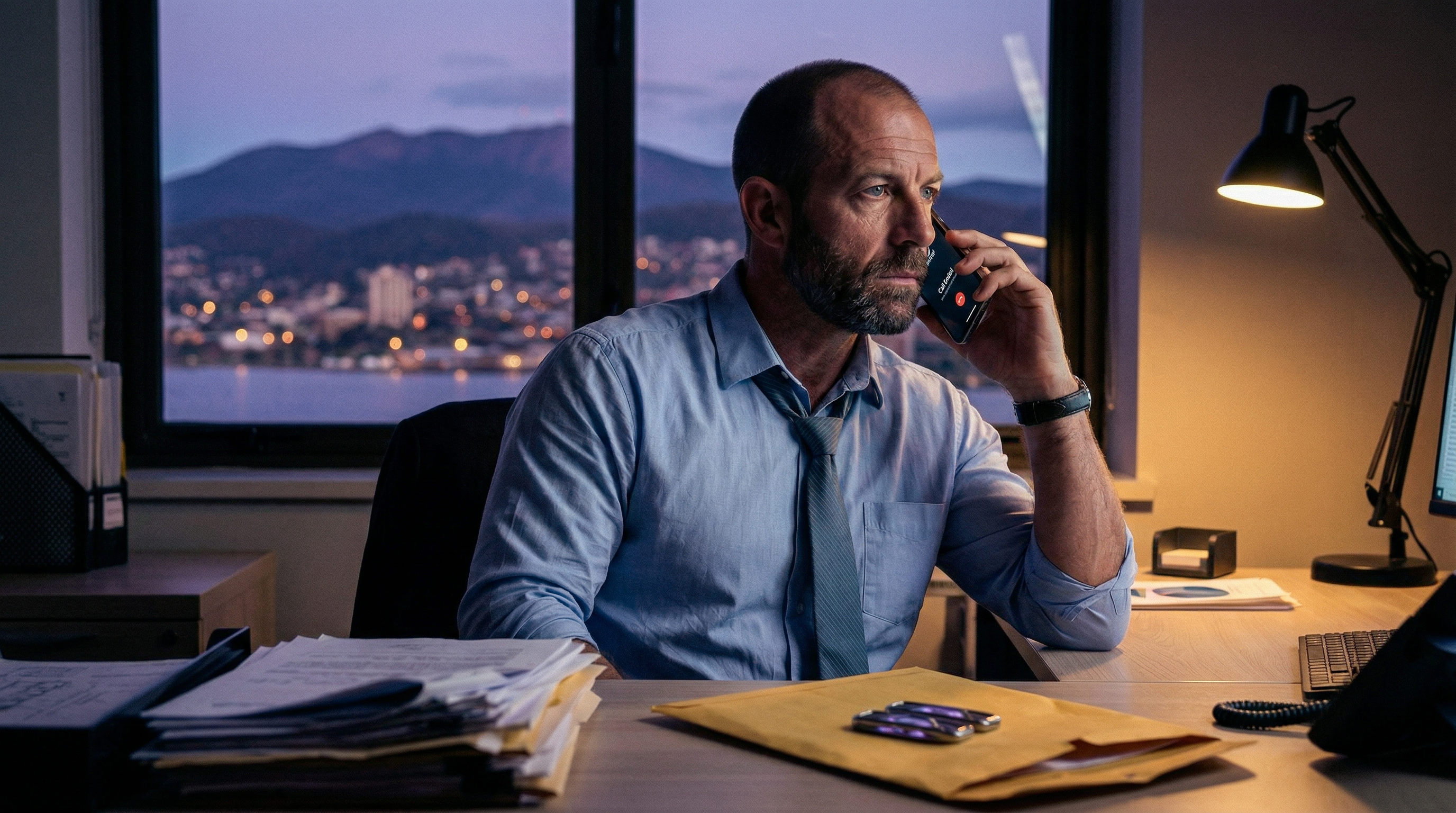
I got out my phone and found my brother's name.
Then I stopped, because I was sitting in the middle of an open-plan office and 4B belonged to somebody else now, and there was not one square metre of privacy left to me in the whole of that building.







