4338.209 · July 28, 2018 AD
The Drawer of Leverage
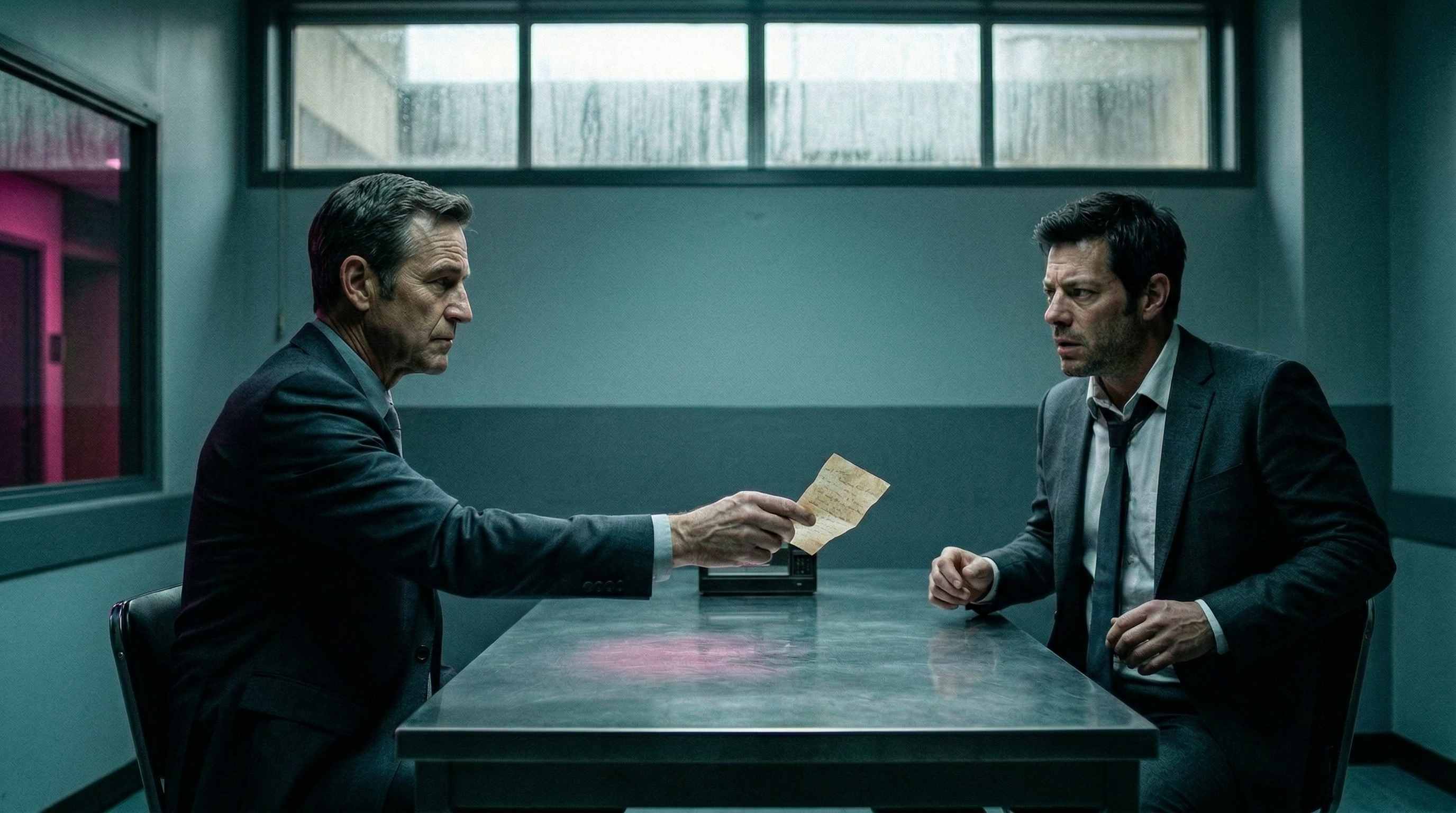
With the interview room empty and Karl still reeling, Charlie closes the door and shows his hand—a crumpled scrap of paper that turns the newly promoted detective's face the colour of old bone. No words are needed to explain what it means; the past has a way of speaking for itself.
"You don't need to make threats when you've got the right piece of paper. The silence does all the talking for you."
The door opened and I stepped inside.
Karl was still standing in the middle of the room, locked in whatever private reckoning the interview had triggered. He had the look of a man who'd been ambushed by his own past—shoulders hunched, head slightly forward, hands hanging at his sides like he'd forgotten what they were for. The fluorescent light turned his skin the colour of old newspaper. He turned at the sound of my entrance, and I saw him try to reassemble the professional mask, pulling it back into place like a man straightening a tie before a funeral. It didn't quite fit anymore. The edges showed.
I closed the door behind me. Let the click of the latch settle into the silence. Let him feel the weight of being alone with me in a room that had just witnessed more than he'd wanted to reveal.
The chair Louise had vacated still held the impression of her presence—warmth, probably, if I'd bothered to touch the seat. I didn't. I stood where I was, positioned between Karl and the door, not blocking it but making clear that leaving wasn't the next thing that was going to happen.
"So," I said, keeping my voice casual, almost friendly, the tone you'd use asking about someone's weekend plans, "what do you think of her story? Do you believe any of it?"
He hesitated. I could see him weighing options behind his eyes, calculating risks the way you calculate whether to bet or fold when you're not sure what cards the other player's holding. His tongue moved across his lower lip—dry mouth, nerves, the body giving away what the face was trying to hide.
"I don't know," he said finally. "It doesn't really make much sense at the moment."
Careful. Noncommittal. The answer of a man who didn't want to expose himself, who was testing the ground with each word before putting his full weight on it. He was good at this, normally. But normally he hadn't just spent twenty minutes with a woman who'd clearly meant something to him once, talking about people whose names hit him like punches.
"I'll do a background check on Luke Smith," he continued, reaching for procedure the way a drowning man reaches for floating debris. "See if I can find any connection with—"
He stopped.
Too late. The sentence had already revealed its shape, the outline of what he'd been about to say hanging in the air like the afterimage of a bright light. Any connection with... The words he'd swallowed were still visible in the silence that followed them. Connection with what? With whom? The Queensland history I knew existed but had never been able to fully map? The relationship with Jamie that went deeper than he'd ever declared?
I let my gaze sharpen. Watched the colour shift in his face—what little colour remained draining out, leaving that greyish pallor behind like sediment after dirty water drains away.
"I agree," I said. "You sure you don't think you're too close to this one, Jenkins?"
The question landed. I saw it hit—the slight widening of his eyes, the tension that rippled through his shoulders and down into his hands, which had curled into fists at his sides without him seeming to notice. He took an unconscious step toward the door. Escape reflex. The body betraying what the mind was trying to hide, legs wanting to carry him away from a conversation that was heading somewhere he didn't want to go.
I didn't move to block him. Didn't need to. The weight of what I knew—or what he suspected I knew—was enough to hold him in place, gravity of a different kind keeping his feet planted on the scuffed linoleum.
"Be careful, Karl," I said, softening my voice just slightly. Not kindness—not exactly—but something that might have passed for it if you weren't paying close attention. "These are dangerous times, and we have to deal with dangerous people."
His eyes tracked my every movement as I reached into my jacket pocket. Slowly. Deliberately. Giving him time to imagine what might be coming, to run through the possibilities, to feel the anticipation build in his chest. I'd learned this technique decades ago, back when I was still in uniform—the pause before the reveal, the moment of suspension that made whatever came next land harder than it would have otherwise.
I extended my hand toward him, fingers curled into a tight fist.
The moment stretched. I could see him trying to anticipate what was coming, running through possibilities the way you'd run through a list of worst-case scenarios. Photographs? Documents? A name written on a slip of paper, connecting him to something he'd hoped was buried deep enough to stay buried?
I uncurled my fingers.
In my palm lay a small scrap of paper, torn and crumpled, softened by years of being carried close to someone's body. The edges had gone fuzzy, the creases worn pale from repeated folding and unfolding. It had come to me through channels that didn't exist on any organisational chart—intelligence contacts who collected fragments the way some people collected rare coins or vintage wines, hoarding them against the day they might prove valuable. This particular fragment had surfaced years ago, filed away in a drawer I kept for exactly these situations. The drawer of things that might matter someday. The drawer of leverage.
Today was that day.
Karl's face went white. Not pale—white. The blood retreating from his skin so fast I could almost see it happening, his cheeks going from grey to the colour of old bone in the space of a heartbeat.
I watched recognition strike him—not just of the paper, but of what it meant. The past he'd thought was buried under years of careful behaviour and transferred files and distances measured in thousands of kilometres. The connections he'd never declared to any supervisor, never mentioned in any interview, never acknowledged even to himself in any way that might leave a trace. The ghost of whatever had happened in Queensland, fifteen years ago, that still cast its shadow across his personnel file if you knew where to look and what you were looking for.
I knew where to look. I'd always known.
"Does Louise know?" he managed, the words barely audible, scraped out of a throat that had gone dry as dust. His voice cracked on her name, splitting open in a way that told me everything about how much it mattered, how much she still mattered, how much the thought of her knowing whatever was on that paper terrified him.
"No," I said, shaking my head. A small mercy. A card held back.
The relief that flickered across his face was immediate—a loosening around his eyes, a breath released from lungs that had been holding it. But the relief lasted less than a second before something darker replaced it. Fear. Understanding. The dawning realisation settling over his features like a shadow falling across a window. I held something over him now. Something that could end his career if it surfaced at the wrong moment, in the wrong hands, in front of the wrong people. Something that made him mine in a way that neither of us would ever speak aloud but both of us understood perfectly.
I didn't threaten. Didn't explain. Didn't lay out terms or conditions or any of the things that would have turned this into something that could be documented, discussed, defended against. Just stood there, the paper in my open palm, the silence between us thick enough to taste, and let him draw his own conclusions.
After a long moment—ten seconds, maybe fifteen, though it felt longer—I closed my fingers around the scrap and returned it to my pocket. Close to my chest. Where it would stay.
"Find them," I said. "Kain and Jamie. Whatever it takes. And keep me informed of everything you discover."
He nodded. The response of a man who understood he had no other choice, whose options had narrowed to a single path forward. The nod was stiff, his neck moving like something that had rusted and was being forced to work anyway.
I turned and walked out, leaving him alone with the fluorescent lights buzzing overhead and the empty chairs and the scarred table and the weight of everything he thought he'd left behind.
The corridor swallowed me again. The station hummed with its usual Saturday business—phones ringing in the distance, keyboards clattering somewhere out of sight, footsteps echoing from directions I couldn't place, the mundane machinery of law enforcement grinding forward regardless of what had just happened in the room I'd left.
But underneath it all, the threads were tightening. Luke Smith. Jamie Greyson. Karl Jenkins. Louise Jeffries. The name I'd passed to Louise in a moment of calculated indiscretion. The paper I'd shown Karl in a moment of calculated control.
Pieces of a puzzle I couldn't yet see the shape of, but could feel assembling itself in the dark places between what was known and what was suspected. Something was coming. Something had been building for years, maybe longer, pressure accumulating behind walls that were starting to crack.
I walked toward my office, my knee complaining with each step, my thoughts churning through everything I'd learned and everything I still didn't know. The watch on my wrist—Dad's watch, Mum's gift, Rick's hand pressing it into my palm—told me it was barely past nine in the morning.
It felt like days had passed since I'd walked into this building.
Days more to come, probably, before any of this made sense.
I kept walking.






