4135.76 · March 17, 1815 AD
The Doris Arrives in Sullivan's Cove
The merchant brig Doris completed her fourteen-day voyage from Sydney, arriving in Sullivan's Cove at Hobart Town in Van Diemen's Land. She carried approximately thirty passengers—government clerks, settlers, and freedmen seeking opportunity in the southern colony—along with cargo and correspondence. The passengers disembarked to find a settlement far rougher than Sydney, clinging to the waterfront beneath the imposing presence of Mount Wellington.
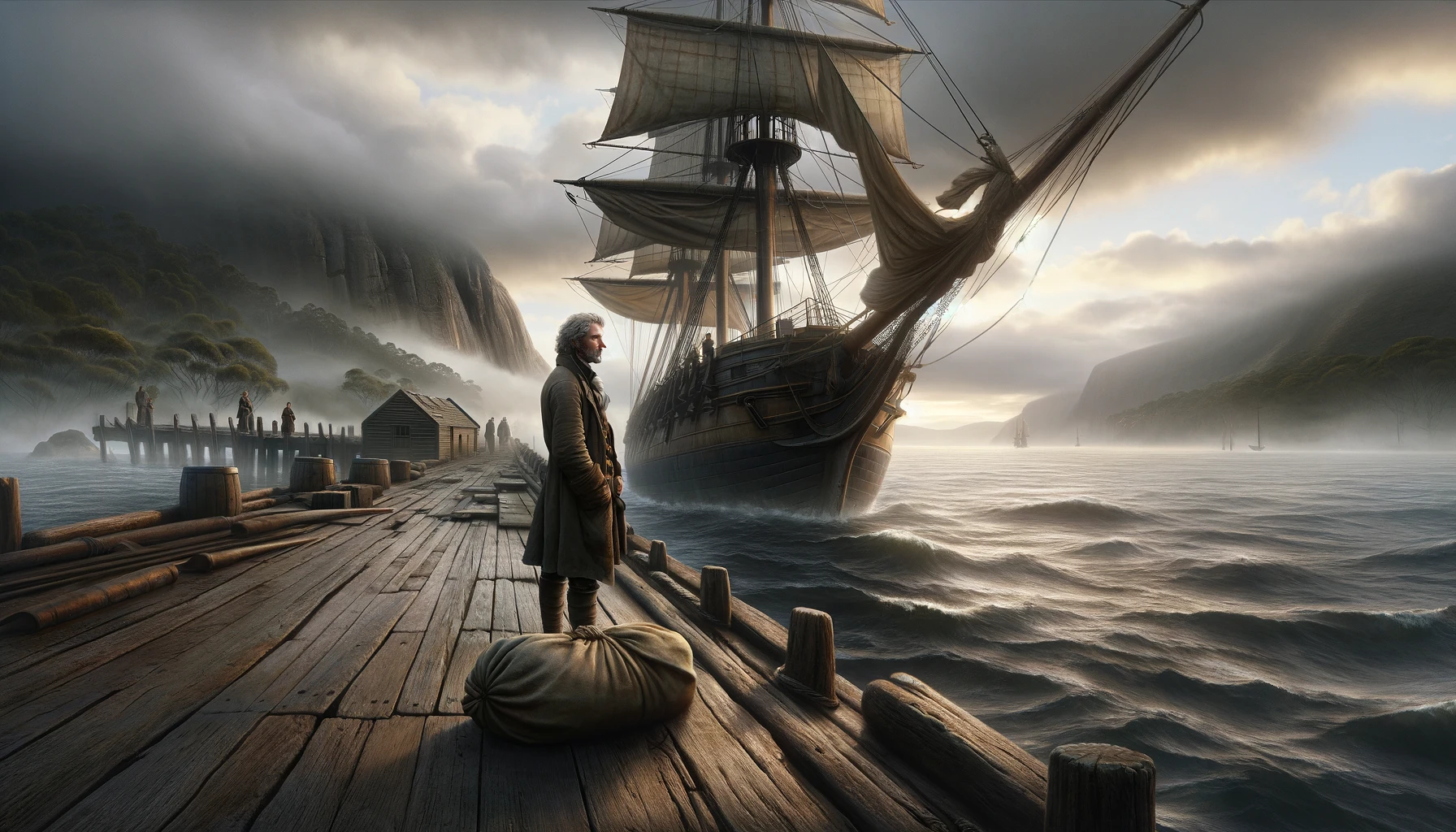
The coastline of Van Diemen's Land emerged from the morning mist on the seventeenth of March, grey cliffs rising from grey water beneath an overcast sky. The merchant brig Doris had been fourteen days at sea since departing Sydney, navigating the eastern coast and crossing the unpredictable waters of Bass Strait before entering the mouth of the Derwent River. Now, as she rounded the final headland into Sullivan's Cove, her passengers gathered at the rails for their first glimpse of the settlement that would be their new home.
Mount Wellington dominated the landscape, rising from the surrounding terrain like a fortress wall. Its flanks were cloaked in dense forest that gave way to bare rock near the summit, and snow lingered on the higher elevations despite the approaching autumn. The mountain watched over Hobart Town with an inescapable presence, its moods reflected in the weather that swept down from its heights to buffet the settlement below.
The town itself presented a stark contrast to the established streets of Sydney. Where New South Wales's capital had grown into something approaching proper civic architecture, Hobart Town remained stubbornly raw—a collection of timber structures and bark huts clinging to the waterfront, with only a few more substantial buildings rising among the makeshift dwellings. The colony was barely a decade old, founded in 1804 as a secondary settlement, and its youth showed in every rough-hewn plank and muddy track.
Sullivan's Cove served as the settlement's harbour, its waters sheltered from the worst of the river's currents. The wharf was a functional affair of timber planks laid across stone pilings, showing the marks of hasty construction but adequate to the task of receiving the vessels that connected Van Diemen's Land to the wider world. Dockworkers moved along its length as the Doris eased alongside, their numbers far fewer than the crowds that thronged Sydney's waterfront.
The passenger manifest recorded approximately thirty souls completing the voyage from New South Wales. They represented the usual mix of colonial society in motion—government officials taking up appointments, settlers pursuing land grants, merchants investigating commercial opportunities, and freedmen carrying certificates that declared them no longer property of the Crown. Some had made the journey before and knew what awaited them; others stepped onto the wharf with expressions that mingled anticipation with apprehension.
The disembarkation proceeded with the organised efficiency of routine. Government clerks in dark coats checked documents and directed new arrivals toward the commissariat for registration. Cargo was unloaded into waiting carts—manufactured goods from England, supplies from Sydney warehouses, correspondence for the colonial administration. The sounds of a working harbour filled the air: shouts and curses, the creak of cranes, the splash of oars as boats ferried goods and people between ship and shore.
Beyond the immediate disorder of the waterfront, signs of growth were visible to those who looked carefully. Timber frames rose where new buildings were under construction. Cleared land stretched back from the shore toward the foothills. Carts moved along roads that were little more than muddy tracks, but they moved with purpose, carrying materials toward destinations that spoke of commerce and expansion.
Van Diemen's Land in March of 1815 was a place of potential rather than achievement—a settlement that had not yet decided whether it intended to flourish or to fade. The men and women who disembarked from the Doris that morning would play their various parts in answering that question, their individual ambitions contributing to whatever future the colony would eventually claim.
The mountain watched in silence as the new arrivals dispersed into the settlement, its snow-capped peak disappearing into clouds that had begun to gather with the afternoon. Whatever judgments it rendered on the human activity below, it kept to itself.







