4344.36 · February 5, 2024 AD
The Daughter They Know
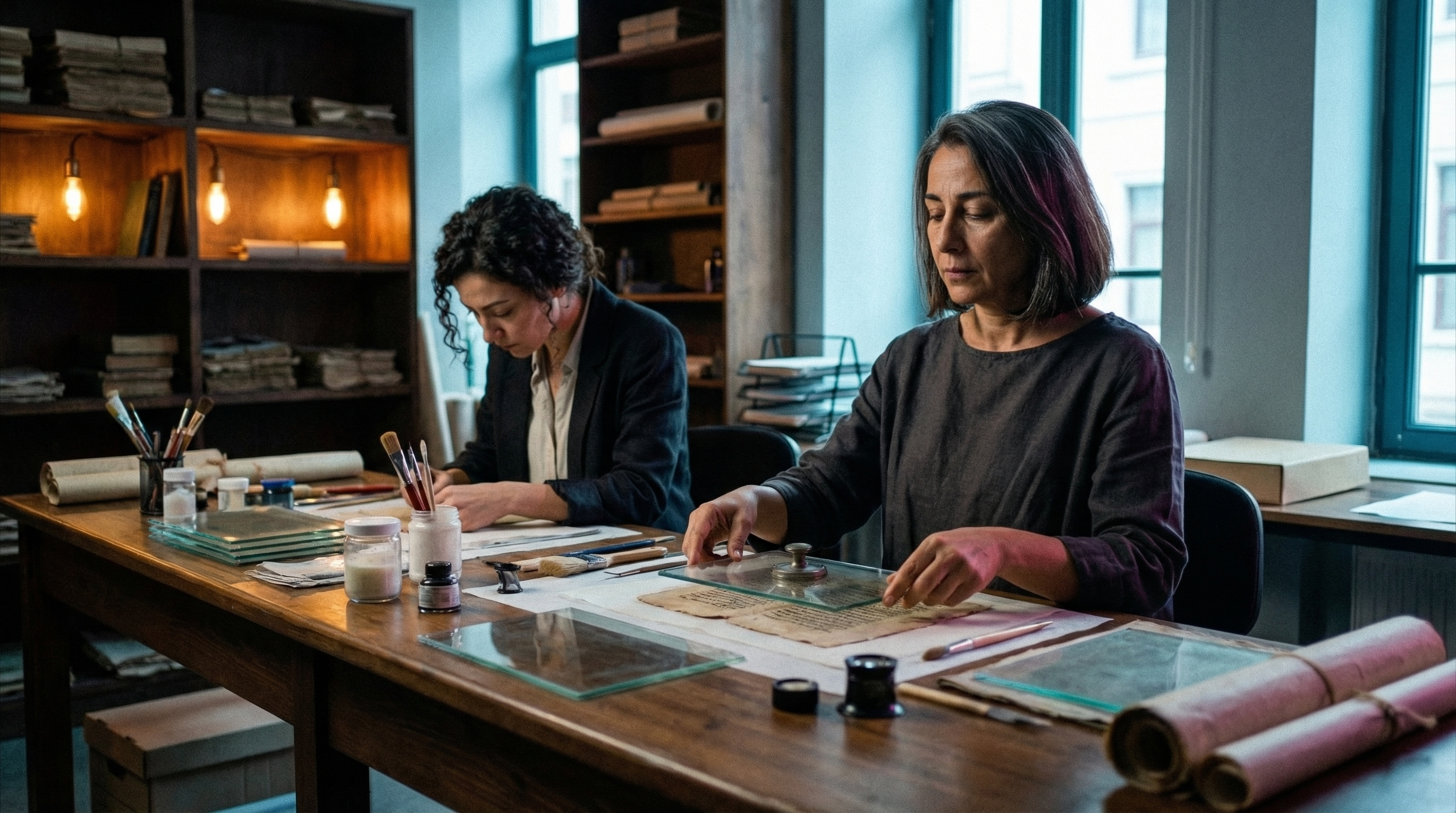
Deniz talks to damaged manuscripts like nervous animals. Mira understands. Some things are easier to care for when they can't ask questions back. The conservation lab is the one place where the world slows to the pace of preservation—where attention to fragile things feels like enough. Then her phone buzzes. And Mira steps into the corridor to become someone she recognises less and less each time she performs her.
"My parents raised me to value truth above everything. That's the part that makes the lying unbearable."
The conservation lab on the second floor of the Karaköy facility had the best light in the building.
This wasn't accidental. When Mehmet Bey had established the archive in the 1820s, he'd understood that preserving documents required more than temperature-controlled vaults and sealed containers. It required people who could see what they were working with—who could distinguish foxing from intentional pigment, identify the precise grain of a papyrus sheet, spot hairline fractures in clay that would become catastrophic cracks if handled incorrectly. He'd positioned the conservation lab on the north-facing side of the second floor, where the light came in steady and cool through tall windows that had been replaced three times in two centuries but always maintained the same proportions.
Deniz Kaya was standing at the long central bench when I arrived, already deep in conversation with a Byzantine manuscript fragment that couldn't hear her but which she addressed with the patient authority of a surgeon speaking to an anaesthetised patient.
"You've lost your margin entirely on the left," she murmured, adjusting the weighted glass plate that held the parchment flat. "And someone has tried to repair you with fish glue at some point, which was a terrible decision and we're going to undo it very carefully."
"Morning, Deniz."
She glanced up. "Ah. You're early. That's either admirable or concerning." She studied me over the top of her reading glasses—tortoiseshell, perpetually sliding down her nose, attached to a beaded chain that she claimed her daughter had made for her but which I suspected she'd bought from a street vendor in Eminönü and attributed to familial love for sentimental reasons. "Have you eaten?"
"I had tea."
"Tea is not food, Mira."
"It's a hot liquid containing trace nutrients."
"It's water that has been acquainted with a leaf." She returned her attention to the manuscript. "There's börek in the kitchen. Handan brought it. Spinach and cheese. Eat something before you start handling materials. Your hands shake when your blood sugar drops and I refuse to be responsible for you cracking a second-century papyrus because you skipped breakfast."
This was Deniz. Fifty-three years old, trained in paper and manuscript conservation at the Süleymaniye Library before being recruited into The Preservation twenty-two years ago by an Archive Keeper whose name she never mentioned and whose methods she occasionally described as "persuasive in the way earthquakes are persuasive." She treated every document that passed through her hands as though it were simultaneously priceless and slightly disappointing—a parent's attitude, essentially, applied to objects that ranged from Ottoman tax records to fragments of Alexandrian scrolls that had survived fires, floods, and two millennia of institutional neglect.
She was the best conservator I'd ever worked with. She was also the person most likely to notice if I hadn't slept, hadn't eaten, or was handling materials with insufficient care, and to comment on all three with the diplomatic restraint of a foghorn.
I went to the kitchen—a narrow room off the main corridor that contained a kettle, a small fridge, a microwave that nobody trusted, and whatever food the facility's small staff brought in to share. Handan's börek was on the counter, still warm, wrapped in the particular way that Turkish grandmothers wrap things—a precise fold of aluminium foil that managed to be both functional and aesthetically judgemental, as though the wrapping itself was commenting on the inadequacy of your own domestic skills.
I ate a piece standing at the counter. Then a second piece, because Deniz would ask and I wanted to be able to say "two" without lying, and because it was actually very good börek and I hadn't eaten properly since the chestnuts I'd bought walking home from Aylin's yesterday.
Back in the conservation lab, I settled at my workstation—a smaller bench near the window where the digitisation equipment was set up. The facility's ongoing project was systematic: every document in the archive needed to be photographed at high resolution, catalogued with full metadata, and uploaded to the digital preservation system. It was the kind of work that would take years even with a full team, and we didn't have a full team. We had Deniz, Handan (who came three days a week and was technically retired), a rotating cast of junior Archive Keepers of whom I was the most consistent, and occasional visits from specialists when something particularly complex turned up.
Today I was working through a set of Ottoman-era correspondence from the 1840s—letters between Mehmet Bey and other Archive Keepers across the network, discussing the consolidation of materials into the new Karaköy facility. Routine work. Historically interesting in a low-key way—the letters revealed the logistics of moving fragile documents across continents in an era before climate-controlled transport, the particular anxieties of people who knew that a single shipwreck or warehouse fire could destroy centuries of careful preservation.
Deniz worked in comfortable silence beside me, occasionally murmuring to her manuscript. The lab had its own soundscape—the soft click of the camera shutter, the hum of the environmental control system, the whisper of Deniz's brush against parchment, the distant sound of the Karaköy streets filtering through walls thick enough to muffle everything to a gentle haze. It was one of the few places in Istanbul where I felt genuinely calm. The world outside was chaotic and loud and full of people living at speeds that exhausted me. In here, time moved differently. Slowly. Carefully. At the pace of preservation.
I'd been working for about ninety minutes—photographing, cataloguing, entering metadata into the system—when my phone buzzed in my pocket.
I ignored it. Continued adjusting the camera angle on a particularly faded letter.
It buzzed again.
And again.
Three buzzes in quick succession meant it wasn't a notification. It was a call.
I pulled the phone out. The screen said Anne.
Deniz glanced over. "Go," she said, without being asked. "I'll keep an eye on your setup."
I mouthed a thank-you and stepped into the corridor. The hallway was narrow, lined with shelves of archival supplies—acid-free boxes, tissue paper, rolls of conservation-grade adhesive—and lit by overhead fluorescents that cast a flat, clinical light completely at odds with the elegant windows of the lab. I leaned against the wall and answered.
"Merhaba, Anne."
"Mira, canım, finally! I called twice already. Are you at work?"
"I'm at the facility, yes. Sorry, I was in the middle of something."
"Always in the middle of something." My mother's voice carried the particular blend of affection and mild reproach that she'd perfected over twenty-seven years of raising a daughter who had inherited her father's capacity for total absorption and none of his ability to resurface at socially appropriate intervals. "Are you eating?"
"I just had börek."
"Real börek? Homemade?"
"Handan made it. Spinach and cheese."
"Good. Handan is a sensible woman." A pause. I could hear the kitchen sounds of my parents' Ankara flat in the background—the rattle of the teapot lid, the click of the gas stove, the particular acoustics of a room where my mother had been cooking for thirty years. "Now. Saturday. You're coming, yes?"
Saturday. The family dinner I'd been half-expecting and half-dreading since my father had mentioned it on the phone last week. I'd been vague then, noncommittal. My mother was not a person who tolerated vagueness or noncommitment.
"I'm planning to, Anne. I just need to check—"
"Check what? What is there to check? You take the bus from Istanbul. It's five hours. You arrive. You eat. You sleep in your bed. You leave on Sunday. This is not complicated."
"I know, but work has been—"
"Work is always busy, Mira. Work will still be there on Monday. Your family is here on Saturday. Sevgi Teyze is coming from Kayseri. She hasn't seen you since the funeral."
The funeral. My grandmother's funeral, two months ago. The last time I'd been in Ankara, standing in a room full of relatives who'd mourned Ayşe as grandmother and matriarch and didn't know she'd been anything else.
"I'll be there," I said. "I'll get the early bus."
"The 7 AM? That gets you in by noon. I'll make mantı."
"You don't have to make mantı, Anne."
"I want to make mantı. You're too thin. Aylin told your father you're not eating properly."
I closed my eyes. Of course Aylin had spoken to my father. She'd met my parents several times over the years—dinners, graduations, the iftar that Deniz had mentioned—and had the kind of easy rapport with them that I envied precisely because it was uncomplicated. Aylin could talk to my parents about her work, her life, her relationships, without filtering a single word through the mesh of secrecy that made every conversation I had with them an exercise in careful omission.
"Aylin exaggerates," I said.
"Aylin is worried about you. I am worried about you. Your father is worried about you, though he expresses it by asking about your career instead of your eating habits because he is a man and this is how men worry."
I almost laughed. My mother's ability to deliver precise psychological assessments disguised as casual conversation was one of her most formidable qualities.
"I'm fine, Anne. Really. The work has just been demanding lately."
"The private collection work."
"Yes."
A beat of silence. My mother was not a fool. She'd never pressed me about the specifics of what I did—had accepted my explanation that I worked for wealthy families who valued discretion, that the work involved manuscript preservation and archival cataloguing, that the pay was modest but the materials were extraordinary. She'd accepted it because it was plausible and because her daughter had a doctorate from SOAS and was clearly not doing anything criminal and because sometimes parents choose to trust the shape of an explanation even when the details don't quite resolve.
But I could feel, sometimes, that she sensed the gaps. Not the way Aylin did—Aylin was a journalist, trained to hear what wasn't being said. Elif Osman was a librarian, trained to notice when the catalogue didn't match the shelves.
"Your father wants to speak to you," she said. "He's been hovering since I dialled. Hold on."
A shuffle. Muffled Turkish—my mother saying something sharp, my father's lower voice responding, the familiar sound of a phone being passed between two people who'd been married for thirty-one years and had long since abandoned any pretence of smooth handoffs.
"Mira."
"Merhaba, Baba."
My father's voice was different from my mother's—quieter, more measured, the voice of a man who'd spent four decades lecturing on Ottoman history and had learned to modulate his tone for maximum clarity with minimum volume. Kemal Osman spoke the way he wrote—precisely, with an awareness of structure, every sentence doing exactly one job.
"Your mother tells me you're coming Saturday."
"I am. Early bus."
"Good. It's been too long." A pause that I recognised—my father gathering his thoughts into their proper order before deploying them. "I spoke with Professor Aksoy at the department last week. He mentioned there's a position opening in the spring. Ancient Near Eastern languages. Part-time initially, but with potential to become permanent."
"Baba—"
"I'm not pressuring you. I'm informing you. There's a difference, and I respect your ability to recognise it."
This was my father's particular gift—the ability to apply pressure whilst simultaneously insisting he wasn't applying pressure, delivered with such intellectual honesty that you almost believed him. He genuinely thought he was just passing along information. He genuinely didn't see how every mention of every academic position was a quiet referendum on the choices I'd made since finishing my doctorate.
"I appreciate you telling me," I said. "But I'm not looking for a university position right now. The work I'm doing is—"
"Important. Yes. You've said." No edge in his voice. No disapproval. Just the flat acknowledgement of a man who'd heard the same answer enough times to recognise it as a wall rather than a window. "Can you tell me what you're working on currently? In general terms, if the families you work for require discretion."
In general terms. If the families require discretion. He was trying so hard to meet me on my territory, to respect the boundaries I'd drawn, and every word of that effort made the deception worse.
"I've been doing a lot of catalogue cross-referencing lately," I said. Which was true. "Comparing holdings across different private collections to identify duplicates and mislabelled items." Also true. "It's painstaking but occasionally you find something that's been misidentified or overlooked." Spectacularly true.
"That sounds like valuable work," he said, and I could hear him choosing to be satisfied with this, choosing to believe that his daughter's career was coherent even if he couldn't see its shape. "Your grandmother would have enjoyed the detective aspect of it."
My throat tightened. He said it casually—a fond reference, grandmother and granddaughter sharing intellectual DNA, the kind of thing families say about their dead without knowing how precisely true it is.
"She would have," I managed.
"We miss her at these dinners. She always had opinions about the food."
"She had opinions about everything, Baba."
"She did." A warmth in his voice that made me want to cry, standing in the fluorescent-lit corridor of a secret archive facility, surrounded by acid-free boxes, holding a phone that connected me to a world where my grandmother was simply a grandmother and nothing more. "Saturday, then. Your mother is making mantı. I'm told this is non-negotiable."
"I heard."
"Bring something warm. The heating in your old room is unreliable. I keep meaning to call someone about it."
"You've been meaning to call someone about it since 2015, Baba."
"These things take time. Proper research is required before selecting a tradesperson."
I smiled. This was an old joke between us—my father's tendency to approach every domestic task with the same rigorous methodology he applied to Ottoman historiography, resulting in projects that were exquisitely researched and never actually completed.
"I'll bring a jumper."
"Bring two. Your mother will worry otherwise, and when your mother worries the mantı suffers, and I refuse to accept substandard mantı because of inadequate layering decisions."
"I love you, Baba."
"I love you too, Mira. We'll see you Saturday."
He hung up. My father had always been the one to end phone calls—a small assertion of control in a household where my mother managed virtually everything else through sheer force of organisational will.
I stood in the corridor. The fluorescent light hummed. A shelf of acid-free tissue paper sat to my left, neatly stacked, labelled in Deniz's precise handwriting. Through the wall, I could hear the faint click of the camera shutter—Deniz had started photographing something, keeping the digitisation moving whilst I was on the phone.
Professor Aksoy's position. Ancient Near Eastern languages. Part-time with potential for permanence. A year ago—even six months ago—I might have considered it. Might have imagined a version of my life that included lecture halls and peer-reviewed publications and the steady accumulation of institutional respectability. A life my parents could see clearly, could describe to relatives at Saturday dinners without pausing to construct careful fictions.
Your grandmother would have enjoyed the detective aspect of it.
She had enjoyed it. Had spent fifty years enjoying it, in this very building, walking these corridors, handling materials that my father—a professional historian—would have given years of his life to study. Ayşe had sat in the same conservation lab where Deniz now worked, had catalogued the same shelves I was digitising, had lived the same double life I was living now. Had sat through the same family dinners, answering the same questions with the same half-truths, loving the same people she couldn't be honest with.
For fifty years.
I looked at my phone. The call log showed six minutes and forty-three seconds. Six minutes of performing the daughter they knew. Six minutes of being Mira-who-works-for-private-collectors, Mira-who-should-consider-academia, Mira-whose-grandmother-was-just-a-grandmother.
Saturday I'd do it for hours. Sit in the flat in Ankara where I'd grown up, eat my mother's mantı, answer Sevgi Teyze's questions about whether I was seeing anyone, listen to my father discuss the latest developments in Ottoman historiography with the passion he brought to everything academic, and keep the wall up the entire time. Smile. Nod. Deflect. Love them completely and lie to them constantly and hope that the lying didn't eventually rot the love from the inside out the way damp rots old paper—slowly, invisibly, until one day you pick it up and it falls apart in your hands.
I put the phone in my pocket. Pushed off the wall. Walked back into the conservation lab.
Deniz was standing at my workstation, examining one of the Ottoman letters through a magnifying loupe. She looked up when I came in.
"Everything all right?"
"Family dinner on Saturday. My mother is making mantı."
"Your mother's mantı?"
"You've never had my mother's mantı."
"No, but the way you say it tells me everything I need to know. Mothers who make mantı for homecoming daughters are making a statement, not a meal." She set the loupe down. "Go. Enjoy it. This—" she gestured at the lab, the shelves, the centuries of accumulated material surrounding us, "—will still be here on Monday."
The same thing Aylin had said, essentially. The same thing everyone said. The work will still be there. As though the work were the problem. As though the reason I struggled to leave wasn't that the work consumed me but that leaving meant returning to a world where she was someone slightly different, slightly less real, slightly more constructed.
"I know," I said. "I will."
I sat back down at my bench. Adjusted the camera. Placed the next letter under the lights — another piece of correspondence from the 1840s, Mehmet Bey writing to an Archive Keeper in Rome about the safe transport of a collection of Mesopotamian cylinder seals.
The materials survived the journey from Baghdad to Constantinople without incident, he wrote, in Ottoman Turkish that I could read as easily as modern text. However, I remain concerned about the cataloguing methods employed by our colleagues in the eastern facilities. Several items arrived with descriptions so vague as to be useless. I have written to Yusuf Bey requesting standardised protocols. Whether he will comply is another matter entirely.
I smiled. Some frustrations were apparently timeless.
"Something good?" Deniz asked, without looking up from her manuscript.
"Mehmet Bey complaining about cataloguing standards in 1843."
"Sounds like Mehmet Bey and I would have got along." She held a strip of Japanese tissue up to the light, checking its weight. "Hand me the wheat starch, would you?"
I passed her the jar. She thanked me with a nod and began applying adhesive to a tear in the parchment with the focus of someone defusing a bomb, her breath held, her fingers completely steady.
I clicked the shutter. Moved to the next letter.







