4338.206 · July 25, 2018 AD
The Curse of the Black Dress
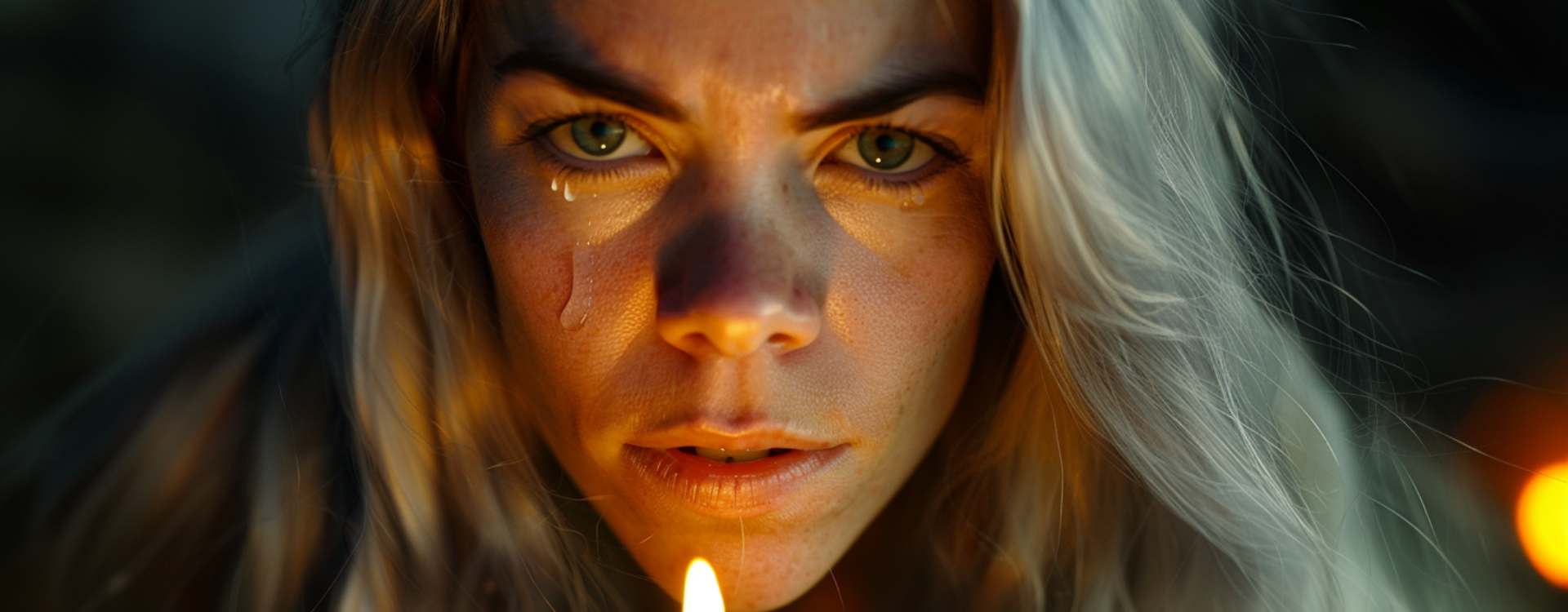
As Beatrix joins Gladys, Luke, and Cody in a candlelit vigil for a boy they never knew, the room thickens with grief, guilt, and unspoken truths. In a night of toasts, tremors, and a single devastating decision, Beatrix realises some threads can’t be unpicked without everything unravelling.
"Some dresses are stitched with silk and some with sorrow. This one’s soaked in both—and I’m done wearing it."
I gave the car horn another long press, the sound slicing through the quiet of the night, marking the exact time of ten-fifty. It echoed off the trees and the distant backyard sheds like a summons, sharp and unforgiving. Impatience bubbled inside me, rising from somewhere deep, uncoiling like a tight spring. I tapped the steering wheel in frustration, the rhythmic thud of my fingertips betraying the anxious energy I could no longer contain. My legs jiggled uncontrollably beneath the dashboard, the tension flooding my limbs as if movement could drain it away.
"What the hell are you doing in there, Gladys?" I muttered to no one, my voice low and sharp. The question dissolved into the cold air, curling into the shadows that clung stubbornly to the corners of the car’s interior.
The dashboard clock ticked with maddening precision, its glowing numbers a quiet taunt. Ten-fifty-one. The minutes were beginning to stretch unnaturally, like time itself had decided to mock me. I shifted in my seat, the leather creaking beneath me, and glanced again at the porch light in the distance, still glowing—still unchanged.
She was never on time, but tonight that fact scraped against my nerves with unusual urgency. Every second spent waiting amplified the dissonance in me. I didn’t know whether it was frustration at her, nerves from the evening, or the residual shadow of Leigh’s sudden appearance in the car park. Probably all three. My body was still on high alert, as though the night had left fingerprints on my skin that I couldn’t scrub off.
I huffed, dragging my fingers down my face in a moment of futile exasperation. Maybe this was my punishment for agreeing to wear the dress again. For letting Jarod get under my skin. For letting Leigh drag me into whatever-the-hell this was. Again.
And now, like some final absurdity, I was being made to wait.
For Gladys.
Of course.
Finally, the front door of the house swung open, spilling a shaft of warm yellow light onto the front step. Gladys emerged, her silhouette brisk and unmistakably impatient as she yanked the door closed behind her. The wooden frame slammed shut with a definitive bang, the sudden sound fracturing the stillness and causing me to jolt in my seat. My heart skipped a beat, the involuntary thud pulsing in my throat. I hadn’t realised how tightly strung I was until that moment.
"You’re all dressed up," Gladys observed as she opened the passenger door and slid into the seat beside me, her tone tinged with something I couldn’t immediately place—surprise, maybe, or perhaps mild judgement.
"And you’re not," I shot back, my eyes flicking over to take in her outfit—jeans, trainers, and a hoodie with a faded logo stretched across the front. The words left my mouth sharper than intended, laced with the frustration I’d been swallowing since I’d left MONA. The contrast between her thrown-together casual and my carefully selected black dress, still pristine despite the evening’s chaos, was almost comical. It summed us up in an instant—two people on the same path, yet walking at entirely different paces.
"Do you want me to get changed?" Gladys snapped, her hand already moving towards the door handle, a familiar flare of defiance flashing across her face.
"Don’t worry about it," I sighed, the tension slipping from my shoulders as the pressure of the moment began to ebb. "No time for that now." There wasn’t. Not really. The night had already stretched thin, and I didn’t have the patience to unravel another thread.
"You’re in a mood," Gladys scoffed, her voice settling into that infuriatingly perceptive tone that only a sister could manage—equal parts teasing and entirely accurate.
I chose not to answer. Instead, I focused on the road ahead, slipping the car into gear and pulling away from the kerb with a firm foot and a mind still cluttered. The silence that fell between us wasn’t awkward. It was something older than words, a kind of truce built from years of navigating each other’s sharp edges. The tension hung in the space like mist—unspoken, unresolved, but somehow, oddly comforting.
Gripping the steering wheel tightly, I tried to steady my hands, though the faint tremor in my fingers betrayed the storm still raging beneath my skin. The cool leather beneath my palms did little to soothe me. My knuckles stood out pale against the wheel as I flexed my grip—once, twice—each movement a silent mantra: hold it together. The decision to meet up with Jarod loomed large, a growing thunderhead in the back of my mind. It would only cause trouble, I chided myself again, the words circling like vultures over whatever calm I had left.
Over the past few years, I’d fought hard—harder than anyone could have known—to suppress the instinctive flick of the wrist, the wandering fingers, the adrenaline buzz of a perfectly timed lift. I’d extracted myself from the playgrounds of temptation: casinos, gala events, high-end shops with far too few cameras. I’d built a life around avoiding triggers, around staying still. But tonight had nudged the door ajar. And Jarod... he had a way of blowing things wide open.
"Did you get anything for the memorial?" Gladys’s voice broke the silence, sudden and sharp. Her words landed like a pebble tossed into murky water, drawing my focus up from the depths. I blinked, realising I hadn’t heard a thing outside my own mind for the last few minutes.
"No," I replied flatly, the word clipped, the tone unintentional but accurate. My mind was too full, my nerves too raw to feign politeness.
"I got some scented candles," she continued, undeterred, reaching into her bag with the quiet diligence of someone trying not to make a scene. Her rummaging was punctuated by the soft clink of glass. One by one, she drew out several small votives—lavender, rosemary, something musky I couldn’t name. "We can say they’re from both of us, if you like?"
I glanced at her from the corner of my eye. Her face was turned forward, eyes fixed on the road ahead, but there was a tightness to her jaw that told me she was bracing for a brush-off. I responded with a small shrug, unsure how else to acknowledge her effort. It wasn’t unkindness—just fatigue. The kind that seeps in not from physical exertion, but from too many secrets, too many almosts, too many versions of myself I’d had to suppress just to survive the night.
The car lapsed back into its awkward silence, the kind that crackled not with hostility, but with the weight of everything unsaid. The road stretched ahead, dark and winding, the headlights sweeping through the night. And I drove on, clinging to the rhythm of the engine, to the quiet flick of the indicators, anything but the noise in my own head.
"Did you bring any spirits?" I found myself asking, the words slipping out with a desperation I hadn’t intended to reveal. The thought of stepping into the memorial without something to blunt the edges of my spiralling thoughts felt impossible. A shot or two of something strong—just enough to take the sting out of the night—suddenly seemed not only reasonable, but vital.
"Cody is bringing the whiskey," Gladys responded, her voice maddeningly casual.
"Cody is coming?" I repeated, unable to keep the edge of disbelief from sharpening my tone. That detail had clearly been omitted from our earlier exchanges—and for good reason, it seemed. The idea of him being there unsettled me in a way I didn’t have the energy to dissect.
"Yeah," Gladys confirmed, nonchalantly. "He said he’ll meet us there."
I didn’t respond. I couldn’t. Instead, I focused on the rhythm of the road as it unravelled ahead of us, the headlights carving a soft path through the evening haze. The streetlamps seemed duller than usual, the houses quiet, their interiors glowing faintly with the amber hue of domesticity—safe, settled, oblivious to the emotional landmines we were approaching.
Several minutes later, we turned into Luke’s driveway. The scene was subdued, the hush almost reverent. Only Jamie’s car was present, sitting stoically beneath a flickering light. The absence of other vehicles, of any other noise, gave the moment an eerie stillness, as though time itself had paused to honour the night’s significance.
"Let’s wait for Cody," Gladys suggested, her voice now laced with something firmer—concern, perhaps, or misplaced wisdom—as she reached across and wrapped her hand around my arm just as I moved to open the door.
The contact sent a spike of agitation straight through me. My patience, already brittle, shattered under the pressure of her grip. I yanked my arm free, my heart pounding with the need to move, to do, to escape.
"I’m not waiting," I snapped, my voice low but unwavering.
Without another word, I stepped out into the cool night, the air biting against my exposed arms, my breath already fogging as I slammed the car door behind me. The sound was loud, almost vulgar in the quiet, like a cymbal crash at a funeral. It echoed through the driveway, a punctuation mark to the brief exchange, and perhaps a warning to whatever came next.
Standing on the small front porch, I paused, drawing in a long breath as the night air met my skin. It was crisp, tinged with the scent of damp earth and eucalyptus, pulling me back into the present. The cold crept into my chest, momentarily numbing the ache that had been expanding there all evening. I closed my eyes for a second, letting the stillness wrap around me like armour. This is Joel’s night now, I reminded myself, gripping the railing as though to hold the thought in place. It’s not about Jarod, or Leigh, or any of it. Just Joel. A mantra, plain and pointed, trying to pierce through the clutter.
The porch light flickered gently overhead, casting long, uncertain shadows at my feet.
Gladys appeared beside me, her presence sudden but not unwelcome. She said nothing, just inhaled deeply, mirroring my attempt at composure. Then came the front door—its weathered hinges singing out a rusty protest as she pushed it open, the sound far too loud in the reverent hush of the moment.
"Hey, Luke," we both offered, our voices overlapping with an accidental synchronicity that stirred the quiet air. It didn’t fix anything, but it softened the edge of what was about to follow.
From within, the unmistakable clink of glass on stone rang out—sharp and decisive. The kind of sound that carried meaning when nothing else dared. A shot glass. I didn’t even need to look to know.
Then came Cody’s laugh. That rich, easy baritone that filled rooms and tried to smooth over cracks with sheer volume. But even that felt out of place here, like someone whistling through a graveyard.
"You two couldn’t even wait for us?" Gladys asked, her tone straddling that fine line between faux outrage and genuine reproach. Her gaze was fixed on the bottle, but her attention was on Cody.
"How rude," I added, lips curling into a smirk that didn’t quite reach my eyes. Still, it was something—an offering, however hollow, to the spirit of the gathering.
"I was just cheering Luke up," Cody said, tossing the words out casually. But the lie hung there, thin and unconvincing. His eyes didn’t quite meet ours, skimming past, refusing to land.
"I’m sure," Gladys replied, her voice cool and clipped, the subtle barbs beneath her words revealing themselves only to those who knew her well. She didn’t trust the moment, or perhaps she just didn’t like the way grief made people reach for whatever numbed fastest. Either way, her guard was up—and suddenly, so was mine.
Approaching the bench, I slowed my steps, watching as Luke aligned his glass with a delicacy that seemed almost ritualistic. Each one stood like a silent sentry, an emblem of remembrance or perhaps retreat, marking the progression of the night in measures of liquid resilience. There was something sacred in the stillness of his action, as though the act of straightening tumblers was the only thing keeping the grief from flooding over him.
Cody, for his part, poured with casual efficiency, his hand steady despite the undertow of sorrow that tugged at all of us. The amber liquid caught the overhead light, shimmering briefly before settling into stillness. I couldn’t help but think how often distraction masqueraded as purpose—his focused movements a shield against words unspoken, truths untouched.
"So how—" I began, the question slipping from my mouth before I had the chance to second-guess it. But it was immediately cut short.
"I really don’t want to talk about it," Luke said, quick and firm. His voice, though level, carried the unmistakable thrum of exhaustion—emotional, physical, existential. The kind of tired that no amount of sleep could mend.
"Or drunk," Gladys muttered, her tone needling but laced with that undercurrent of familial concern she rarely allowed to show.
In that moment, our eyes met—mine and hers—and for once, there was no combat, no clashing of wills. Just mutual understanding. A silent ceasefire born of shared helplessness.
"Not yet," Luke replied, and the words hung in the space between us, suspended by their candour. It wasn’t a joke, nor was it an admission—it was a line in the sand, drawn by a man who hadn’t decided yet whether to cross it.
As we stood there, shoulder to shoulder in that dimly lit kitchen—cups waiting, grief looming, and the air thick with unsaid things—I realised how tightly stitched we all were by our shared scars. This house, this moment, bore witness to who we had been, and who we were still becoming in the shadow of loss. And while we might never say it outright, we were all trying—clumsily, quietly—to keep each other from drowning.
"We’ve brought the candles," I announced, the words drifting gently through the haze of drink and unspoken thoughts, a small declaration of purpose that shifted the mood, if only fractionally. It wasn’t much, but it was something—an anchor to remind us why we were here, and who we were missing.
Gladys caught the cue immediately, hoisting her handbag onto the bench with the ease of someone who’d been carrying not just candles, but the weight of expectation. Her silence was an invitation; I reached in without a word, sifting through the mismatched collection she’d gathered—pillars, tea lights, a stubby little thing that smelled vaguely of eucalyptus. It was chaotic, but oddly fitting. Grief wasn’t neat either.
Luke moved then, purposefully, as if our gesture had sparked something in him. He rummaged through the drawers with the distracted air of someone half in the moment and half somewhere else entirely. His search ended when he found the gas lighter, which he handed to me with no words exchanged. None were needed. In his eyes, I saw a flicker of gratitude—or maybe just relief at having something to do that didn’t involve feeling.
I took it, nodding slightly, and began to light the candles one by one. The scent of melting wax mingled with the faint residual smell of whiskey in the air. There was something deeply meditative in the act, each flame a quiet promise, a whispered name.
"Are you sure you have enough candles?" Cody’s chuckle broke the silence, misplaced in its attempt at levity. It grated against the hush like a record scratch.
I shot him a look, sharp enough to silence a room. And it did. That kind of humour might have worked on another night, any other night. But not tonight.
"Turn the lights off," I said softly to Luke, the firmness in my tone brooking no contradiction. The moment demanded more than flickering ambience—it demanded intention. Darkness gave the candles dominion, gave memory space to stretch and settle into the bones of the house.
The switch clicked.
The room transformed instantly. The overhead glare disappeared, replaced by the warm, flickering hush of candlelight. Shadows swelled and danced across the walls, giving the space an otherworldly quality, like we had stepped out of time. The kitchen, with its marble tiles and glossy laminate, felt like a cathedral.
We stood close, the four of us, the island bench between us as Cody began to hand out the shot glasses. There was no toasting, no fanfare—just silent acknowledgement as each of us took one, the glass cool and small in the hand, a vessel for a sorrow too large to measure.
The candlelight reflected off each surface, casting halos around our still forms. It was grief made visible. Reverence distilled. And for the first time that evening, the silence didn’t feel awkward. It felt right.
"Do you have a picture of him?" The question slipped out before I could rein it in, an instinctive reach for something tangible—something to fix the grief to a face, an image, a name. A part of me instantly regretted it, worried I’d prodded too hard at a wound barely scabbed over.
Luke’s response came with a slow shake of his head, the movement almost imperceptible. "No," he admitted softly, his voice caught somewhere between confession and lament. "We only learnt about him a few months ago." The rawness in his tone wasn’t loud, but it cut deep. His grief wasn’t dramatic—it was quiet, worn, and all the more haunting for it. The kind that sits low in the belly and doesn’t move unless summoned.
Gladys’s brow furrowed as she leaned slightly forward, her voice a feather in the dark. "Does… does Jamie know he’s dead yet?" The question was cautious, reverent, as if saying the words too plainly might summon something unmanageable. I glanced at her, noting how her features softened in that moment—an unexpected grace from someone so often rough-edged.
My breath caught as Luke shook his head again, slower this time. "No," he said, the single syllable almost inaudible. "And he won’t ever find out. Cody took care of it." His glance towards Cody was brief but heavy—there was weight behind it. Thankfulness, yes, but also the unspoken burden of what had been erased.
"Yeah," Cody echoed. His voice had lost its edges. It was dull, flat, as if pressed down by everything he wasn’t saying. He stared into the shot glasses like they were augury tools, some oracle of fire and liquid that might tell him whether he’d done the right thing. I doubted he’d ever get an answer.
"It’s so sad," I murmured, my own voice hollow with the realisation settling in. There had been no ceremony, no photograph, no anecdotes passed around a lounge room filled with laughter and stories of a life lived. Just silence. Just shadows.
"He looked so young."
"He was," Luke replied, and in those two words was a quiet devastation I couldn’t begin to unpack. "He was only nineteen."
"Tragic," Gladys breathed, her hand lifting to swipe at a tear that had made its way down her cheek, uninvited but not unwelcome. There was something deeply human in the way she did it—not self-conscious or performative, just a simple act of grief.
And there we stood—four people lit by flickering candlelight, holding glasses of whiskey like relics, speaking softly of a boy we’d never truly known but somehow already missed.
Then, as if driven by a force greater than ourselves, Luke raised his shot glass—a gesture that silenced the room, a silent summons for unity in grief. No words were needed; the movement alone held weight. Without hesitation, we followed suit, each of us lifting our glass with a reverence that turned the act into something almost ceremonial. The whiskey shimmered in the candlelight, catching the flicker of flames and reflecting it back as if imbued with the very essence of memory.
I held mine aloft with a quiet solemnity, the cool glass against my palm a small point of contact. It felt less like a drink and more like a vigil—a torch lifted in the dark, a beacon for a boy whose story ended far too soon. The pressure of the moment tightened around me, the collective silence dense and sacred.
"What do we say?" Gladys’s voice broke through, hesitant but sincere. "We never really knew him."
There it was, the truth of it. We were standing for someone who had brushed the edges of our world without ever truly entering it. Yet here we were, hearts heavy, eyes soft, arms raised. That had to mean something.
"You say whatever is in your heart to say," Cody answered, his voice stripped of bravado, its simplicity settling us. There was no script for this. No right or wrong. Just truth.
And so, standing in the dim candlelight that softened the room into a sanctum, we prepared ourselves—not just to speak, but to feel. The quiet hum of grief pulsed like a second heartbeat. We weren’t just honouring a life; we were acknowledging the fragility of our own, the strange and fleeting ways we all intersect. With Cody’s words as our guide, we ventured together into that uncertain territory of the heart, letting silence, sorrow, and gratitude braid together into something wholly human.
"I’ll go first," I declared, surprising even myself with the steadiness of my voice. The weight of the glass in my hand gave me something tangible to hold onto amidst the swirl of emotion that had begun to gather like a stormcloud behind my ribs. My fingers tightened around the shot glass, trembling only slightly—just enough to betray the undercurrent of nerves threatening to surface.
I stepped forward, positioning myself before the flickering benchtop shrine of candlelight, but the words I had intended to speak caught in my throat, snagged on the knot of grief I hadn’t realised had formed there. For a fleeting moment, I stood frozen in the hush, the silence pressing in around me, intimate and immense.
Leaning towards Luke, I found myself whispering before I could stop the impulse. "What’s his name again?" The question slipped out like a confession, my voice tight with the effort of containing the crack in my composure. A wave of shame lapped at my heels—how could I forget? But it was more than forgetting. It was the strangeness of mourning someone you’d never met, and the guilt of that distance.
Luke turned to me with a small, understanding smile that radiated warmth and forgiveness. "Joel," he whispered back.
I turned back to face the others, the candlelight painting soft gold on our skin, on the bench, on the waiting glasses. My voice, though shaky, rose with purpose. "Joel," I said again, more certain now. Saying it gave me somewhere to stand.
"We never had the chance to know you. But we love Jamie. And you are his blood." The words formed slowly, each one measured, each one sincere. I wasn’t speaking just for myself—I was speaking for all of us. A bridge formed in that moment, between grief and grace.
And then—Brody. Unbidden, his face swam into my thoughts, vivid as ever. His absence throbbed within me like an old wound pressed too hard. This wasn’t just about Joel—it was about all the ones we’d lost, all the ghosts we carried with us.
"And so, we love you too." My voice cracked slightly at the end, but I didn’t let it break. I wouldn’t. That sentence wasn’t just for Joel. It was for all the young lives stolen by fate, and all the love we gave too late.
"To Jamie’s son," I declared at last, raising my glass high, the liquid inside catching the flame’s shimmer like amber starlight. It felt ritualistic, sacred even. A baptism by fire, swallowed.
"To Jamie’s son," the others echoed around me, their voices thick with sentiment. Our glasses met the bench again with soft, definitive thuds. A benediction concluded.
In the silence that followed, the shadows continued their dance, and I felt a subtle shift within me—as though something heavy had been acknowledged, if not quite released.
Gladys took her refilled glass from Cody with a steadiness that seemed at odds with the shimmer in her eyes. There was a quiet strength to her movements, a grace that came not from confidence, but from the vulnerability she dared to show. The way her fingers curled around the glass spoke of a need for something solid to cling to in the rising tide of emotion.
"Joel," she began, her voice clear but delicate, like glass not yet shattered. The name lingered on her tongue, tender and reverent. Her eyes didn’t search for ours; instead, they looked inward, as though the words she was about to speak had come from a place long buried. "May your soul one day know your father and know the good man that he is."
Her voice wavered, just slightly—but the sentiment held. Her words, wrapped in both longing and belief, drew taut across the stillness like a wire. They carried the weight of a future never to be, a wish for a connection that lived only in the realm of the imagined. And yet, there was something gently triumphant in it too: a hope offered to the void, to be caught, perhaps, by something greater.
I blinked rapidly, willing the moisture in my eyes to retreat. But it was no use. A tear slipped free, warm against the chill of my cheek. Reflexively, I raised my hand and dabbed at it, as if I could swipe away the grief along with it. But the ache didn’t lift. Gladys’s words had struck deep, splintering through the defences I’d spent so long building. My breath caught, the ache in my chest rising like a wave about to break.
"To Joel," Gladys said, raising her glass with quiet solemnity, the amber liquid trembling just slightly in the flickering candlelight. Her voice became the focal point of the room, a steady light cutting through the murk of mourning.
"To Joel," we echoed, the three of us responding not just in words, but with everything we carried. Our glasses rose in unison, a ritual act of collective grief and reverence. The whiskey met our tongues like fire, searing and sharp, tracing a burn that mirrored the one in our chests. But we didn’t flinch. We drank to Joel—not just in remembrance, but in honour, in sorrow, and in the fragile hope that somehow, wherever he was, he might feel it.
In the silence that followed, we waited—a moment suspended in time, a collective breath drawn but not yet released. The flickering candles cast shifting shadows across the benchtop, the wax pooling slowly like time made visible. We all expected Cody to move, to refill our glasses, to keep the rhythm of remembrance steady. But instead, he stood motionless, his glass raised yet untouched, poised like an offering before the altar of our shared grief.
He seemed caught in his own stillness, his eyes fixed intently on the hollow of the glass, as if it held more than just the residue of whiskey—as if it contained echoes of laughter never heard, moments never lived, a future already lost. His shoulders were stiff, braced against something internal. In the gentle, wavering candlelight, the glisten in his eyes betrayed the emotion clawing its way to the surface, resisting his efforts to contain it.
"Joel," Cody began, his voice emerging hoarse and low, freighted with everything he hadn’t said until now. "You met unfortunate circumstances. But—" He paused, faltering, and the moment wavered with him. His throat moved as he swallowed, hard, forcing himself onward. "But—" he repeated, as if the very weight of what came next might break him.
Gladys sniffed quietly beside me, and I mirrored the sound almost in perfect rhythm. Our tears didn’t need permission; they flowed in quiet solidarity, not just for Joel, but for everything and everyone we’d lost along the way. In that moment, we weren’t just mourning Joel—we were mourning what he symbolised.
Then Cody straightened, his voice steadier now, imbued with a quiet force. "Death is but a mere process, and when we learn to master that process, we will master death itself." His eyes shifted to Luke—locked onto him with a strange intensity, as if the message were meant solely for him. There was a conviction in his tone, something ancient and unyielding, like the slow turning of the earth. The words hung there, suspended above the benchtop like mist.
None of us moved.
They were words you didn’t question, not out loud—not when they rang with such strange authority. Yet something stirred uneasily in my chest, like a hand brushing against memory. I didn’t know what Cody meant—not really—but something about the phrasing, the tone, the gravity, made the air feel charged. I thought of Brody, with his insatiable need to understand the hidden mechanisms of life. He would’ve loved that sentence. Or hated it. Either way, he’d have pulled it apart, examined every word. My chest tightened. I missed him.
"To Joel," Cody said finally, and his voice was softer now, stripped bare. He lifted his empty glass with a reverence that made it feel full again—of meaning, of sorrow, of tribute.
"To Joel," we echoed, our voices low but steady, the fragile chorus of the living, honouring the dead.
As the moment passed and we each retreated into our personal reveries, the room fell into a hush broken only by the occasional soft crackle of a candle wick. Shadows ebbed and flowed across the walls like passing ghosts, mirroring the burden each of us carried but dared not voice aloud. My gaze drifted downward, snagging on a loose thread curled delicately at the edge of my lace sleeve. Almost instinctively, my fingers found it, rolling it between thumb and forefinger, tugging just enough to feel the gentle resistance of the fabric.
The movement was mindless, but the metaphor was all too clear: something was beginning to unravel. Not just the dress, but me—my composure, my resolve, my carefully repressed guilt. Every flick of the thread seemed to pull at a truth I tried to keep buried.
The irony clawed at me with cruel precision. Here I sat, mourning a boy I’d never known, whose life had been entangled in a murder I hadn’t committed but had undeniably helped to obscure. A quiet co-conspirator. A bystander in too many sins. And all of this only hours before agreeing—without protest, without real resistance—to rekindle the kind of danger that had cost me the love of my life.
I looked down at the dress, its intricate black lace still pristine despite its history, and yet it felt soaked in memory. It had borne witness to Brody’s funeral, clung to me like penance as I stood graveside, numb and hollow. And now, here again, it accompanied me through another vigil, another reminder of lives ended and truths too heavy to speak aloud.
This dress is cursed.
The thought slipped into my mind fully formed, not as a flippant judgement, but as a verdict. A sentence. Its beauty, its delicacy, belied the grief and guilt stitched into every thread. It had become a second skin for mourning, and I could no longer bear to wear it.
And when I get home, I’m going to burn it.
The decision didn’t come with fanfare, only quiet resolve. It felt necessary—like shedding a layer of myself I no longer wished to carry. As if by ridding myself of this one piece, I might begin to chip away at the weight of it all. The lies, the losses, the loops I couldn’t seem to stop walking in.
But even as I promised myself a symbolic act of release, I knew better. The past clung to more than just fabric. It lived in glances, in memories, in the choices I continued to make—even tonight. A cursed dress was easy to destroy. The hard part was still to come.







