4338.205 · July 24, 2018 AD
The Ceiling Doesn’t Expect Replies
Beatrix, paralysed by quiet despair and the weight of unspoken grief, withdraws into the comfortless ritual of her childhood home. But a late-night phone call from her sister stirs something long dormant—and as a chilling, familiar sensation creeps over her skin, Beatrix knows the past isn’t done with her yet.
"Sometimes the only thing more exhausting than loneliness is the decision to break it."
I lay on my bed, the soft duvet moulding to the contours of my body like wet plaster. A small comfort, I supposed—an inanimate embrace in the muted theatre of my room. The ceiling stared back at me, cracked faintly in one corner like an old tooth, and the walls, once a serene pale blue, now bore the dullness of overwashed hospital linen. They echoed the rhythm of my days: safe, bland, and slowly calcifying into habit.
From downstairs came the unmistakable squawk of forced laughter—my parents, enthralled by whatever reality television slop was currently parading across the screen. The acoustics of suburban architecture made sure no door was thick enough. I could make out the cadence of a host’s artificially cheerful voice, punctuated by my mother’s guffaw and the scrape of my father’s beer bottle on the coffee table. The soundtrack of the ordinary.
Their world felt like a different orbit entirely. Television never did much for me—too glossy, too loud, too neat in its messiness. Manufactured problems with ad breaks. It all felt like trying to eat soup with a fork—designed for someone else’s hunger.
I sighed—one of those long, slow exhalations that empty you out and leave the room no different for it. It wasn’t grief, not exactly. More like an ache for something lost I hadn’t quite had to begin with. The kind of weariness that doesn’t scream, but settles into your bones and politely refuses to leave.
How did life become so mundane?
The question hung there, absurd in its simplicity, yet barbed with truth. It lingered in the stale air like the scent of old flowers—something that had once been vibrant, now just dry and vaguely disappointing.
I let my eyes drift shut, not in search of sleep, but escape. My mind, ever the reluctant wanderer, began its usual shuffle through the past week—bland days punctuated by mild irritations. Coffee runs, hollow small talk, the occasional glimmer of humour at work that fizzled out before it could catch. Everything seemed to land with a soft thud, no echoes, no ripples. Like speaking into a room that absorbs sound and gives nothing back.
Nothing had felt worth sharing. And still I wanted to be heard—the one appetite that outlasts having anything to say.
The idea of reaching out surfaced—embarrassingly sentimental, but there it was. Not in some grand, cinematic gesture, but in the quiet, habitual way that sometimes saves us without us realising. My sister, perhaps. Gladys. Steady, unfaltering Gladys. Always orbiting close enough to touch, never quite colliding. She irritated me in ways only someone who knew you inside out could. But she was familiar. And familiarity, in moments like this, was as close to salvation as I dared reach for.
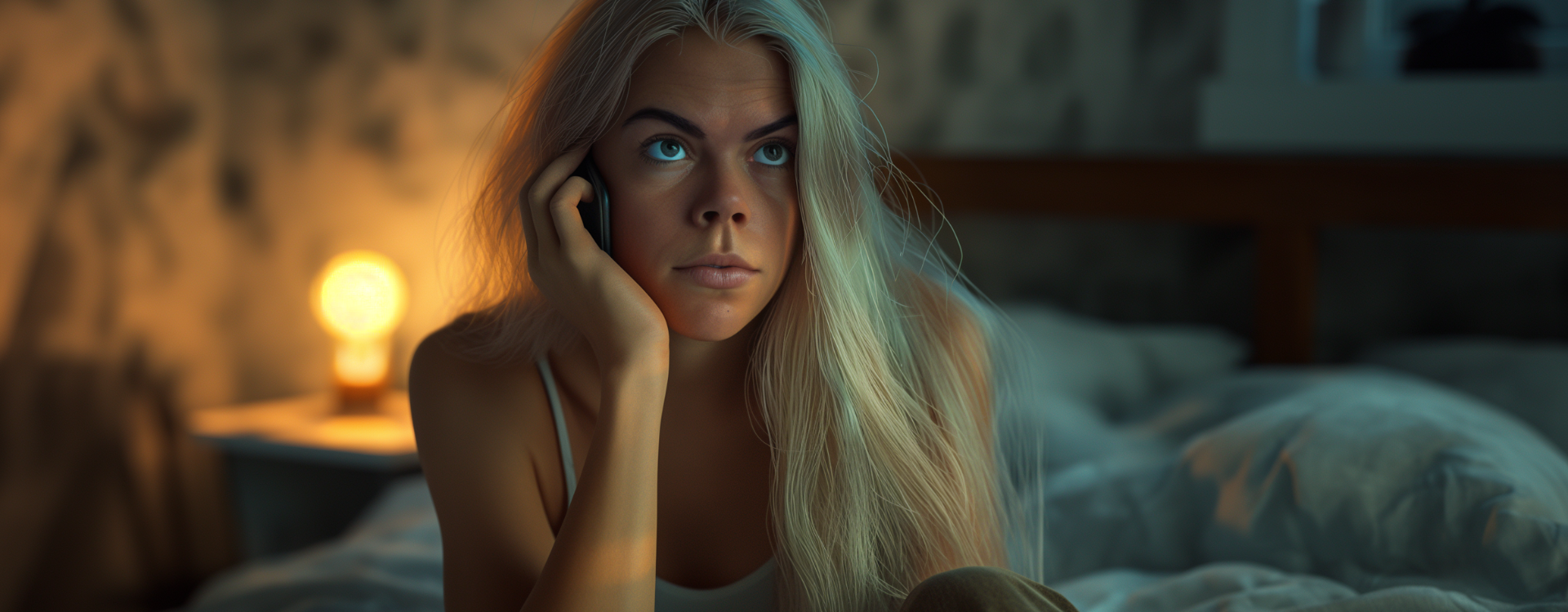
With a sense of resignation—or hope; at that hour they weighed the same—I extended my arm, slow and indifferent, as though it belonged to someone else. The duvet clung to my wrist like it didn’t want me to bother. I retrieved my mobile from the bedside table, its cold smoothness a rude contrast to the softness of my bed.
The screen blinked awake with that sterile glow, casting a faint blue sheen across the walls. A rectangle of curated reality. Notifications flickered—sales, politics, someone’s over-filtered lunch—and then disappeared. I dismissed them without thought. Junk food for the mind. What I craved was something warmer. Human, maybe.
I opened the messaging app. That blank conversation field stared back at me, pristine and full of expectation. A digital well daring me to speak. My thumb hovered above the contact list. Each name felt like a fragment of another life. People I’d drifted from, ducked behind, or deliberately exiled for reasons that once seemed valid and now seemed… well, irrelevant, mostly.
Who to reach out to? Who would welcome the intrusion into their evening without the usual transactional awkwardness—Hi, how are you? Fine. You? Fine. Dead air.
The names blurred. Former colleagues, old school acquaintances, that one bloke from the workshop who insisted I "had a good aura." Right.
Indecision crept in like fog under the door. I loathed this part—this modern ritual of pretending we’re one message away from rescue, when we’re all just stalling against the silence.
And then, almost theatrically, the screen hiccupped—froze for half a second, just enough for it to feel staged—and when it caught up with itself, there she was.
Gladys.
Her name sat like a keystone in the sea of digital detritus. Neat, unassuming. A familiar presence in an otherwise unremarkable scroll. I stared at it. Funny how a name can feel louder than a voice. It brought with it the sound of our shared childhood: late-night whispers across bunk beds, a scraped knee and her rare, unprompted laughter, the stern way she used to say my full name when I was being especially reckless.
For a moment, I hesitated—thumb frozen mid-air, eyes suddenly too tired to squint at the screen.
"Oh," I moaned into the emptiness of my room, the sound flat and unglamorous, more lament than complaint. "No, I really can’t be bothered," I declared to the phone, as though it were a guilty dog or a poorly trained servant.
With all the grace of someone done performing for an invisible audience, I mashed the home button and let the phone slip from my fingers. It landed back on the bedside table with a muted thunk. Not a satisfying clatter. Just enough weight to say: this was me giving up.
It felt ceremonial, somehow. A quiet surrender. Not to despair, but to the inertia of it all. The honest truth was: connection requires energy. And tonight, I’d rather talk to the ceiling. At least it didn’t expect replies.
Rolling onto my other side, I sought distraction in the quiet theatre of the familiar. The bed creaked beneath me—an old complaint I’d grown fond of—and I let my gaze land on the wall opposite, the only one in the room with any personality. It wore its wallpaper like armour: a tapestry of grey hexagons nested with smaller octagons, crisp and deliberate, as if geometry could somehow hold the world together where emotion could not.
It was an odd thing, this affection I’d formed for the pattern. My parents weren’t known for their daring when it came to interiors—more the lace-doily-and-magnolia crowd—but somehow, this particular choice had slipped through. It struck me as an accident of taste, the kind that happened when you close your eyes and point. And yet, it worked. The design pulled at something in me. Not nostalgia, exactly, but a sense of containment. Precision without sterility. Structure, minus the sermon.
In those shapes, there was a rhythm—reliable and indifferent, like the tick of a well-made clock. I could follow the lines with my eyes, let them loop and knot, anything to soften the jagged edges of my own thinking.
My eyelids grew heavy. I let them fall, and welcomed the hush that comes when sleep arrives without being asked.
And then, with the tact of a car alarm in a monastery, my phone shrieked.
The ringtone cleaved through the quiet like a knife through wet bread.
"Really?" I muttered, not quite to the room, not quite to the universe. Just into the charged nothingness where meaning sometimes echoes back. My voice bounced off the walls and came back smaller.
The screen lit up again, garish and insistent. Gladys.
Of course it was. Her name, still warm from earlier hesitation, now pulsing on the glass like a lighthouse beam.
I stared at it. The temptation to let it ring out was almost reflexive, like swatting at a fly. A self-preservation tick. Because picking up meant vulnerability. It meant being asked questions, or worse, answering them.
But there it was again—that quiet nudge, the whisper of intuition that sometimes slips through when you’re too tired to argue with it. This wasn’t her usual hour. Gladys operated on solar time and strict schedules. A call from her now wasn’t casual. It was an anomaly.
And it’s always the anomalies that matter.
With a hesitant swipe, I answered the call. The motion felt strangely defiant, as if I’d just cracked open a door I’d meant to keep bolted shut. The device was barely at my ear when it hit me—that sensation. That cursed, uncanny rush I knew too well.
It began as a shimmer along the skin, the fine hairs on my arms lifting like grass before a storm. Then the spine—a single cold line down it, drawn slow and deliberate, the way you score glass before you snap it. It didn’t hurt. It was worse than hurting. It recognised me. And I recognised it.
That feeling always arrived ahead of something—a messenger without a face, a flicker before the match is struck. It lodged itself behind my neck, that tender hollow where worry likes to settle, and there it bloomed. Not pain, but pressure. As if the world had just leaned closer to whisper something I wasn’t ready to hear.
It wasn’t new. I’d felt it before at moments that later split my life into Before and After. The kind of moments that sound ordinary when recounted, but lived in the body like seismic events.
It hadn’t come at the start, though. When Brody and I first prised open the rusted locks of that old sandstone church, years back, there was nothing colder than dust on our hands. For a long while after, life still had colour to it—muted, maybe, but warm. Hope had calluses then. So did my hands.
We were building something. No, becoming something. The antique shop wasn’t just a business; it was our stitched-together sanctuary, part museum, part mausoleum, a place where forgotten things could matter again. I could still smell it if I closed my eyes: dust caught in timber grain, the metallic tang of old hinges, the earthy sweetness of aged books, like time itself had made tea and left it steeping in the air.
We filled that space with artefacts that had been mishandled by history. Furniture with ghost-thin scratches, paintings with faces half-faded, dolls with too-human eyes. And somehow, among all those echoes, I felt at peace. Alone, but never lonely.
Now, with the phone to my ear and that old chill clinging to my spine, I knew the moment had turned. Something was about to shift. The sensation never lied.
It had been my harbinger before—unwelcome, unswerving. That same foreboding, like the air thickening just before a fracture in time. A prelude to tragedy, it crept over the skin in slow, deliberate strokes, like frostbite disguised as a caress. And when it came, it never came empty-handed.
I remembered the last time.
That day, everything in the shop had felt slightly off-kilter. The shadows stretched wrong. The usual warm musk of old wood and oiled hinges had turned faintly sour, tinged with the copper scent of dread. My fingertips trembled slightly as I arranged a late Victorian mourning brooch in its case—tiny curls of hair pressed behind glass, delicate and grotesque. It had felt fitting, though I didn’t know why at the time.
Then the front door burst open.
The bell above it gave a violent jangle, startled into hysteria. Gladys stood there like she’d run through a war zone—her face blotched and streaked, tears carving raw rivulets down her skin. Her blouse was askew, shoes uneven, breath coming in jolts. She didn’t look at anything. Just me.
And then she ran.
She collided with me so forcefully it sent us both staggering back, her arms thrown round my shoulders like she needed to tether herself to something—anything—or she’d vanish into the grief that had gutted her. The contact was immediate, visceral. It startled something loose inside me. I hadn’t seen her cry since we were children, and even then, she’d done it with the sort of defiance that dared you to comment.
This wasn’t that.
This was collapse. This was the kind of sorrow that bypasses language.
Our history—bristling with rivalry, sharpened by contrast—fell away like ash. There was only instinct, the unspoken alliance that blood occasionally remembers when everything else fails.
"Brody has been in a serious accident."
The words came out of her like broken glass—sharp, fractured, and impossible to handle gently. "He didn’t make it."
Just like that. No buffer, no sedation. The syllables cleaved through the stillness of the shop, and everything inside me shattered on impact.
I collapsed into her. My legs simply gave way, as if they’d been pretending to work and had finally decided otherwise. There was no strength in me to hold up anything—not my weight, not my disbelief, not the history that had just split in two.
And still, I didn’t cry.
Not one tear.
The grief was too sudden, too absolute. It cauterised everything in its path. There was no room for tears in that first moment. Only silence, as if even my sorrow had been stunned speechless.
That’s what I became—scorched ground. And somehow I stayed standing in it.
In the months that followed it came apart. Not all at once; tragedy rarely has the courtesy of speed. It peeled away in layers, quiet and deliberate. The antique shop, once humming with the thrum of discovery and dust, turned still. Dead still. Part gallery, part reliquary, and then neither.
It became a mausoleum. Not of him, exactly—but of us. Of what we’d dared to build with our own hands, thinking it might save us from the ordinary.
And then came the bureaucrats. The bank came in with their spreadsheets and practised detachment, valuing the place the way I’d once valued everything in it—by what it would fetch, never what it meant. Their silence on the matter of grief was almost impressive. The church was repossessed without ceremony. The contents catalogued, boxed, dispersed. All of it reduced to assets.
Each item taken was a small death. A dismantling of memory.
Worse still was the estate debacle—Brody’s family, conveniently estranged during his life, suddenly found the will to show up. With lawyers. They came bearing faux concern and sharpened claws. The legal battles were bitter, protracted, and designed to punish me for existing outside their control. My mourning was cross-examined. My legitimacy dissected.
By the time it ended—if it ever really did—I had nothing left to hold on to. Not the shop. Not Brody. Not even the illusion of closure.
Moving back in with my parents wasn’t a choice. It was a surrender—not the peace kind. The white flag you raise when you’ve run out of everything else, including the will to remember what you were defending.
Their house hadn’t changed, which somehow made it worse. It greeted me with the smugness of survival, the furniture just where it had always been, the wallpaper intact. I slunk back into my childhood bedroom—thirty-three years old and folded back into the exact drawer I’d spent a whole life climbing out of. Defeated. Diminished. A woman-shaped scar trying to remember how to heal.
Now, with Gladys’s voice cracked and small in my ear, the air changed—that quiet drop in pressure, the world drawing breath before the weather turns.
"Hey, Gladys," I said. Level, easy—the same voice I’d once used to sell doubtful provenance to the right kind of buyer. It had never matched what was underneath. It didn’t now.
I held the phone where it was. A slim rectangle of glass, and somehow the only thing in the house wired to anything that mattered.
The past was shifting in its grave. And I was listening.







