The Catuṣkoṭi (Four-Cornered Logic)
The Catuṣkoṭi (Sanskrit for "four corners") is a logical framework from Indian Buddhist philosophy that recognises four possible positions on any proposition: true, false, both true and false, and neither true nor false. Most fully developed by Nāgārjuna (c. 150-250 CE) in the Madhyamaka tradition, it predates Western non-classical logics by approximately 1,800 years and has been shown to be formally equivalent to modern four-valued logics such as First Degree Entailment.
Overview
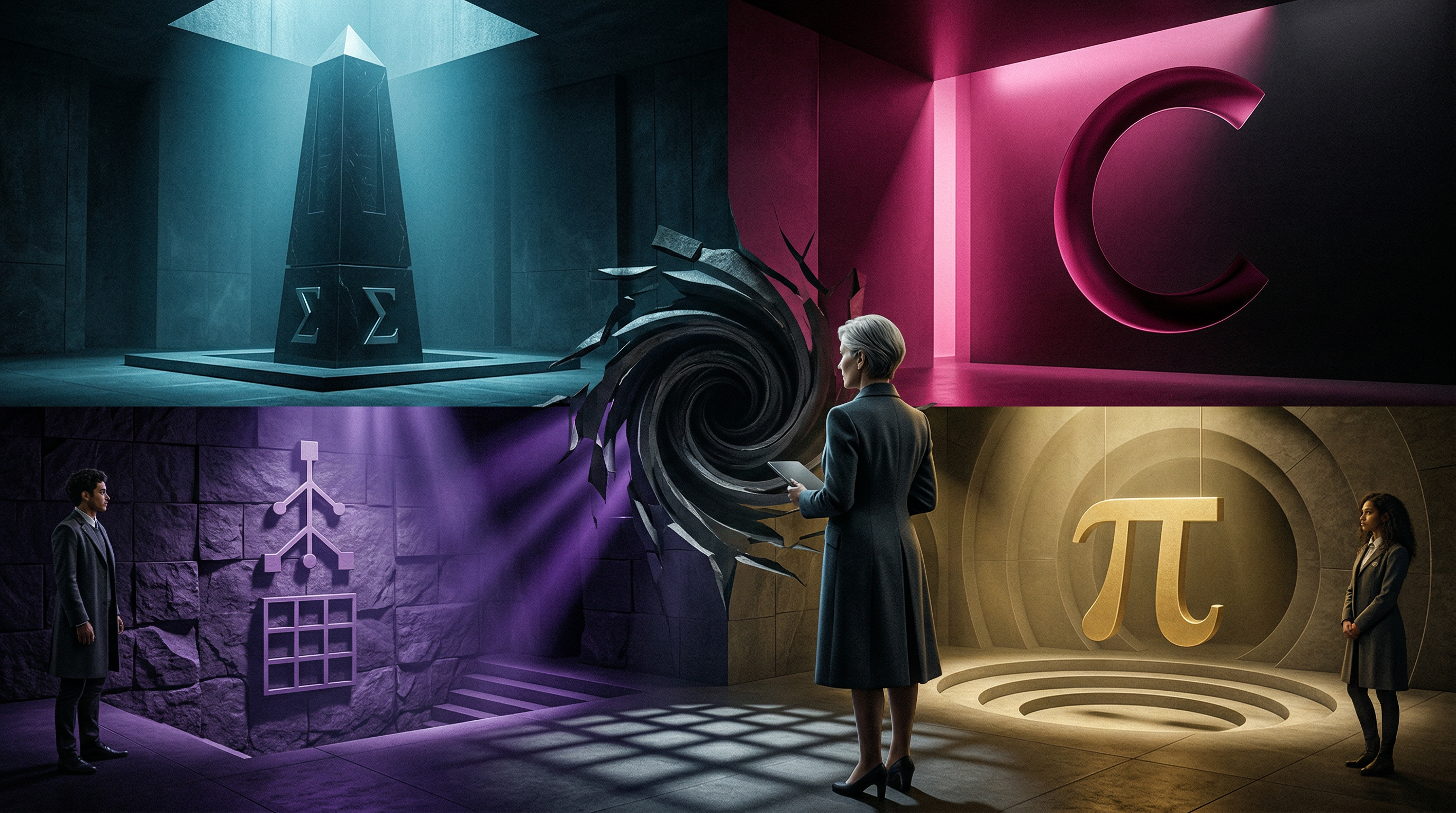
The Catuṣkoṭi (Sanskrit: चतुष्कोटि, literally "four corners") is a logical framework originating in Indian philosophy that systematically examines four possible positions on any proposition. Also known by its Greek equivalent, the tetralemma, the Catuṣkoṭi holds that for any claim of substance, there are four possibilities: that the claim is true, that it is false, that it is both true and false, and that it is neither true nor false.
This four-valued structure stands in fundamental contrast to Western classical logic, which has operated since Aristotle on the assumption that every proposition must be either true or false (the law of excluded middle) and that no proposition can be both (the law of non-contradiction). The Catuṣkoṭi explicitly accommodates both the "both" and the "neither" — two truth values that classical Western logic declares impossible.
The Catuṣkoṭi is not a marginal curiosity of Eastern philosophy. It is a rigorous logical framework that was central to some of the most sophisticated philosophical traditions in human history, most notably the Madhyamaka school of Buddhist philosophy founded by Nāgārjuna. Its existence demonstrates that binary logic is not a universal feature of human reasoning but a culturally specific framework — one that has dominated Western thought since antiquity but that other traditions have challenged with equal rigour and arguably greater flexibility.
Historical Development
The four-cornered structure of argumentation predates its most famous exponent, Nāgārjuna, by several centuries. It appears in the earliest strata of Buddhist literature, in the discourses attributed to the Buddha himself (c. 6th-5th century BCE — making the Buddha a rough contemporary of Aristotle, the founder of Western formal logic). Canonical Buddhist texts frequently structure philosophical questions in terms of these four possibilities, treating the four corners as an exhaustive partition of logical space.
The structure also appears in the broader Indian philosophical context beyond Buddhism. Sanjaya Belatthiputta, a sixth-century BCE Indian ascetic whose teachings are recorded in the Samaññaphala Sutta, employed a four-cornered evasion on metaphysical questions about the afterlife that demonstrates awareness of the same logical structure. The Jain tradition developed a related but distinct multi-valued framework called anekāntavāda (the doctrine of many-sidedness) and syādvāda (conditional predication), which assigns seven possible truth values to propositions.
The Catuṣkoṭi achieved its most philosophically sophisticated form in the work of Nāgārjuna (c. 150-250 CE), the founder of the Madhyamaka (Middle Way) school of Mahayana Buddhism. Nāgārjuna's principal work, the Mūlamadhyamakakārikā (Fundamental Verses on the Middle Way), employs the Catuṣkoṭi systematically — but with a crucial twist. Rather than affirming one of the four corners on each question, Nāgārjuna frequently negates all four, a procedure sometimes called the "fourfold negation." This radical application asserts that on certain fundamental questions — about the nature of existence, causation, identity, and reality — none of the four positions can be coherently maintained. All conceptual positions, including the apparently exhaustive four corners, fail to capture ultimate reality.
The Catuṣkoṭi continued to develop through later Buddhist philosophy, particularly in the work of Candrakīrti (c. 600-650 CE), who provided extensive commentaries on Nāgārjuna, and in East Asian Buddhist traditions, notably in the work of Jizang (549-623 CE), the Chinese Madhyamaka philosopher who developed increasingly complex layered applications of the four-cornered structure.
The Four Corners
The formal structure of the Catuṣkoṭi presents four possible positions on any proposition P:
First koṭi — Affirmation (P): The proposition is true. "Things exist." This corresponds to the standard affirmative position in any logical framework.
Second koṭi — Negation (not-P): The proposition is false. "Things do not exist." This corresponds to the standard negative position and is fully compatible with classical logic.
Third koṭi — Both (P and not-P): The proposition is both true and false. "Things both exist and do not exist." This directly violates the classical law of non-contradiction, which declares that no proposition can be simultaneously true and false. In the Catuṣkoṭi, this is a legitimate position — an acknowledgment that some realities may genuinely exhibit contradictory properties.
Fourth koṭi — Neither (not-P and not-not-P, or equivalently neither P nor not-P): The proposition is neither true nor false. "Things neither exist nor do not exist." This directly violates the classical law of excluded middle, which declares that every proposition must be either true or false. In the Catuṣkoṭi, this too is a legitimate position — an acknowledgment that some questions may transcend the binary framework entirely, admitting no truth value at all.
These four positions are typically presented as mutually exclusive (exactly one holds for any given proposition on any given question) and jointly exhaustive (no fifth option exists). However, as Nāgārjuna's fourfold negation demonstrates, more radical applications deny even this exhaustiveness — asserting that for certain questions, none of the four positions is adequate.
The Fourfold Negation
Nāgārjuna's most distinctive use of the Catuṣkoṭi is not the affirmation of one of the four corners but the systematic negation of all four. In the Mūlamadhyamakakārikā, he repeatedly demonstrates that fundamental concepts — existence, causation, motion, identity, time — cannot be coherently described by any of the four positions. Things do not exist (in the way we think they do). Things do not not-exist. Things do not both exist and not-exist. Things do not neither exist nor not-exist.
This is not nihilism — Nāgārjuna is not asserting that nothing is real. Rather, he is demonstrating that all conceptual frameworks — including the four-cornered framework itself — are inadequate to capture ultimate reality (paramārtha-satya). Concepts are tools for navigating conventional reality (saṃvṛti-satya), but they cannot reach what lies beyond conceptualisation. The fourfold negation is a philosophical method for pushing the mind past its dependence on conceptual categories, revealing the emptiness (śūnyatā) of all fixed positions.
Graham Priest has suggested that the fourfold negation implies a "fifth corner" — a position beyond the four, which he has explored in his 2018 book "The Fifth Corner of Four." This suggestion is contested by scholars of Buddhist philosophy, some of whom argue that the fourfold negation is not an assertion of a fifth position but a dissolution of the entire framework of positions. The debate reflects the difficulty of translating between philosophical traditions that operate with fundamentally different assumptions about the purpose and scope of logic.
Formal Logical Structure
Western logicians have historically struggled to make formal sense of the Catuṣkoṭi. If classical logic is assumed — with its commitment to the law of excluded middle and the law of non-contradiction — then the third and fourth koṭis are simply impossible. A proposition cannot be both true and false, and every proposition must be either true or false. End of discussion.
However, Graham Priest has demonstrated that the Catuṣkoṭi makes perfectly good formal sense within the semantics of certain non-classical logics, particularly First Degree Entailment (FDE). FDE is a four-valued logic in which propositions can be assigned any combination of the classical truth values True (T) and False (F):
Assigned {T} only — the proposition is true (first koṭi).
Assigned {F} only — the proposition is false (second koṭi).
Assigned {T, F} — the proposition is both true and false (third koṭi).
Assigned {} (neither) — the proposition has no truth value (fourth koṭi).
FDE was developed independently of Buddhist philosophy by Nuel Belnap in the context of computer science — specifically, for reasoning about databases that might contain incomplete or contradictory information. The structural similarity between Belnap's four-valued database logic and the Buddhist Catuṣkoṭi has been noted by multiple researchers and represents a striking convergence between ancient Eastern philosophy and modern Western logic.
Priest's formalisation allows the Catuṣkoṭi to be studied using the tools of contemporary mathematical logic — truth tables, semantic valuations, proof systems — while preserving its philosophical content. This work has generated significant academic debate, with some scholars arguing that Priest's reading accurately captures Nāgārjuna's intentions and others contending that formal logical reconstruction distorts a framework whose purpose is soteriological (oriented toward liberation) rather than theoretical.
The Catuṣkoṭi and Western Logic
The relationship between the Catuṣkoṭi and Western logical traditions illuminates deep assumptions about the nature of logic itself.
Classical Western logic, founded by Aristotle and formalised in the modern era by Frege, Russell, and others, operates on two foundational principles that the Catuṣkoṭi challenges. The law of excluded middle asserts that every proposition is either true or false — there is no gap between truth and falsity. The law of non-contradiction asserts that no proposition is both true and false — there is no overlap between truth and falsity. Together, these laws establish a binary framework in which truth and falsity are exhaustive (everything falls into one category or the other) and exclusive (nothing falls into both).
The Catuṣkoṭi denies both exhaustiveness and exclusivity. The fourth koṭi (neither) denies exhaustiveness — some propositions fall into neither category. The third koṭi (both) denies exclusivity — some propositions fall into both categories. The result is a richer logical space that contains the classical binary as a special case (the first two koṭis) while accommodating possibilities that classical logic forbids.
This does not mean that classical logic is "wrong" and the Catuṣkoṭi is "right." It means that different logical frameworks are appropriate for different domains of inquiry. Classical logic works excellently for domains where every question has a definite yes-or-no answer — arithmetic, standard mathematics, everyday factual claims. The Catuṣkoṭi may be more appropriate for domains where questions resist binary resolution — metaphysics, the study of self-referential systems, quantum mechanics, and the investigation of consciousness.
The existence of the Catuṣkoṭi as a well-developed, historically influential, philosophically rigorous logical framework demonstrates that the dominance of binary logic in Western thought is a cultural phenomenon, not a logical necessity. Other traditions have reasoned with equal sophistication using different foundational principles, and their frameworks may prove valuable for addressing problems that binary logic struggles with.
Connection to Paraconsistent Logic
The relationship between the Catuṣkoṭi and modern paraconsistent logic is one of the most active areas of cross-cultural philosophical research.
The third koṭi (both true and false) corresponds directly to the dialetheic position advocated by Graham Priest — the view that some contradictions are genuinely true. A proposition that occupies the third koṭi is a dialetheia in Priest's terminology. The fact that Buddhist philosophy explicitly accommodated this possibility more than two millennia before Priest proposed dialetheism suggests that the acceptance of true contradictions is not a modern innovation but a recurring philosophical insight that has been independently discovered in multiple traditions.
The fourth koṭi (neither true nor false) corresponds to the paracomplete position — logics in which some propositions have no truth value. Intuitionistic logic, developed by L.E.J. Brouwer in the early twentieth century, is the most prominent Western paracomplete logic, though it was developed for very different reasons (constructive mathematics) than the Buddhist motivation (transcendence of conceptual categories).
The Catuṣkoṭi is unique in accommodating both paraconsistency (the third koṭi) and paracompleteness (the fourth koṭi) within a single unified framework. Western non-classical logics have tended to develop these in separate streams — paraconsistent logics address overdetermination, paracomplete logics address underdetermination — without unifying them. The Catuṣkoṭi, by contrast, treats both as equally legitimate possibilities within a single logical structure. This unification predates the Western recognition that both phenomena exist by approximately 1,800 years.
Philosophical Context: Śūnyatā and the Two Truths
The Catuṣkoṭi cannot be fully understood in isolation from the broader philosophical framework within which it operates — particularly the Madhyamaka concepts of śūnyatā (emptiness) and the doctrine of the two truths.
Śūnyatā is the central concept of Madhyamaka philosophy. It asserts that all phenomena are "empty" of inherent existence (svabhāva) — they do not exist independently, permanently, or in the way they appear to naive perception. This does not mean they do not exist at all; it means their existence is dependent, conditioned, and relational. A table is empty of inherent "table-ness" — it is a temporary arrangement of wood, which is a temporary arrangement of cells, which are temporary arrangements of molecules, all the way down. Nothing has a fixed, independent essence.
The doctrine of the two truths distinguishes between conventional truth (saṃvṛti-satya) — the everyday reality in which tables, people, and propositions function perfectly well — and ultimate truth (paramārtha-satya) — the reality that reveals itself when conceptual categories are exhausted. The Catuṣkoṭi operates at the boundary between these two levels. The first two koṭis function within conventional truth. The third and fourth koṭis push toward the boundary. And the fourfold negation gestures toward ultimate truth — the reality that cannot be captured by any conceptual position, including "both" and "neither."
This philosophical context is essential because it explains why the Catuṣkoṭi is not merely a logical curiosity but a philosophical method with a specific purpose: the liberation of the mind from attachment to fixed conceptual positions. In the Buddhist context, attachment to views — including the view that contradictions are impossible — is itself a form of suffering. The Catuṣkoṭi, and especially its fourfold negation, is a tool for breaking that attachment.
Applications and Contemporary Relevance
Self-referential paradoxes: The Catuṣkoṭi provides a natural framework for addressing self-referential paradoxes such as the Liar's Paradox and Russell's Paradox. The Liar sentence ("this statement is false") oscillates between the first and second koṭis but can be naturally accommodated in the third (both true and false) or described by the fourfold negation (none of the four positions adequately captures what the sentence does). The Catuṣkoṭi does not need to ban self-reference or restrict language to handle these paradoxes — its logical space already contains the positions they produce.
Quantum mechanics: Quantum superposition — a particle existing in multiple states simultaneously until measured — bears structural resemblance to the third koṭi (both). A particle that is both spin-up and spin-down occupies a state that classical binary logic cannot accommodate but that the Catuṣkoṭi explicitly provides for. The fourth koṭi (neither) may correspond to quantum states before any basis has been selected — states for which the question "is it spin-up or spin-down?" is not merely unanswered but inapplicable. These connections have been noted by several researchers but remain largely unexplored in formal detail.
Computer science: Belnap's four-valued database logic, developed for reasoning about information systems containing both incomplete and contradictory data, is formally identical to the Catuṣkoṭi's truth-value structure. This convergence between a sixth-century BCE philosophical framework and a twentieth-century computational tool suggests that the four-valued structure reflects something deep about the nature of information and reasoning, not merely the cultural assumptions of a particular tradition.
Consciousness studies: The self-observation problem — the question of whether consciousness can observe itself — may benefit from a four-valued framework. The experience of consciousness observing itself may be neither straightforwardly "possible" (first koṭi) nor "impossible" (second koṭi) but may require the third koṭi (possible and impossible simultaneously, because the observer and the observed are the same entity) or the fourth (the question transcends the categories of possible and impossible). The Catuṣkoṭi provides conceptual space for these possibilities that binary logic does not.
Scholarly Debates
The interpretation and formalisation of the Catuṣkoṭi is the subject of active scholarly debate spanning Buddhist studies, comparative philosophy, and mathematical logic.
The central disagreement concerns whether the Catuṣkoṭi is properly understood as a logical framework (a system for evaluating the truth values of propositions) or as a soteriological tool (a method for liberating the mind from conceptual attachment). Priest and his collaborators, including Jay Garfield, have argued that it is both — that formal logical reconstruction illuminates the philosophical content without reducing it. Critics, including some specialists in Buddhist philosophy, argue that formal reconstruction distorts the Catuṣkoṭi by treating it as a theory about truth values when its actual purpose is to demonstrate the inadequacy of all theories about truth values.
A related debate concerns whether Nāgārjuna himself was a dialetheist — whether he genuinely accepted the existence of true contradictions. Priest and Garfield have argued that he was. Other scholars, drawing on the work of Tibetan Madhyamaka philosophers such as Gorampa Sonam Senge (1429-1489), argue that Nāgārjuna's use of contradiction is methodological rather than metaphysical — he deploys contradictions to undermine conceptual attachment, not because he believes contradictions are features of reality.
The distinction between these positions is subtle but consequential. If Nāgārjuna was a dialetheist, then the Catuṣkoṭi is evidence that true contradictions were recognised and accommodated in a rigorous philosophical tradition two millennia before Western logic considered the possibility. If his use of contradiction was purely methodological, then the Catuṣkoṭi is a pedagogical tool rather than a logical framework, and its relevance to formal logic is less direct.
Significance
The Catuṣkoṭi is significant for several reasons that extend far beyond the history of Buddhist philosophy.
First, it demonstrates that binary logic is not a universal feature of human reasoning. Western philosophy has treated the laws of excluded middle and non-contradiction as foundational and self-evident since Aristotle. The Catuṣkoṭi shows that an equally sophisticated philosophical tradition developed an equally rigorous framework based on fundamentally different principles — and that this framework was productive, influential, and intellectually durable over more than two millennia.
Second, it provides historical precedent for logical pluralism — the view that different logical frameworks may be appropriate for different domains. The existence of a well-developed four-valued logic in the Buddhist tradition, completely independent of the Western development of paraconsistent and paracomplete logics in the twentieth century, suggests that the four-valued structure reflects something genuine about the nature of reasoning rather than the idiosyncrasies of any particular culture.
Third, it offers conceptual resources for contemporary problems. Self-referential paradoxes, quantum superposition, database inconsistency, and the nature of consciousness all involve phenomena that resist binary classification. The Catuṣkoṭi provides a well-established framework that already contains the logical space these phenomena require — a framework that was developed not as a response to these specific problems but as a general-purpose tool for navigating the full complexity of reality.
The convergence between the ancient Catuṣkoṭi and modern non-classical logics — particularly First Degree Entailment — is one of the most remarkable examples of independent discovery in the history of ideas. Two intellectual traditions, separated by two millennia and the breadth of the Eurasian continent, arrived at structurally identical logical frameworks. This convergence suggests that the four-valued structure is not an arbitrary construction but a discovery — an observation about the nature of logic and reality that is available to any sufficiently reflective tradition, regardless of cultural context.






