4135.8 · January 8, 1815 AD
The Card on the Desk
When Reginald Donnelly offers William a position in Van Diemen's Land that could remake his future, it comes with a price neither he nor Eliza anticipated—and in their hidden clearing, she forces him to choose between a love that can never be more than a secret and a life that might finally be worth living.
"A man's birth determines his prospects in England. Here, his usefulness determines them. But there are ceilings—invisible ones, mostly, but no less real for that."— Eliza Donnelly
The new year arrived with the particular intensity of an Australian summer, the January heat pressing down upon Sydney like a hand intent on suffocation. The harbour shimmered in the relentless sun, its waters turned to molten silver, whilst the streets of the town baked and cracked beneath the assault of temperatures that would have been unimaginable in Portsmouth winters.
For William, the turning of the calendar brought a significance beyond the mere marking of time. February would see the expiration of his original sentence—seven years from the day he had been loaded onto the hulks at Portsmouth, seven years since a stolen watch and a false friend had torn his life apart. The ticket of leave he carried would become, in the eyes of the law, a certificate of freedom. He would no longer be a convict working toward redemption; he would be a free man, entitled to all the rights and privileges that status conferred.
The prospect should have filled him with joy. Instead, it filled him with a gnawing anxiety that he could not quite name.
Freedom, he had discovered, was a more complicated thing than he had imagined during those long nights on the Resolution, those endless days at Parramatta. The convict stain did not wash away with the completion of a sentence; it lingered in the way men looked at him, in the opportunities that remained closed despite his legal status, in the invisible barriers that separated those who had come to the colony in chains from those who had arrived by choice. He would be free, yes—but free to do what? To remain a checker on the docks until his back gave out? To scratch together a meagre existence in a society that would always view him with suspicion?
Or to reach for something more, something that the colony's rigid hierarchies insisted he could not have?
Their Sunday meetings had become the fixed point around which William's week revolved. Each day was measured not by its own merits but by its distance from that hidden clearing in the Domain—the hours until he would see Eliza again counting down like a heartbeat made audible.
The grove had become their world. Beneath the screening branches of the eucalyptus, surrounded by the alien chorus of Australian birds, they had built something that existed outside the colony's rules and expectations. Here, William was not a convict and Eliza was not a merchant's daughter; they were simply themselves, two people who had found in one another something neither had expected to discover.
Eliza brought books—texts on commerce and navigation, on colonial law and land management, on the intricacies of trade that connected Sydney to the wider world. She brought newspapers from London, months out of date but invaluable for understanding the currents of fashion and politics that shaped colonial demand. She brought, most importantly, her own sharp mind and her willingness to share its contents with a man whom society insisted was beneath her notice.
"The key to advancement in this colony," she explained one sweltering afternoon, fanning herself with a folded newspaper whilst William listened with the intensity of a man receiving sacrament, "is understanding that the old rules don't entirely apply. In England, a man's birth determines his prospects. Here, a man's usefulness determines them—at least to a point."
"To a point," William repeated. "And where is that point, precisely?"
"It shifts. A convict who proves himself indispensable can rise further than anyone would have predicted. But there are ceilings—invisible ones, mostly, but no less real for their invisibility." She paused, her eyes meeting his with the directness he had come to cherish. "A transported man can become wealthy. He can become respected, after a fashion. But certain doors will always remain closed to him. Certain... alliances... will always be forbidden."
The word hung between them, unspoken but understood. Marriage. She was speaking of marriage.
"Unless," William said slowly, "he finds a way to open those doors from the other side."
Eliza's smile held both admiration and something that might have been hope. "Unless that, yes. Though such a feat would require resources, connections, and opportunities that don't simply materialise from nothing."
It began, as such things often do, with small changes that seemed insignificant in isolation but accumulated into something transformative.
William's work at the docks had always been competent; now it became exceptional. Armed with Eliza's insights into the patterns of colonial trade, he began noticing discrepancies that others missed—not merely the obvious shortfalls and overages, but subtler patterns that suggested systematic fraud. A captain who consistently underreported his cargo by the same percentage. A merchant whose shipments always seemed to lose weight during unloading. A customs official whose inspections produced suspiciously uniform results.
He documented these observations carefully, sharing them with no one except Eliza during their Sunday conversations. She helped him understand the implications, the web of relationships and obligations that made the colonial economy function—and the points of leverage where a clever man might apply pressure to his advantage.
"You're thinking like a merchant now," she observed one afternoon, a note of pride in her voice that warmed William more than the summer sun. "Seeing the system as a whole rather than just your corner of it."
"I had an excellent teacher."
"You had raw material worth teaching. Most men in your position would be content to keep their heads down and count the days until their sentences expire. You're building something."
William considered this. It was true that his ambitions had expanded beyond mere survival—had grown, in fact, to encompass possibilities he would not have dared contemplate a year ago. The colony was changing, opportunities were multiplying, and he was positioning himself to seize them when they appeared.
But his ambitions were no longer solely his own. They were tangled up with copper hair and emerald eyes, with Sunday afternoons in a hidden clearing, with a future he could not quite see but desperately wanted to believe in.
The trouble with excellence, William discovered, was that it attracted attention—not all of it welcome.
Harbour Master Whitfield had never forgiven William for showing him up in front of Eliza Donnelly that first day. The man's resentment had simmered through the intervening months, expressing itself in petty inconveniences: the worst shifts assigned, the most tedious work allocated, the occasional "oversight" in William's pay that required days of effort to correct.
William had borne these indignities with the patience of a man who understood that open conflict would only harm himself. The harbour master had authority; William had none. Any confrontation would end with William's ticket of leave revoked and his hopes of advancement crushed.
But Whitfield's campaign of harassment had an unintended consequence. The harder he worked to make William's life difficult, the more opportunities William found to demonstrate his value. Every disadvantage became a chance to prove his worth under adverse circumstances. Every obstacle became a platform from which his competence could shine.
And people were noticing.
"That checker of yours," William overheard a merchant saying to Whitfield one afternoon, their conversation drifting through the thin walls of the counting room. "Jeffries. He caught a discrepancy in my Singapore shipment that would have cost me fifty pounds if it had gone unnoticed. Where did you find him?"
Whitfield's response was inaudible, but William could imagine its grudging tone. The harbour master was trapped: he could not dismiss a man whose work was drawing praise from the very merchants he needed to keep satisfied, but neither could he admit that a convict was outperforming the free men under his authority.
It was a small victory, but William had learned to appreciate small victories. They were the building blocks from which larger ones were constructed.
The meeting that would change everything came on a Thursday afternoon in late January, when the summer heat had driven most sensible people indoors and the docks operated at the sluggish pace of men conserving their energy against the brutal sun.
William was in the counting room, reviewing manifests for a shipment of wool bound for London, when the door opened to admit a figure he had seen from a distance but never encountered directly. Reginald Donnelly was a man of perhaps fifty-five years, his hair silver-grey and his bearing that of someone accustomed to authority. He was not a large man—indeed, he was shorter than William by several inches—but he possessed a presence that seemed to fill whatever space he occupied.
His eyes, William noted immediately, were the same striking green as his daughter's.
"Mr Jeffries, I believe?" Donnelly's voice was measured, carrying the faint trace of an accent that spoke of origins somewhere in the north of England. "I'm told you're the man responsible for catching the Harrington discrepancy last month."
William rose from his desk, acutely conscious of the contrast between his working clothes and Donnelly's tailored coat. "I noticed an irregularity in the documentation, sir. The numbers didn't align with what I observed during unloading."
"The numbers didn't align." Donnelly repeated the phrase as though tasting it. "A diplomatic way of saying that Captain Harrington was helping himself to cargo that didn't belong to him. He's been doing it for years, you know. Other checkers noticed the shortfalls but assumed they were honest errors. You're the first to document the pattern."
"Patterns are easier to see when you're looking for them, sir."
Donnelly's eyes narrowed slightly—not with suspicion, William thought, but with the sharpened attention of a man recognising something unexpected. "And what made you look for them? Most men in your position are content to do their jobs adequately and no more."
It was a test, William realised. The merchant was probing, trying to understand what manner of man stood before him. The safe response would be humble deflection—a convict knowing his place, grateful for whatever scraps of recognition fell his way.
But William had not survived seven years in the colony by being safe.
"Because adequacy leads nowhere, sir," he said, holding Donnelly's gaze. "I came to this colony against my will, but I don't intend to leave it as I arrived. Every task I'm given is an opportunity to prove my worth—to myself, if no one else. The patterns were there to be seen; I simply refused to ignore them."
A long moment passed in which Donnelly said nothing, his green eyes fixed on William with an intensity that seemed to strip away all pretence and examine what lay beneath. It was an uncomfortable sensation, being weighed and measured so openly, but William forced himself to endure it without flinching.
Finally, the merchant nodded—a small gesture that nevertheless carried considerable weight.
"My daughter speaks well of you," he said, and William felt his heart stutter despite his best efforts at composure. "She tells me you have a head for figures and an eye for detail. That you ask intelligent questions and remember the answers."
"Miss Donnelly has been kind enough to discuss her father's business with me on occasion," William managed, his voice steady despite the turmoil beneath. "I found her insights... educational."
"Educational." That faint smile again, knowing but not unkind. "Yes, Eliza has a talent for education. She's been trying to teach Sydney's merchants how to do business properly for years, though most of them are too proud or too stupid to listen." He paused, his gaze drifting to the window and the harbour beyond. "She tells me you listen."
"I've learned that listening is often more valuable than speaking, sir."
"A rare quality in a young man. Rarer still in one who has reason to be angry at the world." Donnelly turned back to face William, and something in his expression had shifted—some decision had been made, some assessment concluded. "Your sentence expires next month, I understand. What are your plans thereafter?"
"I had hoped to remain at the docks, sir. To continue building my experience in trade and commerce."
"Under Whitfield?" Donnelly's tone made clear his opinion of the harbour master. "You'd be wasted there. The man's a fool who resents anyone cleverer than himself—which, admittedly, includes most of the population of Sydney. He'll find ways to hold you back, to ensure you never rise above the station he believes you deserve."
William said nothing. The assessment was accurate, and they both knew it.
"There may be another option," Donnelly continued, his voice taking on the measured tone of a man presenting a business proposition. "I have associates in Van Diemen's Land—merchants in Hobart Town who are building something significant in the southern colony. They're in need of capable men. Men with experience in trade, who can be trusted with responsibility, who aren't afraid of hard work or difficult circumstances."
William's breath caught in his throat. Van Diemen's Land—the island colony to the south, younger and rougher than New South Wales, but growing rapidly as settlers and convicts alike poured in to exploit its resources. He had heard stories of fortunes being made there, of men who had arrived with nothing and built empires from the wilderness.
He had also heard stories of men who had died there, broken by the land or the labour or the brutal system that governed convict life in the southern settlements.
"You're offering me a position, sir?"
"I'm offering you an opportunity," Donnelly corrected. "The position would be clerk to a merchant named Samuel Hartley—a good man, fair but demanding. He's looking for someone to manage his shipping interests, to coordinate the movement of goods between Hobart Town and Sydney. It's not glamorous work, but it's work with prospects. A man who proves himself in Hartley's employ could find doors opening that would remain forever closed here."
"And my... history?" William asked carefully. "Would Mr Hartley be willing to employ a transported man?"
"Hartley's colony is built on transported men. Half of Van Diemen's Land was settled by people the Crown couldn't be bothered to hang. What matters to him is capability, not pedigree." Donnelly's eyes held William's with uncomfortable directness. "The question, Mr Jeffries, is whether you're willing to start over. To leave behind whatever you've built here and begin again in a place where no one knows your name or your story."
William's mind raced. The offer was everything he had hoped for—a chance to escape the limitations that would forever constrain him in Sydney, to build a life based on his abilities rather than his past. In Van Diemen's Land, he would be simply William Jeffries, a clerk with letters of introduction from a respected Sydney merchant. The convict stain would not follow him; it would fade into irrelevance as he proved his worth in a colony too hungry for capable men to care about the circumstances of their arrival.
But Van Diemen's Land was hundreds of miles to the south. It was weeks of travel by sea. It was a world away from copper hair and emerald eyes, from Sunday afternoons in a hidden clearing, from the woman who had awakened something in him that he had thought permanently extinguished.
"I... would need time to consider, sir," he heard himself say. "The offer is generous, and I'm grateful for your confidence. But it's not a decision to be made lightly."
Donnelly nodded, apparently unsurprised by this response. "Of course. I wouldn't expect otherwise from a thoughtful man." He reached into his coat and withdrew a card, which he placed on the desk between them. "My address. Call on me when you've made your decision. But don't take too long—the Doris sails for Hobart Town on the third of March. If you're to take this opportunity, you'll need to be aboard her."
After Donnelly departed, William sat for a long time in the counting room, staring at the card that lay on the desk before him. The merchant's copperplate script seemed to pulse with significance, each letter a door opening onto a future he had not dared to imagine.
Van Diemen's Land. A fresh start. A chance to become the man he might have been if Jack Hawley's betrayal had never occurred.
And Eliza.
The thought of her was a physical ache, a tightness in his chest that made breathing difficult. He had told himself, during those Sunday afternoons in the Domain, that he was merely enjoying the present—that their connection, however intense, was a temporary respite from the loneliness of his existence rather than a foundation for any lasting future. He had known, with the clarity of a man who had learned to see the world as it was, that their different stations made any permanent union impossible.
But knowing and feeling were different things entirely. The prospect of leaving her—of sailing away to a place where he might never see her again—felt like contemplating the amputation of a limb. Necessary, perhaps, for survival. But devastating nonetheless.
He thought of Eliza's father, of the knowing quality in those green eyes so like his daughter's. Donnelly had spoken of Eliza's praise for William, of her educational efforts, with a casualness that suggested he understood more than he was saying. Did he know about their meetings? About the feelings that had grown between them?
Perhaps that was the point. Perhaps this offer was not merely an act of commercial kindness but a strategic intervention—a way of removing William from Sydney before the situation between him and Eliza could develop into something that would damage her reputation and destroy her prospects.
If so, it was a kind cruelty. Donnelly was offering William a future precisely because he understood that William had no future in Sydney—at least, not one that included his daughter.
Sunday arrived with the inevitability of tides, and William made his way to the Domain with the card still in his pocket, its weight far greater than paper and ink could account for. The January heat had not relented; the air hung thick and motionless beneath the eucalyptus trees, and the harbour below shimmered in the afternoon sun like a vision of some other world.
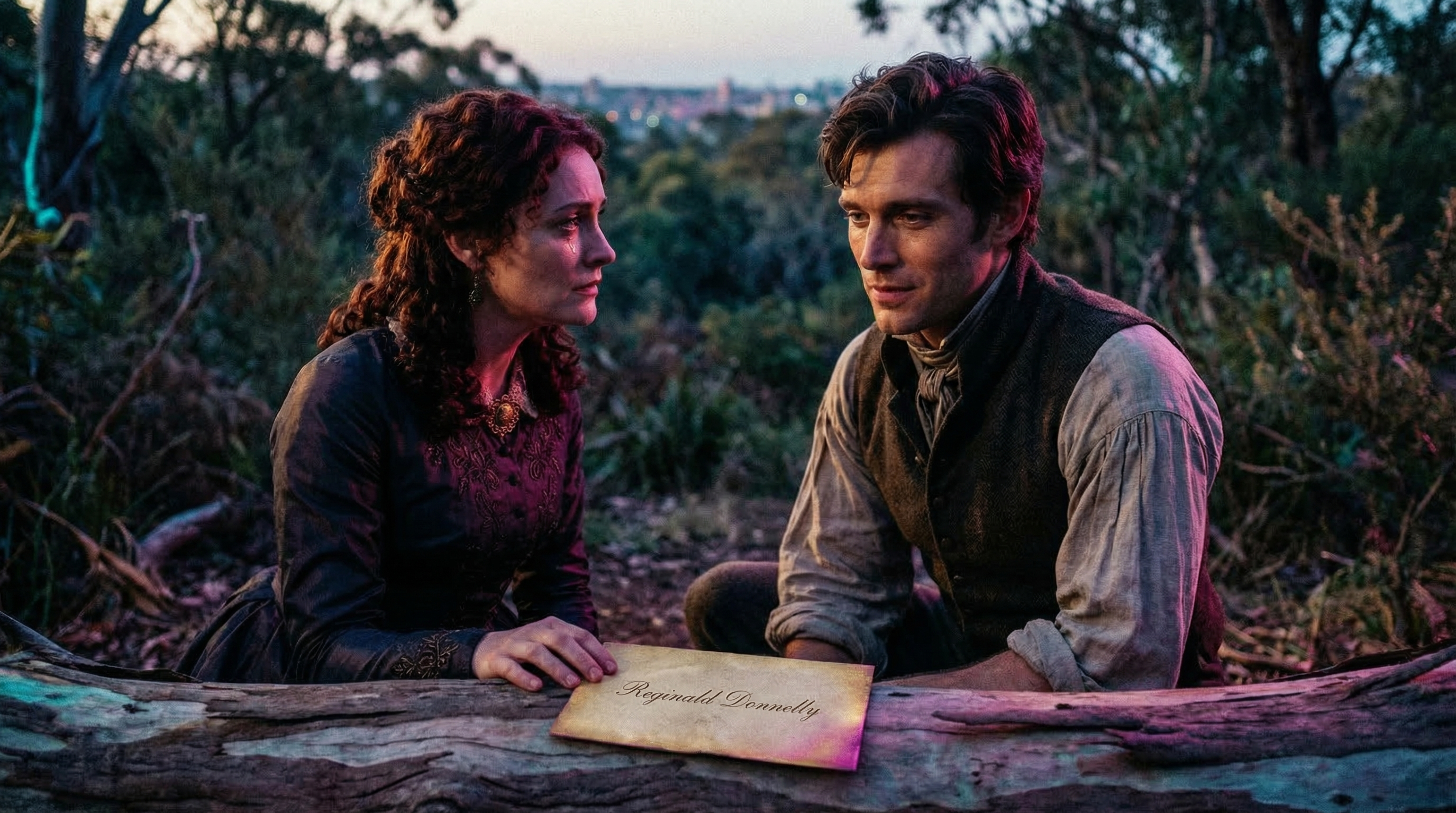
Eliza was already there, seated on their fallen tree, a parasol casting a circle of shade around her. She looked up as William emerged from the path, and her smile—that smile he had come to crave like breath itself—faltered as she took in his expression.
"Something's happened," she said. Not a question.
"Your father came to see me." William lowered himself onto the log beside her, close enough that their shoulders almost touched, and withdrew the card from his pocket. "He made me an offer."
Eliza took the card, her eyes scanning its surface though she must have known what it said. When she looked up again, her face held an expression William could not quite read—something between hope and grief, tangled together beyond easy separation.
"Van Diemen's Land," she said softly. "Samuel Hartley. He's a good man—fair, my father says. You could build something there."
"I could." William took her hand, heedless of propriety, heedless of everything except the need to touch her. "But it would mean leaving you."
"Yes." Her voice was barely above a whisper. "It would mean that."
Silence stretched between them, filled with all the things they could not say. Above them, a cockatoo shrieked its harsh cry and launched itself from a nearby branch, its white wings catching the light as it wheeled across the sky.
"Did you know?" William asked finally. "Did you know he was going to offer this?"
"I knew he was considering it." Eliza's fingers tightened around his. "I may have... encouraged the consideration. Spoken of your abilities, your potential. Suggested that you were wasted at the docks." Her eyes met his, and William saw tears gathering there despite her composed voice. "I didn't know it would feel like this. Planning for your success, working toward it—I told myself I was helping you. I didn't realise I was also preparing to lose you."
"You could come with me." The words escaped before William could consider their wisdom. "Not immediately—I know that's impossible. But in time. Once I've established myself, once I have something to offer beyond a convict's past and empty hands—"
"William." Eliza silenced him with a gentle finger to his lips, the same gesture she had used the day they had first acknowledged what was growing between them. "You know that's not possible. My father might overlook our friendship whilst we remain within certain bounds, but he would never consent to... to what you're suggesting. The scandal would destroy him—destroy everything he's built."
"Then I'll refuse. I'll stay in Sydney, find another way—"
"And do what? Spend your life checking cargo under Whitfield's thumb? Watching opportunities pass you by because the colony can't forget what you were?" Her voice was fierce now, the tears spilling freely down her cheeks even as her words cut with the clarity of blades. "I won't be the reason you waste yourself, William. I won't be the chain that keeps you bound to a future you don't deserve."
"You're not a chain. You're the only thing that matters—"
"No." The word was quiet but absolute. "No, William. I matter, yes. But so do you. So does the man you could become if you're given the chance. This—" she gestured at the clearing around them, at the hidden space they had carved from a world that would never accept them, "—this is beautiful. What we have is real, and precious, and I will treasure it for the rest of my life. But it's not a foundation. It's not something we can build upon. It's a secret, and secrets eventually come to light, and when this one does, it will destroy us both."
William wanted to argue. He wanted to tell her she was wrong, that their love was strong enough to overcome any obstacle, that they would find a way to be together despite the impossible odds. But the words died in his throat, murdered by the same clarity of vision that had carried him through seven years of transportation.
She was right. She was right, and they both knew it, and the knowing was a kind of death.
They sat together as the afternoon faded, hands clasped, saying little. There was nothing to say that hadn't already been said—nothing that words could add to the understanding that had passed between them.
William thought of the convict ship that had carried him to this shore, of the moment when the New Holland coastline had first emerged from the sea like a dream made solid. He had stood at the rail of the Resolution, his future stretching before him like an unmarked page, and he had vowed to make something of himself despite everything that had been taken from him.
He had not anticipated that making something of himself might require giving up the only person who had ever truly seen him.
"I'll go," he said at last, the words tasting of ash in his mouth. "I'll take your father's offer. I'll sail to Van Diemen's Land and work for Samuel Hartley and build whatever I can from the opportunities I'm given."
Eliza nodded, her face wet with tears but her eyes clear. "It's the right choice. The only choice, really."
"And you?" William asked. "What will you do?"
"What I've always done. Help my father with his business. Make myself useful in whatever ways I'm permitted. Perhaps, eventually, accept some suitable marriage that satisfies everyone's expectations." Her voice caught on the last words, betraying the cost of speaking them. "I'll survive, William. I've learned that from watching you."
He pulled her close then, wrapping his arms around her as though he could shield her from the future that awaited them both. She buried her face against his chest, her body shaking with sobs she no longer tried to suppress, and William held her whilst the sun descended toward the harbour and the shadows lengthened around them.
"I will never forget you," he said into her hair, breathing in the lavender scent that he would carry with him across the sea and through whatever years remained to him. "Whatever happens, wherever I go, you will always be—"
"Don't." She pulled back, her hands framing his face, her eyes fierce despite the tears. "Don't make promises we both know you can't keep. Just... remember that someone loved you. That what you feel—what we feel—is real, even if it can never be anything more than this."
And William, who had thought himself beyond breaking, felt something fracture in his chest that he was not certain would ever fully mend.






