4338.205 · July 24, 2018 AD
The Butter Didn't Melt
Morning brings more than breakfast in Rose’s world—it brings the sound of Grandpa’s cough, the silence between Grandma’s glances, and questions no one wants to answer. As toast grows cold and voices falter, the house begins to feel like it’s waiting for something none of them can name.
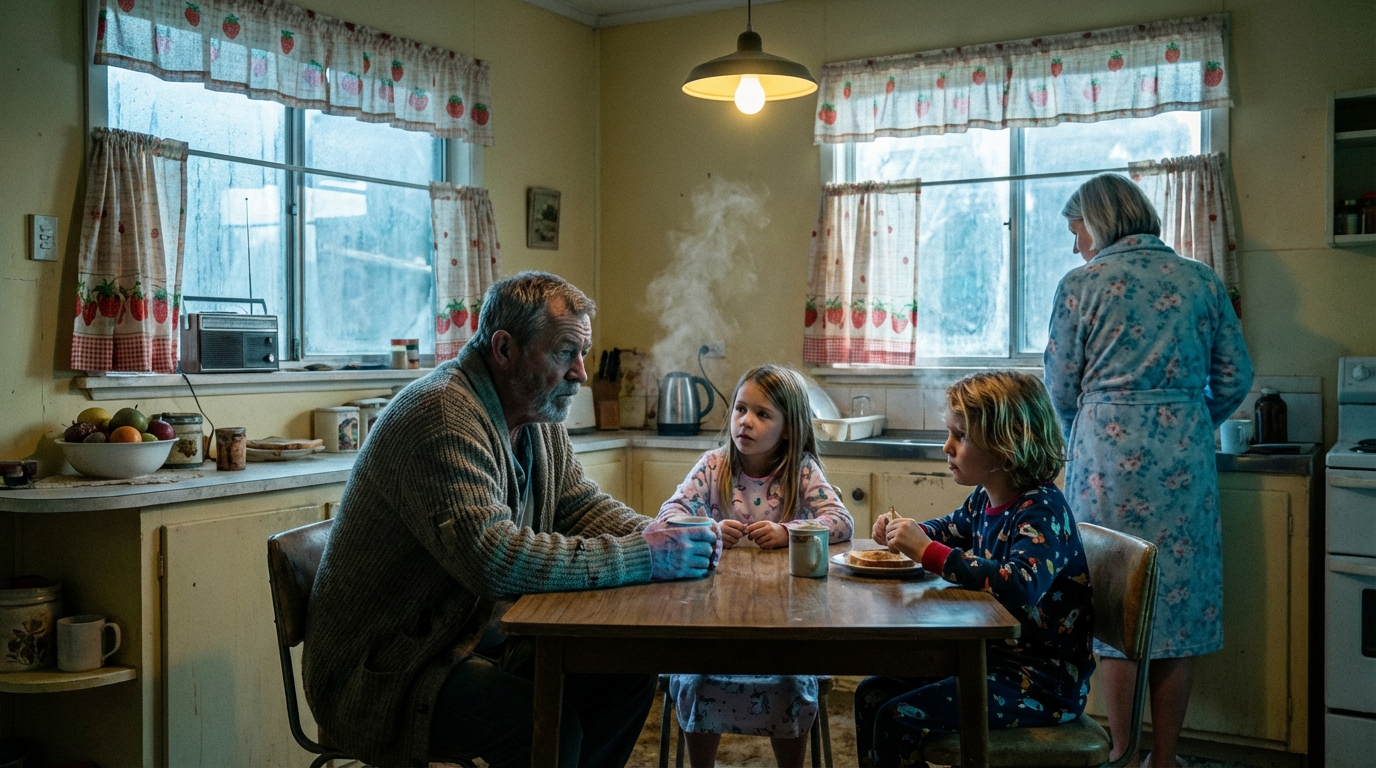
“When even toast and tea feel nervous, you know something’s wrong before anyone says so.”
I woke up to a noise that didn't belong in a dream. It was deep and rough and sounded like something getting stuck in a pipe. At first, I thought it might be the telly left on in the lounge again — sometimes Grandpa falls asleep in his chair with the volume up too loud, and you wake up thinking the weather man is yelling at you about clouds.
But this wasn’t the telly.
It came again — a loud, barking cough that made the air feel tight. Then another, longer one that didn't stop right away. It rattled, deep and chesty, like someone had swallowed gravel. Like the sound Mack's toy truck makes when the batteries are dying and it drags itself across the floor before stopping completely.
I sat up slowly, rubbing my eyes with the back of my hand. The blanket had slipped down past my knees, and my toes felt cold. Mack was still curled beside me, one arm flopped across his face, breathing slow and steady. His hair was sticking up at the back like a cockatoo's crest, and there was a tiny bit of dried drool on his chin. The room was dim with early-morning light — not quite golden, more like the grey-blue of Grandpa's old flannel shirts. The kind of light that can't decide if it wants to be night or day yet.
The memories from last night tiptoed back into my head. Mum's voice. The lie about Dad. The quiet that came after. For a moment, I thought maybe I'd dreamt it all, but then I saw Ribbons the Rabbit squished beneath Mack's elbow, her one good eye staring at me like she knew exactly what I was thinking.
I pushed the blanket aside and slid off the bed, careful not to wake Mack. The floorboards were chilly, and I tiptoed across the rug towards the door. It was already cracked open a smidge, just enough to let a slice of hallway brightness leak in. My unicorn nightie wasn't warm enough for the morning chill, and I wished I'd brought my dressing gown – the fuzzy purple one with stars that Dad had bought me last birthday.
The cough came again, clearer now — definitely coming from the kitchen. It sounded like whoever was coughing was trying to be quiet about it, but couldn't quite manage. Like when you're trying not to laugh in church but it keeps bubbling up anyway.
I crept into the hallway. The air out here was cooler, but not cold. It smelt like toast and tea and something musty, like old winter jumpers pulled out of a drawer. Through the lounge room window, I could see the sky was the colour of faded jeans, with thin streaks of pink at the edges. In Broken Hill, the mornings always smelled a bit like dust and eucalyptus, even in winter when the air was too cold for proper smells.
I padded down the hall, past the crooked ship painting and the dinosaur-shaped tile, and paused at the kitchen doorway. Gerald the dinosaur seemed to wink at me as I stepped on him. I wondered if he'd been awake all night too, listening to the grown-ups talk about things children weren't supposed to hear.
Grandpa was sitting at the table, hunched over like a coat on a hook. His face looked pale, almost grey, and he kept dabbing at his mouth with a crumpled tissue. He had his big knitted cardigan on — the one with the elbow patches that Grandma had mended so many times it was more patch than cardigan — but he still looked small somehow, like the cardigan was swallowing him up. His hands trembled slightly as he reached for his tea mug.
Grandma was at the bench, wrestling with the toaster like it was being cheeky. She kept tapping the side with the flat of her hand, then peering into it like she expected it to apologise. The radio was on low — something about traffic in Adelaide — but neither of them was really listening. Her hair wasn't properly brushed yet, and she was still in her dressing gown – the blue flowery one from last night. She looked tired, like she'd been awake much longer than the sun.
I stood quietly for a moment, watching. The kitchen felt different in the morning – less magical and more worried. The buttery yellow walls seemed paler somehow, as if they'd faded overnight.
The crossword puzzle was still folded up next to Grandpa's tea mug. He always did his crossword in the morning. It was the first thing he did after checking the back door was locked, and before anyone else got a word in. But today it just sat there, untouched, like a present nobody wanted to open.
That's when I knew something really wasn't right.
It was like when you're playing a game and suddenly realise everyone else is playing a different game but forgot to tell you the rules had changed. The kitchen was the same – same wobbly table, same strawberry curtains, same fake fruit bowl with the bitten apple – but something invisible had shifted.
I must have made a noise, because Grandma looked up suddenly, her hands pausing mid-tap on the toaster.
“Good morning, petal,” Grandma said without turning around. Her voice sounded tired, like it had stayed up all night with the rest of her.
I jumped a little. “How did you know I was there?”
“I've got eyes in the back of my head,” she said, finally turning with a smile, though it looked a bit thinner than usual. Like butter spread over too much bread. “And your feet aren't as quiet as you think.”
“I tried,” I said, tiptoeing in and sitting on one of the kitchen chairs — the wobbly one, but I knew how to lean just right to keep it steady. The trick was to tilt slightly to the left. Mack always wobbled because he couldn't sit still, but I had perfected the art of wobbly chair sitting.
The kitchen was warmer than the hallway. The kettle had recently boiled, and little wisps of steam still curled from its spout. Outside the window, the morning light was growing stronger, turning the sky from sleepy blue to proper day. A magpie was strutting across the back fence, its black and white feathers gleaming like it had just been polished.
Grandpa gave me a small nod and a half-smile. “Morning, Rose,” he said, voice rough like sandpaper on old wood. His face looked even greyer in the daylight, the lines around his mouth deeper than usual. He was wearing his blue flannel shirt – the one with the pocket that always held a pencil stub – but it seemed to hang off him, as if it had been made for someone much larger.
“Are you sick?” I asked before I could stop myself.
Grandpa waved a hand as if brushing the question away like a fly. “Just a tickle. Bit of winter in the chest, that's all.” His fingers, I noticed, had a slight bluish tinge at the tips, like he'd been sorting blueberries.
He started coughing again, harsher this time, and leaned forward with his hand over his mouth. The sound of it filled the whole kitchen, bouncing off the yellow walls and making the sugar bowl rattle slightly. It made the spoon on the bench tremble, like it was afraid of whatever was making Grandpa sound like that.
Grandma came over and patted his shoulder gently, then handed him a fresh tissue from the little box she kept by the kettle. The box was covered in pictures of daisies, though most of them had faded from being in the sun too long. Grandma's hand lingered on his shoulder a moment too long, and I saw the way her fingers curled into the fabric of his shirt, just slightly.
“I made you tea,” she said to him. “And toast's on the way. You need to eat something.” Her voice was firm but gentle, the way she spoke to me when I had a fever last summer and didn't want to take my medicine.
“I'll manage,” he muttered, but he didn't reach for the tea. The mug sat steaming, a dark amber pool with a tiny milk cloud swirling in the middle. Grandpa always had his tea strong enough “to stand a spoon in it,” as he liked to say.
The toaster pinged, and Grandma turned back to the bench. I watched her as she buttered the toast — slowly, carefully, all the way to the edges, just how I liked it. The butter was the proper kind, from a dish not a tub, and it melted instantly on the hot toast, soaking into the bread and making little golden pools. But she didn't pass it to me straight away. She just stood there for a few seconds, looking at the toast like it had done something wrong.
That's when Mack came in, hair sticking up on one side and still rubbing sleep from his eyes. His pyjama top was inside out, the tag sticking up at the front of his neck like a tiny flag.
“Morning,” he mumbled, slumping into the chair beside me. He smelled like sleep and that weird boy smell that was a bit like dirt and a bit like the inside of a pencil case.
“You're up,” Grandma said, her smile tightening again. “Toast?”
“Yes please.”
Mack glanced at Grandpa, who was still coughing quietly into his tissue. A frown flickered across Mack's face, there and gone so quickly you'd miss it if you weren't looking properly.
“Are you sick, Grandpa?” he asked, same as I had.
Grandpa tried to laugh, but it turned into another spluttering cough. It sounded wet and sticky, like when you step in a puddle with your socks on.
“Not sick,” he wheezed. “Just getting old.” He attempted a wink, but it looked more like a twitch.
“You're not that old,” I said, trying to be nice. “You still beat me at dominoes.” I didn't mention that he'd been letting me win lately, moving his pieces more slowly, as if thinking hard about moves that used to come easily.
“Barely,” Mack added. But I could tell he was worried too. His eyes kept darting between Grandpa and Grandma, watching for clues like we sometimes did when playing detective in the back garden.
Grandma slid a plate of toast onto the table — four slices, buttered to perfection — and sat down opposite us with a tired little sigh. Her hands wrapped around her own mug of tea like it was a heater. The skin on her knuckles looked paper-thin and slightly crinkled, like tissue paper that had been scrunched and smoothed out again. But she didn't drink it. The tea just sat there, getting cooler by the minute.
“It's just a cold,” she said. “He'll be right. These winter bugs come and go.” But her eyes kept sliding to Grandpa, checking, assessing, worrying.
“But he's not eating,” Mack said quietly. His voice had that serious tone he used when trying to sound grown-up, the one that sometimes made Mum look at him with a mixture of pride and sadness.
“He'll eat when he's ready.”
We all picked at our toast for a while. The kitchen was quiet except for the radio murmuring something about water restrictions in Broken Hill and road works on Argent Street, and the occasional clink of cutlery. A crow cawed from somewhere nearby. Grandpa still hadn't touched his mug. His hands stayed wrapped around it like he was trying to steal its warmth.
I looked at them for a long time.
They were shaking.
Just a little.
Like leaves trembling before a storm.
The toast was warm and buttery, but I didn't feel much like eating. I nibbled at the corner of my slice, watching the way the butter soaked into the bread, making it shiny and golden. Mack had eaten one piece already, but now he was pushing the second around on his plate, leaving long crumbs in circles. He kept glancing at Grandpa, then Grandma, then back at his toast. His foot was jiggling under the table, making the floor vibrate slightly.
Grandpa coughed again. Not loud this time, but dry and stubborn, like it didn't want to go away. Like it had moved in and was unpacking its suitcases, planning to stay.
Grandma stood up and fetched another tissue from the box, placing it gently next to his mug without a word. He gave her a small nod and turned his face away to clear his throat.
It was quiet for a long time. Not comfy quiet, but the kind where no one knows what to say next. The kind that feels like walking on eggshells, where every breath sounds too loud.
Mack cleared his throat. “When's Mum coming back?” His voice was casual, but his eyes were serious, watching Grandma's face for any flicker of truth or lie.
Grandma didn't answer straight away. She reached across the table for the butter dish, though there was nothing left to butter. Her fingers gripped the little glass lid tightly before she let it go. I watched the way her thumbnail went white from pressing too hard.
“Soon, love,” she said. “She just needed to take care of something.” The words came out smooth and practiced, like she'd been repeating them to herself.
“She didn't come in last night,” I said softly. I stared at a small pool of melted butter on my plate, watching it catch the light from the window.
Grandma gave me a look — not cross, but the kind that adults use when they don't want to talk about something and are trying to decide if you'll notice. I noticed. I always noticed. Kids notice everything, especially the things grown-ups think they're hiding.
“She was tired, petal,” she said gently. “Long night. Grown-up things to think about.” She reached over and tucked a strand of hair behind my ear, her fingers cool against my cheek.
That didn't feel like a proper answer, but I nodded anyway and dipped the corner of my toast into the edge of my tea. Grandma didn't usually let me, but she didn't say anything today. The toast soaked up the tea like a sponge, turning soft and soggy at the edges. Usually, I liked it that way, but today it just made me think of things falling apart.
The radio on the windowsill continued its gentle murmur about local matters, while the telly in the lounge was also on, low and fuzzy with news voices. Grandpa always had both going at once—the radio for local Broken Hill news and the telly for the “bigger picture,” as he called it. Sometimes he said it was so he didn't miss anything important, but I think he just liked the company. The sound of other voices made the house feel less empty, like it was filled with invisible friends having conversations nobody was really listening to. Grandma complained about the electricity bill, but she never turned either of them off. I think she understood that Grandpa needed the noise to fill up the quiet places in his head.
“…increased cases reported in regional towns across New South Wales…”
That made Mack look up, his whole body suddenly alert like a dog that's heard a whistle. He turned towards the lounge, straining to hear better.
“…clusters of flu-like symptoms… elderly residents in several aged-care homes…”
The newsman's voice sounded serious and important, the way grown-ups talk when they don't want children to understand but are saying it in front of them anyway.
Grandma stood up suddenly. “Oh, that thing's too loud,” she said, hurrying into the lounge. Her slippers made soft shuffling sounds against the carpet.
A second later, the telly clicked off. The silence that followed was sharper than before, like a fresh cut.
“Did they say it's here?” Mack whispered, leaning towards me. His eyes were wide, and there was a smear of butter on his chin.
I shrugged. I didn't really understand. Lots of people got colds in winter. Mum said it was just what happened when people didn't wear socks. Or when they went outside with wet hair. Or when they didn't eat enough oranges. Mum had a lot of theories about colds.
But the look on Grandma's face when she came back into the kitchen said something different. She smiled at us, but her eyes weren't smiling. They were worried, like rain clouds gathering on what was supposed to be a sunny day.
“I think that's enough news for one morning,” she said, smoothing her hands over her apron. The apron had tiny blue flowers all over it, except for one spot where she'd once spilled beetroot and it never quite came out. The stain looked like a tiny purple country on a blue sea.
Mack didn't argue, but he didn't look convinced either. His eyebrows were pulled together in that way that meant he was thinking hard about something, storing it away for later. For a moment, he looked exactly like Dad when he was trying to figure out a difficult puzzle.
Dad. The thought of him made my tummy twist again. Where was he now? Did he know Grandpa was sick? Would he come back if he knew?
I looked down at my half-eaten toast and suddenly wasn't hungry at all. The morning stretched ahead of us, long and uncertain, filled with questions no one was answering and coughs no one was explaining.
Outside, the magpie had been joined by another. They warbled to each other, their morning song carrying through the kitchen window. At least some things were still normal, still making sense. I watched them hop along the fence, black and white and perfectly certain of exactly who they were and what they were doing.
I wished I could feel that sure about anything right now.
I watched Grandma while she washed a few plates that didn't really need washing. She kept rubbing the same one in slow circles, like she was polishing it for a museum. Her movements were careful, almost methodical, as if the plate might shatter if she stopped concentrating on it. The water ran and ran, steam rising in little wisps that fogged the window above the sink.
Her hands were red — not from the water, but from rubbing them together. She kept doing it without realising, fingers twining and untwining like she was making invisible string shapes. Cats' cradle, but in the air. When I was smaller, she used to make real string games with me. Her fingers would dance, creating stars and cups and cradles that seemed like magic. Now they just twisted around each other, making nothing but worry.
Grandpa hadn't moved much. He was still sitting hunched over, the steam from his tea curling up and vanishing into the air. His fingers looked pale — not just pale like usual, but see-through around the knuckles. The skin looked thin, like tracing paper, and the tea wasn't even that hot anymore. The surface had formed a thin skin, like a puddle beginning to freeze.
He hadn’t touched it.
His eyes were fixed on something outside the window, something far away that only he could see. His breathing was shallow but raspy, like there was sandpaper in his lungs. Every few minutes, he'd cough that horrible cough, then go quiet again. The tissue in his hand was crumpled tight, like he was afraid to let it go.
I leaned closer to Mack and whispered, “He looks worse than last night.”
Mack nodded. “Maybe we should call the doctor.” His voice was low but firm, older somehow than it had been yesterday.
I blinked. “Can we do that?” The idea of us, children, calling a doctor seemed impossible. That was grown-up business, like paying bills or knowing how to drive.
He shrugged. “We can try.” He looked serious, his few freckles standing out against his pale skin, his eyes never leaving Grandpa.
“But Grandpa doesn't like doctors,” I said. “Remember when he got that splinter and refused to go for three days?” It had gone all red and puffy, and Grandma had threatened to call the doctor herself. Grandpa had finally let her dig it out with a needle sterilised over the stove flame. He'd grumbled the entire time about how doctors were just after your money.
Mack gave a half-smile, but it didn't stay. Like sunshine on a cloudy day, there for a moment then gone. “This is different.” There was something in his voice that made my stomach feel tight.
We were quiet again after that.
I picked at the crust of my toast and tried to think about something else. Pancakes, maybe. Or the picture book about the dog that wore glasses. But the thoughts wouldn't stick. They slipped away like fish in a stream, leaving only the reality of the kitchen, Grandpa's breathing, and Grandma's anxious hands.
Through the window, I could see the sky turning a clear winter blue. In Broken Hill, winter skies were the most beautiful – deep and endless, stretching forever over the red dirt and scrubby bush. But today, the beauty seemed distant, like it belonged to another world entirely.
Breakfast ended slowly, like a bath that drains one drip at a time. No one said we were finished. We just sort of stopped. The toast got cold. The tea went untouched. Even the radio seemed to fade into background hum, words no longer distinguishable from static.
Grandma stood by the sink, staring out the little window above it. The dishes were done, the bench was clean, but she stayed there, hands resting on the edge like she might fall if she let go. Her knuckles were white from gripping so hard, her wedding ring glinting in the sunlight.
The backyard was still — the clothesline empty, the gum tree waving a bit in the breeze. The neighbour's cat was on the fence again, tail flicking, keeping time for a song no one was playing. A magpie swooped down to peck at something in the grass, then flew away. Life going on as usual, unaware of the stillness inside our kitchen.
But Grandma didn’t seem to see any of it.
She just stared, like the world outside had frozen and she was waiting for it to start again. Like she was watching a film that had paused, her finger hovering over the play button but unable to press it.
I looked over at Mack, then reached under the table and held his hand. His palm was sweaty, and there was a bit of toast crumb stuck to it, but I didn't mind.
He didn't look at me, but he gave it a squeeze. A quick pulse of pressure, brother to sister, saying all the things we couldn't find words for. Saying I'm here. Saying I'm scared too. Saying we'll figure this out.
Only for a second, though. Then he let go and folded his arms, looking out the window like Grandma. Trying to be grown-up, like he always did when things got scary. As if by looking serious and staying quiet, he could somehow make everything better.
I put my hand back in my lap and didn't say anything. My fingers felt empty without his. I traced the pattern on my pyjama bottoms – little unicorns dancing in a field of stars – and tried to imagine being somewhere else. But my mind kept coming back to this moment, this kitchen, this silence.
We didn't go play in the lounge like we usually did. We didn't argue about what to watch on telly or beg for another biscuit. We just sat at the table while the house held its breath. The clock ticked. Grandpa coughed. The radio murmured. But underneath it all was a silence so deep it seemed to swallow everything else.
I looked at Grandpa, then at Grandma, then at Mack.
No one was saying it, but I could feel it — something wasn't right. Something was starting to happen. Like when the air gets heavy and the birds go quiet and the clouds gather on the horizon, dark and threatening.
I didn’t know what it was yet.
But I knew it had begun.







