4338.208 · July 27, 2018 AD
The Bug Lady And The Dust Remover
Meeting Karen and Chris should feel like a victory—more hands, more help, Luke's promise of growth becoming real. Instead, Paul finds himself grappling with an uncomfortable question as everyone around him springs into action with skills and purpose he doesn't possess. When Karen speaks about masterpieces and blank canvases with unshakeable conviction, Paul's skepticism wavers. But as tasks multiply and he's gently redirected away from helping, he begins to wonder what his role actually is.
"The moment you realise everyone has skills you don't is the moment you understand leadership isn't about being the most capable—it's about keeping capable people from killing each other."
"That was bloody awesome!"
Kain's enthusiasm was infectious, his high-five a physical punctuation to our shared thrill. We stood at the front of the ute, its once clean surface now covered in layers of the very dust that had threatened to halt our journey. The red-brown powder coated everything—the bonnet, the windscreen, the door handles—a badge of honour from our impromptu expedition. My palm still stung slightly from the impact, but it was a good kind of pain. The kind that reminded you that you were alive, that you had accomplished something.
"Apart from clogging up the engine!" I replied, my laughter mingling with his, the relief of having overcome our mechanical challenge lending a lightness to the moment.
It was one of those rare times when the journey itself overshadowed the destination, each obstacle a shared victory. My throat still felt raw from all that blowing—half an hour on our hands and knees, taking turns to blow the fine dust out of the engine intake, the powder billowing back into our faces until we were both coughing and laughing in equal measure. It had been absurd. It had been undignified. And it had been worth it.
"Come on," Kain prodded, his eyes sparkling with the residue of our recent escapade. "You have to admit, even that was fun."
And in truth, amidst the laughter and the transient worry, it had been. There was something about overcoming a problem together, about the absurdity of two grown men blowing dust out of an engine like it was some kind of bizarre birthday cake, that created a bond stronger than mere acquaintance. Back in Broken Hill, I would have called a mechanic. Would have stood aside with my hands in my pockets while someone more competent solved the problem. Here, there was no one else to call. There was only us, and the problem, and whatever solution we could cobble together.
"Guys!" Glenda's voice cut through our mirth, grounding us with the reminder of our present reality. "We have two new guests."
Her announcement was a pivot, a momentary bridge from our shared joy back to the responsibilities that awaited us. I turned toward the newcomers—a man and woman standing beside Glenda, watching our dust-covered arrival with expressions I couldn't quite read. Curiosity, perhaps. Assessment. The wariness of strangers in a strange land, meeting other strangers who seemed to be covered head to toe in red-brown powder and grinning like children.
"I wouldn't call them guests," Jamie interjected swiftly, his tone laced with his typical candour. "They're not going anywhere."
And Jamie's back to his usual self, I mused silently as the group lapsed into an awkward silence.
His ability to cut through the pretence with his straightforward observations was as reassuring as it was jarring. At least he was consistent. You always knew where you stood with Jamie—usually somewhere uncomfortable, often on the receiving end of a truth you hadn't asked for.
I may have been a bit late to the introduction, but recalling my promise to Luke, I stepped forward, intent on bridging the gap between our established group and our newest arrivals. Luke had asked me to give them a warm welcome. I could do that, even covered in dust and still catching my breath from our adventure. Even if I had no other useful skills to offer, I could at least be welcoming.
"I'm Paul," I introduced myself, extending my hand in a gesture of welcome. It was a small act, but in the context of our secluded existence, it held the weight of an unspoken pledge of solidarity. Welcome to our strange little world. We're making it up as we go.
"Chris Owen," the man replied, his grip firm and assured.
His appearance—short and with thinning hair that was already collecting a fine layer of dust—belied a strength that was immediately apparent in his handshake. The kind of grip that came from years of physical work, of lifting and carrying and building. The kind of hands that knew how to do things, how to make things, how to fix things. The kind of hands I had never developed.
"And this is my wife, Karen," he continued, his introduction straightforward but warm, the way he looked at her suggesting a partnership that ran deeper than mere marriage.
"Nice to meet you, Karen," I said, turning my attention to her.
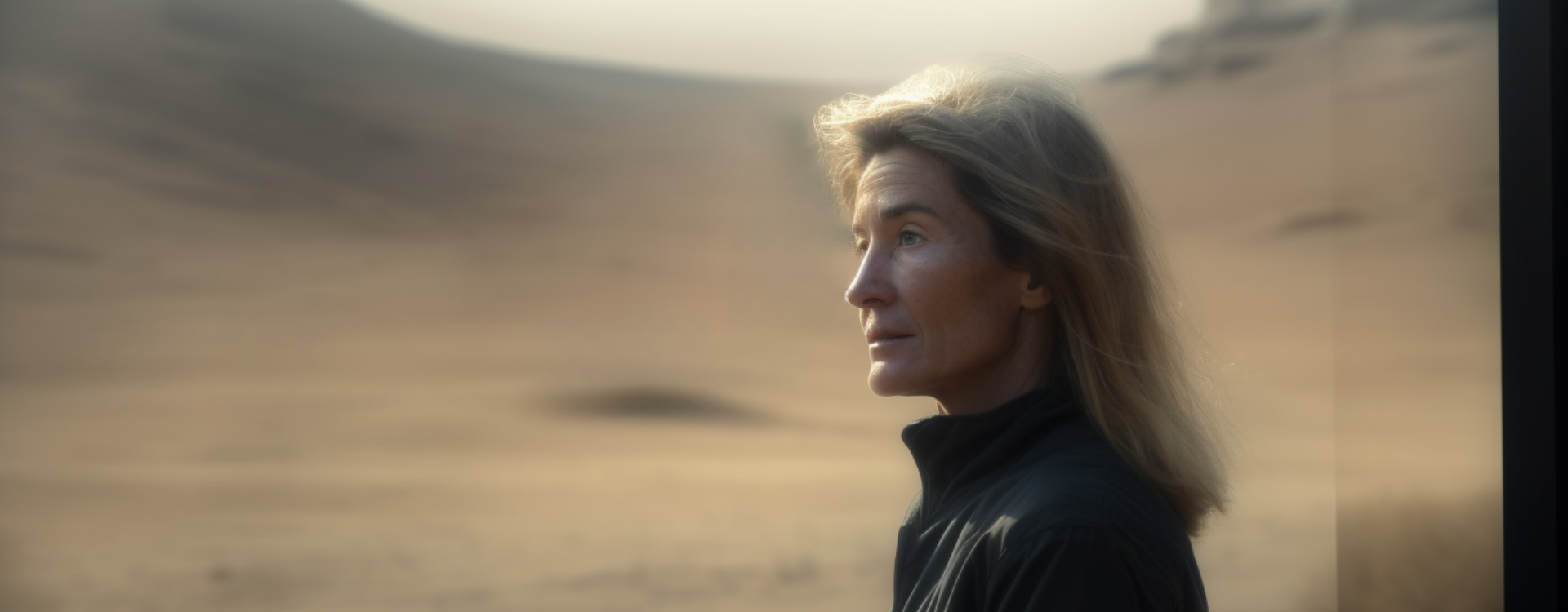
She was slight, with sharp eyes that seemed to take in everything at once—cataloguing, assessing, filing away details for later consideration. There was an intensity to her gaze that made me feel slightly examined, like a specimen under a microscope. She was already studying us, I realised. Already analysing our little community with the same precision she probably brought to her work.
As Kain stepped forward to make his introductions, the dynamics of our group subtly shifted, the initial awkwardness giving way to the beginnings of understanding.
"Kain," he said. "Jamie's nephew."
"Ahh," Karen responded, her eyes lighting up with recognition.
There was something in that recognition—some prior knowledge, some connection through Luke that I didn't fully understand. Luke had been preparing for this, I realised. Had been building connections on Earth that would eventually bear fruit here. The scope of his planning was becoming clearer with every new arrival.
"I see you've met Jamie," I remarked, gesturing towards where Jamie stood, a stoic figure with Henri sitting uncomfortably at his feet.
Henri must be feeling adventurous today, I mused internally, finding a moment of amusement in the rarity of Henri's ventures outside. The Shih Tzu usually stayed in the tent, hidden away from the dust and the strangeness of this world. Something had drawn him out—perhaps the new scents, or perhaps some canine curiosity about the new arrivals.
"We've only just met," Karen responded, her tone carrying a hint of warmth, perhaps gratitude for the recognition. "But Luke has told us a lot about him over the years."
"Us?" Chris interjected, his confusion manifesting in a furrowed brow. "I've never heard his name before," he admitted, the perplexity evident in his voice and the slight downturn of his expression.
Karen's response to her husband was patient, tinged with an explanatory tone that spoke of long practice in clarifying things for him. "Not you, darling. Jane."
"Who's Jane?" Kain queried, his curiosity piqued.
"Oh," I exclaimed, a lightbulb moment of realisation. "You must be one of Luke's bus friends."
The pieces fell into place, recalling Luke's stories of Karen and Jane, two names that had peppered our conversations over the last few years. The women Luke spoke to on the bus, the ones he had described as kindred spirits in a world that didn't understand him. Yet the Karen before us defied the image I had unwittingly constructed—a contrast that served as a reminder of the gap between perception and reality. I had imagined someone... different. Younger, perhaps. Less composed. More tentative. Not this sharp-eyed woman who seemed to be studying us all with scientific curiosity, who stood in the dust of an alien dimension as if it were merely an interesting new environment to explore.
"Yes," Karen affirmed, her response simple yet laden with the weight of shared experiences and memories with Luke that we were only now beginning to uncover.
"But where is Luke?" Kain's question redirected our focus, his gaze sweeping towards Chris as if he might hold the answer.
"He's not here," Karen answered for her husband, her voice carrying a hint of resignation or perhaps acceptance of the situation's fluidity.
Luke had brought them and left. Typical Luke. He appeared when he wanted, delivered what he chose, and vanished when he was needed most. It was a pattern I was becoming all too familiar with.
I exchanged a glance with Glenda, seeking some understanding or insight. Luke's decision to bring the couple here and his implicit trust in me to lead the welcoming committee was clear, but his absence left a void filled with unanswered questions and unspoken expectations. Where had he gone? Why hadn't he stayed to introduce them properly? What else was he doing on Earth while we struggled to build something from nothing?
"Appears this was another accident," Glenda observed, her shoulders slumping in a mix of disappointment and resignation.
"Figures," Kain muttered, his words barely audible.
Luke appeared and disappeared according to his own schedule, his own priorities. We were learning to adapt. Learning to accept that the gatekeeper of our world operated on a logic we couldn't always follow.
"Not to be rude, but what do you actually do?"
My curiosity was genuine, tinged with a hint of scepticism as I struggled to see how Karen's expertise fit into our rugged, survival-driven existence. Luke had said their skills would be "pretty evident." I was still waiting for the evidence. We needed builders. Farmers. Engineers. People who could turn this dust-choked wasteland into something liveable.
"I'm an entomologist," Karen replied, her face alight with a pride that was both infectious and bewildering. Her enthusiasm for her profession was clear, but its relevance to our immediate needs was not.
"A what?" I found myself echoing, the unfamiliar term hanging awkwardly in the air.
"She studies bugs," Kain interjected, his simplification both helpful and seemingly dismissive.
"Oh," was all I managed, my mind racing.
How the heck is this bug lady supposed to help us?
The thought was uncharitable but honest, reflecting my inability to connect the dots between her expertise and our day-to-day challenges. We needed builders. Farmers. Engineers. What we apparently had was someone who studied bugs. Someone whose greatest skill was understanding creatures that crawled and burrowed and generally made themselves nuisances. I tried to keep my face neutral, tried to hide the disappointment that was surely creeping into my expression.
"Insects," Karen corrected sharply, her glare at Kain a silent rebuke for his oversimplification. "Insects, not bugs."
Her distinction made a point, though the significance was lost on me. Bugs, insects—in my world, they were all just things that crawled and occasionally bit. The difference seemed academic at best, pedantic at worst.
"Well," Karen began, launching into an explanation with a passion that was almost tangible. "I work with the University of Tasmania to understand how insects contribute to ecosystems and work with local communities and environmental groups to petition for greater protections."
Her words painted a picture of a world far removed from the immediate practicalities of our survival—academic conferences and research papers and policy recommendations. Important work, perhaps, in a world where such things mattered. But here, where we couldn't even keep dust out of our engines, where we were building shelters with our bare hands and hoping they wouldn't collapse in the first storm, her expertise seemed as useful as my business management degree.
"That's great!" I exclaimed, more out of politeness than comprehension.
My mind was still trying to bridge the gap between her world of insects and our immediate needs. What good was ecosystem understanding when we couldn't even keep dust out of our engines? What did it matter how insects contributed to environments when we were struggling to build shelters that would survive the night? I turned towards Chris, hoping for something more tangibly useful to our situation.
"I do yard work," Chris stated simply, his words carrying none of his wife's academic flourish.
Ooh, my internal response was immediate. A dust remover! Perfect!
His profession, mundane as it might sound, was exactly the kind of practical skill we were in desperate need of. Someone who knew how to work with land, how to clear and shape and maintain outdoor spaces. Someone who could look at this wasteland and see possibilities instead of obstacles. Someone who knew which end of a shovel to hold.
"Yard work?" Kain echoed, his interest clearly piqued.
Chris crouched down, his action drawing our collective attention as he scooped up a handful of the omnipresent dust. He examined it with a professional eye, rubbing it between his fingers, watching how it fell. It was the gesture of a man who understood soil, who had spent his life working with the earth.
"It's everywhere!" I couldn't help but exclaim, feeling an instant kinship with Chris. His observation was so simple, yet it spoke volumes. Finally, someone who understood the problem. Someone who looked at the dust and saw a challenge to be conquered rather than an inconvenience to be tolerated.
I like him already, I decided, appreciating the practical implications of his skills. Here was a man who understood the problem, who was already assessing the landscape with a worker's eye. Already calculating what would need to be done, how the ground would need to be prepared, what tools would be required.
Chris let the dust cascade through his fingers, a silent demonstration of the challenge we faced. The red-brown powder fell in a slow stream, catching the light before returning to the earth it had come from.
"Yeah, I've noticed that," he responded with a calmness that was reassuring. His glance towards Karen was tender, a silent pact between them that spoke of years of partnership, of challenges faced together. "But if this is our home now, we'll find a way."
The statement, so quietly made, was like a lighthouse in the storm of our uncertainty. No complaints. No demands. No questions about why or how or when they could go back. Just acceptance, and a commitment to making the best of whatever circumstances they found themselves in.
Luke is a genius, I realised with a surge of optimism.
In bringing Karen and Chris here, Luke had somehow managed to balance our need for immediate, practical solutions with the longer-term vision of sustainability and ecological balance. Karen's expertise, though initially seeming out of place, offered a broader perspective on our relationship with the environment we were part of. If we were going to survive here—truly survive, not just scrape by—we would need to understand this world, not just endure it. Chris's skills, on the other hand, addressed our immediate challenge of making this place liveable. Together, they represented a blending of the practical and the profound, a reminder that survival was not just about enduring but thriving within the ecosystem we now called home.
"Call me crazy," Karen said, her smile directed at Chris. "But I trust Luke."
Jamie's reaction was immediate, a scoff that cut sharply through the air, his scepticism unmasked and unapologetic. "You're definitely crazy, then."
His words were edged with a sneer that seemed to underscore the divide between hope and reality. Jamie had seen too much, I supposed. Had been through too much to trust easily. His son had nearly died—had died, I suppose—and then somehow managed to be still not dead.
Yet Karen remained unfazed. Her face illuminated with a conviction that seemed to stem from a place of deep certainty, a faith that couldn't be shaken by cynicism or experience.
"A beautiful masterpiece starts with a single brushstroke. This is our blank canvas. Let's create a masterpiece. Together."
Her words flowed, not just as a retort to Jamie's cynicism but as a vision, a rallying cry for what could be amidst the desolation that surrounded us. The words should have sounded naive. Should have sounded like the empty optimism of someone who didn't understand what they were facing. But something in the way she said it—the quiet conviction, the unshakeable certainty—made me want to believe her.
In that moment, my perception of Karen shifted. Here was a woman I had initially doubted, unsure of her place within the harsh reality of our existence. Yet her optimism, her unwavering belief in the potential of what we could achieve together, struck a chord. Despite my earlier reservations about her expertise in a world that seemed to demand more immediate, practical skills, I found myself unexpectedly inspired. Her optimism, in contrast to the often grim pragmatism that defined our days, offered a different kind of value—a reminder of the importance of hope and vision in the face of adversity.
The couple will make a good addition to the small settlement, I concluded, my earlier scepticism giving way to a cautious optimism. Karen's words, imbued with a sense of possibility, and Chris's practical skills, suddenly seemed not just useful but essential. We needed hands to build. But we also needed someone to remind us why we were building in the first place.
"I better check-in with Joel," Jamie said, his words slicing through the tension that had settled among us.
His departure was swift, marked by a light wave and a fleeting expression of courtesy towards our new arrivals. "Nice to meet you both," he offered, before vanishing into the fabric confines of the tent that held so much of our collective concern.
"Joel?" Karen's inquiry came, her brow arching in curiosity.
"Jamie's son," Glenda provided, her voice steady but her eyes betraying the complexity of emotions that Joel's situation evoked within us all.
"He's not... been well," I found myself contributing, my gaze flicking to Glenda in a silent plea for guidance.
I was treading carefully, wary of dousing the flicker of hope and enthusiasm that Karen and Chris brought with them. How did you explain Joel? A man who had died and come back? A resurrection by lagoon? The stitches holding his throat together, the raspy voice, the way he moved like someone still learning to inhabit his own body? It was too much to explain, and too soon to burden them with the strangeness of this place.
"I'm sure he'll be fine after a few days' rest," I hastened to add, an attempt to paint a brighter picture.
"Yes," Glenda concurred, her sideways glance a silent conversation, an acknowledgment of the delicate balance we were attempting to maintain. Some truths could wait.
"Perhaps you and Kain would be best moving back in there for a short time," she suggested, her nod towards the tent housing Jamie and Joel a directive that sent a ripple of apprehension through me.
My heart sank at the prospect.
Glenda can't be serious.
A thought that was as much a reflex as it was a silent protest. The tent with Jamie's moods and Joel's unsettling recovery? The tent where I had broken Joel's finger in my panic to escape—an accident I was still trying not to think about too closely? The thought of sleeping there, of being that close to whatever Joel had become, made my skin crawl. The tent was too small for the weight of what had happened there, too thin to shield me from the sounds of Joel's laboured breathing, from the sight of those stitches every time I looked at him.
And then, as if sparked by necessity, inspiration struck.
"We have another tent," I declared, the enthusiasm in my voice belying the rapid shift in my emotions. My suggestion, pointing towards the ute, was a lifeline, a tangible solution that suddenly seemed so obvious.
"Brilliant!" Glenda's cry was a mix of relief and approval, a shared recognition of the simple yet effective resolution to our immediate dilemma.
Kain was the first to act, lifting the first of the boxes from the back of the ute. "Looks like they got a little dusty," he observed, the action of blowing the top sending a swirl of red dust into the air. Everything got dusty here. It was the one constant we could rely on. The dust was always there, always waiting, always ready to claim whatever we tried to keep clean.
"Here, let me take that," Chris offered, stepping forward to take the box from Kain. His movement was natural, instinctive—the response of a man who saw work that needed doing and did it without being asked.
"Thanks," Kain responded.
"May as well put it next to ours, I guess," I suggested, pointing towards the third tent.
Chris nodded and then headed in that direction, the box balanced easily on his shoulder.
"Tent pegs," I offered, extending the small box towards Karen with a gesture that felt both trivial and essential in the grandeur of our shared endeavours.
She thanked me with a nod, her actions brisk as she quickly followed Chris, each step they took together a further integration into our makeshift community. They moved in sync, I noticed—the easy coordination of people who had worked together so often that they didn't need to discuss who would do what. They just knew.
Turning back to the ute, I hefted the final box. It was heavier than I expected, the weight of it straining my arms in a way that reminded me how soft my muscles had become. In Broken Hill, I had a gym membership I rarely used. Here, every task was exercise, and my body was slowly—painfully—adapting.
It was in this moment of transition, as I balanced the load in my arms, that Kain announced his intention to return to the Drop Zone for the concrete.
"Hold up," I found myself saying, my voice a mix of urgency and surprise. The box wobbled precariously as I reached out in a futile attempt to halt Kain's departure. I almost dropped it, catching it against my chest at the last moment.
"What?" Kain's impatience was palpable as he shrugged off my attempt to delay him. "If you want these sheds up, we have to get this concrete poured asap."
I frowned, the logistics of construction and curing times tumbling through my mind. This was Kain's domain, not mine. He knew how concrete worked, how long it needed to set, what conditions it required. I knew how to calculate profit margins and negotiate contracts. The disparity in useful knowledge had never felt more stark.
"Five to seven days?" The question hung between us, a verification of our shared understanding.
"Five to seven days," Kain confirmed, his assurance momentarily reassuring. "Although if we're going to keep getting these cloudless skies, we might get away with four."
"What's five to seven days?" Glenda's query, innocent in its asking, underscored the vast array of skills and information we were all rapidly having to assimilate.
"We have to let the concrete..." I paused, grappling for the correct terminology that Kain had effortlessly used earlier. "Rest," I finally said, the word a poor substitute for the precise process Kain had described but the best I could muster under the weight of her questioning gaze. I knew it was wrong even as I said it. Concrete didn't rest. It hardened. It set. It did something technical that I couldn't remember.
"Ah, that makes sense," Glenda responded, a simple acknowledgment that somehow managed to convey understanding.
Yet her acceptance only served to amplify my internal frustration.
Why does everyone act like this should be common knowledge?
The thought echoed in my mind. Concrete curing. Tent assembly. Engine maintenance. All these things I had never needed to know, had paid other people to handle. In my old life, I had been successful precisely because I didn't do these things myself. I hired people. I delegated. I managed. Now those skills were worthless, and the things I had never bothered to learn were the only things that mattered.
"How many sheds?" Glenda asked.
"Not sure," Kain's response was equally laconic, his gaze fixed on the horizon as if he could summon the answer from the barren landscape itself. "I'll check how many Luke's left us."
"We may as well do as many slabs as possible for the concrete we have," I found myself saying, eager to contribute to the conversation meaningfully. If I couldn't do the work, I could at least help plan it.
As I looked around at the dusty landscape, a sense of urgency settled within me. The world around us was a canvas of desolation, each grain of sand a silent witness to our struggle. "I don't think we can have too much storage and protection here."
The dust was everywhere—coating our equipment, invading our supplies, finding its way into everything we tried to preserve. Every shed we built was another barrier against that relentless invasion. Every shelter was another small victory against the landscape that seemed determined to consume us.
"And Luke can always bring us more sheds," Glenda added, her tone imbued with a hint of optimism.
"I'll bring all the concrete supplies we have then," Kain declared, his figure swiftly moving to climb into the front seat.
"I'll come with you," I said, moving toward the passenger side, driven by a desire to be useful. To contribute something. To not just stand around while others worked.
"No offence," Kain's words were a gentle rebuff. "But maybe you'd be better helping Glenda with the new tent."
His decision, while practical, left a sting of exclusion. He didn't want my help. Didn't need it. I was more hindrance than assistance when it came to the concrete work, and we both knew it. My presence would slow him down, would require explanations and supervision that he didn't have time for. It was the right call. That didn't make it hurt any less.
"Chris and I can help," Karen's voice, bright and cheerful, broke through my reverie, as she and Chris approached the small group. "We're used to camping when we go on our short trips. Shouldn't take too long."
"That'd be great," Glenda replied.
"Okay," I said, shrugging my shoulders in a gesture of resignation.
Kain doesn't want my help with the concrete, and now Glenda has the new people to help her.
A sense of isolation crept upon me, as if I were adrift. The businessman without a business. The manager without anyone to manage. The father without his children. Everyone around me had skills that translated to this new world. Chris knew yard work. Karen knew ecosystems. Kain knew construction. Glenda knew medicine. Jamie knew... how to be difficult, which at least was something.
And what did I know? How to negotiate contracts. How to manage supply chains. How to read a quarterly report. Skills that were about as useful here as knowing how to operate a fax machine.
"So, what am I doing now?"
My question was a lifeline thrown into the void, a search for connection. For purpose. For something to anchor me to this moment. The words came out more plaintively than I intended, betraying the desperation I was trying to hide.
The group fell into silence, a palpable tension that enveloped us like the dust swirling around our feet. I could feel all eyes on me, their gazes weighing heavily. They were trying to think of something for me to do. Trying to find a job that I couldn't mess up. The realisation was humiliating.
The lagoon sounds good right now, I mused silently, yearning for a moment of solitude, a brief escape from the weight of helplessness. At least there I could think. Could process everything that was happening without feeling like an obstacle in everyone else's way. Could float in the cool water and pretend, for just a moment, that I wasn't completely useless.
"You're helping us put the tent up," Glenda's voice was decisive, a beacon guiding me back from the brink of isolation.
Not a suggestion. A declaration. She was giving me a task, a purpose, a reason to stay. Whether I actually needed to be there was another question entirely—but she was including me, and right now, that mattered more than whether my contribution would make any real difference.
"Great. Let's get to it," I said, my voice infused with a newfound eagerness. Even if it was charity work—even if they didn't really need me—it was something to do. Something to be part of.
"I'm going to go check on Kain," I murmured to Glenda, my voice barely rising above the hum of activity surrounding us.
She brushed past me, her arms laden with the skeletal framework of another future shelter, another long tent pole balanced precariously against her shoulder. She had been carrying things all morning, her energy seemingly inexhaustible while I had struggled to keep up.
She paused, her hand finding its way to my shoulder, grounding me amidst my momentary despair. The touch was unexpected—gentle, almost maternal.
"You okay?"
Her gaze pierced through the veil of dust and sweat, seeking out the truth hidden behind my forced bravado. She saw through me. Of course she did. Glenda saw through everyone.
"Yeah," I managed, contorting my lips into a semblance of a smile. "Tents aren't really my thing," I confessed with a nonchalant shrug, trying to mask the unease that seemed to cling to me like the fine sand underfoot.
The truth was deeper than that. I wasn't good at any of this—the building, the physical labour, the practical skills that everyone else seemed to possess naturally. The tent had gone up despite my help, not because of it. I had held poles in the wrong places. Had tangled guy ropes. Had been gently repositioned more times than I could count while Karen and Chris worked around me with the easy competence of people who had done this dozens of times before.
"You've done a good job," Glenda reassured me, her voice a soothing balm against the prickling of my insecurities.
It was a lie, and we both knew it. But it was a kind lie, and kindness was something I desperately needed right now.
"I'm sure Kain would appreciate the help too," she added.
"Thanks, Glenda."
"Hey, Glenda, have you seen pole L?" Karen's voice, sharp and clear, cut across the tent site, slicing through our momentary connection.
Glenda's hand tightened on my shoulder, a final, affirming squeeze before she released me back into the whirlwind of our makeshift community. The pressure of her fingers said what words couldn't—you're doing fine, you're trying, that's what matters—and then she was turning away, her attention already shifting to the next problem.
"Let me check," she called out to Karen, her voice carrying over the din of their collective endeavour.
And then she was gone, moving with a purpose that I admired yet was presently struggling to emulate. I watched her for a moment, her figure a constant amidst the flux of our expanding settlement, before turning my attention back to my new task. At least checking on Kain was something I couldn't get wrong. At least walking was a skill I had mastered.
Is he going to stay in there all day?
The question lingered in my mind like an uninvited guest as I ambled past the tent where Jamie had disappeared earlier to check in on Joel. A flicker of curiosity ignited within me, overpowering my initial reluctance. With cautious steps, drawn by an invisible thread of concern and nosiness, I found myself gravitating towards the tent's entrance.
I should keep walking. Should mind my own business. But something drew me closer—some need to understand what was happening inside that tent, to see for myself how Joel was recovering, to reconcile the horror of what had happened with the quiet normalcy that Jamie seemed to be projecting.
Gently pushing the flap aside, I peered into the dimly lit interior, my eyebrows arching in mild surprise. Jamie and Joel were ensconced on the mattress, their attention divided between the meagre remnants of food on a plate between them and my sudden appearance. Their faces, etched with the quiet intimacy of shared hardship, turned towards me, marking the end of their secluded moment.
Joel looked... better. More present. His eyes tracked my movement with an awareness that hadn't been there yesterday. The stitches on his throat were still horrific—a jagged line of black thread holding together flesh that should never have been parted—but the skin around them had lost that ashen pallor. He was recovering. Impossibly, undeniably recovering. Whatever the lagoon had done to him, it was working.
"Sorry, need to get some paper," I muttered, breaking the silence as I navigated towards a small bag of supplies nestled in a corner of the tent. The fabric underfoot whispered secrets with every step I took, the canvas shifting beneath my weight.
"Oh, and I need Joel's address too," I added, the thought springing to mind like a forgotten chore. Luke had asked me to collect addresses for everyone, so he could bring their belongings through the Portal.
"What for?" Jamie's response was sharp, a bark that seemed to slice through the tent's sombre atmosphere. Always suspicious, always challenging. It was exhausting.
I met his challenge with a steady gaze, my eyes narrowing slightly. "So Luke can bring him some fresh clothes," I replied, my voice carrying a flat, unyielding tone.
There was a brief, charged silence, a standoff not just of words but of wills. I refused to look away. Refused to back down. Joel needed clothes. Luke needed an address. It was simple. Jamie could make it difficult if he wanted to—he seemed to enjoy making things difficult—but I wasn't going to apologise for asking a reasonable question.
Jamie's demeanour shifted subtly, a silent concession as he gestured for me to pass him the pen and paper. The tension eased, not entirely gone but manageable now. Turning to Joel, his voice softened in a way I hadn't expected.
"Do you want to try writing?"
The question was gentle, an offer of support that seemed at odds with the man I was still getting to know. This was the same Jamie who had snapped at everyone since arriving, who had confronted Luke about everything from food to housing to the impossibility of their situation. But here, with his son, he was different. Tender. Patient.
"Yeah," Joel's voice was a raspy whisper, a sound of vulnerability and determination intertwined. The words scraped through his damaged throat, each syllable an effort.
I watched, a silent observer, as Jamie guided Joel's hand, their actions a delicate dance of patience and care. Joel's fingers trembled as they wrapped around the pen, the simple act of writing transformed into something monumental by his condition. Jamie didn't rush him. Didn't offer to do it for him. Just held his hand steady and let him work through it at his own pace.
It was a side of Jamie I hadn't expected, a revelation that unfolded before me in the quiet of the tent. The hostile, critical man transformed into something tender when his son needed him. Perhaps that was the key to understanding Jamie—everything he did, every sharp word and suspicious glance, was rooted in protection. In love. In the desperate need to keep his son safe in a world that had already nearly killed him once.
"Thanks," I said as I collected the paper, the scrawled address barely legible but readable enough. "Should have it by the end of the day."
"Thanks," Joel responded, his gratitude palpable, his gaze lifting to meet mine.
There was something human in that look—something grateful and aware. Whatever else Joel had become, whatever the lagoon had done to him, there was still a person in there. Still someone capable of saying thank you for a simple kindness. Still someone who wanted fresh clothes, who wanted to feel normal, who was fighting his way back to life one laboured breath at a time.
"No worries," I responded, the words leaving me with a sense of completion, of having contributed something meaningful, however small.
I stepped back into the embrace of the warm sun, leaving the tent and its occupants behind. The exchange with Jamie remained unspoken, yet it hung in the air between us, a silent acknowledgment of something shifted, however slightly, in the intricate web of our survival.
Perhaps Jamie wasn't entirely the difficult man I had judged him to be. Perhaps, like all of us, he was simply doing his best in circumstances none of us had chosen. The hostile exterior was armour, I realised—protection against a world that had already hurt him deeply. And beneath that armour was a father who would do anything for his son.
The thought settled over me as I walked toward the Drop Zone, the scribbled address tucked safely in my pocket—a small task completed, a small contribution made, a small step toward becoming the community we needed to be.
I still didn't know what my role was in this place. Still didn't know what skills I could offer, what value I could add. But maybe that was okay. Maybe the point wasn't to be the most useful person in the camp. Maybe the point was to show up, to try, to collect addresses and hold tent poles and keep walking even when I felt like giving up.
The dust swirled around my feet as I walked, and for once, I barely noticed it.







