4338.207 · July 26, 2018 AD
The Beetle Line
On a wintry evening bus ride through Hobart, Karen is comforted by the familiar presence of her friend Jane. But when a call from Luke disrupts the routine, a thread of unease begins to unravel—hinting that even the smallest moments might carry a deeper weight.
"It's strange how the bus always feels the same—even when everything else has started to shift under your feet."
"Oh my god, I can't believe it's still here!" I announced, my voice edged with surprise and, underneath it, nostalgia, as I leaned in closer to Jane in the queue.
We were waiting on Elizabeth Street, under the long shadow of the bus shelter's corrugated roof, the wind weaving its way in little stinging gusts around our ankles. The familiar streets of Hobart unfurled before us, that gentle, mismatched blend of past and present I'd always loved but rarely took the time to notice anymore. Today, though, something had shifted. The old city—my city—seemed to breathe a little louder.
The cobblestones underfoot glistened with recent rain, slotting unevenly into stretches of new pavement like teeth grown crooked with time. Old red-brick terraces huddled against steel and glass newcomers, their eaves heavy with decades of moss and soot. A bakery I'd assumed long gone still displayed its flour-dusted loaves behind steamed-up glass, as if the last ten years had merely paused.
Jane bounced lightly on the balls of her feet in front of me, caught off guard by my sudden burst of emotion. Her head swung round, eyes scanning the scene before she settled on the same shopfront I had. Her mouth broke into that easy, open grin of hers—the kind that felt like spring light through dirty windows.
"Oh Karen," she laughed, her voice carrying a warmth that settled somewhere low in my chest. "You almost scared me to death."
Her eyes held mine a moment, bright with the joke. I hadn't realised how much I'd missed being seen without having to explain myself.
I laughed too, the sound rougher than I expected. "I needed a good chuckle after the day I've had," I admitted, rubbing the back of my neck as the wind tossed a strand of hair across my face. It had been one of those grey, bone-tired days where thoughts snagged like thorns and everything felt a few degrees off-kilter. But Jane had a way of anchoring me, of reminding me I still existed outside the worn corridors of lecture halls and the pages of environmental impact reports.
She was part of the rhythm of my life—these early evenings wrapped in scarves and bus timetables, cups of takeaway tea cradled like offerings between us. We rarely planned these moments, but they'd become their own kind of ritual.
"You too, hey?" Jane replied, and left it there—no probing, no platitudes. Just that barely-there nod of hers that said she knew. And that was enough.
As the bus line inched forward, I gave Jane a small nod and gestured for her to go ahead. She climbed the steps with that steady, no-nonsense stride of hers—shoulders squared, chin up—the quiet efficiency that made even the dullest task look deliberate.
Her bus card tapped the reader with a practised flick, the brief electronic chime breaking through the low murmur of conversation and the hiss of damp coats brushing past each other. The air inside was thick with the smell of wet wool and the faint, metallic tang of old heating systems trying their best. Jane moved ahead, eyes scanning for free seats with a hawk-like precision honed by years of peak-hour travel.
"Here. I've saved you one," she called over her shoulder, patting the cracked vinyl cushion beside her. Her smile—open, unguarded—did more for the day than the bus's tired heating ever would.
I manoeuvred down the narrow aisle, my knees brushing bags and elbows. As I sat, my long legs found their usual awkward angle, bent and tucked in too tightly against the back of the seat in front. The usual compromise between sitting and contorting.
"Sorry," Jane said, brow furrowing as she noticed me shifting. "Didn't look like we had many options."
"We never do this late in the day," I replied, stretching my neck slightly as I tried to release the tension that always seemed to live at the base of my spine. My gaze slid to the window, where city lights were beginning to glimmer through condensation and streaks of rain. The sky was already folding itself into night. "It's basically dark already."
My voice surprised me—lower than I meant it to be, edged with the resignation winter always seemed to draw out of me. The shrinking days, the light gone before you'd had time to notice it fading.
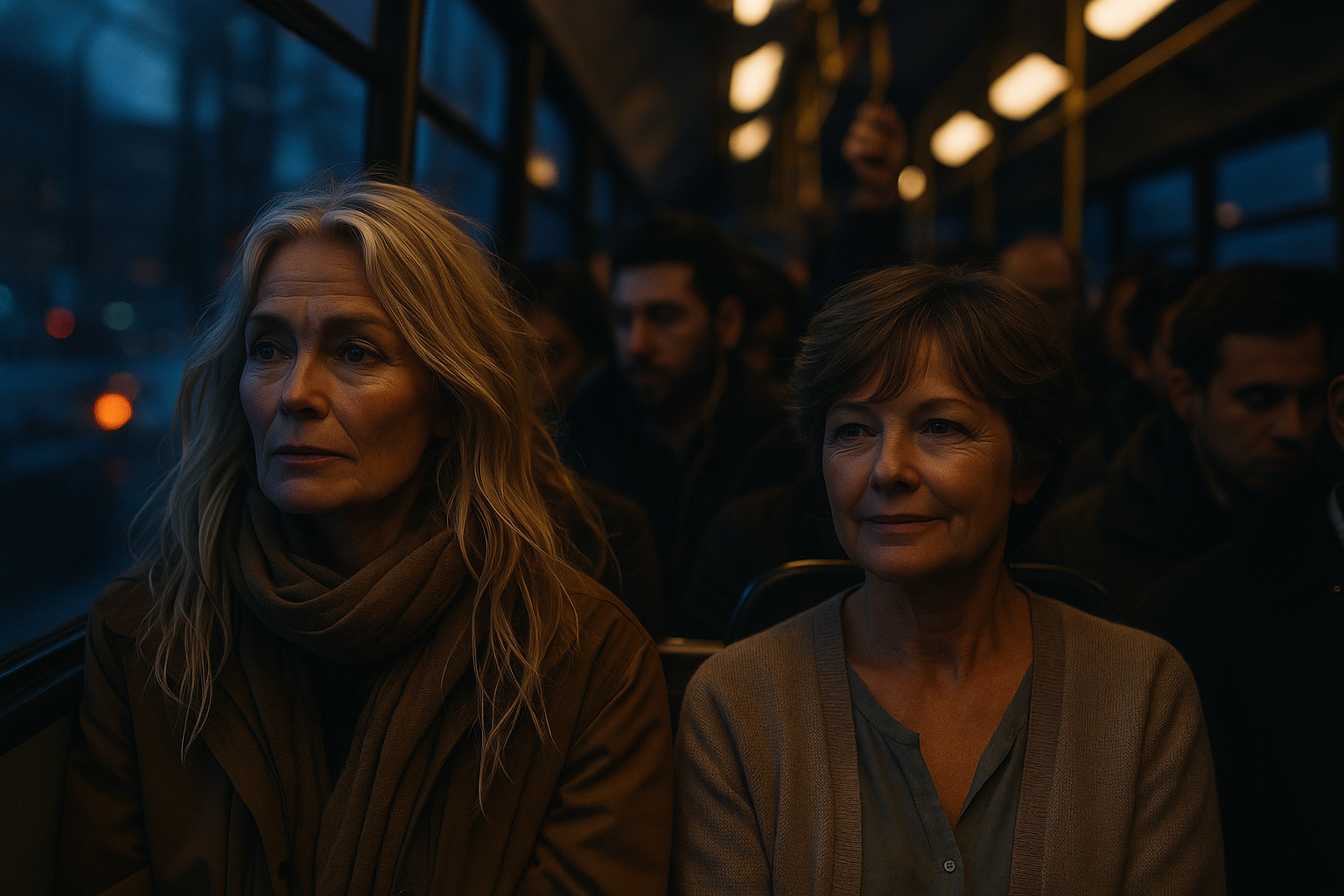
"I know," Jane said, her breath fogging slightly in the cold air that had sneaked in with the last group of passengers. The overhead lights cast a faint golden hue across her face, settling her features in a way I rarely managed myself. "Middle of winter. Days will start getting lighter again, soon."
Her words didn't push against the gloom—they sat with it. Not dismissing it, just letting it be there without letting it fill the space between us.
I shivered, almost involuntarily. The mention of winter seemed to give the chill permission to press closer. Cold radiated through the windows at our backs, seeping into the threadbare cushions and past the layered seams of my coat. I tugged it tighter around me—pointless, really, but reflexive, like holding your breath when you hear bad news.
The bus rattled forward, its windows steamed over with breath and weather, the outside world reduced to shadow and blur. Inside, a low murmur of conversation persisted—a blend of tired voices, rustling newspapers, and the occasional sigh. We were all wrapped in our own little islands of fatigue, held together only by the dull warmth of proximity.
In that moment, the bus felt like its own weather system—insular, dim, suspended in motion. Outside, winter waited in silence. Inside, we held fast to the small heat of human company, and for a little while, that had to be enough.
Jane shifted the bags on her lap—small, deliberate movements, but enough to draw my eye. One strap was fraying at the edge. The canvas tote bore faint coffee stains and the faded green of the Landcare logo we both knew. The grocery runs, the work notes, the last-minute post: the small freight no one ever asked about, that made up the scaffolding of our lives.
The bus juddered over a pothole, and I felt the contents of my satchel shift awkwardly against my side—field notes, a weather-warped notebook, and the half-eaten apple I'd forgotten was still in there. For a moment, the fog of shared warmth gave way to the familiar grit of the everyday. Commuter fatigue. The ache behind my eyes. That low, hollow echo of things left unfinished.
"So why are you so late today?" Jane asked, her tone casual but not careless—she'd heard the weariness in my earlier words and was giving it room.
I exhaled slowly, letting the breath rattle out of me as though it might carry some of the tension with it. "Oh," I began, and already I could feel the bitterness creeping into my voice, "We've got no staff and incompetent management to thank for that."
It came out sharper than I'd meant. Not venomous, but edged. The kind of frustration that had been piling up in drips, the way winter rain fills a bucket left out too long—quiet at first, then suddenly overflowing.
"So nothing unusual," Jane quipped, and the timing of it—always just so—loosened something. It didn't erase the frustration, only made room to breathe around it.
"No. I guess that's not unusual, is it," I replied, and despite myself, I felt the faint twitch of a smile take hold. Not wide. Not careless. Just enough to acknowledge her attempt, and that it had worked.
My gaze drifted down to my hands—dry from the cold, cuticle torn where I'd been picking again—and then back to the fogged window beside us. The city beyond was awash in sodium orange and shadow. My thoughts touched briefly on the day just gone: the overlapping meetings, the half-formed decisions, the desk cluttered with papers that all wanted something from me. It was too much, most days. And somehow, never quite enough.
"I've been working on a submission to local council to expand a parcel of land for the further protection of a species of Lucanidae," I said, the frustration still clinging to the edge of my words, but giving way now to something steadier. Purpose. The kind that lived deeper than office politics or late buses.
It was a project that mattered—one of the few lately that did. A chance to put something tangible into the world, to shift the boundary line just far enough to give a small, irreplaceable creature a better shot at survival. Lucanidae had been part of my life since I was fifteen, hunched over a rotting log with my father's field lens and a borrowed notebook. Now, they were still with me—stubborn, intricate, quietly magnificent.
"Oh, right," Jane said, the change in her voice slight but unmistakable. She never quite grasped my love for insects—the complexity, the role they played—but she tried. That counted.
I chuckled softly, a little wearily. "It's a Stag Beetle," I added, my voice buoyed by a flicker of pride despite myself. The name meant more to me than the creature—persistence, fragility, the beauty of structure at its most precise.
"Of course," Jane replied, and I didn't have to turn to see the smile on her face. It lived in her voice, in the bend she put on the words. "I know how much you love bugs."
There it was. The word again—bugs. I winced, inwardly. Not out of snobbery, but out of tiredness. It was always this, always a gentle correction standing between the world I lived in and the one people assumed I did.
"No, they're not bugs. They're—" I began, catching myself mid-sentence, the old reflex of clarification slipping out before I could temper it. The tone a touch too sharp, more from fatigue than anything Jane had said.
"Beetles," she finished for me, her laughter soft and low, curling into the quiet of the bus like steam rising from a forgotten cup of tea.
"See, you do know," I said, letting the smile come. It spread slowly, loosening something tight around my eyes, and I felt—if only for a moment—lighter. Not fixed. Just less frayed.
Jane turned towards me slightly, her features softened by the amber glow of the overhead lights, which flickered now and then as we passed under streetlamps. Mischief sat in the set of her mouth, and under it something steadier.
"Oh, I know. I just forget sometimes," she said with a small shrug. "I'm not as up to date with these things as you are."
She didn't compete or pretend to follow. She just let me have my world, even when it baffled her—the way you leave a strange nest alone and let it get on with its work.
Despite the respect Jane and I held for each other's passions, I caught her profile in the dim windowlight and felt the small distance open. Not judgement, not even disinterest—just that some things in my world would always go untranslated in hers. We lived side by side, but our internal maps were drawn with different symbols.
"It's not something new," I said, more abruptly than I meant to, the edge of defensiveness slipping in before I could catch it. "They've always been beetles. They're in the Tasmanian Threatened Species Protection Act."
A pause, brief but palpable. Jane turned towards me properly now, her expression shifting. The lightness drained from her face—not in discomfort, but in recognition. She understood, at least enough to meet me halfway.
"Oh, I don't doubt they are," she said evenly. No irony, no backpedal—just the steadiness she kept for when it mattered.
I opened my mouth to speak again, but she shifted the conversation, not out of avoidance, but with the deft grace of someone who knew how to navigate around tangled roots rather than through them.
"So, with you being so late tonight, how are you getting back home? Is Chris waiting for you at the usual spot?" she asked, brow furrowing slightly. Her head tilted in that way she did when she was reading more from my silence than from my words.
I felt my forehead crease, the logistical fog of the evening rolling in once again. "I'm not sure yet," I admitted, glancing down at my phone in my lap, though the screen remained blank. "Earlier I told him to go home as usual and I'd let him know what time to come and get me. But I haven't been able to reach him as yet. I may have a lengthy walk ahead of me."
The idea settled low—cold air, wet roads, and the long, steep climb from the main road up into Collinsvale. It wasn't the distance so much as the knowing: how alone the world could feel after dark.
"Don't be silly, dear friend," Jane said, and the warmth in her voice cut through the creeping dread. She reached over and laid her hand gently on my arm, the pressure light but deliberate, steady.
"Message Chris and tell him not to worry about it. I'll take you home tonight."
I stared at her for a moment, her words meeting resistance in me—not disbelief, but hesitation. Relief edged in, quick and quiet, but it was chased by guilt. I couldn't ask her to do that. Not after the day we'd both had.
"You can't do that," I protested, instinctively, the words catching in the space between gratitude and concern. "Wouldn't Valerie have dinner ready and waiting for you by now?" I asked, my thoughts turning to Jane's evening routine—her partner, her life outside of this bus, this friendship.
But Jane didn't waver.
"Of course I'll take you. We can't very well have you walking all the way from Berriedale to Collinsvale in the cold and dark now, can we," she said, her voice firm but kind, with a finality there was no arguing.
And I knew, then, not to argue further. This was Jane. And I was lucky to know her.
Just then, my phone erupted with its loud ring—sharp, urgent—breaking over the murmur of bus conversation like a sudden clap of thunder. Heads turned, a few glances cast my way, before returning to half-finished thoughts and scrolling thumbs. I flinched at the volume, jolted out of the warm rhythm of my conversation with Jane.
"This is probably Chris now," I said quickly, a flicker of hope threading through the apprehension that had been quietly knotting in my chest since we'd boarded. I fumbled in my coat pocket, hands uncooperative and clumsy. The phone slipped slightly as I pulled it free, and I had to catch it with both hands—too many winters spent with delicate instruments had left me with a certain caution, a precision not suited to the brute immediacy of ringing devices.
My fingers, more at home brushing aside leaf litter or adjusting a microscope lens, felt oddly out of place in the frantic dance of touchscreens and swiping. The phone's surface was slick, almost defiant under my grip, and the momentary delay in answering only heightened the rush of unease.
I brought it to my ear, half-turning away from Jane and the rest of the bus, shielding myself instinctively with my body. I was hoping for the steadying timbre of Chris's voice—a tether to the one steady thing at the end of a disjointed day.
"Hey Karen," came the voice, bright and unmistakable. Not Chris. Luke.
There was a pause in me—brief, confused—and then the recognition clicked into place. A familiar wave of warmth followed. Luke's voice had that curious ability to both ground and unsettle, depending on the day. We'd shared so many mornings together—Luke, Jane, and I—climbing aboard at Berriedale, settling into our unofficial seats. It had started simply enough: a shared nod, a half-joke about the weather, but over time it became its own kind of ritual. Our 'bus world', as Jane once called it. Conversations about everything and nothing. The quiet companionship of people thrown together by timing and habit, but held there by something more deliberate.
"Can you hear me okay?" he asked. His tone carried its usual brightness, but it had softened, gone careful. The kind of voice that didn't just want to be heard—it needed to be.
I pressed the phone more firmly to my ear, brow tightening as I strained to make out every word. "Yeah. You're a little soft, but I can hear you well enough," I replied, adjusting my grip again, as though sheer determination could sharpen the signal. The bus's interior buzzed with low conversations, the odd cough, the steady churn of tyres on damp asphalt. Every background sound seemed magnified, intruding on this small, private thread of connection I was trying to maintain.
"Oh good," Luke said, the relief in his voice faint but unmistakable—like someone releasing a held breath. It struck me then that he, too, had been waiting for this thread to hold, this line between two people suspended in the white noise of everyday life. And for reasons I didn't yet understand, that mattered.
A pause hung in the air, stretched taut between us and padded by the steady hum of the bus's engine. The vehicle rocked slightly as it rounded a bend, the overhead lights flickering briefly, casting soft shadows across the floor. Jane's bags rustled as she shifted again beside me, the muted scrape of canvas against her coat sleeve pulling my attention for a heartbeat. The sound, so ordinary, suddenly grated—like a tap dripping into an already brimming sink.
My patience—already rubbed raw by the day's demands—thinned to near transparency. I could feel it, that fraying edge, just shy of snapping. I didn't mean to sound so abrupt, but the silence on the line was needling.
"I'm on the bus with Jane," I said, cutting into the quiet, my voice tight with a mix of irritation and an eagerness to move things along, to return to something more certain.
"Oh. Hi Jane," Luke replied, a slight lift in his voice—a deliberate attempt to sound cheery, perhaps even apologetic. I could picture his face as he said it: the tilt of his head, the earnestness in his eyes, trying to close the gap between where he was and where we sat now, shoulder to shoulder in the dim glow of the bus.
I turned slightly to Jane, offering her the words with a glance and a small smile. "Luke says hi," I told her, keeping my tone light, though it carried more than the words did.
Her face warmed immediately, lips parting in that gentle, knowing smile she reserved for the few people who found their way under her skin—the look she might have given a favourite student, or a neighbour's son who needed feeding up. It settled something in me. Luke had become that for both of us, in his own way. A kind of surrogate—though the role had never been named aloud.
"She says you're a slacker. We haven't seen you on the bus all week," I said into the phone, picking up the thread of her earlier teasing and tossing it Luke's way. My voice held the familiar lilt of mischief we often used to cover deeper concern. It wasn't really about his attendance. It never was.
"Ahh. I know," Luke's voice came through again, sheepish and unmistakably genuine. "I've had the week off."
There was a simplicity to his answer that made me smile despite myself. No elaborate defence. Just truth. And in that honesty, a little permission—for all of us—to step outside the routines we'd built without apology.
"Fair enough then," I said, letting the words soften, a smile tugging unbidden at my lips. I glanced at Jane, who returned my look with one of quiet approval. Can't really argue with that, I thought, filing it away alongside our many other small admissions: that we were tired, that the world asked more than we had, that sometimes we just needed to step back and breathe.
The conversation ebbed again, giving way to a silence that felt oddly shaped—neither comfortable nor tense, but waiting. The kind of pause where something more might have been said, if we'd had the clarity or the courage. Instead, the space filled itself with the usual soundtrack of evening transit: the low murmur of strangers, the rhythmic squeal of the brakes, the intermittent hiss of the door seals. And beneath it all, that ache of things left unsaid, sitting in the space between us.
"You busy tomorrow morning?" Luke finally broke the silence, his voice emerging from the small speaker. It caught me slightly off guard, jolting me out of my drifting thoughts.
His question felt sudden—not abrupt, exactly, but unexpected. A shift from casual to specific, from ambient to immediate. It tugged my attention back, like a diver resurfacing, lungs pulling in the air they'd forgotten they needed.
"Well," I began slowly, the word buying me a moment as my thoughts changed tracks. I could see it clearly in my mind's eye: Chris kneeling by the wall in his old gardening jeans, soil streaked across his forearms, the two of us working side by side in companionable silence. "Chris and I have to make an early start in the morning to fix the small hole in the retaining wall. It keeps running mud underneath the back door when it rains."
The sentence landed softly. It wasn't much—just mud and maintenance—but it was ours. A life built out of repeated gestures, patched walls, and shared responsibility.
Then a different image came to me, lighter, brighter: Chris in the kitchen, a tea towel slung over one shoulder, spatula in hand, fussing over the eggs like he was preparing them for a panel of judges. "But if you come over at nine, Chris might cook you up a fresh duck egg omelette," I added, and even as I said it, I felt the familiar warmth rise in my chest—the kind that only came with thinking about home, and the people who made it feel that way.
"That'd be lovely," Luke replied—a small lift in his tone, genuine and unguarded. Enthusiasm, yes, but under it something like gratitude. As though the offer meant more than just breakfast.
"Okay. See you at nine then," I said, sealing the invitation with a finality that surprised me a little. A plan had been made. A simple one, but it had shape, time, and a place in the quiet rhythm of the following morning. And beneath it, a thread of apprehension I chose to file as curiosity. It was always hard to tell with Luke.
"Okay. Bye," he said, and with that, the call ended. A soft click. A line gone quiet.
I lowered the phone slowly, staring at the screen as it returned to its idle state. Around me, the bus continued its journey, indifferent to the small shift that had just occurred. Jane sat beside me, still wrapped in her thoughts, and beyond the steamed windows the city lights blurred into streaks of amber and silver.
I sat with it—the strangeness of the moment. It had only been a few minutes, just a handful of words, and yet the exchange clung to me. Luke didn't invite himself anywhere; tonight he had.
The phone sat in my hand, screen cooling. Not urgent, not ominous—just there, waiting to mean something. A reminder of how even the smallest moments could widen into something else. A call. A plan. A question you didn't know how to answer yet.
"Not Chris then," Jane observed, her voice drawing me back from the spiral Luke's call had spun me into. It was always like that with her—no abruptness, no demand, just a nudge that brought me back to the world around me.
"No," I echoed, my voice trailing, as though part of me were still back in the call, reluctant to let go of the odd cadence it had left behind. The bus thrummed on beneath us, each jolt and creak a reminder of movement, of time pressing forward even when the mind lagged behind.
"Everything okay?" Jane asked, her tone soft but sharpened by concern. It reached me clearly over the murmur of the bus—the shuffle of shoes, the low chatter, the occasional mechanical sigh of the air brakes.
I gave a small shrug, but it didn't shake the feeling clinging to me. "I don't know. That was all very odd." I wasn't sure why I said it aloud—maybe I was hoping that saying it would settle it. It didn't. The words seemed to hang between us like condensation on the bus window—blurry, unresolved.
"It was a bit, wasn't it. Does he visit your place often?" Jane's gaze found mine, steady and searching. There was no intrusion in it, only that gentle insistence she had when something didn't sit right.
"Only that one time with you," I replied, the memory surfacing slowly. I could picture it now with almost uncomfortable clarity—Luke standing awkwardly by the kitchen doorway, commenting on the smell of eucalyptus and warm compost, nodding too much, eyes flicking about as if trying to map the space into something familiar. It had seemed innocuous at the time, one of those unremarkable days that melt into routine. But now it shimmered with a strange afterglow, like a frame in a film that takes on new meaning only once you know the ending.
Jane's brow creased, her mouth drawing in with thought. "Very odd indeed," she murmured, voicing what I hadn't quite been able to say outright.
"Hmm," I said aloud—a small sound doing more work than its size. Something about the whole exchange didn't sit quite right—not threatening, exactly, but off. Luke wasn't typically spontaneous, and he certainly wasn't the sort to invite himself over for omelettes on a whim.
And yet, I trusted him. That was the oddest part, really. For all his quirks and his occasional distance, Luke had been a fixture—one of those rare constants that made the daily commute feel less mechanical, more human. The bond we'd formed—me, Jane, and Luke—hadn't been dramatic or confessional, but it was real. Built one bus ride at a time, stitched together with weather talk, shared groans about the transit app, small observations about the world passing by outside the window.
Still, trust didn't preclude questions. And the timbre of his voice tonight had stirred a ripple I couldn't smooth over.
Jane nudged me gently, pulling me from my thoughts. "We're nearly there. Quick. Send Chris that message," she said, ever the pragmatist, her voice slipping back into the comforting cadence of the immediate, the tangible.
"Yeah. Alright," I murmured, already reaching for my phone. The screen lit up cold against my fingers, the keys familiar beneath my touch even as my mind remained elsewhere. I typed out a quick message to Chris, letting him know about the change in plan, about Jane's offer to drive me home. Straightforward. Necessary. Done.
But the moment my thumb hovered over the send button, the thought returned, insistent and quiet, and would not be put down.
What do you really want, Luke Smith?
It lodged itself in my mind, a question without context, without answer—yet somehow not unfounded. As the message sent and the screen dimmed, the question lingered, a whisper threading through the edges of an otherwise ordinary evening.







