Tasmania Police (Southern Division)
Tasmania Police Southern Division is the largest of the state's three regional commands, policing roughly 250,000 people across 18,000 square kilometres that run from Hobart's waterfront to the empty heart of the Central Highlands. Constituted in 1917 out of fourteen quarrelling districts, it spent a century becoming a modern investigative force without ever quite shedding the instincts of an isolated island constabulary. Its headquarters stand at 47 Liverpool Street; its institutional memory runs darker than its public face. The division has never wholly recovered from the fortnight in 2018 when it lost Detective Karl Jenkins to a disappearance no one can explain and Detective Sarah Lahey to a death no one will fully discuss.
The Weight of the Badge and the Geography of Service
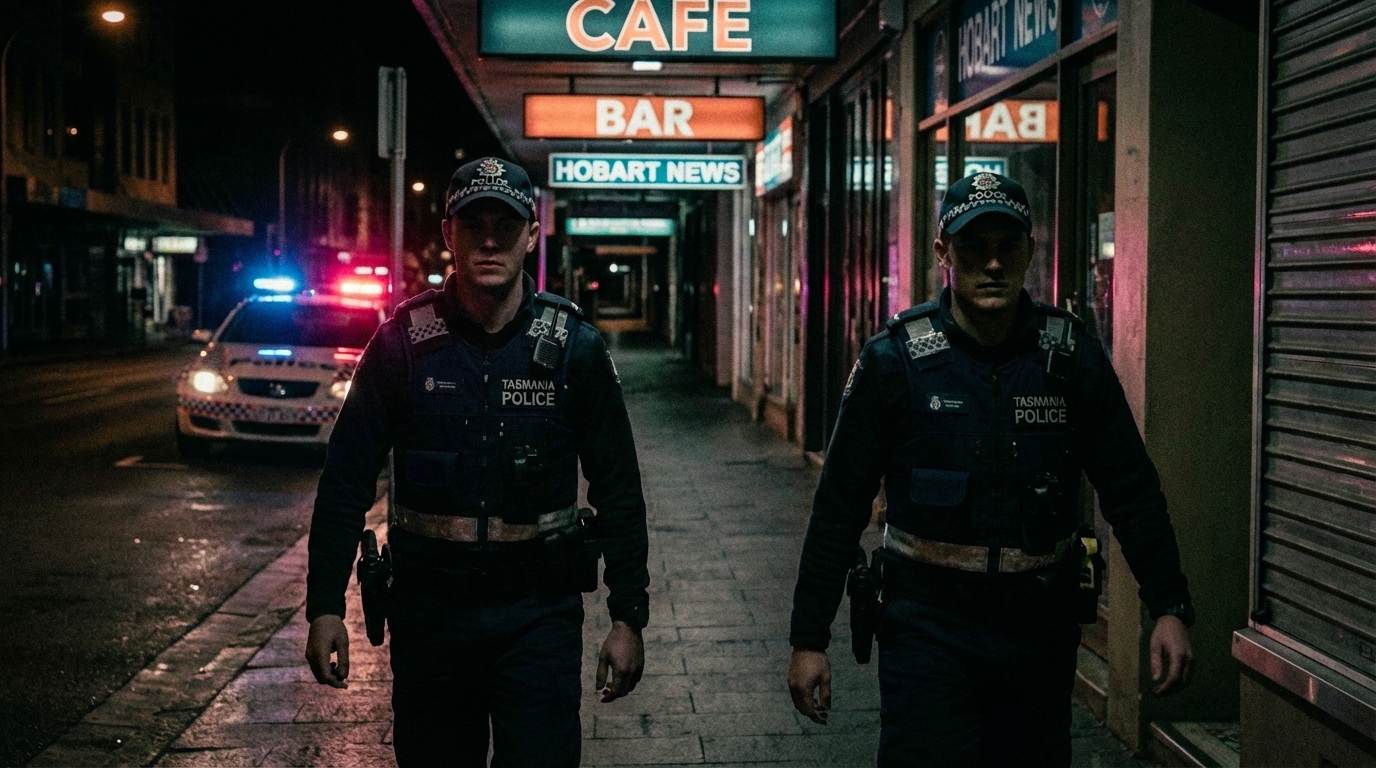
Southern Division polices a single jurisdiction that behaves like three. There is the city: Hobart packed against its waterfront, sandstone warehouses and weekend crowds, the ordinary trade of any urban command. There is the valley country beyond it, the Derwent farms and the orchard towns of the Huon, where properties run to hundreds of acres and the local sergeant knows every gate by name. And there is the high interior, the Central Highlands and the wild country to the south-west, where mobile coverage fails, the roads turn to gravel, and the nearest neighbour can be an hour away. An officer's working life is shaped almost entirely by which of these worlds they are posted to. The constable walking Hobart's Friday-night blocks and the one easing a four-wheel drive along Storm Bay carry the same warrant card and little else in common.
Eight hundred and fifty sworn officers cover this ground, and the geography sets the terms of everything they do. Response times in the city are measured in minutes; for a remote highland property they can stretch past an hour, and both figures sit in the same divisional report as though they described the same job. A search across trackless bush demands skills the urban detective never has cause to learn. A welfare check in a township of two hundred is half policing and half neighbourliness, because the officer will meet the same faces at the shop on Saturday. The division's standing problem is that the city wants visible patrols and fast cars while the rural districts want anyone at all within reach, and no roster ever written has satisfied both at once.
Roughly 250,000 people live inside the division's 18,000 square kilometres, and they are not spread evenly across it. They cluster in Greater Hobart and thin out fast: regional centres at New Norfolk and Huonville, then a scatter of one-pub towns, then highland country where the population per square kilometre rounds down to nothing. The boundary has barely shifted in a century. What changed is everything inside it.
From Fourteen Districts to One Command
The division was not so much founded as assembled out of failure. When the Police Regulation Act of 1898 swept away Tasmania's patchwork of municipal forces and raised a single state service on 1 January 1899, Commissioner George Richardson carved the colony into fourteen districts that followed the old municipal and magisterial lines. The arrangement preserved local familiarity and sacrificed nearly everything else. Each district inspector ran his patch with little oversight and less coordination, and cooperation across a boundary depended on whether the two inspectors happened to be on speaking terms. For close to two decades the inefficiency was tolerated as ordinary, because Tasmanian crime was overwhelmingly local and rarely demanded more than one inspector's authority to manage.
The war changed the arithmetic. By early 1917 the force had lost almost a quarter of its officers to enlistment; the Commissioner himself, Colonel John Lord, was somewhere in France and had not set foot in his headquarters for over a year; and Acting Commissioner Arthur Ninnis was left presiding over fourteen separate command structures the shrinking force could no longer afford. A committee he convened late in 1916 returned its recommendation within eight weeks: collapse the fourteen districts into three regional divisions, each under a superintendent with genuine authority over resources and procedure, the boundaries drawn along Tasmania's mountains and rivers rather than its municipal traditions. On 1 March 1917 Ninnis signed General Order No. 14, and Southern Division came into being as the largest of the three.
Its first commander was Superintendent Edwin Heyward, a thirty-year veteran who had served under three commissioners and knew precisely what he was inheriting, having worked the same building decades earlier as a young detective sergeant. He took command from the old Argyle Street headquarters in Hobart, a sandstone pile whose dignified façade concealed damp basements and timber-partitioned offices that carried every conversation through the walls. His division ran to 127 officers across nineteen stations, with an administrative staff of four, a complement cut nearly a fifth below its pre-war strength by the same enlistment that had hollowed out the rest of the force. Hobart station held thirty-four of those officers; at the far end of the scale, the lone constable at Ouse policed more country than he could cross in a week. Heyward standardised what mattered most first, evidence handling and custody, where the old districts' inconsistencies had been quietly losing prosecutions, and by the end of that March a single superintendent held operational authority over the whole of southern Tasmania for the first time in the state's history.
Almost nothing of Heyward's division survives except its boundaries. Horses gave way to motor vehicles, telegraph to radio, the misfiled evidence ledger to the database. The decisive break came in 2003, when the force abandoned the last of its colonial-era premises for a purpose-built headquarters at 47 Liverpool Street, ten storeys raised between 2001 and 2003 and occupied that March, designed around computer networks and forensic laboratories rather than filing cabinets and party-line telephones. The building only made a deeper change visible. An officer from 1917 set down in the modern division would recognise the badge, the oath, and the map, and very little else about the work.
The Criminal Investigation Branch
The Criminal Investigation Branch is where the division does its slowest and most deliberate work. Sixty-five detectives staff it, and where a patrol officer closes one incident and moves to the next call, a detective lives inside a case for weeks or months, assembling something a court will accept out of fragments that began as almost nothing. The Branch divides along predictable lines: a Major Crime Unit for homicides and serious assaults, where the scrutiny is heaviest and an error can leave a violent offender at large; a Drug Investigation Unit running long surveillance operations and informants against networks that reach across Bass Strait and the occasional international border; a Fraud and Cybercrime Unit forever a step behind the technology it polices; and a Child Protection unit doing the work that costs its detectives the most to do well.
The Missing Persons Unit occupies stranger ground than the rest, because its cases open with an absence rather than a body, and some of the people it searches for do not wish to be found. Its best day and its worst both sit in recent memory. In 2016, eight-year-old Emma Thompson was recovered alive after the dog Duke tracked her seventeen kilometres through dense bush, the outcome against which every search is measured. Two years later came the Greyson-Jeffries investigation, the inversion of it: a tangle of disappearances around Jeffries Manor that resisted every conventional explanation, consumed the detective leading it, and was finally overtaken by that detective's own disappearance and his partner's death. The files sit in the Cold Case & Records Room now, pulled out periodically by Detective Sergeant Alexander Stout, who has never been able to make them resolve.
Jenkins, Lahey, and the Partnership That Broke the Division
Karl Jenkins came to the division in 2003, a transfer from the Queensland force with five years in South Australia behind that, and a reputation that arrived before he did. His first years in Hobart were not spent in the field but on the division's machinery: he built the triage and briefing systems that cut response times and closed the gaps between shifts, reforms that had Hobart cited as a model command by 2006. Only in 2008 was he promoted to detective and assigned to the Organised Crime Division, partnered with Detective Sergeant Charlie Claiborne, whose street instinct made a working complement to Karl's relentless method. Operation Tidewater, the cross-strait methamphetamine investigation that ended in seventeen arrests and millions in seized assets, marked him as perhaps the finest investigator the division had; his field notes became training material at the academy.
What his colleagues could never reach was the man himself. They respected the sixteen-hour days and the pattern recognition that found connections no one else could see, and they kept their distance from someone who appeared to have no life beyond the work to return to. Partnership requests thinned over the years, officers asking to be reassigned after a few months of his silence and his intensity. He was admired and unknown in equal measure, which is a precarious way for any institution to hold one of its most valuable people.
The 2017 pairing with Jargus-9B was, in part, a solution to that problem. The dog had come out of the breeding programme with an independence the trainers had never seen, and matching him to Karl produced the division's first detective-K9 team, built for exactly the missing-persons and wilderness work the Branch most struggled with. Deputy Commissioner Roger Matthews signed off on the experiment. For a year it worked, and it drew national attention.
Detective Constable Sarah Lahey had partnered with Karl since October 2016, and she read people in a way he never could, which made their clearance rate the highest in the division and their partnership the thing that destroyed them both. What grew between them was never named and never resolved. Claiborne watched it from across the office floor, the looks held a beat too long, the proximity past any operational need, and recognised compromised judgement taking hold of two officers he could not separate without saying aloud what he was seeing. Karl, who could not return what Sarah felt and could not function without her near, bound them both tighter into something that served neither.
It came apart at Berriedale, over a fortnight of incidents at a single house on the south side of the river. On 29 July 2018 Karl forced entry to a residence tied to the Greyson-Jeffries case, certain of evidence he had no authority to seize. He returned the same day with Sarah and with legitimate access, and there, hearing a voice he could never afterwards prove was real, his control gave way completely. He turned on the room, and when Sarah moved to stop him he struck her. The injury was slight in itself, a laceration to her hand, and the official record made it slight in every other respect too: a workplace incident report that documented a wound and said nothing of how it came to be. The institution wrote down a fact and buried the truth inside it, which is a thing institutions do well. Sarah drove back to Hobart and left Karl to walk it in the winter cold. The partnership was finished.
Four days later it stopped being a disciplinary matter. On 2 August, following a call that placed his suspect at Jeffries Manor in Granton, Karl pursued Luke Smith into a shed on the property while Sarah secured the house. The operations desk logged his last contact at 14:37. When Sarah reached the shed minutes later it stood empty, no Karl, no Smith, no sign of where either had gone. Sarah herself was dead within the week, killed on 8 August during a confrontation with Gladys Cramer in Myrtle Forest while under the surveillance Internal Affairs had authorised on her, the inquiry into her conduct closing with findings of unauthorised activity and her place on the memorial wall left provisional. Jargus disappeared from police custody on 6 August, in the days between the two of them, the exceptional animal whose career had validated an entire programme, gone without a body or an explanation.
The division absorbed all of it inside nine days and has never entirely metabolised it. Two officers and a working dog lost; investigations orphaned mid-stream; and the colder recognition, never minuted but understood on every floor, that the warning signs had been legible for a year, and that the institution had watched them and failed to act in time.
The Special Operations Group
The Special Operations Group exists for the work that exceeds a patrol crew: armed offenders, high-risk warrants, sieges, the hostage situation and the counter-terrorism callout it trains relentlessly for and hopes never to see. Sixteen operators hold the capability, and they hold it by never quite finishing their training, weekly tactical work, quarterly shoots, annual recertification, the endless scenarios that rehearse decisions measured in seconds. It is not a thing a body can sustain forever, which is why SOG careers run in years rather than decades before operators rotate out carrying whatever the work has deposited in them.
Senior Sergeant Dale Murphy anchors the unit's experienced core. His public criticism of K9 protocols after the dog Magnus was injured in the 2019 Sandy Bay operation created real friction between the tactical and K9 sides, and then did what institutional friction is meant to do and rarely does: it forced a genuine review and produced better coordination between them. A commander prepared to say a procedure was unsafe, and a leadership prepared to examine the claim rather than close ranks, is the version of the division that works.
K9 Operations and the Argument Over How a Dog Learns
The Rokeby K9 Training Centre opened in 2002 under Inspector Graham Whiteley, on the orthodox model of the day: dominance, compulsion, the handler's authority over the animal. It produced working dogs that functioned, on assumptions about how dogs think that were already being questioned elsewhere. Claire Morgenstern's arrival as programme director in December 2014 overturned them. Her approach treated each dog as a mind to be assessed and developed rather than a temperament to be overridden, positive reinforcement in place of compulsion, problem-solving encouraged rather than trained out. Traditionalists objected; Queensland's Inspector Bruce Harrison argued, in the trade's plain terms, that soft methods would break under operational stress. The numbers answered him. Handler-K9 success rates rose thirty-seven per cent between 2015 and 2020, and other Australian programmes began studying what Tasmania was doing.
The breeding programme near New Norfolk, run by Kenneth Rawlings, supplies the German Shepherds and Belgian Malinois the centre trains. Its most extraordinary product was Jargus-9B, born in October 2015 with a problem-solving independence that read as something close to intelligence, the quality that fitted him for detective work no patrol dog could manage, and that placed him with Karl Jenkins. His disappearance from custody on 6 August 2018 cost the programme not only a dog but its proof of concept. The detective-K9 experiment has sat suspended ever since, its expansion shadowed by the knowledge of how its first iteration ended.
The Human Face of the Institution
Most of what the division does to prevent crime never surfaces in an arrest figure. Forty-seven Neighbourhood Watch zones run on the slow accumulation of trust between residents and their liaison officers, the kind built in quiet years so that it is there when a bad one comes. School liaison officers work the harder edge of the same idea, holding authority and rapport in the same hand, their success measured in the offences that never happen and the adolescents who never escalate. An elder-abuse programme reaches into the exploitation that hides inside families and rarely reaches a statistic, and multicultural liaison officers serve communities whose dealings with police elsewhere taught them a wariness effective policing has to earn its way past. None of it photographs well. All of it is the difference between a force that polices a community and one that merely patrols it.
Forensic Services
Beneath the Liverpool Street headquarters sits the forensic laboratory the officers call the Lair, where investigation edges toward science. Its examiners work to a standard set by the certainty that nothing can be undone: contaminated evidence cannot be cleaned, a broken chain of custody cannot be repaired, an analysis that consumes the only sample cannot be run a second time. Every result they produce is built to survive a defence expert hunting for the single flaw that excludes it. Digital forensics has become the fastest-growing part of the work and the hardest to keep current, the technology always a little ahead of the training. The relationship between the laboratory and the detectives rests on each understanding the other's limits, a balance the Greyson-Jeffries investigation strained badly as Karl Jenkins pressed for analyses beyond protocol that the technicians could no longer justify against everything else competing for the bench.
The Arithmetic of Never Enough
Every capability the division maintains is paid for by one it goes without. The 2020 proposal to consolidate K9 operations made the arithmetic visible, budget pressure set against performance data and public feeling, the cuts ultimately abandoned but the underlying squeeze never resolved. The pressures are the ordinary ones, sharpened by the place. Cybercrime and forensic specialists can earn more outside policing than within it. Experienced detectives retire and take with them institutional memory no course can replace. Rural stations struggle to attract officers who would rather work the city. And the equipment contemporary policing now assumes, the cameras and drones and the fleet and the systems, arrives on a replacement schedule the budget has never once met on time. Command spends every cycle deciding which gap stays open, and explaining to officers and public alike why the resources never quite match the need.
Borrowed Reach
What the state budget cannot fund, the division borrows. Its relationship with the Australian Federal Police opens counter-terrorism and organised-crime capabilities no island force could sustain alone; the Australian Border Force shares the work of port security and the interdiction of whatever moves through Hobart's docks under cover of legitimate cargo. Bass Strait is the recurring fact of all this external work, at once a barrier that isolates Tasmania and a highway that carries drugs, weapons, and fugitives to and from the mainland, which makes the Victoria Police relationship a standing necessity rather than an occasional courtesy. None of it runs itself. It survives on maintained channels and the patient navigation of whose jurisdiction is whose.
The Division That Persists
The division continues because a division has no option to stop. Crime does not pause for grief, emergencies do not wait on adequate resourcing, and the shifts change at Liverpool Street whether or not anyone has the capacity left to feel them change. Recruits arrive from the academy at Rokeby and inherit desks whose former occupants they never met, learning the geography and the culture the only way either is ever truly learned, by working them.
The memorial wall at headquarters carries the names of officers who died in service. Karl Jenkins is not among them; a man who is missing rather than confirmed dead falls into an administrative gap that no one passing the wall mistakes for the truth of what became of him. Sarah Lahey's name is there only provisionally, held back by bureaucratic caution about the circumstances of her death, the formality doing nothing to make the loss less real. Everyone who passes the wall knows who belongs on it and why the institution cannot quite say so. That gap, between what is recorded and what is known, is the division in miniature: it writes down the fact and carries the truth privately, persists through what it cannot resolve, and keeps working, because the work is what remains when the people are gone.







