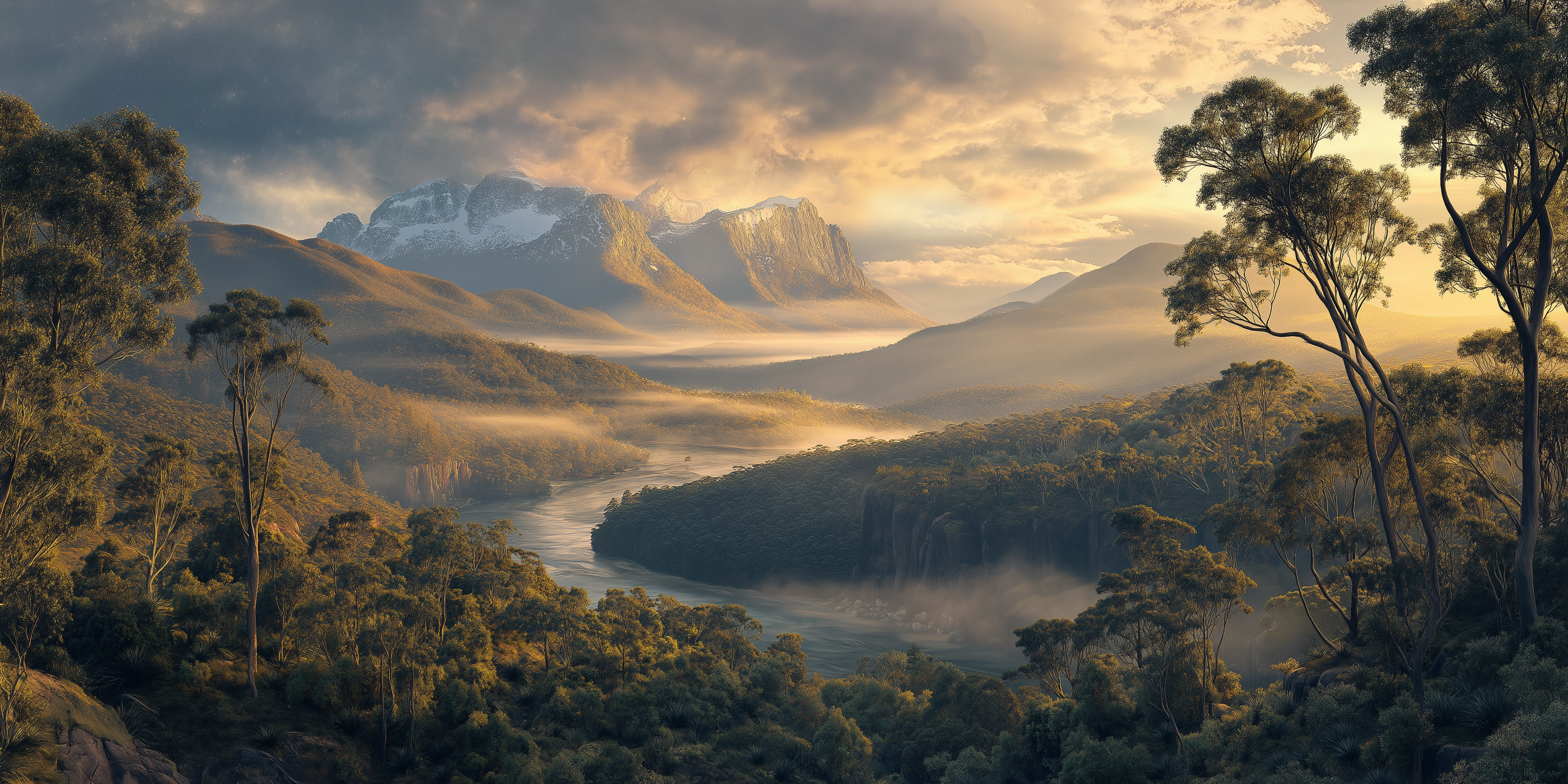
Tasmania, Australia
Tasmania is Australia's island state, separated from the mainland by Bass Strait and home to the Palawa peoples for over forty thousand years. Founded as the British penal colony of Van Diemen's Land in 1803, it developed through convict labour, mineral wealth, and the establishment of dynasties like the Jeffries family whose manor near Granton witnessed two centuries of tragedy. The island balances heritage preservation with environmental consciousness, its isolation breeding distinctive resilience and character.
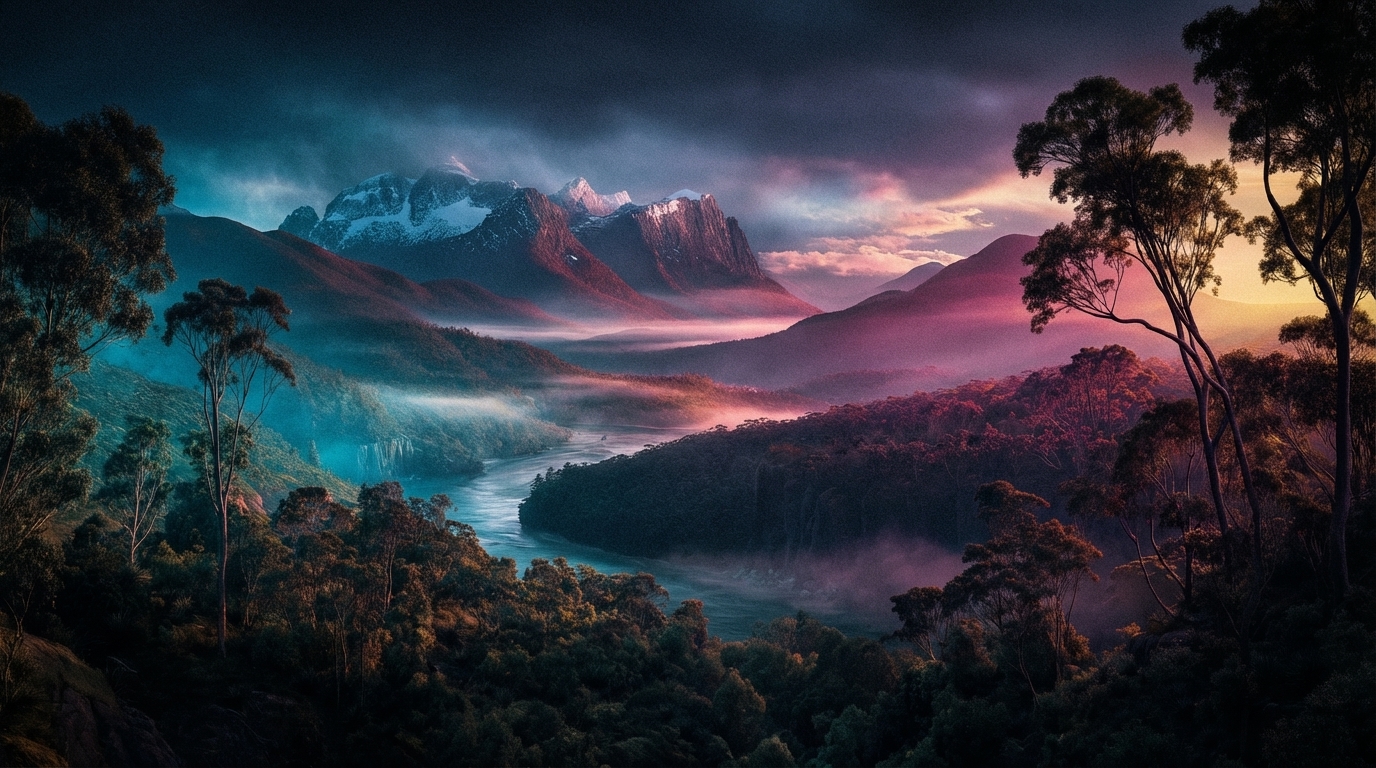
Ancient Land and First Peoples
Tasmania exists as Australia's island state, separated from the mainland by the turbulent waters of Bass Strait yet bound to the continent by geological history and cultural connection. For at least forty thousand years before European vessels appeared on the horizon, the Palawa peoples inhabited this land, developing sophisticated cultures adapted to the island's temperate forests, coastal resources, and highland environments. The Muwinina of the south-east, the Paredarerme of the midlands, the Tommeginne of the north-west coast, and numerous other nations maintained distinct identities whilst sharing kinship networks and trading relationships that wove the island into a coherent cultural landscape.
The ice ages periodically connected Tasmania to the Australian mainland via a land bridge across what is now Bass Strait, allowing human migration and the movement of flora and fauna between the two landmasses. When rising seas finally severed this connection approximately ten thousand years ago, the Palawa peoples continued developing their cultures in relative isolation, creating distinctive traditions that evolved independently of mainland Aboriginal societies. This separation fostered unique approaches to tool-making, hunting, and ceremony, whilst the island's cooler climate and dense forests shaped material culture in ways that distinguished Tasmanian Aboriginal life from that of the warmer north.
The relationship between the Palawa and their country was intimate and reciprocal. Fire management shaped the landscape, creating the open eucalypt forests and grassy woodlands that characterised much of the island when Europeans arrived. Shell middens along the coastline, some dating back millennia, testify to the sustained harvesting of marine resources that supplemented terrestrial hunting and gathering. The mountain known to the Muwinina as kunanyi, which colonisers would rename Mount Wellington, held spiritual significance that transcended mere geography, connecting the physical landscape to ancestral beings and ceremonial obligations.
European Contact and Colonial Foundation
Dutch navigator Abel Tasman became the first European to sight the island in 1642, naming it Van Diemen's Land after the Governor of the Dutch East Indies. Yet it would be more than a century and a half before permanent European settlement began. British interest in the region intensified following the establishment of the New South Wales colony, driven by concerns about French exploration and the need for additional sites to absorb the growing convict population that transportation policies generated.
The settlement of Risdon Cove in 1803, followed by the establishment of Hobart Town at Sullivan's Cove in 1804 under Lieutenant-Governor David Collins, marked the beginning of Van Diemen's Land as a British colony. The deep-water harbour of the Derwent River provided excellent anchorage, whilst the mountain behind offered timber, fresh water, and the strategic elevation that colonial planners valued. The settlement developed rapidly as convict transports delivered their human cargo and free settlers arrived seeking opportunities in the new colony.
The colonial period brought catastrophe to the Palawa peoples. Violence, disease, and dispossession combined to devastate Aboriginal populations within decades of European arrival. The Black War of the 1820s and 1830s saw organised attempts to remove Aboriginal people from settled districts, culminating in the so-called "Friendly Mission" that relocated surviving Palawa to Flinders Island, where many perished from illness and despair. This history of violence and removal represents one of the darkest chapters in Australian colonial history, a concentrated tragedy that Tasmania's subsequent development could never entirely efface.
The Convict System and Its Legacy
Van Diemen's Land developed as one of the British Empire's most significant penal colonies, receiving tens of thousands of transported convicts between 1803 and 1853. The convict system fundamentally shaped the island's early character, providing the labour that built roads, bridges, and buildings whilst also creating the social hierarchies and tensions that defined colonial society. Port Arthur, established on the Tasman Peninsula in 1830, became the most notorious of the island's penal settlements, a place of harsh discipline and experimental punishment that earned fearsome reputation throughout the Empire.
Yet the convict system also produced unexpected transformations. Former convicts who had served their sentences, or who had received pardons or tickets of leave, often remained in the colony, some achieving remarkable commercial success. William Jeffries Senior, who arrived in Van Diemen's Land in 1815 after completing his sentence in New South Wales, exemplified this trajectory. Within two years, he had accumulated sufficient wealth to purchase a substantial tract of land along the Derwent River outside New Norfolk, where he constructed Jeffries Manor beginning in 1817. The estate, built by convict labour from locally quarried sandstone, became the seat of a dynasty that would shape Tasmanian commerce for two centuries.
The sandstone that convict hands quarried and shaped became the signature material of Tasmania's colonial architecture. Its warm honey tones, ranging from cream to deeper ochre depending on iron content and weathering, lent distinctive character to the buildings that rose across the island during the early and mid-nineteenth century. Georgian and Victorian architectural principles found expression in this local material, creating a built heritage that remains one of Tasmania's most significant cultural assets.
Colonial Prosperity and Transformation
The mid-nineteenth century brought significant change to Van Diemen's Land. The transportation of convicts ended in 1853, removing the labour system that had built the colony whilst also lifting the social stigma associated with penal status. The colony's renaming as Tasmania in 1856 represented a deliberate break with the convict past, an assertion of respectability and self-governance that accompanied the granting of responsible government. The new name honoured Abel Tasman whilst severing linguistic connection to the colonial administrator whose name had become synonymous with convict suffering.
The discovery of mineral wealth in Tasmania's interior generated prosperity that flowed through the island's commercial centres. Tin, gold, copper, and other minerals attracted miners and investors, creating boom towns in the remote west and north-west whilst enriching the merchants and financiers of Hobart and Launceston. The Colonial Bank of Tasmania, founded in 1821, provided financial services to this growing commercial class, surviving the banking crisis of 1893 that destroyed many colonial financial institutions.
Educational and cultural institutions developed alongside economic growth. The University of Tasmania, established in 1890, became Australia's fourth university and the southern hemisphere's most southerly. The institution would grow to serve the island's educational needs whilst conducting research into the distinctive environments and communities that Tasmania contained. Secondary schools, including the Hutchins School founded in 1832, educated the sons of the colonial elite, preparing them for positions in the professions, commerce, and public service that maintained social order.
Federation and the Twentieth Century
Tasmania's entry into the Australian Federation in 1901 integrated the island state into the newly formed nation whilst preserving its distinctive character and institutions. The state retained its own parliament, courts, and administrative apparatus, managing affairs within the constitutional framework that Federation established. Yet Tasmania's small population and geographical isolation increasingly positioned it as peripheral to the mainland centres of economic and political power.
The twentieth century brought modernisation alongside this growing peripherality. The reorganisation of Tasmania Police in 1917 established the divisional structure—Southern, Northern, and Western—that would continue to serve the state into the twenty-first century. The Southern Division, headquartered in Hobart, served approximately 250,000 residents from its base at 47 Liverpool Street. Law enforcement developed the professional character and institutional frameworks necessary for modern policing, though the intimate scale of Tasmanian society meant that officers often knew the communities they served in ways impossible in larger jurisdictions.
Healthcare infrastructure expanded throughout the century. The Royal Hobart Hospital, Tasmania's oldest public healthcare institution dating to 1804, underwent successive modernisations to meet contemporary medical standards. Regional hospitals in Launceston, Burnie, and Devonport served the populations of the north and north-west, whilst specialist facilities addressed particular medical needs. The New Norfolk District Hospital served communities in the Derwent Valley, including the rural areas surrounding Granton where Jeffries Manor had stood since the colonial period.
The Tasman Bridge Disaster
The evening of 5 January 1975 brought catastrophe that would define a generation of Tasmanian memory. The bulk carrier MV Lake Illawarra, travelling up the Derwent River toward Hobart, struck the Tasman Bridge, the vital link connecting the eastern and western shores of the capital. Two spans of the bridge collapsed onto the ship, which sank with the loss of twelve lives, including both crew members and motorists whose vehicles plunged into the river. The bridge's central section simply disappeared, severing the most direct connection between the city's two halves.
The disaster's impact extended far beyond the immediate tragedy. Eastern shore communities like Lindisfarne found themselves isolated from the city centre, dependent on emergency ferry services and the circuitous route via the Bridgewater Bridge far to the north. Families were separated, commuters faced hour-long diversions, and the daily rhythms of urban life were fundamentally disrupted. The bridge would not reopen until October 1977, nearly three years after the disaster.
Yet the crisis revealed the resilience that had always characterised Tasmania. Communities on both shores adapted to the new reality, developing local services and support networks that reduced dependence on cross-river travel. The disaster became a defining moment in collective memory, a shared experience that bound generations of Tasmanians together. The rebuilt bridge symbolised recovery and continuity, though the scars of that January evening never entirely faded from the state's consciousness.
Geography and Environment
Tasmania's geography shapes every aspect of the island's character. Covering approximately 68,000 square kilometres, the state comprises the main island plus numerous smaller islands including King Island and the Furneaux Group in Bass Strait, Bruny Island off the south-east coast, and Macquarie Island far to the south in the sub-Antarctic. This archipelagic nature creates diverse environments from the temperate rainforests of the west to the drier eucalypt woodlands of the east, from the alpine plateaus of the central highlands to the coastal heathlands and beaches that ring the island.
The World Heritage Area that covers much of western and south-western Tasmania protects one of the last great temperate wilderness areas on Earth. Ancient Gondwanan rainforests, glacially carved landscapes, and ecosystems that have evolved in relative isolation create conservation values of global significance. The Tasmanian Wilderness, inscribed on the World Heritage List in 1982 and subsequently extended, encompasses national parks, nature reserves, and conservation areas that together protect the natural heritage that distinguishes Tasmania from the Australian mainland.
Endemic species reflect Tasmania's long isolation and distinctive environments. The Tasmanian devil, the world's largest surviving marsupial carnivore, has become an international symbol of the island despite the threat posed by devil facial tumour disease. The Tasmanian tiger or thylacine, officially declared extinct in 1986, haunts the collective imagination as a symbol of what colonisation destroyed. Potoroos, pademelons, and numerous bird species found nowhere else on Earth inhabit the forests and grasslands that remain despite two centuries of European land use.
Flora equally reflects Tasmania's unique position. Tasmanian oak eucalypts rise to become some of the world's tallest flowering plants in the wet forests of the south and east. Tea tree and silver wattle provide understorey in many vegetation communities, whilst the ancient Huon pine, some specimens thousands of years old, survives in the remote river valleys of the south-west. These plant communities, shaped by fire, climate, and geological history, create the landscape character that contemporary Tasmanians inherit and seek to protect.
Cities and Communities
Hobart, the state capital, dominates Tasmania's urban hierarchy. Situated on Muwinina country at the confluence of the Derwent River and the slopes of kunanyi/Mount Wellington, the city serves as administrative, commercial, and cultural centre for the entire island. The waterfront precinct of Salamanca, with its Georgian warehouses converted to galleries, restaurants, and markets, has become internationally recognised, whilst the heritage suburb of Battery Point preserves one of Australia's finest collections of colonial domestic architecture.
Launceston, in the island's north, functions as Tasmania's second city and the commercial centre of the northern region. Situated at the head of the Tamar Valley, where the North and South Esk rivers meet, the city developed as a significant port and agricultural service centre. Cataract Gorge, where the South Esk River cuts through dolerite cliffs within minutes of the city centre, provides a natural amenity that few Australian cities can match.
The north-west coast supports the industrial centres of Devonport and Burnie. Devonport, where the Spirit of Tasmania ferries connect the island to the mainland, serves as the gateway for vehicular traffic crossing Bass Strait. Burnie developed around its port and industrial facilities, though economic restructuring has challenged the manufacturing base that once sustained the city's growth. Both communities reflect the working-class character that distinguishes the north-west from the more gentrified atmospheres of Hobart and parts of the south.
Beyond these urban centres, Tasmania's communities range from historic villages like Cygnet and Richmond to the remote settlements of the west coast, from the fishing towns of the east coast to the agricultural service centres of the midlands. Each possesses its own character, shaped by geography, economy, and the particular histories that have unfolded within its boundaries. The intimacy of Tasmanian society means that connections between these communities often prove stronger than their geographical separation might suggest.
Dynasties and Institutions
Tasmania's relatively small population has allowed certain families to maintain prominence across generations in ways that larger societies rarely permit. The Jeffries family, whose commercial activities began with William Jeffries Senior's establishment of the Jeffries Trading Company in 1815, evolved into Jeffries Industries by 1819 and continued to shape Tasmanian business into the twenty-first century. Jeffries Manor, the family seat near Granton, witnessed two centuries of family drama including the mysterious disappearance of its founder in 1821 and the tragic massacre of 11 August 2018 that claimed multiple family members.
Legal dynasties similarly maintained their influence. Blackwood and Associates, established in 1866 by Thomas Erasmus Blackwood, practised law in Hobart for over a century and a half. Successive generations of Blackwoods entered the legal profession, creating institutional memory and professional networks that shaped the island's judicial culture. The relatively small legal community meant that lawyers often knew one another personally, creating both collegial relationships and potential conflicts of interest that larger jurisdictions might avoid.
Educational institutions preserved and transmitted the values of established families whilst also providing pathways for social mobility. The University of Tasmania educated generations of professionals who would serve the island's medical, legal, educational, and commercial needs. Secondary schools like Hutchins and their female equivalents prepared students for university study and professional careers, maintaining standards that connected Tasmania to broader British and Australian educational traditions.
The Summer of 2018
The year 2018 proved a watershed in Tasmania's recent history, concentrating tragedy and mystery in ways that shook institutions and communities across the island. A series of disappearances beginning in July drew Tasmania Police into investigations that would prove devastating for the force itself. Detective Karl Jenkins vanished under circumstances that remained unclear, whilst his partner Detective Sarah Lahey died on 4 August 2018 whilst pursuing inquiries that touched upon some of the island's most established families.
The Jeffries Manor Massacre of 11 August 2018 brought the winter's horrors to their apex. Louise Jeffries and her daughters Rebecca and Emily died in violence that engulfed the historic estate, whilst Thomas Jeffries, his youngest daughter Katie, and his grandmother Thelma vanished, their fates remaining unknown. The forensic investigation that followed transformed the manor's rooms into evidence, its furniture into potential testimony, its two centuries of family history into material for criminal analysis.
Detective Sergeant Alexander Stout assumed leadership of investigations following Detective Lahey's death, coordinating Tasmania Police efforts to understand events that seemed to defy rational explanation. The force, already stretched by the complexity of multiple concurrent investigations, found itself processing trauma even as it sought to maintain operational effectiveness. The events of 2018 became a dividing line in Tasmania's contemporary consciousness, separating an era of assumed stability from a more uncertain present.
Contemporary Character
Modern Tasmania exists in productive tension between preservation and innovation, isolation and connection, tradition and transformation. The heritage architecture that distinguishes its cities and towns attracts visitors and residents drawn by aesthetic appeal and lifestyle considerations, yet the population growth that follows creates pressures on the very character that attracted newcomers. Property markets have transformed areas like Battery Point from working-class maritime communities to some of Australia's most expensive real estate.
Environmental consciousness has become central to Tasmanian identity, though debates continue about the appropriate balance between conservation and development. The Tasmanian Wilderness World Heritage Area protects vast tracts of the island from exploitation, yet forestry, mining, and aquaculture remain significant industries employing thousands of workers. The TerraNova Conservation Foundation, established in 2015 with backing from the Aegis Consortium, represents the institutional dimension of environmental advocacy, though its connections to broader networks raise questions about the interests that shape conservation agendas.
Cultural institutions continue to evolve. The Museum of Old and New Art, opened in 2011 on Hobart's northern shore, has transformed Tasmania's international cultural profile, attracting visitors who might never have considered the island as a destination. Traditional institutions including the Tasmanian Museum and Art Gallery, the Royal Tasmanian Botanical Gardens, and numerous regional galleries maintain their programmes whilst adapting to changed expectations and reduced government funding.







