Tariq Hassan al-Rashid
Tariq Hassan al-Rashid (born 23 April 1979) is a senior Archive Keeper of The Preservation and head of the Mesopotamian section at the Cairo Preservation Archive Facility, one of the largest installations in the organisation's global network. A trained papyrologist who worked at the Institut français d'archéologie orientale before his recruitment in 2003, he manages a collection of over four thousand catalogued Mesopotamian items and an unknown quantity of uncatalogued materials.
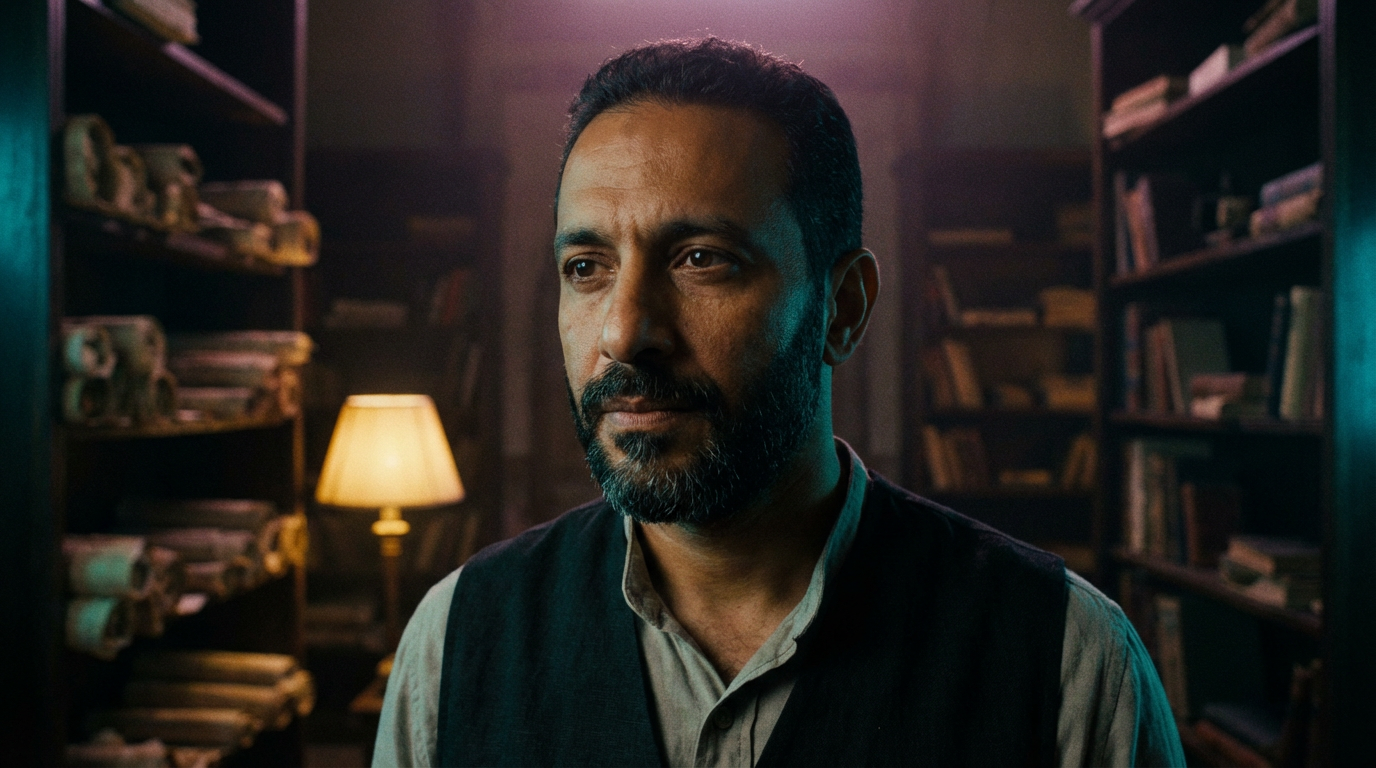
Early Life and Family (1979–1997)
Tariq Hassan al-Rashid was born on 23 April 1979 in Cairo, Egypt, the second of three children born to Hassan Ibrahim al-Rashid, a secondary school Arabic teacher in the Sayeda Zeinab district, and Hanan al-Rashid (née Mostafa), a clerk in the Cairo Governorate's civil records office. The family lived in a fourth-floor flat on Sharia Qasr al-Aini in Garden City, one of central Cairo's older residential quarters whose tree-lined streets and faded colonial-era apartment buildings housed a population that ranged from diplomats and university professors to government clerks and teachers whose salaries required the creative household management that Egyptian middle-class families had refined into an art form.
Hassan al-Rashid taught Arabic literature with the passionate conviction of a man who believed that poetry was a civic necessity rather than a cultural luxury, and who conducted family dinner conversations as though they were seminars — quoting Mutanabbi, debating the relative merits of pre-Islamic and Abbasid verse, assigning his children passages to memorise and recite with the same expectations he brought to his classroom. Hanan's professional life at the civil records office exposed the family to a different dimension of Egyptian institutional culture — the bureaucratic apparatus whose filing systems, registries, and catalogues documented the births, deaths, marriages, and property transfers of twenty million Cairenes with the comprehensive inefficiency that characterised Egyptian government administration. Everything was recorded. Nothing was easily retrievable. The household absorbed her particular understanding that documents mattered — that the physical records of human lives were simultaneously mundane and irreplaceable, and that the people who maintained them performed a service whose importance was visible only when the records were needed and could not be found.
Tariq's elder brother, Ibrahim Hassan al-Rashid, born 15 August 1976, studied law at Cairo University and practised commercial litigation in Dokki with the steady competence that Egyptian legal practice rewarded. A younger sister, Mariam, born 2 February 1983, trained as a dentist at Ain Shams University and established a practice in Heliopolis whose patient list eventually included enough of the neighbourhood's diplomatic community that her waiting room sometimes contained conversations in three languages simultaneously.
The childhood unfolded within Cairo's particular sensory environment — the call to prayer from the neighbourhood mosques, the traffic on Qasr al-Aini whose horns constituted a language of their own, the scent of ful medames from the street vendor who appeared each morning at the corner with his blackened copper pots. Tariq attended a government primary school in Sayeda Zeinab and then El-Hussein Secondary School for Boys, where his academic performance was characterised by a combination of thoroughness and quietness that his teachers interpreted as diligence and that Tariq understood as something closer to absorption — the capacity to lose himself in material that interested him and to complete material that didn't with the minimum effort that acceptable grades required.
The discovery that ancient objects required the care of living hands arrived through a school visit to the Egyptian Museum in Tahrir Square. The visit was routine — every Cairo schoolchild of his generation had stood in the same galleries, stared at the same sarcophagi, listened to the same guide. What Tariq noticed, and what most of his classmates did not, was the conservation laboratory visible through a window at the end of a corridor the tour route did not include. A woman in cotton gloves was working on a fragment of papyrus under a lamp whose light she adjusted with movements so precise they suggested the material beneath her hands might disintegrate if the illumination fell at the wrong angle. The image settled into the substrate of a young person's attention and influenced subsequent decisions without announcing itself as the reason.
Education (1997–2003)
Tariq enrolled at Cairo University in September 1997 to study archaeology, intending to specialise in Egyptology. The department's programme combined fieldwork, museum practice, and the language training that working with ancient Egyptian materials demanded — hieroglyphics, hieratic, Demotic, Coptic — each script representing a different period and a different set of palaeographic challenges. The undergraduate years were competent without being spectacular. Professors noted the steadiness of his hands during practical sessions, the patience he brought to damaged texts whose legibility rewarded persistence rather than brilliance, and the particular quality of attention he directed at objects that other students dismissed as routine.
A postgraduate place at the Institut français d'archéologie orientale (IFAO) followed, funded by a scholarship whose modest stipend was supplemented by Hanan's quiet transfers from her civil-service salary — contributions she described as loans and that both parties understood would never be repaid. The IFAO's conservation laboratories and papyrus collections provided the environment his aptitudes required: hands-on work with materials spanning the full chronological range of Egyptian civilisation, supervised by French and Egyptian specialists whose technical standards were exacting and whose tolerance for imprecision was minimal.
The master's research focused on the conservation challenges of Ptolemaic-era papyrus documents — materials whose multilingual character created treatment complications that monolingual documents did not present. Different inks responded differently to the same interventions. Different scripts had been applied with different implements at different pressures. The work required understanding not just the papyrus but the full history of each document's creation and subsequent damage — a forensic biography that treated every stain, tear, and area of brittleness as evidence of what the object had experienced between the day it was written and the day it arrived on the conservator's bench. Tariq completed the master's in 2003. The IFAO offered a junior research position. He was preparing to accept when a different offer arrived.
Recruitment into The Preservation (2003)
The approach came through a contact at the IFAO — a visiting scholar whose institutional affiliation was genuine but whose additional commitments were not disclosed on any academic CV. Three meetings at a café on Sharia Qasr al-Aini that Tariq had walked past a thousand times without entering developed from professional enquiry into a proposition whose scope expanded until the full picture emerged.
An organisation existed. It had existed for a very long time. Its Cairo facility — one of the oldest and largest in a global network — required a trained papyrologist and conservator to manage the Mesopotamian holdings. The previous head of the section, Mahmoud Farid, had run the collection for thirty years with a meticulousness that bordered on obsession and a personality that colleagues described in terms ranging from "exacting" to "impossible." Farid had retired in 2002, and the section needed someone with the technical skills to maintain his standards and the temperament to work within an organisation whose operational requirements included absolute secrecy.
The salary was better than the IFAO position. The materials were older, more varied, and more significant. The working conditions — a purpose-built facility with environmental controls that Egyptian institutional conservation could not match — were superior to any academic employer. Tariq spent two weeks considering before accepting. The decision was professional rather than ideological — he was not yet informed of The Preservation's full mission. The materials needed his skills, the conditions were better than the alternatives, and the work was exactly what he had trained to do.
The Early Years at the Cairo Facility (2003–2008)
The Cairo Preservation Archive Facility occupied a building on Sharia al-Falaki in the downtown district, its exterior presenting the unremarkable facade of a private research institute. The neighbouring businesses — a bookshop, a print studio, a café whose owner had been serving Turkish coffee from the same copper cezve for forty years — had no reason to suspect what the building contained. The facility was older and larger than most installations in The Preservation's network, its holdings consolidated across centuries from repositories established, destroyed, and re-established as the region's political landscape shifted.
Tariq's first task was learning the Mesopotamian section's particular logic — or rather, learning where logic existed and where it gave way to the accumulated idiosyncrasies of Mahmoud Farid's thirty-year custodianship. The catalogued holdings contained over four thousand items: clay tablets, cylinder seals, papyrus fragments, and the miscellaneous documentary debris that four millennia of civilisational activity in the Euphrates-Tigris basin had produced. Farid's cataloguing system reflected his personality — meticulous where his attention had been engaged, sparse where it had not, occasionally brilliant in its cross-referencing and occasionally baffling in its omissions. An entry might contain exhaustive physical description alongside the assessment "no historical significance," a judgement that was often correct by conventional standards and that occasionally proved spectacularly wrong when subsequent discoveries revealed connections Farid could not have anticipated.
Beyond the catalogued holdings lay an unknown quantity of uncatalogued materials — items that had arrived through channels whose documentation was lost, that had been placed in storage during institutional transitions and never processed, or that Farid had examined, found uninteresting, and shelved in the expectation that someone would eventually attend to them. This uncatalogued stratum represented both the section's greatest liability and its greatest potential — the archival equivalent of unmapped territory whose contents were unknown precisely because nobody had yet invested the labour required to map them.
The first two years were spent verifying Farid's entries against the physical materials, updating records where descriptions had become outdated, and developing a working familiarity with a collection whose four-thousand-item scope defeated any attempt at comprehensive memorisation. Tariq moved through the holdings systematically, handling each object with the deliberate care that his IFAO training had instilled, occasionally finding items whose condition had deteriorated since Farid's last assessment and whose stabilisation required immediate intervention. The conservation work — cleaning, repair, environmental adjustment — operated alongside the cataloguing work in a daily rhythm that left little time for the kind of scholarly analysis that an academic position would have encouraged. The materials were not there to be studied. They were there to be preserved.
By 2005, Tariq had begun the digitisation effort that the facility had been discussing since the 1990s but that nobody had possessed the combination of technical skill and stamina to execute. The process was straightforward in conception — photograph each item, enter its catalogue data into a searchable database, create a digital record that would supplement the handwritten cards and scanned images that constituted the existing system — and glacial in execution. A single specialist working with limited technical support could process perhaps ten to fifteen items per day to the standard that accurate cataloguing demanded. Four thousand catalogued items at that rate represented over a year of continuous work, and continuous work was impossible when conservation emergencies, facility maintenance, and the routine demands of operating within an institutional structure consumed substantial portions of every working week.
Marriage and the Middle Years (2008–2018)
On 7 March 2008, at twenty-eight, Tariq married Noha Samir Abdel-Fattah, a librarian at the Bibliotheca Alexandrina whom he had met during a conservation workshop in Alexandria the previous year. The connection had been professional before it was personal — three days in adjacent workstations discussing the relative merits of wheat starch paste versus methylcellulose for papyrus repair, a conversation whose technical specificity would have bored anyone else in the room but that they conducted with an intensity their colleagues recognised as something other than purely academic.
Noha was four years younger, practical in temperament, possessed of the particular tolerance for archival obsession that a library career cultivated. The explanation she received about Tariq's employment — private conservation work for an international research organisation that valued discretion — was plausible enough that she chose not to interrogate it further, a decision reflecting both trust in his character and the pragmatic understanding that some professional arrangements functioned better when their details remained undisclosed. They settled in a flat in Zamalek, the island district in the Nile whose residential character suited the professional class and whose commute to the Sharia al-Falaki facility took twenty minutes by taxi or forty on foot through Garden City.
The digitisation effort continued through 2008 and 2009 at the same incremental pace, Tariq spending his mornings on conservation tasks and his afternoons on the database, the percentage of catalogued holdings entered into the digital system climbing toward forty per cent with the particular slowness of progress that was measurable by year rather than by month. The work was solitary in a way that his IFAO training had not prepared him for. The Cairo facility's staff was small — a facility director whose responsibilities encompassed the entire archive, a conservator who worked primarily with the Egyptian and Coptic collections, two part-time administrative staff, and Tariq, whose Mesopotamian section he managed essentially alone. Mahmoud Farid had operated the same way for three decades, and the institutional expectation was that his successor would do likewise.
A son, Youssef Tariq al-Rashid, arrived on 14 November 2010, and the domestic logistics of new parenthood reorganised the daily schedule that the previous seven years of professional routine had established. Mornings at the facility started later. Evenings ended earlier. The particular exhaustion that infant care produced combined with the particular exhaustion that conservation work generated to create a weariness whose cumulative effect Noha monitored with the concern of a wife who understood that her husband's professional dedication operated without the self-regulating mechanisms that a normal employer's working hours would have imposed. Hanan, Tariq's mother, travelled from Garden City to Zamalek three mornings a week to manage Youssef whilst both parents worked — a grandmother's contribution whose reliability provided the domestic infrastructure that two professional incomes and one infant required.
The digitisation passed fifty per cent in early 2012. Tariq marked the milestone with no particular celebration — the remaining fifty per cent, plus the entirety of the uncatalogued materials, represented a task whose completion he sometimes calculated in years and sometimes preferred not to calculate at all. The uncatalogued stratum remained the persistent background anxiety of his professional life — shelves of unprocessed materials whose contents might include items of extraordinary significance or might include nothing that Mahmoud Farid hadn't already assessed and dismissed. The uncertainty was the problem. Without examining every item, there was no way to know, and the resources to examine every item did not exist.
A daughter, Salma Tariq al-Rashid, was born on 3 August 2013, and the Zamalek flat adjusted again to accommodate a second child whose temperament differed from her brother's with the thoroughness that siblings sometimes achieved. Youssef was quiet and bookish — a quality that his grandfather Hassan attributed to genetic inevitability and that manifested in a preference for reading over conversation that the household accepted as hereditary rather than concerning. Salma was vocal, social, and possessed of an opinion about everything that Noha attributed to her father's side of the family and that Tariq, whose own opinions were held with conviction but expressed with restraint, found simultaneously bewildering and delightful.
The family settled into the rhythms that dual-professional Cairo households maintained through the combination of parental scheduling, grandparental availability, and the informal neighbourhood networks whose reliability exceeded what formal childcare arrangements could have provided. Youssef attended a bilingual school in Zamalek. Salma followed him three years later. The flat accumulated the evidence of a household organised around texts — Tariq's professional library of archaeological journals and conservation manuals in the living room, Noha's literary fiction and library science publications in the bedroom, the children's books colonising every remaining surface with the territorial confidence that children's possessions brought to domestic space.
Through these years the professional work continued at its steady, incremental pace. The digitisation climbed past sixty per cent by 2018. Conservation tasks arrived with the regularity that a four-thousand-item collection generated — temperature fluctuations in the storage areas requiring emergency stabilisation of vulnerable materials, insect damage discovered during routine inspections, the gradual degradation that even optimal conditions could slow but not halt. Tariq handled each intervention with the unhurried precision that his training and temperament combined to produce, his hands steady, his assessments considered, his voice — lower than most people expected, carrying the slight rasp of long hours in controlled dry air — delivering professional judgements with the particular authority of someone who had spent over a decade handling materials that most scholars knew only from photographs.
The Conference and Its Aftermath (2022–2023)
The 2022 Preservation conference — one of the rare occasions when Archive Keepers from multiple facilities gathered in the same location, conducted under cover of an academic symposium on Mediterranean manuscript traditions — took place in Athens. Tariq attended as the Cairo facility's Mesopotamian specialist, presenting a paper on conservation challenges in multi-century clay tablet collections that was technically accurate and professionally received and that represented approximately two per cent of what he actually knew about the materials in his care. The remaining ninety-eight per cent could not be discussed in any forum that might include non-Preservation personnel, a constraint that made academic conferences simultaneously useful for maintaining professional cover and frustrating for anyone who wanted to discuss their actual work.
Mira Osman attended the same conference. They spoke briefly — the polite, professional exchange of colleagues who understood they were part of an organisation that had been operating in secret for four thousand years and who conducted themselves at public events with the particular care that this awareness demanded. Tariq noted her competence. Mira noted his quietness. Neither had reason to suspect that their professional paths would intersect significantly within two years.
The period between the conference and January 2024 continued the pattern that the preceding decade had established. Digitisation inched forward. Conservation tasks arrived and were addressed. The uncatalogued materials remained on their shelves, their contents unknown, their potential significance a question that Tariq carried with the background persistence of a problem whose resolution he desired but whose timeline he could not control. Youssef, now thirteen, was developing the kind of focused reading habits that suggested either a future academic or a future hermit, the distinction being largely one of institutional affiliation. Salma, ten, had discovered that her social confidence translated effectively into theatrical performance and had secured a role in her school's production of a play whose Arabic title Tariq could never remember and whose rehearsal schedule Noha managed with the cataloguing precision that her library training had refined into a domestic survival skill.
Hassan al-Rashid, Tariq's father, retired from teaching in 2021 at seventy and spent his mornings at the Garden City flat reading the poetry he had taught for four decades, no longer constrained by curriculum requirements to limit himself to the approved anthology. Hanan continued at the civil records office with the particular tenacity of a woman who understood that her pension depended on reaching a specific number of service years and who intended to reach it regardless of what her knees thought about the daily commute. Friday prayers at the neighbourhood mosque remained a family ritual — Tariq attending with the moderate observance that characterised his relationship with religion, neither zealous nor indifferent, the faith of a man who found in the weekly regularity a counterweight to the irregularity that archival work produced.
The Intersection with the Kisura Investigation (2024–Present)
In early February 2024, a routine enquiry from the Karaköy facility in Istanbul drew Tariq's attention to Fragment 847-C — a damaged Akkadian bill of sale from Larsa that Mahmoud Farid had catalogued decades earlier with the assessment "no historical significance." The fragment sat in a subsection of the holdings that had been awaiting reorganisation for several years, one of the many corners of the uncatalogued stratum that the digitisation effort had not yet reached. Tariq located it, photographed it, and sent the images to Dr Mira Osman, whose subsequent analysis identified the scribe's hand in the fragment's footer section as matching that of Azariel Tiberius Voshtar on the Kisura contract discovered in Istanbul three weeks earlier.
The identification transformed the Mesopotamian section's operational status. A collection that had been managed for two decades as a stable conservation and cataloguing exercise became the focus of an active investigation — a systematic search through four thousand catalogued items and an unknown quantity of uncatalogued materials for additional fragments bearing the same hand. The work demanded exactly the skills that twenty years of custodianship had developed: the intimate familiarity with the collection's organisation and its gaps, the physical handling expertise that fragile materials required, and the particular patience of a man whose professional life had been structured around the understanding that preservation was cumulative rather than dramatic, and that the significance of what he maintained might not become apparent until long after the maintenance itself had been performed.
The uncatalogued stratum — the shelves of unprocessed materials whose contents Tariq had carried as a background anxiety for two decades — acquired a new urgency. What had been a long-term administrative problem became an immediate research priority, the possibility that additional Azariel documents existed somewhere within those unexamined holdings converting theoretical potential into operational imperative. The digitisation effort that had been climbing toward completion at the pace of a single specialist's capacity suddenly required acceleration that the facility's resources had not been designed to support.







