4308.263 · September 19, 1988 AD
Syrup and Dreaming
Pancakes stack like golden currency on the Dallow kitchen table whilst three women orbit the morning in their separate rhythms — Jasmine precise at the stove, Violet sprawled and dreaming of distant universities and African plains, Evelyn listening from her sewing table with thread still taut between her fingers. The sisters speak of futures that stretch wide and limitless. Their mother counts the stitches and says nothing about the ways that time can fold without warning.
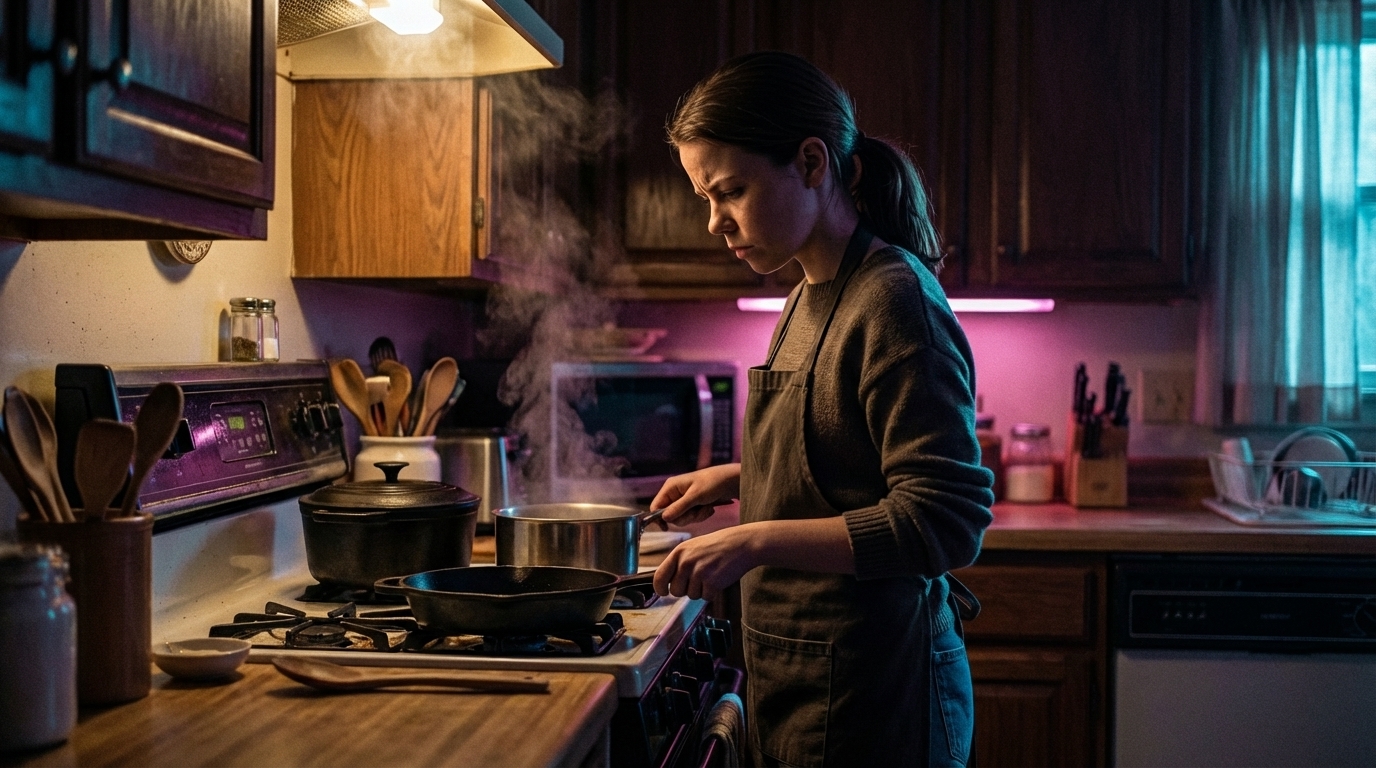
The kitchen of the Dallow Residence occupied the rear of the house, positioned where generations of mining families had understood a kitchen should be — close to the back door for ventilation, distant enough from the front rooms to keep cooking heat from making the rest of the house unbearable during summer. On this September morning, with early spring still cool enough to permit comfort, the room held warmth rather than expelled it, the air heavy with the scent of sizzling butter and sweet batter mingling with the mineral tang of Outback breeze drifting through the open louvre window.
Jasmine Anne Dallow stood at the stove with the focused attention of someone performing a task she had claimed as her own. She was fourteen years old — her birthday had fallen just three weeks prior, on the twenty-seventh of August — and she had already developed the kind of domestic precision that made her sister both amused and faintly unsettled. Her hair, brushed into a low ponytail that permitted not a single strand's rebellion, caught the morning light that slanted through the window and turned it copper at the edges. A thin smear of flour graced her left cheek, unnoticed, lending her a seriousness that was somehow also endearing. The skillet hissed beneath her hand as she tilted batter with measured care, watching the edges firm before executing the flip with a practised motion that suggested she had rehearsed this particular gesture more times than anyone had thought to count.
There was something about the way Jasmine moved through domestic spaces that carried the echo of their mother — the same economy of motion, the same instinct for the right tool at the right moment, the same quiet satisfaction in transformation. Where Evelyn turned flat fabric into garments, Jasmine turned raw ingredients into meals, and both approached the work with an attention to detail that elevated routine into something approaching craft. She had set two mugs on the bench beside the stove, handles angled identically, and the coffee she poured into them carried the particular darkness of a brew made strong enough to constitute an opinion.
Violet arrived in the kitchen doorway and leaned against the frame with the loose-limbed ease of someone who treated vertical surfaces as optional furniture. Her boots scuffed softly against the floorboards. Her eyes, still carrying the residual brightness of whatever dream had released her, swept the room and found it as it always was: small, crowded with the accumulated evidence of years, and suffused with the particular warmth that came not from the stove alone but from the invisible infrastructure of family ritual. The bowl of overripe mandarins on the bench. The tin of mismatched cutlery. The cracked clock on the wall ticking a fraction too slowly, as though time itself moved at a gentler pace inside these walls.
The sisters exchanged a glance that carried the compressed vocabulary of shared history. Neither needed words to communicate what passed between them — the acknowledgement of morning, the assessment of mood, the thousand micro-negotiations that siblings conducted beneath the threshold of language. Jasmine's expression held the quiet satisfaction of someone who had already accomplished something before her older sister had properly begun, whilst Violet's carried the faint amusement of someone who recognised this small victory and chose not to contest it.
Beyond the kitchen threshold, in the sewing room that opened off the hallway, Evelyn had returned to her machine. The garment she was constructing — sky blue cotton, white piping, brass buttons — lay partially assembled beneath the presser foot, but she had paused mid-seam to listen. The sounds of her daughters moving through the kitchen reached her with the clarity that came from years of maternal surveillance conducted through walls and closed doors. She could distinguish Jasmine's measured footsteps from Violet's more percussive movement the way a musician could distinguish instruments in an orchestra. The particular clatter that meant plates being set on the Formica table. The hiss of batter meeting the skillet's heat. The soft percussion of cutlery being drawn from the tin.
She sat with thread taut between her fingers, spectacles perched on the bridge of her nose, and allowed herself the quiet indulgence of listening to her household function. This was the sound of ordinary life — the sound she had built with Robert over eighteen years of marriage, maintained through economic uncertainty and the demands of raising two children whose temperaments required entirely different forms of attention. The sound carried no premonition. It contained no warning that the ordinary had an expiration date, that these mornings of pancakes and coffee and sisterly exchanges conducted in glance and gesture were not infinite but numbered, each one subtracted from a total that would prove far smaller than any of them suspected.
At the kitchen table, Violet and Jasmine settled into the rhythms of breakfast. The pancakes Jasmine had produced were stacked with geometric precision — golden rounds whose uniform colour spoke of careful temperature control and the exact patience required to achieve even browning. Syrup pooled in the shallow curve of each plate, thick and amber, catching the strengthening light like something precious trapped in glass. The orange juice, slightly warm from sitting on the bench whilst the cooking finished, carried the sharp citrus scent that cut through the heavier sweetness of batter and butter.
Violet ate with the unselfconscious appetite of someone whose body spent its days climbing escarpments and scrambling through gullies. She loaded her fork with generous portions, syrup trailing in amber threads between plate and mouth, and chewed with an attention that was divided between the immediate pleasure of food and the distant territories her mind had already begun to roam. Her gaze drifted beyond the scuffed window frame, beyond the scraggly hills that bordered the town's western edge, and further still — to the imagined spaces that occupied more of her waking consciousness than the physical room around her.
Those spaces shifted and reformed as she ate. A university cloister materialised in her mind's eye — sandstone and ivy, lecture halls whose acoustics amplified ideas into something approaching revelation. She pictured herself at a desk, surrounded by volumes whose spines bore titles she did not yet know but somehow recognised, her voice rising in a room full of people who took her questions seriously. The image held the particular intensity of dreams that have been rehearsed so many times they begin to feel like memories of a future already lived. Sydney or Melbourne, Monash or Macquarie — the names carried weight and promise, and she turned them over in her thoughts the way she might turn over an interesting stone found in the mullock heaps beyond town.
But the university dissolved, replaced by a landscape of amber plains stretching beneath a foreign sun, her hand raised to shield her eyes as she scanned a horizon where giraffes moved like apparitions through the heat shimmer. An African safari — the word alone produced a physical sensation, a tightening in the chest that she understood as longing. She had read enough to know that safari meant journey in Swahili, and the rightness of that translation pleased her. Everything she wanted was a journey. Everything that mattered lay in the distance between departure and arrival.
And yet the dream that lingered longest — the one rooted not in fantasy but in the landscape that surrounded her every day — was her vision for water. Not merely conserving it, but comprehending it. The aquifers that lay beneath the red earth, the systems that could be designed to harness what little rain the Outback received, the engineering and science that might transform scarcity into sufficiency. Out here, water carried more value than the silver that had built the town, and the land whispered its thirst to anyone willing to listen. Violet was willing. She was listening.
Jasmine ate with more deliberation, cutting her pancakes into measured portions, dabbing at her mouth with a napkin between bites. She watched her sister's gaze drift toward the window and recognised the expression — the slight unfocusing of the eyes, the fork's aimless drift through syrup — that indicated Violet had departed the kitchen for one of her internal destinations. It was a familiar phenomenon. Jasmine had grown up observing these departures, had learned to wait patiently for her sister to return from wherever she had gone, understanding that the distance Violet travelled in her mind was as real to her as any physical journey.
She had her own interior life, though it moved at different speeds and occupied different terrain. Where Violet dreamed of far places and grand transformations, Jasmine's imagination worked closer to the ground — the textures of things, the way a leaf curled as it dried, the particular satisfaction of a task completed with precision. She had turned fourteen three weeks ago and the world had not changed, which was both reassuring and faintly disappointing. She liked animals. She liked being outside. She thought she might like to do something with nature, though the shape of that ambition remained deliberately vague, held at a distance where it could not be measured against her sister's more vivid declarations and found wanting.
The conversation, when it came, moved between the sisters with the ease of water finding a channel. Violet spoke of futures that stretched wide and limitless — universities, safaris, water systems, the whole grand catalogue of possibility that she curated and polished like the opal fragments she kept on her shelves. Jasmine offered quieter contributions: animals, nature, the outdoors, a future she described as unresolved, content to leave its edges blurred. They had conducted variations of this exchange dozens of times before, and its familiarity made it safe — a script they both knew, whose performance required no rehearsal and carried no risk.
Yet beneath the surface, something more complex operated. Violet needed Jasmine to witness her dreams, to receive them and reflect them back as real and possible. Jasmine needed Violet to demonstrate that dreaming itself was permissible — that ambition did not require apology, that imagining a life larger than Broken Hill's boundaries was not betrayal of the people who remained within them. They served each other in this exchange without naming what they provided, the way roots serve branches without requiring acknowledgement.
From the sewing room, Evelyn listened. The thread between her fingers remained taut, the presser foot raised, the garment paused mid-construction. Her daughters' voices reached her as murmur and melody rather than distinct words — the particular music of sisterly conversation that she had been hearing since Jasmine was old enough to form sentences and Violet was old enough to dominate them. She did not need to hear the content. She knew what they were discussing. They were discussing the future, which was another way of saying they were discussing escape, which was another way of saying they were reminding each other that Broken Hill was not the whole world even if it sometimes felt that way.
She understood the impulse. She had grown up in this same town, had watched her own siblings leave or stay or die — Colleen to Sydney, Ron to an early grave through workplace accident, Andrew to a motorbike at fourteen. She knew what it cost to remain and what it cost to go, and she understood that her daughters' dreams were not criticisms of the life she and Robert had built but rather evidence that the life had succeeded — had produced two girls confident enough to imagine more than what they had been given.
Still, the listening carried a weight that her daughters could not perceive. Evelyn heard them speak of tomorrow as though it were guaranteed, as though the distance between today and the futures they described were traversable through desire alone. She did not grudge them this confidence. It was the birthright of the young, and she would not have stolen it even if she could. But she carried knowledge they did not — knowledge purchased through the early death of a brother, through years of watching miners' wives receive the news that transformed ordinary afternoons into permanent nightmares, through the simple arithmetic of living in a place where the distance between safety and disaster was measured in moments rather than miles.
She rose from the sewing table and moved to the threshold of the kitchen, leaning against the doorframe in unconscious echo of the posture Violet had adopted minutes earlier. Her gold-rimmed spectacles caught the light. Her hands, still carrying the ghost-sensation of fabric between their fingers, rested at her sides. She watched her daughters at the table — Violet leaning back in her chair with the expansive ease of someone for whom the world was an invitation, Jasmine sitting straighter, more contained, her dimples appearing as something her sister said struck the right chord.
The morning light had strengthened whilst she worked, pouring through the louvre window in broad slabs that illuminated the kitchen's familiar geography: the scarred table where generations of meals had been served, the linoleum floor whose pattern had worn to ghostly suggestion in the high-traffic areas, the enamel mugs and chipped surfaces that constituted the material evidence of a family that made do and made well with what it had. Dust motes drifted through the light with the lazy indifference of particles that owed allegiance to no one.
Evelyn offered what she always offered when her daughters spoke of futures: the reminder that dreams required labour to become real. It was not a reprimand but a contribution — the perspective of a woman who had built a livelihood from thread and patience, who understood that the distance between imagining a garment and holding the finished article was filled with ten thousand stitches, each one requiring attention. Her voice carried the particular blend of affection and gravity that she had inherited from her own mother, who had stitched and counselled in equal measure, and from Mrs Thornton, who had taught her that craftsmanship was a form of honesty.
The girls received this counsel as they always did — Violet with a flicker of complicated admiration that contained both gratitude and resistance, Jasmine with the quiet absorption of someone who filed important information for later retrieval. Evelyn did not press the point. She had learned, across sixteen years of mothering Violet and fourteen of mothering Jasmine, that the most effective guidance arrived obliquely, offered once and then left to work its way through soil in its own time.
The sewing machine clicked back to life in the next room — Evelyn had returned to her work, and its motor purred through the walls like a second heartbeat. The scent of starch and cotton mingled with the remnants of syrup and the faint char of butter that had lingered a moment too long in the pan.







