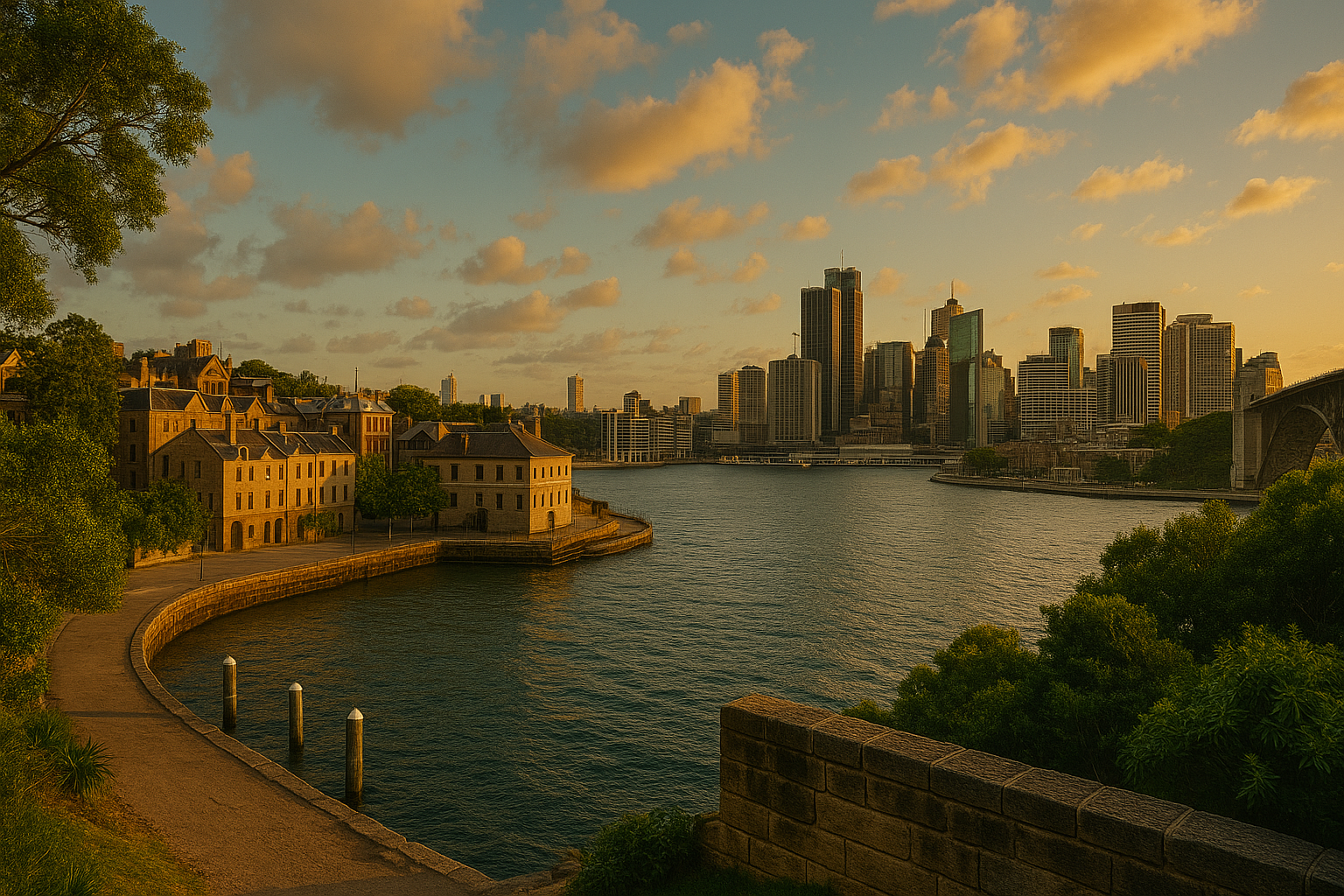
Sydney Cove, New South Wales, Australia
Nestled within the vast expanse of Sydney Harbour, Sydney Cove stands as the birthplace of European Australia, where the First Fleet dropped anchor on 26 January 1788 upon land the Gadigal people had inhabited for millennia. This small harbour inlet witnessed the colony's founding, the processing of countless convict transports including the HMS Resolution in 1808, and the political upheaval of the Rum Rebellion that fractured early colonial governance and shaped the settlement's turbulent character.
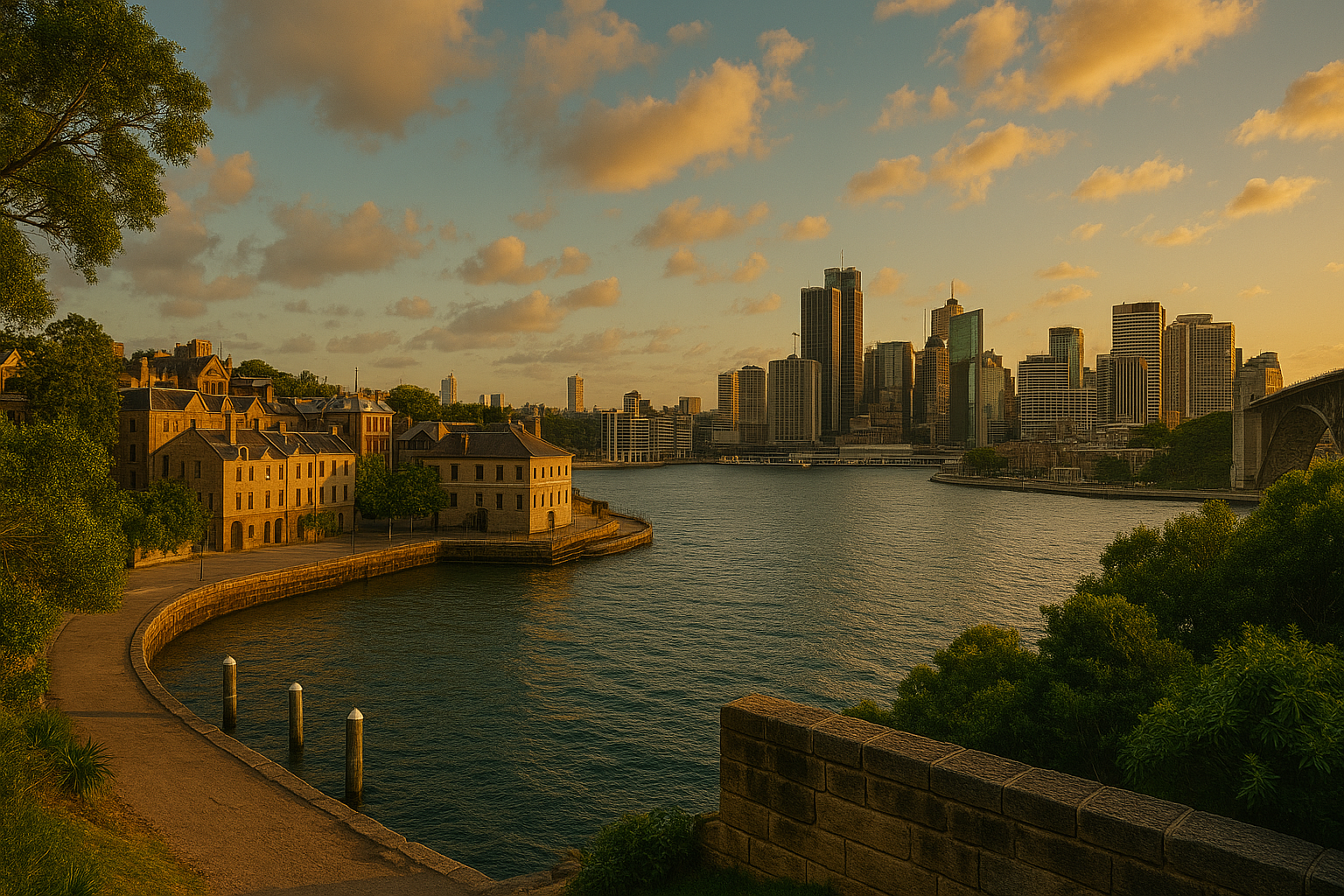
The Harbour and Its First People
Long before European sails appeared on the horizon, the harbour that would transform the southern continent's destiny sustained the Gadigal clan of the Eora nation. The waters they called Warrane provided sustenance through their rich populations of fish and shellfish, the rocky shorelines yielding oysters and mussels that supplemented the protein gathered from deeper waters. The Gadigal had developed sophisticated knowledge of the harbour's seasonal rhythms—when certain fish ran, where shellfish grew fattest, which winds brought storms and which promised fair weather for their bark canoes.
The cove that would bear Sydney's name nestled within the harbour's southern shore, a sheltered inlet where fresh water flowed into the salt. The Gadigal knew this place as part of their broader country, one element in a landscape they had managed and understood across generations beyond counting. The surrounding bushland provided timber for canoes and shelters, whilst the sandstone outcrops that rose along the harbour's edges offered vantage points from which to observe the waters' moods and the movements of prey.
The arrival of the First Fleet in January 1788 initiated changes that would transform this harbour utterly. Captain Arthur Phillip, commanding eleven ships carrying approximately fifteen hundred souls—convicts, marines, and the officials who would attempt to forge a colony from this unlikely beginning—had first made landfall at Botany Bay. Finding that location unsuitable, he sailed north and discovered the harbour that would become the empire's foothold on the Great South Land.
Phillip's first glimpse of the harbour reportedly prompted him to declare it the finest natural port in the world—a judgement that history would vindicate as the settlement grew from desperate encampment to thriving metropolis. The entrance lay between sandstone headlands that glowed amber and ochre in the southern light, their faces scarred by millennia of wind and wave into patterns that seemed almost deliberately carved. Beyond these guardians, the harbour opened into innumerable coves and inlets, offering shelter, fresh water, and the promise of anchorage for the fleet that had carried Britain's unwanted to the far side of the earth.
The Founding of Sydney
On 26 January 1788, the First Fleet's company came ashore at the cove that Phillip named for Thomas Townshend, Lord Sydney, the Home Secretary whose decisions had set this improbable venture in motion. The convicts who stumbled onto that rocky shore, weakened by the eight-month voyage and bewildered by the alien landscape that confronted them, could not have imagined that their presence marked the beginning of a transformation that would remake both this continent and the empire that had transported them.
The early days tested every capacity the settlement possessed. The convicts, most of them urban poor whose experience extended no further than London's streets or the manufactories of English industrial towns, struggled to adapt their skills to a landscape that bore no resemblance to anything European memory contained. The few farmers among them found the soil around the cove rocky and reluctant, unsuited to the crops whose seeds they had carried across fifteen thousand miles of ocean. The tools available were inadequate, worn from the voyage and ill-matched to the timber and stone of this new world.
Starvation loomed as a genuine possibility during those first years. The rations brought from England dwindled whilst the colonial gardens produced barely enough to supplement the dwindling stores. Governor Phillip implemented strict rationing that applied equally to convict and free, marine and officer—a decision that earned grudging respect from men who might otherwise have mutinied. The settlement survived those desperate months through a combination of luck, determination, and the gradual acquisition of knowledge about what this land could provide.
The harbour itself offered some relief. Fish could be caught in sufficient quantities to supplement the grain rations, and the Gadigal shared knowledge of which shellfish were safe to eat and which should be avoided. These interactions between the original inhabitants and the newcomers were complex and fraught with misunderstanding, marked by moments of cooperation that alternated with violence and the creeping displacement that would eventually dispossess the Gadigal of their country entirely.
Growth and Transformation
The discovery of fertile land at Rose Hill—soon renamed Parramatta—alleviated the immediate threat of starvation and allowed Sydney Cove to develop as the colony's administrative and commercial centre rather than its agricultural foundation. Whilst convict labour tilled the fields fifteen miles upriver, the cove became the point through which all colonial traffic flowed. Ships arrived bearing convicts, free settlers, supplies, and the occasional official whose decisions would shape the colony's direction. Ships departed carrying the modest exports that the settlement could produce—whale oil, sealskins, timber, and eventually wool that would transform Australian fortunes.
By the turn of the century, Sydney Cove had begun to assume the character of a genuine town. Buildings of brick and stone replaced the rough timber and bark structures of the earliest years. A church spire rose above the rooftops, its cross catching the morning light and proclaiming British presence to any vessel entering the harbour. Streets climbed the gentle rise behind the waterfront in something approaching order, lined with structures that ranged from substantial dwellings to the rough hovels of those whose circumstances permitted nothing better.
Government House stood as the colony's administrative heart, the residence from which successive governors attempted to impose order upon a population that remained predominantly criminal in origin and frequently resistant to authority. The building witnessed the arrivals and departures that marked colonial transitions—the pomp of official welcomes, the quieter scenes of families reporting for duty, the endless procession of petitioners seeking land grants, pardons, or redress for grievances.
The waterfront bustled with the commerce that sustained the settlement. Warehouses and storerooms clustered near the water's edge, their doors standing open to receive the cargoes that arrived with increasing frequency as the colony established its viability. Merchants in coats of good broadcloth conducted transactions that moved goods from ship to shore to the settlements spreading across the hinterland. The air carried the mingled scents of tar and salt, of timber and livestock, of the human activity that marked a colony finding its feet.
Gateway of the Condemned
Sydney Cove's most enduring function in the colony's early decades was as the gateway through which Britain's transported criminals entered their new existence. Convict ships arrived with grinding regularity, each vessel carrying its cargo of men and women whose crimes—or misfortunes—had earned them exile to the far side of the world. The cove's waters bore witness to countless such arrivals, each adding another layer to the settlement's complex human tapestry.
The processing that accompanied these arrivals followed patterns established through repetition until they achieved the grinding efficiency of bureaucratic routine. Ships anchored in the harbour whilst officials prepared the paperwork that would transform human beings into units of colonial labour. Convicts were brought ashore, their particulars recorded—name, crime, sentence, skills if any—and assignments determined according to the colony's needs. Some found themselves directed toward the government farms, others to road gangs or the quarries that consumed men with an appetite showing no sign of satisfaction, whilst a fortunate minority with useful skills might be assigned to private households.
The arrival of the HMS Caledonia on 2 January 1805 illustrated how Sydney Cove served as gateway not merely for the condemned but for free settlers whose ambitions drew them to the colony's opportunities. Dr Samuel Hawkins brought his family ashore that summer day—his wife Annabelle, their children Jonathan, Marianne, and Elizabeth—stepping onto the uneven wooden pier into air that bore no resemblance to English memory. The children witnessed convict labourers in chains, their striped uniforms and sun-darkened faces a stark reminder of the penal foundations upon which this settlement rested. A horse-drawn cart conveyed the family toward Government House, where the doctor would report for duty as the colony's newest physician.
Three years later, on 28 February 1808, the HMS Resolution completed her own ten-month voyage from Portsmouth, carrying one hundred and fifty convicts including William Jeffries, a twenty-two-year-old dockworker whose conviction for stealing a pocket watch had earned him seven years' transportation. The cove that received him had transformed remarkably since the First Fleet's arrival—brick and stone buildings lined the waterfront, streets climbed the rise in something approaching order, and vessels of every description lay at anchor throughout the harbour. Captain Josiah Haverford oversaw the processing, directing convicts toward their various assignments whilst the colonial sun bore down with an intensity that left English skin prickling with the promise of burns to come.
The Rum Rebellion and Its Aftermath
The political upheaval that convulsed Sydney in January 1808 demonstrated how the cove had become not merely a gateway for arrivals but a theatre for the conflicts that shaped colonial governance. Governor William Bligh, appointed to reform the colony's administration and curb the excesses of the New South Wales Corps, found himself confronting officers whose wealth and power derived from the rum trade he sought to suppress.
The New South Wales Corps—nicknamed the Rum Corps for their involvement in the lucrative alcohol trade—had assumed a dominant role in colonial affairs since their arrival in 1790. Officers leveraged their control over supplies to amass significant wealth, using spirits as currency in a cash-strapped settlement and enriching themselves through practices that respectable authority officially deplored. Bligh's attempts to curtail these activities brought him into direct conflict with men who had no intention of surrendering their advantages.
On 26 January 1808—the twentieth anniversary of the First Fleet's landing—Major George Johnston led members of the Corps to Government House and placed Bligh under arrest. The Rum Rebellion, as it came to be known, represented the most dramatic assertion of military power in the colony's short history. Bligh remained under house arrest whilst the rebel officers assumed control of colonial administration, their actions sending ripples of uncertainty through a settlement accustomed to turbulence but unprepared for outright coup.
The aftermath of the rebellion transformed Sydney Cove into a place of departure as well as arrival. Families who had sought stability in the colony now found themselves reconsidering their circumstances. The Hawkins family, having spent three years establishing themselves in Sydney, accepted reassignment to Van Diemen's Land, where medical officers were desperately needed and the political atmosphere promised to be calmer. On 14 March 1808, they boarded the HMS Integrity and watched the coastline shrink in the distance, joining the tide of those seeking refuge from the chaos that the rebellion had unleashed.
Commerce and Character
Despite—or perhaps because of—its turbulent politics, Sydney Cove developed into a commercial centre whose reach extended far beyond the immediate settlement. The harbour's natural advantages attracted traders whose vessels connected the colony to the wider world. Ships arrived from India and China, from the Pacific islands and the Americas, their cargoes contributing to a colonial economy that gradually diversified beyond its penal foundations.
The merchants who established themselves along the waterfront represented a new class in colonial society—men whose wealth derived from trade rather than land grants or official position. Their warehouses stored goods ranging from tea and textiles to rum and tobacco, their counting houses recording transactions that linked Sydney to commercial networks spanning multiple continents. Some had arrived as convicts and risen through enterprise and luck; others had come free, attracted by opportunities that older societies could not match.
The wharves that extended into the harbour served as the colony's commercial arteries. Goods flowed across their weathered planks in both directions—imports that the settlement could not yet produce itself, exports that demonstrated colonial capacity to the wider empire. Labourers worked these docks under the same sun that had greeted the First Fleet, their efforts continuing the work of transformation that those first arrivals had begun.
The physical infrastructure expanded to accommodate growing trade. New wharves extended the waterfront's reach into the harbour. Warehouses multiplied along the shoreline, their capacious interiors swallowing cargoes that earlier generations could not have imagined. The roads leading from the cove toward the inland settlements improved, facilitating the movement of goods to and from the growing agricultural districts.
The Cove's Enduring Legacy
Sydney Cove's significance transcended its function as port and administrative centre to become the symbolic heart of European Australia. The anniversary of the First Fleet's arrival became a marker around which colonial identity crystallised, a date that carried meaning far beyond its factual content. The harbour that had received those first ships remained the colony's face to the world, the landmark by which visitors recognised their arrival and residents oriented their sense of place.
The transformation the cove had witnessed in its first two decades merely anticipated changes that would accelerate throughout the nineteenth century. The settlement that had struggled to feed itself would become a city whose prosperity attracted immigrants from across the globe. The harbour that had anchored eleven ships would accommodate fleets of vessels, its waters busy with traffic that moved goods and people in quantities the First Fleet's passengers could never have imagined.
Yet beneath the wharves and warehouses, beneath the streets and buildings that colonial development imposed upon the landscape, traces of earlier occupation persisted. The harbour still supported fish populations, though in diminished numbers that reflected the changes European presence had wrought. The sandstone headlands that had greeted Phillip's fleet continued to glow amber and ochre in the morning light, their ancient faces indifferent to the structures that now clustered around them.
The dispossession of the Gadigal and their Eora relatives proceeded alongside colonial expansion with a quiet relentlessness that official records barely acknowledged. Disease, displacement, and violence combined to reduce populations whose ancestors had managed this harbour for thousands of years. By the mid-nineteenth century, Indigenous presence in Sydney had become marginal in ways that the original inhabitants could never have imagined when strange ships first appeared between the headlands.
The harbour waters that had witnessed the First Fleet's arrival continued to receive vessels bringing new arrivals to Australian shores. Each ship that passed between the sandstone guardians traced the path that Phillip had charted, entering the harbour that had determined Australia's colonial destiny. The cove that received them had changed beyond recognition from the rocky shore where convicts first stumbled ashore, yet it remained what it had been from that January morning in 1788—the point where one world met another, where transformation began, where the story of European Australia took its first uncertain steps.







