Substance vs Process Ontology
The debate between substance ontology and process ontology addresses the most fundamental question in metaphysics: whether reality is ultimately composed of enduring things that bear properties and undergo change, or of dynamic happenings and events that exhibit temporary patterns of stability. Rooted in the ancient Heraclitus-Parmenides opposition and developed through Aristotle, Descartes, Whitehead, and Bergson, this debate shapes the understanding of identity, consciousness, time, and — in the Clivilius context — whether a bio-virtual dimension is genuinely real.
Overview
The debate between substance ontology and process ontology is the most fundamental question in metaphysics: what is reality ultimately made of? Are the basic constituents of existence things — enduring, independent entities that possess properties and undergo change while remaining fundamentally the same — or are they happenings — dynamic events, activities, and processes that exhibit temporary patterns of stability but are never truly static?
This question may sound abstract, but it determines the answer to every other metaphysical question. What is a person — a thing that has experiences, or an ongoing process of experiencing? What is a particle — an object that occupies space, or an event in a field? What is a mind — a substance that thinks, or a pattern of thinking? And, in the Clivilius context: what is a world — a place made of stuff, or a pattern of activity that exhibits world-like properties? The answer to the substance-versus-process question shapes our understanding of identity, consciousness, causation, time, and the nature of reality itself.
For most of the history of Western philosophy, substance ontology has been dominant. But process philosophy — developed most fully by Alfred North Whitehead and Henri Bergson in the early twentieth century, with roots extending back to Heraclitus and deep resonances in Eastern thought — has mounted an increasingly serious challenge, particularly in domains where substance thinking struggles: quantum mechanics, the philosophy of mind, the study of living systems, and the metaphysics of worlds whose fundamental substrate does not correspond to ordinary material substance.
Substance Ontology
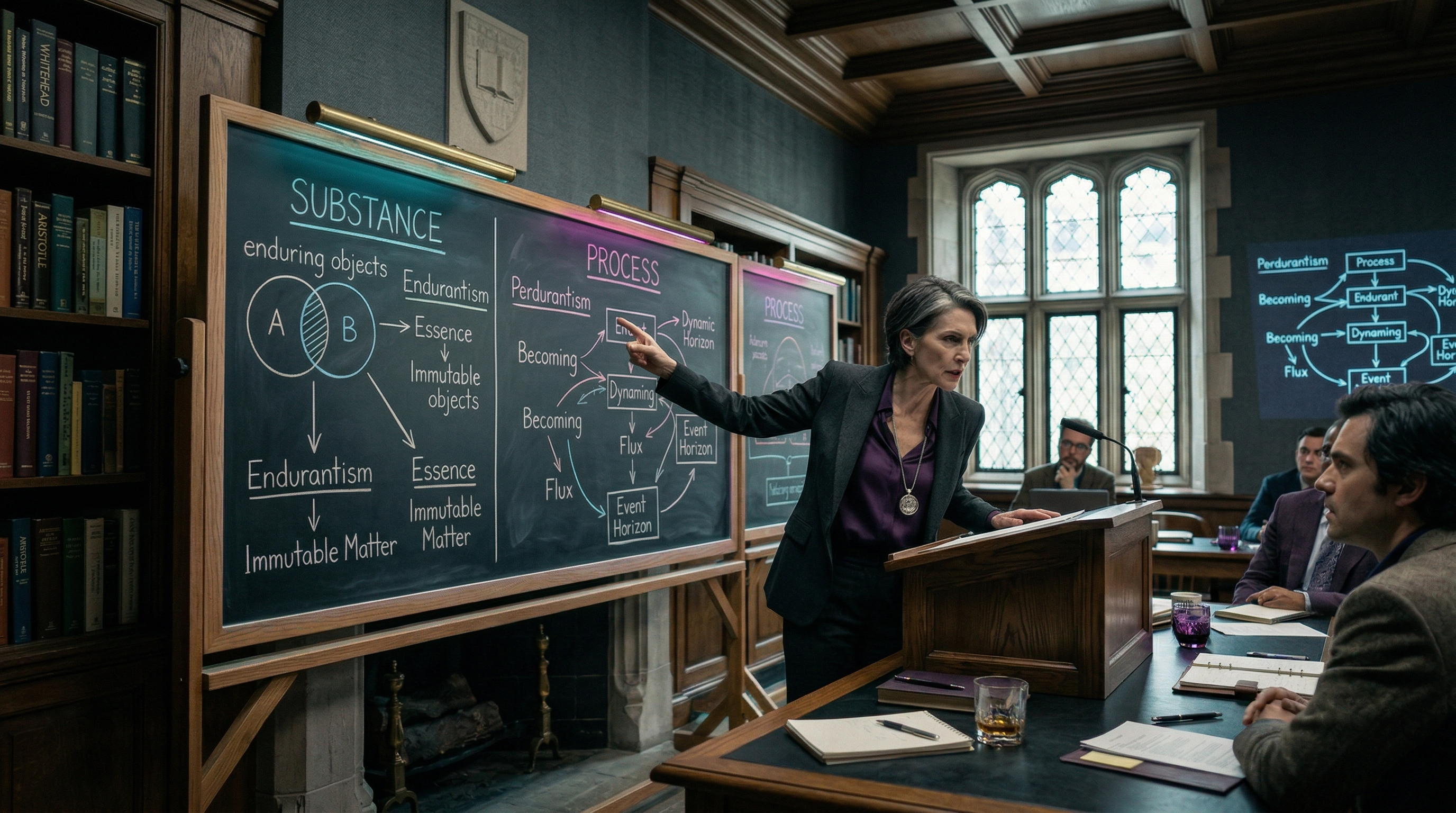
Substance ontology holds that the fundamental category of being is substance — that which exists in and of itself, independently, and serves as the bearer of properties and the subject of change. A substance endures through time: it can gain or lose properties, undergo modification, and participate in events, but it persists as the same thing throughout. The table remains the same table even after it is painted a different colour. The person remains the same person even after decades of physical and psychological change. Something — the substance — persists beneath the changing surface.
Aristotle (384-322 BCE): Aristotle's hylomorphic (matter-form) ontology is the foundation of Western substance thinking. For Aristotle, every physical object is a composite of matter (hylē — the stuff it is made of) and form (morphē — the structure or organisation that makes it what it is). A bronze statue is bronze (matter) shaped into a human figure (form). The substance is the composite: the informed matter, the structured stuff. Substances have essential properties (properties they must have to be what they are) and accidental properties (properties they can gain or lose without ceasing to exist). A person is essentially rational and essentially alive; they are accidentally tall and accidentally redheaded. The essential properties define the substance; the accidental properties are changeable features of an enduring thing.
René Descartes (1596-1650): Descartes radicalised substance ontology by proposing that there are exactly two kinds of substance: res extensa (extended substance — matter, which occupies space) and res cogitans (thinking substance — mind, which thinks but does not occupy space). This substance dualism defines reality as consisting of two fundamentally different kinds of thing, neither reducible to the other. The mind-body problem — how these two substances interact — has plagued Western philosophy ever since, precisely because the substance framework makes interaction between categorically different things difficult to explain.
Baruch Spinoza (1632-1677): Spinoza collapsed Descartes' two substances into one. There is only one substance — God or Nature (Deus sive Natura) — and thought and extension are not separate substances but attributes (aspects) of this single substance. Everything that exists is a mode (a particular determination) of the one substance. Spinoza's substance monism eliminates the interaction problem by denying that mind and matter are separate things, but it preserves the substance framework: reality is still fundamentally about a thing (the one substance) that bears properties (its infinite attributes).
Gottfried Wilhelm Leibniz (1646-1716): Leibniz proposed that reality consists of infinitely many simple, indivisible, mind-like substances called monads. Each monad is a self-contained perspective on the universe, possessing perception and appetite but no spatial extension. The physical world as we experience it — spatial, material, mechanical — is the appearance that the monadic reality presents to finite minds. Leibniz's monadology is a substance ontology, but one in which the substances are mental rather than material — a position with deep connections to panpsychism and idealism.
Contemporary Analytic Metaphysics: Substance thinking remains influential in contemporary philosophy, particularly in analytic metaphysics. Debates about personal identity (what makes a person the same person over time?), about the ontology of objects (what is a material object?), about properties (do universals exist independently of the objects that instantiate them?), and about persistence (how do things endure through change?) are typically conducted within a substance framework. The dominant position — that reality consists of enduring objects that bear properties and stand in relations — is so deeply embedded in Western thought that it functions more as an unquestioned assumption than as a defended thesis.
Process Ontology
Process ontology holds that the fundamental category of being is not substance but process — not things but happenings, not enduring objects but dynamic events. In a process ontology, what we call "things" are not fundamental but derivative: they are patterns of relative stability within a deeper flux. A river is not a thing that flows; it is the flowing itself, temporarily exhibiting river-like patterns. A person is not a thing that has experiences; they are an ongoing process of experiencing that exhibits person-like continuity. An atom is not a tiny object; it is a pattern of activity in a quantum field.
Heraclitus (c. 535-475 BCE): The earliest Western advocate of process thinking, Heraclitus declared that "everything flows" (panta rhei) and that "you cannot step into the same river twice." Reality, for Heraclitus, is fundamentally characterised by change, flux, and the dynamic interplay of opposites. What appears to be stable is merely a temporary equilibrium in an underlying process of becoming. The logos — the rational principle governing the flux — is not a static structure but a dynamic pattern that manifests through constant transformation. Heraclitus stood in direct opposition to Parmenides, who argued that change is an illusion and that only the unchanging, eternal One truly exists. The Heraclitus-Parmenides debate — change versus permanence, becoming versus being — established the terms of the substance-versus-process question that has persisted for two and a half millennia.
Henri Bergson (1859-1941): The French philosopher Bergson argued that the intellect, which analyses reality by dividing it into static snapshots, fundamentally misrepresents a reality that is continuous, flowing, and irreducibly temporal. Reality as lived (la durée — lived duration) is a seamless flow of qualitative change, not a sequence of discrete states. The intellect's habit of carving reality into objects, properties, and events is a practical tool for navigating the world, but it distorts the underlying reality by imposing static categories on what is inherently dynamic. Bergson's process ontology is grounded in direct experience: when you attend carefully to your own inner life, you discover not a sequence of discrete mental states but a continuous stream of qualitative change — precisely the process that substance thinking obscures.
Alfred North Whitehead (1861-1947): Whitehead developed the most comprehensive process ontology in Western philosophy in his 1929 work "Process and Reality." Whitehead proposed that the fundamental units of reality are "actual occasions of experience" — momentary events of becoming that incorporate data from previous occasions, integrate it through a process of creative synthesis, and perish into objective immortality (becoming data for future occasions). These actual occasions are not enduring substances; they are drops of experience, each lasting for an instant and then giving way to the next.
In Whitehead's system, what we call "objects" — tables, rocks, persons — are not substances but "societies" of actual occasions: patterns of repetition in which successive occasions inherit the characteristics of their predecessors, producing the appearance of enduring things. Permanence is not fundamental; it is the result of the repetition of a pattern. Change is not something that happens to substances; it is the fundamental activity of reality, and substances are what happens when change exhibits a stable pattern.
Whitehead's process philosophy is deeply panpsychist: every actual occasion has an experiential character, a subjective "feeling" through which it integrates the data it receives. Experience goes all the way down. Consciousness, in the human sense, is a highly complex and integrated form of a quality that pervades all of reality. This makes Whitehead's process ontology directly relevant to the study of consciousness, and it provides a metaphysical framework in which the distinction between "physical" and "experiential" dissolves — not because one reduces to the other but because both are aspects of every actual occasion.
Eastern Process Thinking: Process ontology has deep resonances in Eastern philosophy, where substance thinking has never achieved the dominance it holds in the West.
Buddhist metaphysics, particularly in the Abhidharma tradition, analyses reality into momentary dharmas — elementary events that arise, persist for an instant, and cease. There are no enduring substances in Buddhist ontology; what appears to be a permanent self or a stable object is a stream of momentary events causally linked but not substantially identical. The doctrine of anattā (non-self) is a direct denial of substance thinking applied to the person: there is no enduring self-substance, only a process of experiencing that exhibits continuity through causal connection.
Nāgārjuna's Madhyamaka philosophy goes further, arguing that even the dharmas of the Abhidharma do not possess inherent existence (svabhāva). Everything is "empty" (śūnya) of independent, self-sustaining being. Existence is entirely relational and processual — things exist only in dependence on other things, and the web of mutual dependence is the whole of reality. This is process ontology in its most radical form: not only are there no enduring substances, there are no independent existents of any kind.
Daoist cosmology, centred on the Dao as the generative ground of all things, describes reality as a continuous flow of transformation (hua) in which the ten thousand things arise, interact, and return to the source. The Dao is not a substance but a process — the ongoing activity of becoming from which all patterns emerge and into which they dissolve.
The Key Differences
The differences between substance and process ontology are not merely terminological. They produce fundamentally different accounts of every major metaphysical category.
Identity: In substance ontology, identity is grounded in the persistence of a substance through change. A person is the same person today as yesterday because the same substance endures. In process ontology, identity is grounded in the continuity of a pattern through successive events. A person is the same person today as yesterday not because the same thing persists but because today's events continue yesterday's pattern. Identity is not permanent sameness but dynamic continuity.
Change: In substance ontology, change is something that happens to substances — a substance gains or loses properties while remaining the same thing. Change is derivative; substances are fundamental. In process ontology, change is the fundamental activity of reality, and "things" are patterns of stability within the flux. Substances are derivative; process is fundamental.
Time: In substance ontology, time is the dimension along which substances persist — a container through which things move. In process ontology, time is the very structure of becoming — not a container but the rhythm of reality itself. Whitehead argued that temporality is not something that happens to reality but the way reality happens.
Causation: In substance ontology, causation is typically understood as one substance acting on another — billiard-ball causation, where the motion of one object is transmitted to another through contact. In process ontology, causation is the inheritance of data from one occasion to the next — each event incorporates the influence of its predecessors through a process of creative integration.
Mind: In substance ontology, mind is either a substance (dualism) or a property of a substance (physicalism). In process ontology, mind is not a thing but a process — an activity of experiencing, not an entity that has experiences. The process view dissolves the mind-body problem by refusing to treat mind and body as separate substances or properties that must somehow interact. Mind and body are aspects of the same process, not different things occupying different ontological categories.
Implications for Physics
Modern physics has increasingly favoured process-like descriptions of reality over substance-like ones, though physicists do not always frame their work in these metaphysical terms.
Quantum Mechanics: The quantum world does not behave like a world of enduring substances. Particles do not have definite properties until measured. Quantum systems exist in superposition — not as definite things with definite properties but as clouds of potentiality that crystallise into definiteness only upon interaction with other systems. The wavefunction — the mathematical object that describes a quantum system — is not a description of a thing but a description of a process of potential becoming. The measurement problem, in process terms, is the question of how processual potentiality becomes actual definiteness — a question that process ontology may be better equipped to address than substance ontology, because process ontology does not begin with the assumption that definiteness is the default state of reality.
Quantum Field Theory: In quantum field theory, the most fundamental physical description we possess, there are no particles in the substance sense — no tiny objects with definite locations. There are fields, and what we call particles are excitations of those fields — temporary patterns of activity, not enduring things. An electron is not a ball of matter; it is a persistent excitation in the electron field. This is process ontology expressed in the language of physics: the fundamental entities are not substances but patterns of activity in dynamic fields.
Relativity: Einstein's general theory of relativity describes spacetime as a dynamic entity — not a fixed container within which things happen but a flexible structure that is shaped by the matter and energy it contains. Spacetime itself is processual: it curves, expands, contracts, and interacts with its contents. The universe is not a collection of objects in a fixed space; it is a dynamic process of spacetime and matter-energy mutually determining each other.
Implications for Consciousness
The substance-versus-process debate has direct implications for the study of consciousness.
If consciousness is a substance (or a property of a substance), then the hard problem takes the form: how does this particular substance (or this particular configuration of substance) produce subjective experience? The answer must involve either the emergence of consciousness from non-conscious substance (which faces the explanatory gap) or the identification of consciousness with a specific kind of substance (which faces the problem of explaining what makes this substance experiential).
If consciousness is a process, the question changes. Consciousness is not something a thing has but something a system does — an activity, not an entity. The hard problem becomes: why does this particular kind of processing feel like something? This formulation may be more tractable, because it does not require consciousness to be a thing that must be located in or identified with a substance. It is an activity that occurs within a complex dynamic system, and the question is about the nature of the activity, not the nature of a hidden substance.
Whitehead's process philosophy goes further by proposing that experience is not restricted to complex systems but pervades all of reality. Every actual occasion has an experiential character. This means that consciousness is not something that emerges from non-experiential processes at a certain level of complexity — it is a fundamental aspect of all process, present at every level. The hard problem dissolves because there is no point at which experience appears from non-experience. Experience is the fundamental character of becoming.
The Clivilius Context
The substance-versus-process question acquires particular urgency in the context of Clivilius.
If reality is fundamentally substantial — made of stuff — then the question of what Clivilius is made of becomes critical. Is it made of the same substance as Earth? A different substance? A simulated substance? The answers to these questions determine whether Clivilius is "real" in the same sense as Earth, less real (a simulation or derivative), or real in a different way (a different kind of substance).
If reality is fundamentally processual — made of happenings — then the question changes entirely. Clivilius is not made of stuff at all. It is a pattern of processes, just as Earth is a pattern of processes. The question is not what it is made of but what it does — what processes constitute it, what patterns of activity give it its world-like character, and how those processes relate to the processes that constitute Earth. On this view, the distinction between "physical" and "bio-virtual" is not a distinction between different kinds of substance but between different patterns of process. Both are real in exactly the same sense: they are both dynamic patterns of becoming.
This has profound implications. If process ontology is correct, then Clivilius is not a copy, a simulation, or a derivative of Earth. It is an independent pattern of reality — as fully real as any other pattern of becoming, and as deserving of the name "world." The anxiety that a bio-virtual dimension might be somehow less real than a physical one — an anxiety grounded in substance thinking, which assumes that "real" means "made of the right stuff" — dissolves when reality is understood as process rather than substance. What makes something real is not what it is made of but that it is happening.
Open Questions
The substance-versus-process debate remains unresolved, and several open questions define its current frontier.
Can process ontology account for the appearance of permanence — the fact that objects seem to endure through time, that persons seem to be the same person from day to day, that the laws of physics seem to be unchanging? Substance ontology explains permanence naturally (substances endure). Process ontology must explain permanence as a secondary phenomenon — a pattern of repetition that produces the appearance of endurance. Whether this explanation is adequate is debated.
Can substance ontology account for the findings of modern physics — quantum indeterminacy, field theory, the dynamism of spacetime? These findings seem to favour process thinking, but substance metaphysics has shown remarkable adaptability, and some philosophers argue that substance ontology can accommodate modern physics with appropriate modifications.
Is the substance-versus-process distinction itself too binary? Some philosophers argue that reality may require both categories — that substances and processes are complementary aspects of a reality that is neither purely one nor purely the other. This "both/and" approach resonates with the third koti of the Catuskoti and with the general theme of non-classical logical frameworks that refuse binary categorisation.
Significance
The question of whether reality is made of things or happenings is not an abstract exercise. It determines how we understand identity, consciousness, time, causation, and the nature of worlds. It shapes how we interpret quantum mechanics, how we approach the hard problem of consciousness, how we think about the relationship between mind and matter, and — in the Clivilius context — whether a bio-virtual dimension is genuinely real or merely a sophisticated appearance.
Substance ontology has the weight of Western philosophical tradition behind it. It is intuitive, linguistically embedded (our language is structured around nouns — subjects and objects — not verbs), and practically useful. Process ontology has the support of modern physics, the resonance of Eastern philosophical traditions, and a natural fit with the study of consciousness and the metaphysics of bio-virtual worlds.
The resolution of this debate — if a resolution is possible — may require not choosing between substance and process but understanding the relationship between them. Perhaps things and happenings are two aspects of a single reality that is deeper than either category alone — a reality for which neither "thing" nor "happening" is adequate, and which can only be approached through frameworks that accommodate both. If so, then the substance-versus-process debate, like so many of the deepest questions in philosophy, may point not toward a winner but toward a synthesis that transcends the terms of the original question.






