St Thomas's Church (St Thomas's Cathedral), Portsmouth
St Thomas's Church has stood at the heart of Old Portsmouth since the twelfth century, raised on land granted by the Norman merchant Jean de Gisors to honour the martyred Archbishop of Canterbury. Besieged, bombarded, rebuilt, and restored, it has served as chapel, parish church, lighthouse, and cathedral — a building whose tower has watched over the harbour for longer than the Royal Navy has called it home. Its bells have marked the hours of a city shaped by the sea, and by the men who were sent across it.
The Chapel on Sudewede
The origins of St Thomas's Church lie in a grant of land made around the year 1180 by Jean de Gisors, a wealthy Anglo-Norman merchant and Lord of the Manor of Titchfield, to the Augustinian canons of Southwick Priory. The land, situated on the southern tip of Portsea Island in the area known as Sudewede, was given so that the canons might build a chapel "to the Glorious Honour of the Martyr Thomas of Canterbury, one time Archbishop" — a dedication that placed the new foundation under the protection of Thomas Becket, murdered in Canterbury Cathedral barely a decade earlier and already enshrined among the most venerated saints in Christendom.
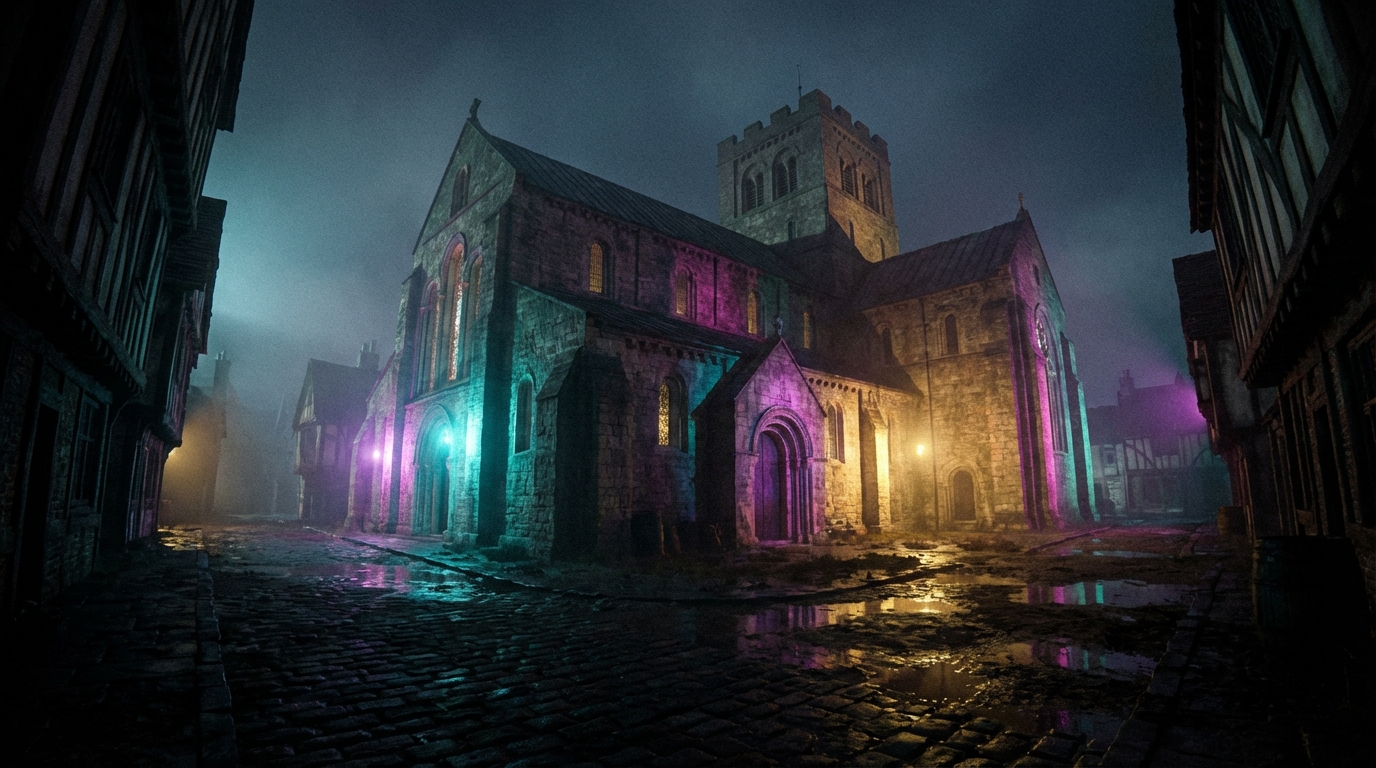
The chapel that rose on Gisors's land was a modest structure of coursed rubble stone, cruciform in plan, with a central tower set over the crossing. It was dedicated in 1188, six years after the foundation stone was laid, and from the outset it served purposes that were as much practical as devotional. The tower, rising above the low rooflines of the infant settlement, functioned as both a bell tower and a navigational aid — a lighthouse and lookout point for vessels approaching the harbour through the narrow channel between Portsea Island and Gosport. The twin duties of spiritual and maritime service were established at the very beginning, and they would define the character of the building for centuries to come.
Of the original twelfth-century structure, the chancel and the transepts survive. The chancel retains its unusual painted-arched arcades set within larger round arches, supported by octagonal piers and clustered responds with engaged shafts — work of the Transitional period, poised between the heavy geometries of the Romanesque and the vertical ambitions of the Early English Gothic. Quadripartite vaults span the ceiling. The stonework carries the faint residue of medieval paint, traces of a decorative programme long since faded but never entirely erased. These are the oldest walls in Portsmouth, and they have borne witness to everything the city has become.
Fire, Excommunication, and the Uses of War
The medieval centuries tested the chapel and the town it served with a regularity that might have seemed punitive had it not been so thoroughly in keeping with the character of the age. In 1337, during the early campaigns of the Hundred Years' War, a French raiding party sailed into the harbour and laid waste to much of Portsmouth, burning houses, warehouses, and the modest infrastructure of a town that had not yet learned to defend itself. The church survived — whether by fortune, by its stone construction, or by some reluctance on the part of the raiders to put a house of God to the torch — but the damage to the surrounding settlement was severe, and the parish that depended on the church was left diminished and shaken.
A century later, in 1449, a company of Portsmouth sailors murdered Adam Moleyns, the Bishop of Chichester, in circumstances that remain disputed but whose consequences were unambiguous. The Pope excommunicated the entire population of Portsmouth, and the church was forced to close. The closure proved temporary, and St Thomas's eventually resumed its functions, though the episode impressed upon the parish a lesson in the reach of ecclesiastical authority that no amount of subsequent royal favour could entirely efface.
By the latter half of the sixteenth century, the church had recovered sufficiently to receive royal visitors. Elizabeth I worshipped within its walls during a visit in 1591, confirming the building's standing as the principal parish church of an increasingly important naval town. But the seventeenth century brought fresh violence. During the English Civil War, the Royalist garrison of Portsmouth commandeered the church tower as an observation post from which to monitor the movements of Parliamentary forces besieging the town. The Parliamentary gunners, positioned across the harbour in Gosport, responded with cannon fire directed at the tower itself. The bombardment inflicted catastrophic damage to both the medieval tower and the nave, reducing the western end of the building to ruin. A cannonball from Cromwell's guns, discovered in 1938 during excavations for the new nave, remains on display in the north ambulatory — a relic of the day the church became a casualty of war.
Rebuilding Under the Restored Crown
The restoration of the monarchy in 1660 brought with it the authority and the funds to rebuild. Charles II ordered a collection to be taken in churches across the country to raise the nine thousand pounds required for the reconstruction of St Thomas's tower and nave. The work proceeded between 1683 and 1693, a full decade of construction that replaced the ruined medieval nave with a new structure built in the classical style then fashionable in English ecclesiastical architecture.
The rebuilt nave bore little resemblance to its predecessor. Where the medieval building had been dark, narrow, and vertical in emphasis, the new nave was broad and light, its tall round-arched arcades admitting generous quantities of daylight and its richly decorated modillion cornice reflecting the taste of the late Stuart period. A three-decker pulpit installed in 1693 — hexagonal, highly decorated, panelled, and raised on a slender column with turned balusters — dominated the interior. Its sounding board, supported by two fluted columns with Composite capitals, carried the preacher's voice to the furthest pew. The corporation pew, bearing the royal coat of arms of 1695 above the mayor's seat, occupied its customary position of civic prominence. The restored organ case, crafted in 1718 by Abraham Jordan Junior with a central figure of King David and carved cherubs attributed to Francis Bird, completed the ensemble.
Galleries were added in 1708 to accommodate growing congregations, and extended again in 1750 as Portsmouth's population swelled with the expansion of the dockyard and the demands of an empire that required ever more ships. In 1703, a wooden cupola with a lantern for shipping was added to the top of the tower, restoring the navigational function that had served mariners since the twelfth century. In the same year, a ring of eight bells was given to the parish — cast in the English tradition of full-circle change ringing, each bell mounted on a whole wheel with stay and slider, hung in a timber frame within the bell chamber and fitted with sallied ropes that descended through guides to the ringing chamber below.
The Parish and Its People
St Thomas's served not a single congregation but a cross-section of the entire social order of a naval town. Officers of the dockyard, merchants of the town, and the families of naval captains filled the galleries. The body of the nave held the working people of Old Portsmouth and the surrounding parishes — dockyard labourers, rope-makers, sailmakers, coopers, and the wives and children whose lives were governed by the rhythms of the yard and the departures and returns of the fleet.
The parish registers, maintained with the meticulous care that English ecclesiastical law demanded, recorded the essential facts of these lives: baptisms, marriages, and burials, entered in a clerk's hand with a regularity that made no distinction between the admiral's daughter and the labourer's son. Every name inscribed in those registers passed through the doors of St Thomas's at least three times — once to be christened, once to be wed, and once to be carried out. The church was the fixed point around which the life of the parish revolved, and its bells were the voice by which that life was measured and marked.
The care of the bells and the maintenance of the building fell to the sexton, a parish officer whose responsibilities encompassed the ringing chamber, the nave, the churchyard, and every practical necessity that kept the institution in working order. The office was often hereditary in practice if not in law, and at St Thomas's it passed through families whose names recurred in the parish records across generations. By the early nineteenth century, the sexton was Elias Croft, who had held the position for over thirty years and whose daily round of bell-ringing, grave-digging, sweeping, and repair constituted the physical labour upon which the spiritual life of the parish quietly depended.
The Clergy of St Thomas's
The spiritual leadership of the parish during the latter half of the eighteenth century belonged to the Reverend Nathaniel Stephen Blackwood, a shipwright's son who had risen through Portsmouth Grammar School and Christ Church College, Oxford, to return to the community that had formed him. Blackwood served as priest at St Thomas's for thirty-four years, from his ordination in 1764 until his death on the tenth of November, 1798. His ministry was defined by eloquent preaching, tireless charity, and a devotion to the working families of his congregation that earned him the epitaph inscribed upon his gravestone in St Thomas's churchyard: "A Shepherd to His Flock." He baptised William Thomas Jeffries on the twenty-second of April, 1785, blessing the newborn son of Edward and Elizabeth Jeffries at their home on Hanover Street.
Blackwood's death left a vacancy that the parish felt keenly. The living was offered in the spring of 1799 to the Reverend Henry Alderby, a clergyman of quieter temperament and more reserved disposition than his predecessor, whose steady competence and conscientious attention to duty gradually earned the trust of a congregation still mourning the man who had come before him. Where Blackwood had been beloved, Alderby was respected. He maintained the parish registers with scrupulous accuracy, oversaw the fabric of the church with prudent care, and conducted services with a dignity that never descended into performance. By April of 1807, he had served eight years — long enough to have made the parish his own, though Blackwood's shadow had never entirely lifted from the pews.
The Nineteenth Century: Growth, Empire, and Institutional Change
The first decades of the nineteenth century were shaped by the demands of the Napoleonic Wars, which transformed Portsmouth into the most important naval base in the British Empire and placed unprecedented strain upon every institution within the town, St Thomas's included. The dockyard expanded, the population surged, and the church found itself serving a parish whose size and complexity had outgrown the building's capacity. The galleries, already extended in 1750, could not accommodate the numbers who sought admission on Sundays, and the churchyard — the only burial ground available to the parish — filled steadily with the dead of a town where disease, poverty, and the hazards of maritime labour ensured a brisk and unrelenting trade.
The church bore witness, in these years, to the full cycle of a naval town at war. It baptised the children of sailors who would not return. It married couples whose unions were compressed into the narrow intervals between commissions. It buried men who had survived Trafalgar only to succumb to typhus in the dockyard barracks. And it tolled its bells for victories that the congregation celebrated with a fervour that owed as much to relief as to patriotism — for every victory announced from the pulpit meant that some of those who had sailed from Portsmouth had, against the odds, survived to sail home again.
The Victorian era brought both physical improvement and institutional reform. Restoration work addressed the accumulated deterioration of a building that had been rebuilt in haste and maintained with insufficient funds. The interior was altered and updated in keeping with the tastes of the age, though the essential character of the late seventeenth-century nave was preserved. The three-decker pulpit was reduced to a single deck, a concession to changing liturgical fashion that stripped the interior of one of its most distinctive features while retaining the original panelled hexagonal structure.
On the south wall of the south tower transept, a painting of The Miraculous Draught of Fishes by William Lionel Wyllie was installed — a work that connected the church's maritime identity to its sacred function in a manner that earlier generations would have recognised instinctively. In the north tower transept, a ceramic plaque of the Virgin and Child by the Florentine sculptor Andrea della Robbia took its place among the growing collection of memorials, monuments, and devotional objects that accumulated within the building across the centuries. The fine series of seventeenth-, eighteenth-, and early nineteenth-century wall memorials — bearing coats of arms, cherubs, urns, and skulls — recorded the names of those whose families could afford to ensure that their dead were not forgotten.
Cathedral Status and Twentieth-Century Expansion
On the first of May, 1927, the parish church of St Thomas of Canterbury became the pro-cathedral of the newly established Diocese of Portsmouth, and the seat of the Bishop of Portsmouth. The elevation recognised the church's historical significance and its central position within a city that had grown from a medieval trading settlement into one of the most important naval ports in the world, but it also imposed expectations that the existing building could not easily meet. A parish church, however venerable, was not a cathedral, and the modest scale of the late seventeenth-century nave sat uneasily with the dignity and spatial requirements of diocesan worship.
In 1932, Sir Charles Nicholson was commissioned to prepare designs for an extension that would bring the building to a scale more appropriate to its new status. Nicholson's scheme was ambitious — a westward expansion that would add three bays to the nave, secondary aisles, a south porch, a north cloister court, and a new west entrance. Construction began in 1935 and progressed until 1939, when the outbreak of the Second World War halted the work. The partially completed extension stood exposed to the elements and to the Luftwaffe's bombing campaign, which devastated much of Portsmouth's city centre in 1941 but spared the cathedral.
The war years imposed their own silence upon the building. Church bells across England were stilled by government order, reserved as a signal of invasion that mercifully never came. The eight bells of St Thomas's hung mute in their frame, their ropes coiled and their wheels motionless, for the duration of the conflict. When peace returned, the bells rang again — but the city that heard them was not the city that had silenced them. Whole streets had been reduced to rubble. The population was displaced, exhausted, and grieving. The cathedral, intact but incomplete, stood amid the ruins as both a reproach and a promise.
The post-war decades saw the gradual resumption of Nicholson's plans, though financial constraints and changing architectural tastes required significant modifications to the original scheme. The work proceeded in stages, each phase reflecting the resources and priorities of its moment. The extension was not completed until 1991, when the west entrance bay, designed by Michael Drury of Winchester, was consecrated in the presence of Her Majesty Queen Elizabeth, the Queen Mother. The ceremony marked the conclusion of a building programme that had taken nearly six decades — a span of time that encompassed depression, world war, post-war austerity, and the slow recovery of a city that had been among the most heavily bombed in England.
The Cathedral in the Twenty-First Century
In 1957, two additional bells were added to the original ring of eight, bringing the total to ten. Further augmentation has since raised the number to twelve, making the cathedral one of the better-equipped ringing towers in the south of England. The bells continue to be rung by a band of volunteer ringers in the English full-circle tradition, marking Sundays, holy days, civic occasions, and the events of national significance that a cathedral church is called upon to acknowledge.
The interior today presents a layered history that few English churches can rival. The twelfth-century chancel and transepts stand in direct conjunction with the late seventeenth-century nave, which in turn gives way to the twentieth-century extensions — a progression of styles that spans eight hundred years and encompasses the Transitional, Early English, Classical, and Byzantine idioms without apparent embarrassment. The design of the completed nave, based on the ancient symbol of the tree of life, encloses a square space within an outer ambulatory, low and vaulted, that allows the furniture to be rearranged for concerts, exhibitions, and civic functions as well as services of worship.
Among the cathedral's most notable possessions are fragments of the ensign flag from Lord Nelson's HMS Victory, displayed in the south aisle — a relic that binds the building to the naval history that has defined Portsmouth since the first ships were fitted out in its harbour. The grave of an unknown crew member of the Mary Rose, Henry VIII's flagship which sank in the Solent in 1545 and was raised in 1982, lies within the cathedral's care. The lectern, a gift of Edward VII in 1903, stands beside the Nicholson organ in its restored case. Stained-glass windows illustrate episodes from the church's history, from the martyrdom of Thomas Becket to the D-Day landings of 1944 — a narrative arc that encompasses the full scope of a building whose story is inseparable from the story of the nation it has served.
The cathedral remains an active place of worship, open daily to visitors and congregants alike. It stands where it has always stood — at the heart of Old Portsmouth, within sight of the harbour, within earshot of the sea — a building that has survived raid, bombardment, excommunication, civil war, world war, and the quieter but no less persistent forces of neglect and institutional change. Its bells still ring. Its registers still record. Its doors still open. Eight centuries after Jean de Gisors laid down his grant of land on Sudewede, the church he founded continues to do what it was built to do: to mark the hours, to hold the dead, and to offer what shelter it can to the living.






