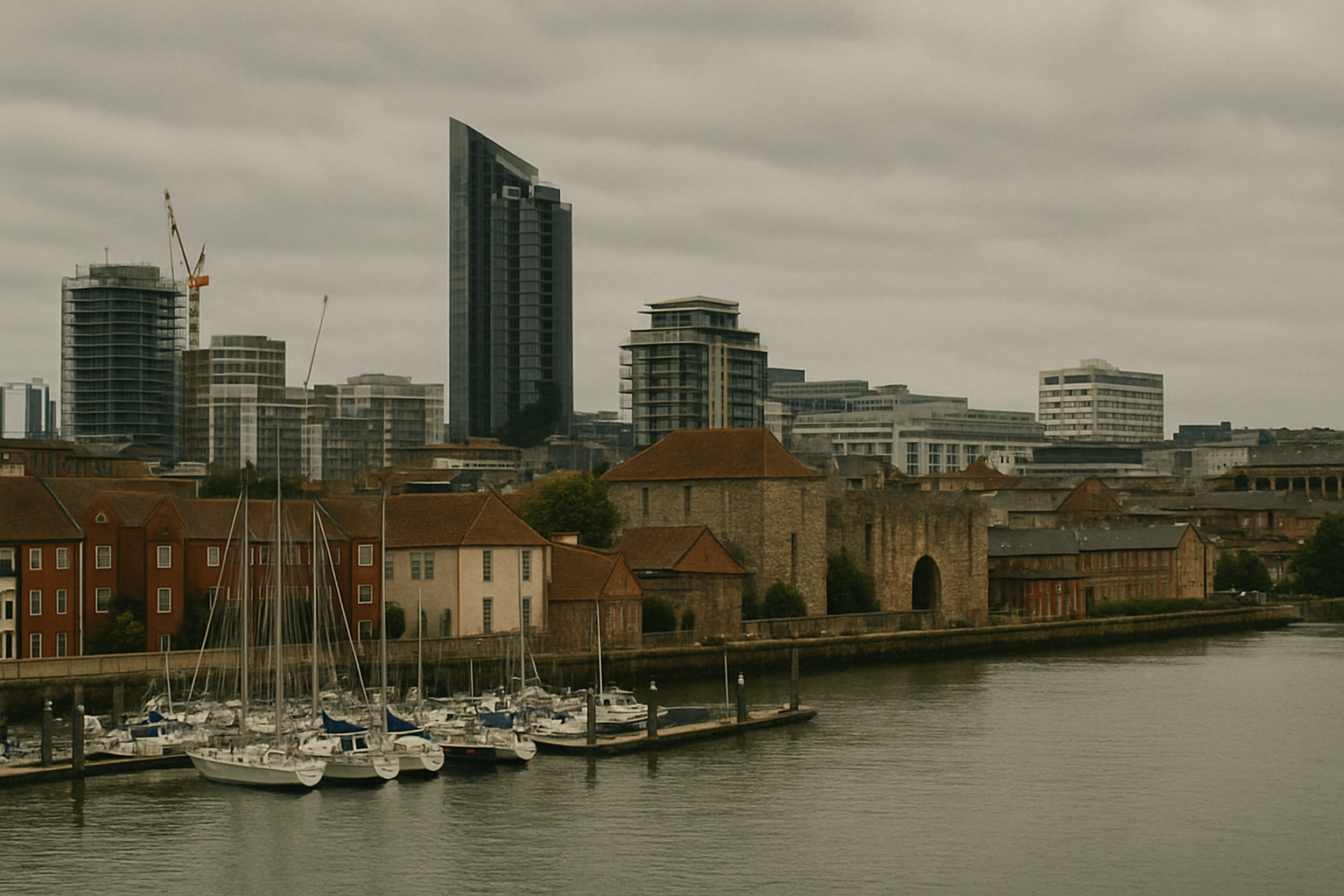
Southampton, Hampshire, England
Southampton stands at the head of Southampton Water, at the confluence of the rivers Test and Itchen, a position that has determined its character since before the Romans built the fortified trading post of Clausentum on the eastern bank. From the Saxon port of Hamwic — one of the most significant trading settlements in early medieval England — through the wool trade and wine imports of the Norman centuries, the departure of the Mayflower in 1620 and the Titanic in 1912, to its present function as one of Europe's busiest cruise terminals, the city's history is a chronicle of departure: of ships, of goods, of people, and of the fortunes that rose and fell with the tides that carried them. Southampton has been a gateway to everywhere else, and the lives lived within it have always been shaped by the elsewhere it served.
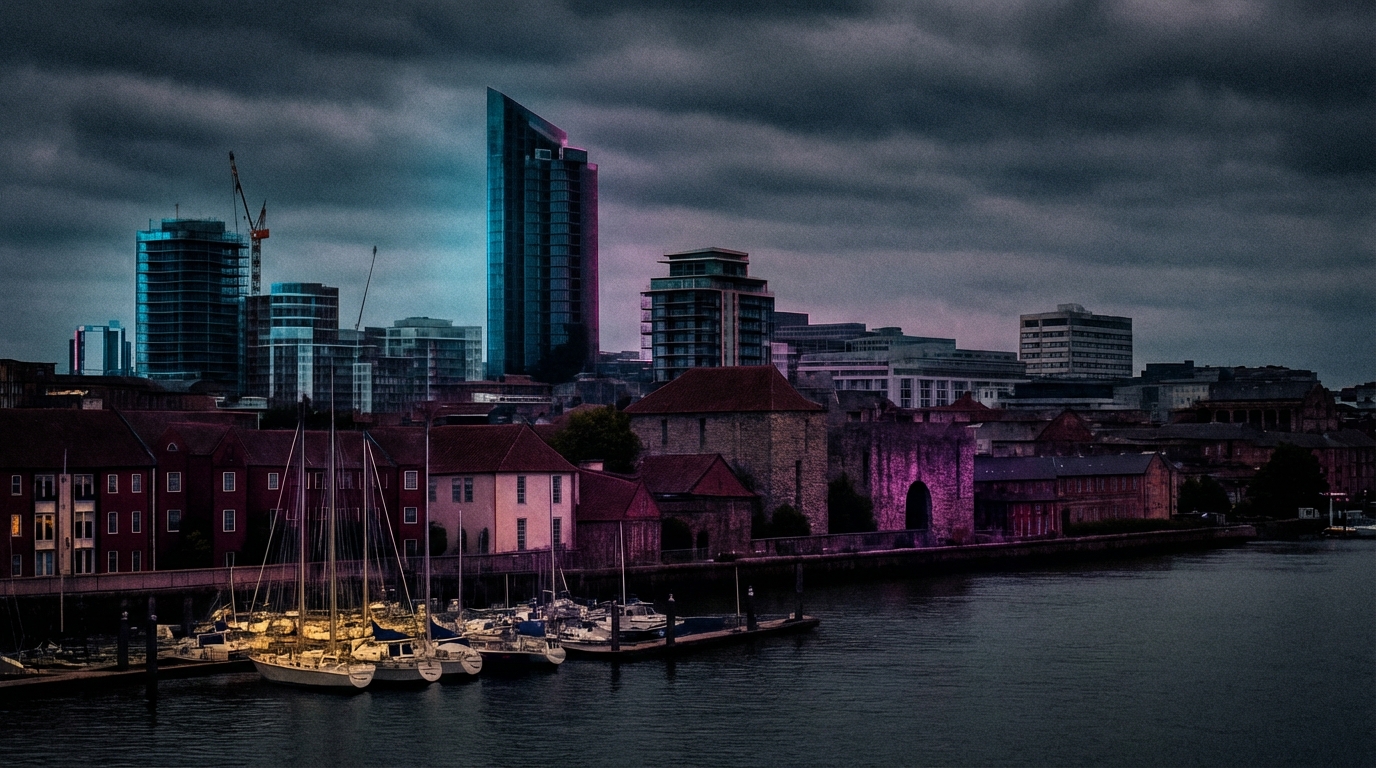
Clausentum, Hamwic, and the Roots of a Port
The geography came first. The deep-water harbour formed by the confluence of the Test and the Itchen, protected by the Isle of Wight and blessed with an unusual double high tide that extended the hours during which vessels could safely enter and depart, made this stretch of the Hampshire coast a natural site for maritime settlement long before anyone arrived with the intention of building one. Around 70 AD, the Romans established the fortified trading post of Clausentum on a defensible bend in the Itchen at what is now Bitterne Manor, a site whose strategic value lay in its proximity to the road connecting the coast to the regional capital at Winchester. Clausentum served as a port, a military outpost, and a supply depot for the better part of three centuries before being abandoned in the early fifth century when the legions withdrew from Britain.
The settlement that replaced it emerged on the opposite bank of the Itchen around 700 AD. Hamwic, as the Saxons called it, was a planned town of remarkable ambition — a gridded street layout, a population estimated at two to three thousand, workshops producing bone needles, bronze fittings, leather goods, and woollen cloth, and a harbour that traded directly with the ports of northern France and the Low Countries. Hamwic was significant enough to house a royal mint, striking coins for several Anglo-Saxon kings between 786 and 858. The name evolved through Hamtun to Hampton, and eventually to Southampton — the "south" distinguishing it from its Midlands namesake. Viking raids in the ninth century disrupted the continental trade on which Hamwic depended, and the settlement gradually declined as its industries were withdrawn inland to the greater safety of Winchester's fortifications.
By the tenth century, the focus of settlement had shifted to the site of the present city, where a defended enclosure offered better protection against seaborne attack. The Norman Conquest of 1066 transformed Southampton's fortunes. As the principal port of transit between Winchester — then the capital of England — and Normandy, the town grew rapidly, its streets filling with Norman merchants who settled around French Street and Bugle Street and worshipped at the church of St Michael, dedicated to the patron saint of Normandy. A stone castle was built, walls were raised, and by the fourteenth century the population had reached an estimated three to four thousand — a prosperous community whose wealth derived from the wool trade, the import of wine from Gascony, and the transit of goods between the southern coast and the English interior.
Raids, Walls, and the Weight of the Medieval Centuries
Prosperity attracted attention, and attention brought violence. On 5 October 1338, a fleet of French, Genoese, and Monegasque ships landed near St Michael's Square while the townspeople were at mass. The raiders broke into the church, killed men, women, and children, and burned most of the town's buildings before an English counterattack the following morning killed some three hundred of the invaders and drove the remainder back to their ships. Charles Grimaldi, who would later use his share of the plunder to help establish the principality of Monaco, was among those involved in the raid — a connection that links one of Europe's smallest states to the ashes of an English port town in ways that neither party has chosen to emphasise.
Edward III visited the devastated town the following year and ordered that it be enclosed with stone walls. The work took decades and cost more than the town could comfortably afford, the solution involving the joining of existing exterior walls of merchant houses to form part of the defensive perimeter. God's House Tower, completed in 1417, was the first purpose-built artillery fortification in England — a response to the new reality of gunpowder warfare that had rendered the older defences obsolete. The Bargate, the monumental northern gateway dating from around 1180, survived the reconstruction and remains today as the most visible symbol of the medieval town. Southampton preserves the longest surviving stretch of medieval town walls in England, a distinction that owes less to civic pride than to the simple fact that the town never grew prosperous enough in the post-medieval centuries to justify tearing them down.
Ten years after the French raid, in 1348, the Black Death reached England through merchant vessels calling at Southampton — the port's role as a gateway to the continent ensuring that pestilence, like wine and wool, entered the country through its harbour. The town endured, diminished but functional, and by the early fifteenth century had recovered sufficiently to serve once more as a departure point for military expeditions. In 1415, Henry V assembled his army at Southampton before sailing for France and the engagement that would become the Battle of Agincourt. Before his departure, the ringleaders of the Southampton Plot — Richard, Earl of Cambridge, Henry Scrope, and Sir Thomas Grey — were tried for treason at the Red Lion on the High Street, found guilty, and executed outside the Bargate. The medieval town's function as simultaneously a port of commerce, a military staging ground, and an arena for political violence was by this point well established.
Decline, Departure, and the Spa Town Interlude
The sixteenth and seventeenth centuries were a period of relative decline for Southampton, as London and other ports competed for the trade that had sustained the medieval town. The Italian commerce dwindled, the harbour grew quieter, and the town's population stagnated. The most significant departure of this era was not military but civilian: on 15 August 1620, the Mayflower and her sister ship the Speedwell sailed from West Quay carrying the group of Puritan Separatists who would become known as the Pilgrim Fathers. The Speedwell proved unseaworthy — possibly sabotaged by her crew — and both ships put into Plymouth, where the Speedwell was abandoned and her passengers transferred to the Mayflower, which completed the crossing alone. Southampton's role as the starting point of the voyage that would lead to the founding of Plymouth Colony is commemorated by the Mayflower Memorial on the waterfront, though the city's claim to the story is routinely overlooked in favour of Plymouth's more dramatic farewell.
By the eighteenth century, Southampton had reinvented itself as a fashionable spa town, the discovery of a spring of chalybeate water in 1740 attracting the sort of visitors who came for their health rather than their commerce. The transformation was temporary. The harbour remained, the double tide remained, and the geographical advantages that had made Southampton a port in the first place had not diminished simply because the town had briefly found other uses for itself.
The Railway, the Docks, and the Gateway to Empire
The revival of Southampton as a major port was a Victorian achievement, driven by the railway and the steamship in roughly equal measure. The Southampton Dock Company was formed in 1835, the foundation stone of the new docks was laid in 1838, and the first dock opened in 1842. The railway connection to London, completed in May 1840, linked the port to the capital and transformed its commercial reach overnight. P&O was the first deep-sea shipping line to use the port, beginning service in 1840; the Royal Mail Steam Packet Company followed in 1842 with routes to South America; the Union Line began service to South Africa in 1857. Southampton became known as the Gateway to the Empire — a title that reflected both its strategic importance and the volume of human traffic that passed through its docks on the way to destinations that most of the city's inhabitants would never see.
The docks expanded steadily through the second half of the century. The Empress Dock, opened by Queen Victoria in 1890, was larger and deeper than its predecessors, capable of accommodating the new generation of steamships whose size and draught demanded facilities that the older quays could not provide. The population, which had stood at approximately twenty-five thousand in the 1840s, grew rapidly as the docks and their supporting industries drew workers from across southern England and beyond. By 1912, it had reached one hundred and twenty thousand — a fourfold increase in seventy years, driven almost entirely by the port and the employment it generated.
It was from these docks, in the early years of the nineteenth century, that men like John Langford and Daniel Parsons had known the waterfront in a very different capacity. Langford, born in 1791, was the son of a barge hand and laundress whose household subsisted on the margins of the dockside economy. Convicted at the Winchester Assizes in 1815 for the theft of six barrels of salted navy beef — the kind of opportunistic crime that the proximity of naval stores made both tempting and inevitable — he was sentenced to fourteen years' transportation and shipped to Van Diemen's Land aboard the Marquis of Wellington. Daniel Parsons, born in 1779 into Southampton's maritime working class, served as ship's cook aboard the merchant vessel Lady Catherine during its 1812 voyage to Van Diemen's Land, sustaining one hundred and forty souls through four months at sea before establishing himself as a tavern keeper at Norfolk Plains. Both men were products of the same waterfront that would later launch ocean liners and cruise ships — the difference being one of scale, not of kind. Southampton had always been a place from which people departed, whether willingly or otherwise.
The Titanic and the Price of a Departure Point
The White Star Dock — later renamed Ocean Dock — was completed in 1911, enclosing sixteen acres of water dredged to a depth of forty feet to accommodate the largest vessels afloat. It was built for the White Star Line's new trio of superliners: Olympic, Titanic, and Britannic. RMS Titanic arrived at Southampton from her sea trials on the early morning tide of 4 April 1912, and at midday on 10 April she departed on her maiden voyage, bound for Cherbourg, Queenstown, and New York.
Four out of five of the Titanic's crew were Southampton residents. When the ship struck an iceberg on the night of 14 April and sank in the early hours of the 15th, five hundred and forty-nine people from the city died — more than five hundred households losing at least one family member. The disaster devastated entire streets. The names of the survivors were chalked on boards outside the White Star Line offices on Canute Road, where families gathered to learn whether their husbands, sons, and brothers were among the living or the dead. The Church of the Holy Rood, which would itself be destroyed by German bombs twenty-eight years later, was dedicated as a memorial to the merchant seafarers of the city, its memorial fountain commemorating the crew who never came home.
The Titanic disaster revealed a truth about Southampton that the city's role as a gateway had always implied but rarely forced into the open: that the people who made the departures possible — the stokers, the stewards, the trimmers, the cooks — bore risks that bore no relationship to the wages they were paid or the conditions in which they worked. The city mourned its dead, the shipping companies adjusted their lifeboat calculations, and the great liners continued to sail.
Wars, the Spitfire, and the Destruction of the Old Town
Southampton was designated the Number One Military Embarkation Port in August 1914, and much of the Common was requisitioned for military use. The city's docks served as the primary departure point for troops heading to France throughout the First World War, a function that confirmed its strategic importance and ensured that it would be targeted when the next war came.
Between the wars, the Supermarine works at Woolston, on the eastern bank of the Itchen, developed a series of high-speed seaplanes that won the Schneider Trophy three consecutive times in 1927, 1929, and 1931. The chief designer, Reginald J. Mitchell, drew on this experience to create the Supermarine Spitfire — the single-engined fighter whose performance during the Battle of Britain would prove decisive. By the end of the war, over twenty-two thousand Spitfires had been built, though the Woolston factory where the earliest models were produced did not survive long enough to see most of them. On 24 and 26 September 1940, the Luftwaffe bombed the factory in two daytime raids, destroying much of the building and killing one hundred and ten workers. Production was dispersed to secret locations across the city and the surrounding area, and continued throughout the war.
The bombing of the Supermarine factory was only the beginning. Between 1940 and 1944, Southampton endured fifty-seven air raids in which approximately two thousand three hundred bombs and over thirty thousand incendiary devices were dropped on the city, damaging or destroying nearly forty-five thousand buildings. The worst attacks fell on 23 and 30 November and 1 December 1940 — three nights of concentrated bombardment that became known as the Southampton Blitz. On the night of 23 November, seventy-seven people were killed and over three hundred injured; the city's water supply was destroyed and fires burned unchecked. The glow was reportedly visible from Cherbourg. A week later, one hundred and twenty bombers returned for a six-hour attack that killed a further one hundred and thirty-seven, ninety-six of them in their air raid shelters. The Bishop of Winchester, visiting on 1 December, found the population broken in spirit, streaming out of the city on foot with whatever they could carry. In total, six hundred and thirty-one people died and eight hundred and ninety-eight were seriously wounded. Southampton lost 12.5 per cent of its housing stock — a higher proportion than any other city in the United Kingdom.
The D-Day operations of June 1944 returned Southampton to the role it had served in every major military expedition since Henry V sailed for Agincourt. Troops, vehicles, and materiel departed from the docks and from the Marchwood Military Port, built in 1943 on the western shore of Southampton Water, for the invasion of Normandy. The city that had been half-destroyed by German bombs served as one of the principal departure points for the campaign that would end the war.
Reconstruction, the University, and the Modern City
Post-war reconstruction replaced much of what the Blitz had destroyed, and erased much of what it had not. The medieval High Street, already damaged by bombing, was redeveloped in a manner that prioritised modern commerce over historical continuity; the result was a city centre whose visual character owed more to the 1950s and 1960s than to the centuries of settlement that had preceded them. Southampton received city status in 1964, a recognition that formalised what the population figures and economic output had long since demonstrated.
The Hartley Institution, established in 1862 through the bequest of the eccentric wine merchant Henry Robinson Hartley, had evolved through the Hartley College and Hartley University College before receiving its Royal Charter in 1952, becoming the University of Southampton — the first university created in the reign of Elizabeth II. The university's growth into a research-intensive institution of international standing, with particular strengths in engineering, oceanography, and electronics, brought intellectual and economic diversity to a city whose identity had previously been defined almost exclusively by its port.
The port itself adapted to the changes in global shipping that reshaped the industry in the second half of the twentieth century. Containerisation reduced the demand for traditional dock labour, and the great passenger liners gave way to the cruise ships that now use Southampton as their home port. The city remains one of Europe's busiest cruise terminals and a significant centre for vehicle exports and container shipping — functions that sustain employment but generate a different relationship between the city and its waterfront from the one that existed when the docks were staffed by the same families who lived in the streets behind them.
Southampton today is a city of approximately two hundred and fifty thousand people, its economy diversified beyond the port into education, technology, and retail. The medieval walls survive in sufficient quantity to remind visitors that the city was once small enough to be enclosed, and vulnerable enough to require enclosure. The Bargate still stands at the head of the High Street, a monument to the twelfth century that now functions as a landmark in a shopping district. The SeaCity Museum tells the story of the Titanic and the city's maritime heritage; the Solent Sky museum preserves the memory of the Spitfire and the workers who built it. The Mayflower Memorial marks the spot where the Pilgrim Fathers departed for a world they had not seen; the Holy Rood Church, left as a roofless ruin after the Blitz, serves as a memorial to the merchant seafarers who departed and did not return.
The city's relationship with departure has not changed; only the mode of departure has evolved. Ships still leave Southampton Water on every tide. The harbour that drew the Romans, sustained the Saxons, enriched the Normans, and survived the French, the Luftwaffe, and the planners of the post-war reconstruction remains the defining feature of a city whose history is inseparable from the water that made it necessary and the traffic that made it prosper.







