Sophia Elaine Pafistis
Sophia Elaine Pafistis, born on 14 May 1972 in Fitzroy, Melbourne, was the eldest child of Konstantinos Pafistis and Helen Pafistis (née Nicolson). A classically trained pianist and violinist who was rejected from the Melbourne Conservatorium, she discovered music therapy through university studies and built a career working with children, trauma survivors, and aged care patients. She relocated to Byron Bay in 2002, establishing an integrative practice blending Western music therapy with sound healing and mindfulness in the hinterland where she continued to practise at fifty-three.
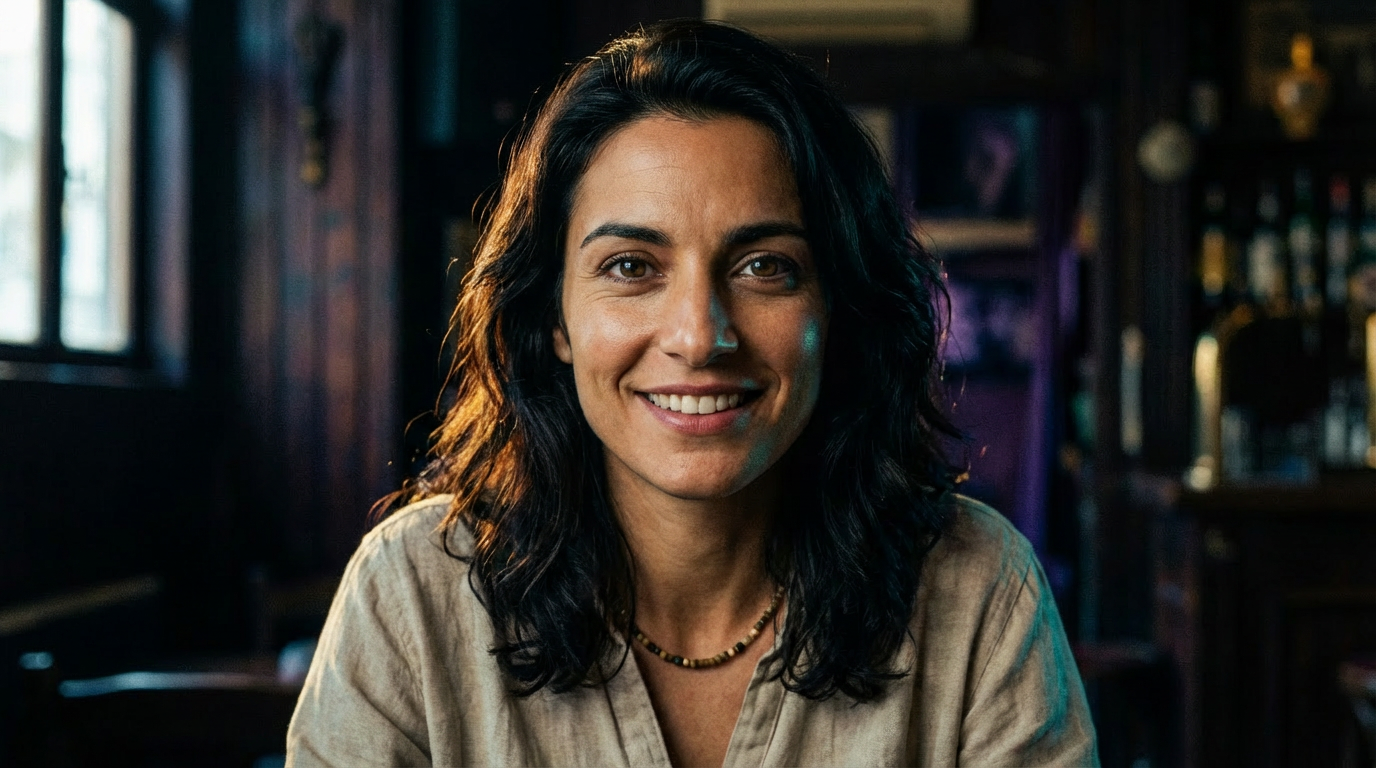
The First Stage
Sophia Elaine Pafistis was born on 14 May 1972 at St Vincent's Hospital in Fitzroy, the first child of Konstantinos "Kostas" Pafistis and Helen Margaret Pafistis (née Nicolson). She was the first grandchild for both families — the Nicolsons' Scottish-Australian lineage and the Pafistis Greek heritage converging in an infant who would grow to embody both traditions' strengths whilst charting a path neither family could have predicted.
The Brunswick East weatherboard where Sophia spent her childhood was modest but culturally rich. Helen, a Year 3 teacher at Princes Hill Primary School, filled the home with children's literature and storytelling — Banjo Paterson, Ursula Le Guin, May Gibbs, Lloyd Alexander. Kostas, a semi-professional poker player whose analytical precision earned steady income across Melbourne's inner-north card rooms, brought a different kind of discipline. The household was part literary salon, part mathematical laboratory, entirely working-class Melbourne — and it became the stage where Sophia's personality announced itself.
She was loud from the beginning. Extroverted, demonstrative, socially confident in ways that contrasted sharply with her father's controlled silence. Kostas did not always know how to respond to a daughter whose emotional expressiveness felt foreign to his temperament, but the distance between them had an unexpected benefit: Sophia never experienced the inhibiting weight of paternal expectations. She was simply too different from him for his ambitions to attach to her.
Her relationship with Helen was warmer and more naturally aligned. Mother and daughter shared a love of narrative and drama, of words deployed for effect, of the particular pleasure of commanding an audience's attention. Helen read to Sophia constantly, encouraged imaginative play, and treated creativity as a serious enterprise rather than a childish phase. The bond between them was the strongest in the household, and it lasted.
Adrian arrived in October 1975, when Sophia was three and a half. She resented the displacement briefly, then adapted — assuming the role of older sister with the same confidence she brought to everything else, alternately protective and bossy, deeply invested in a brother she would later describe as her first audience. Marcus followed in 1979, by which point Sophia was old enough to be genuinely helpful, functioning as an auxiliary parent when Helen's teaching career and domestic responsibilities stretched her capacity.
Scales and Spotlights
Sophia's introduction to music came through Helen's eclectic record collection — classical works, Australian folk, contemporary pop, whatever caught her attention at the local library's music section. But active musical education began in 1978, when Helen enrolled her in group piano lessons at the Brunswick Music School, a community programme offering affordable instruction to working-class families.
Her piano teacher, Mrs Adriana Kostov, a Bulgarian immigrant who taught from her home in Coburg, recognised early that Sophia possessed an unusual combination of technical aptitude and performative confidence. Many children could learn to play competently with sufficient practice. Fewer had Sophia's natural sense of musical phrasing, her instinct for dynamics, her obvious pleasure in performing — the desire to share music rather than merely execute it.
By age eight, she was studying both piano and violin, the latter added at Mrs Kostov's suggestion that a string instrument would develop different musical skills and provide ensemble opportunities. The violin proved more technically demanding — no fixed pitches, the physical challenge of proper bowing technique, a requirement for patience Sophia did not naturally possess. She persisted, partly from genuine interest and partly from competitive determination not to admit difficulty.
Her practice habits reflected her personality: intense but irregular, characterised by passionate immersion alternating with complete neglect. She practised obsessively before recitals, then abandoned her instruments for weeks afterwards. This frustrated teachers who saw unrealised potential, but it also reflected genuine artistic temperament — Sophia engaged deeply when emotionally connected and was incapable of mechanical repetition for its own sake.
By ten, she had transformed the Brunswick East weatherboard into her personal concert hall, staging elaborate performances for family and occasionally neighbours. These home concerts became family legend — Sophia's theatrical announcements, her insistence on proper audience behaviour, her recruitment of Adrian as reluctant stagehand responsible for turning pages and adjusting music stands. The performances were her earliest discovery of what would become her life's central preoccupation: the power of music to create a space where something important happened between performer and listener.
The Conservatorium Door
Sophia attended Princes Hill Primary School from 1978 to 1984, the same institution where Helen taught, though mother ensured daughter was never placed in her classroom. She was popular, socially confident, academically capable without being exceptional — excelling in subjects that allowed creative expression whilst performing adequately in mathematics and sciences. Teachers noted her leadership qualities and occasional tendency toward bossiness, traits that would serve her well in some contexts and complicate others.
In 1985, she began at University High School, the selective state school her mother had attended. Her admission rested partly on academic performance but significantly on musical audition — the school maintained a strong music programme including orchestra, choir, and chamber ensembles. The opportunity to participate in serious ensemble performance whilst receiving a solid general education seemed ideal.
Her secondary years were defined by musical intensification and growing awareness of music's professional limitations. She continued private piano and violin lessons, participated in school orchestras and chamber groups, attended weekend workshops and holiday programmes for young musicians. She competed in eisteddfods where her performances earned commendations if rarely first prizes. She was competent and committed — good enough to contemplate a music career, not so exceptional that success seemed inevitable.
The realities of professional music careers became increasingly clear through older students and teachers. Classical music offered limited employment, mostly teaching rather than performing. Competition for orchestral positions was fierce. Financial rewards were modest. Success required not just talent but extraordinary discipline, political savvy within music institutions, and willingness to subordinate personal life to career demands. Sophia absorbed these realities without being defeated by them, understanding that whatever her future held, it would require both passion and pragmatism.
She completed her VCE in 1990 with strong arts marks and adequate sciences. She auditioned for the Bachelor of Music programme at the Melbourne Conservatorium. She was not accepted.
The rejection stung, though she would later describe it as the most important failure of her life. It closed the door she had been walking toward for a decade and forced her to stand still long enough to notice other doors she might not otherwise have seen.
She enrolled instead in a Bachelor of Arts at the University of Melbourne, majoring in music whilst keeping options open through general humanities subjects. Her university years, from 1991 to 1994, represented intellectual expansion beyond purely musical focus. She studied music history, theory, and composition alongside psychology, literature, and cultural studies. She continued performing through university ensembles and community orchestras, explored jazz and world music and experimental composition — styles that broadened her vocabulary and challenged the classical training that had defined her understanding of what music could do.
The turning point came through an elective psychology course examining therapeutic applications of the arts. Music therapy — the concept of using musical skills in genuine service to others, working directly with individuals rather than performing for audiences, facilitating healing rather than entertainment — resonated with an immediacy that surprised her. The field was relatively new in Australia during the early 1990s, still establishing professional standards and training pathways, offering opportunities for pioneers willing to navigate uncertainty.
She completed her BA in November 1994 with honours in music and spent 1995 working — saving tuition money whilst researching postgraduate music therapy programmes. Options in Australia were limited, but after extensive inquiry she chose the Graduate Diploma in Music Therapy at the University of Queensland, beginning in 1996.
Ward Rounds and Lullabies
The year at the University of Queensland was intensive both academically and emotionally. The programme combined theoretical coursework in psychology, child development, and therapeutic techniques with extensive clinical placements in hospitals, special schools, aged care facilities, and mental health centres. Sophia worked with children with developmental disabilities, elderly patients with dementia, adolescents with mental health issues, adults recovering from trauma — populations for whom music provided a means of communication and expression when verbal methods failed.
The work was demanding and occasionally heartbreaking. Not all interventions succeeded. Some clients made little progress. Funding constraints meant sessions were often too brief to achieve meaningful outcomes. Institutional resistance to arts therapies required constant justification of her work's value to administrators who preferred quantifiable medical interventions over harder-to-measure improvements in quality of life.
Yet the satisfactions were profound. A non-verbal child communicating through rhythm. A dementia patient's face lighting with recognition during a familiar melody. A trauma survivor expressing emotions they could not verbalise. These moments validated her career choice in ways that applause after a recital never had. She was no longer performing. She was listening — and discovering that listening was the harder, more important skill.
She completed her diploma in December 1996 with strong clinical evaluations and returned to Melbourne. Her first professional position was at the Royal Children's Hospital, from 1997 to 1999, providing music therapy to paediatric patients — children with cancer, chronic illnesses, developmental disabilities, those recovering from accidents or surgeries. The work used music to reduce anxiety, manage pain, facilitate developmental goals, and provide moments of normalcy in frightening medical environments.
Alongside the hospital role, she maintained a small private practice, seeing individual clients referred by psychologists and paediatricians. This work supplemented her hospital income whilst allowing more autonomous practice and longer-term therapeutic relationships than the hospital's brief encounters permitted. The two roles together gave her a comprehensive early career — institutional credibility and private flexibility, breadth of experience and depth of relationship.
The Hinterland
By the early 2000s, Sophia was experiencing both professional success and growing restlessness. Her music therapy work was valued and meaningful, but institutional constraints frustrated her. Hospital bureaucracy limited therapeutic flexibility. Insurance requirements prioritised brief interventions over sustained relationships. The relentless pace of urban clinical work left little room for the reflective, holistic approach she increasingly felt the work demanded.
She had also begun exploring interests that sat outside the frameworks of her training. She attended meditation workshops, studied yoga, investigated Eastern philosophical traditions that resonated more deeply than her nominal Anglican upbringing. These weren't rejections of her parents' values but natural extensions of an artistic temperament inclined toward experiential exploration — the same impulse that had once driven her to perform now drew her toward practices that required quieter, more inward forms of attention.
In 2002, at thirty, Sophia made the significant decision to relocate to Byron Bay — the northern New South Wales coastal town known for its alternative lifestyle communities, health and wellness culture, and artistic population. The choice worried Helen, who saw financial instability and distance from family. Kostas said little, which was how Kostas responded to most things he did not understand. But Sophia was certain. Byron Bay offered a community aligned with her evolving values and a market for music therapy among health-conscious populations who did not need convincing that the arts could heal.
Her early Byron Bay years were financially precarious but personally fulfilling. She established a private practice serving families with special needs children, adults seeking alternative therapeutic approaches, and aged care facilities needing creative interventions for residents whose conditions did not respond to conventional treatment. She supplemented her therapy income through private music lessons, occasional performances at local venues, and part-time work at a health food cooperative. The income was modest. The autonomy was worth it.
She also immersed herself in Byron Bay's alternative health community — training in sound healing, studying various meditation traditions, learning about indigenous Australian healing practices, exploring how different cultures understood music's therapeutic potential. These studies expanded her practice beyond Western music therapy's clinical models, incorporating spiritual dimensions and holistic wellness approaches that her university training had not addressed. Some of her Melbourne colleagues viewed this eclecticism with scepticism. Sophia viewed their scepticism as a failure of imagination.
Through the mid-to-late 2000s, she gradually built a sustainable practice. She became known within Byron Bay's health community for her work with children with autism and developmental disabilities, developing particular expertise in using improvised music to facilitate communication and emotional regulation. She also worked increasingly with adults experiencing trauma, anxiety, and depression — conditions where music therapy provided non-verbal means of processing emotions that words could not reach.
Her integrative approach — blending classical music therapy techniques with sound healing, mindfulness, and indigenous concepts of connection — reflected both her eclectic training and Byron Bay's openness to therapeutic pluralism. It also reflected something deeper about who Sophia had become: someone who believed that healing happened not through adherence to a single method but through the quality of attention brought to the encounter between therapist and client.
Listening as Vocation
Sophia's personal life followed patterns that mirrored her professional choices — unconventional, emotionally rich, resistant to the structures that most people used to organise their domestic existence. She had several significant relationships during her Byron Bay years: with a yoga instructor, an environmental activist, an alternative medicine practitioner. Each lasted two to four years before ending amicably, through mutual recognition that compatibility did not equal permanence, that two people could care for each other deeply and still want different futures.
She never married. She never had children. These were partly circumstances and partly choices, and the distinction between the two grew less important to her as she aged. Her work provided the sustained intimacy that some people sought through family — the long therapeutic relationships, the trust built over months and years, the privilege of witnessing someone's most vulnerable moments and helping them find their way through. It was not the same as motherhood. She did not pretend it was. But it was enough, and she had stopped apologising for the fact that enough was enough.
She also became involved in training the next generation of music therapists, supervising practicum students from Australian programmes, presenting workshops on integrative approaches, contributing to professional development seminars. This teaching work provided supplementary income and allowed her to influence the field's development, advocating for more holistic and culturally informed practice. She was good at teaching — the theatrical confidence of her childhood had found its mature expression in the ability to hold a room, explain complex ideas accessibly, and inspire students whose idealism reminded her of her own at twenty-four.
Adrian's disappearance in July 2018 was a rupture she had not anticipated. Her brother — the quiet one who had been her childhood stagehand, who shared her artistic sensibilities even as he expressed them through construction rather than music — had vanished without explanation. Sophia returned to Melbourne more frequently in the months and years that followed, spending time with Helen and Kostas, whose grief compounded their ageing. She became the family's emotional translator, the one who could articulate feelings that her father would not speak and her mother could not quite name.
The grief, whilst real, did not consume her. She channelled it into her trauma work, bringing to her practice a deeper understanding of what it meant to live with loss that offered no closure. She understood, from her own experience now rather than merely her training, that healing did not mean resolution. It meant learning to carry what could not be put down.
She also began travelling to Melbourne more regularly — every six to eight weeks rather than three or four times a year — to spend time with Helen and Kostas, whose ageing had accelerated in ways that Adrian's absence seemed to compound. The visits followed a quiet rhythm: morning tea with Helen in the kitchen, an hour sitting with Kostas in the lounge room where he said little but seemed to appreciate her presence, walks through the Brunswick East streets she had known since childhood and barely recognised now. She spoke to Marcus by phone more often too, checking on him in the way of an older sister who had once been bossy enough to assign him roles in her concerts and was now simply grateful he lived close enough to their parents to notice when something was wrong.
The pandemic that arrived in early 2020 disrupted her practice in ways she had not foreseen. Victoria's extended lockdowns made Melbourne visits impossible for months. Her Byron Bay clients, many of whom relied on the physical presence of shared music-making, could not be seen in person. She adapted — conducting sessions through video calls, mailing instruments and percussion kits to families whose children needed continuity, experimenting with remote sound-based exercises that felt inadequate but were better than silence. The work was harder through a screen. Music therapy depended on the shared vibration of sound in a room, the subtle physical responses she read in a client's posture and breathing, the intimacy of proximity. None of that translated well to a laptop microphone.
Yet the pandemic also clarified something she had sensed but not articulated. The clients who coped best were not those with the most resources or the fewest problems. They were those who had already developed some tolerance for uncertainty — who understood, through prior experience or temperament, that control was largely illusion and that the task was to find steadiness within instability. This observation reshaped her practice when in-person sessions resumed. She began incorporating more improvisation, more open-ended musical exploration where the outcome was unknown, trusting that the therapeutic value lay in the process of navigating uncertainty together rather than in arriving at a predetermined resolution.
By the early 2020s, Sophia had been practising in the Byron Bay region for two decades. She was no longer the Melbourne newcomer finding her footing in an unfamiliar community. She was an established figure — not famous, not widely known beyond the health and wellness networks of the Northern Rivers, but deeply trusted by the families and individuals who had worked with her over years and sometimes decades. Some of her earliest Byron Bay clients still saw her. Children she had treated for developmental challenges in the mid-2000s had grown into young adults who occasionally returned for sessions during difficult transitions.
Her cottage in the hinterland had become an extension of her practice in ways she had not planned. The front room, originally a sitting room, had been converted into a therapy space — instruments arranged along the walls, cushions on the floor, a keyboard in the corner, the windows open to birdsong that became part of the session's soundscape. Clients arrived along a dirt track through subtropical bush, and the walk from car to front door became its own form of preparation, a transition from the noise of daily life into the quieter space where therapeutic work could happen.
She maintained a vegetable garden with the same attentiveness she brought to her clients — patient, responsive to conditions rather than imposing expectations, willing to accept that not everything grew where you planted it. She practised yoga daily, meditated in the mornings before her first session, read widely in fields adjacent to her own — neuroscience, philosophy, indigenous knowledge systems, the growing literature on trauma-informed care that confirmed much of what her clinical experience had already taught her.
Her relationship with music had changed. She still played piano occasionally, alone in the therapy room after the last client left, but she no longer performed for anyone. The instrument had become private — a conversation with herself rather than a broadcast to others. She played fragments of pieces she had learned as a child under Mrs Kostov's instruction, Chopin nocturnes and Bach preludes whose familiar patterns served as a kind of meditation, a return to the place where music had first mattered to her before it became a career, a vocation, a means of service.
By fifty-three, Sophia Elaine Pafistis had built a life in the Byron Bay hinterland that would have been unrecognisable to the ten-year-old staging concerts in a Brunswick East weatherboard. She had not become a concert pianist. She had not joined an orchestra. She had not done any of the things her childhood had seemed to promise. What she had done was discover that the gift she possessed — the ability to create a space where something important happened between two people through music — was worth more when directed toward a single person in pain than toward an audience of hundreds. The performer had become a listener. It was, she understood, the more difficult instrument to master.







