Solomon Thomas Lahey
Solomon Thomas Lahey emerged as the quiet architect of distances—both literal and metaphorical—a man whose life unfolded in the spaces between Tasmania's intimate shores and Melbourne's sprawling possibilities. Born into the heart of the Lahey family in 1953, he embodied a particular kind of Australian masculinity: competent without boasting, successful without fanfare, present yet somehow always slightly apart. His story reveals how middle children often become the family's most astute observers, carrying truths others miss whilst constructing careful boundaries around their own inner worlds.
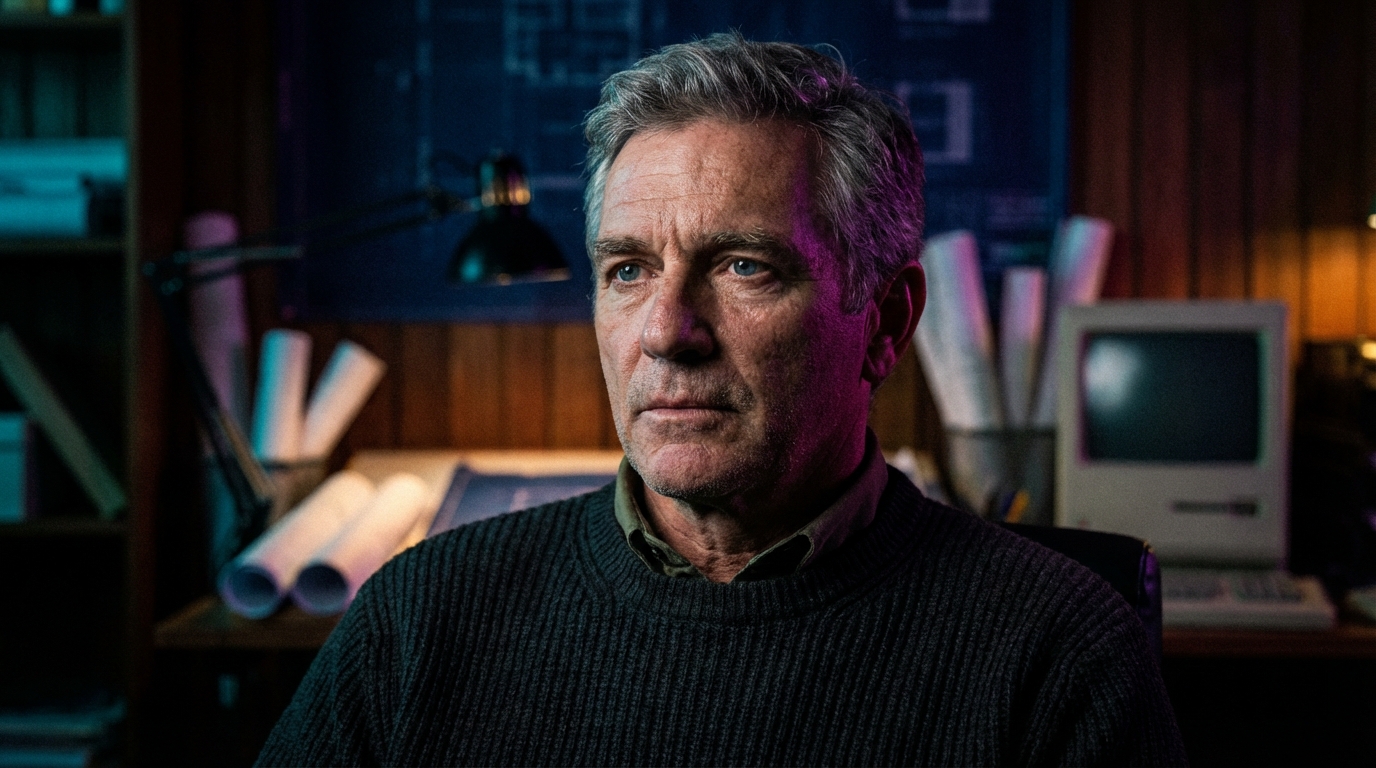
Early Years in Post-War Tasmania (1953-1963)
Solomon arrived on 15th April 1953 at the Royal Hobart Hospital, the third child in what would become a quartet. His birth coincided with Tasmania's post-war building boom, an accident of timing that would later seem prophetic. Patrick, his father, had recently returned from his brief stint working in Sydney, having secured a position as marine engineer at the Hobart docks, whilst his mother Jane managed their Sandy Bay household with the particular efficiency of a woman juggling multiple young children. Nicholas was nearly six, already showing the scholarly bent that would define him, whilst Fiona at four possessed an energy that made the new baby seem remarkably placid by comparison.
The household dynamics at 4 Bective Street shaped Solomon profoundly. Neither the pioneering eldest nor the cherished baby (that role would go to Pip, born four years later), he occupied the liminal space of the overlooked middle. His mother's diary, discovered decades later, contains surprisingly few entries about Solomon's early years—not from neglect but because he rarely demanded attention. "Sol goes about his business," she wrote when he was seven, "building his structures in the back garden, requiring nothing but timber scraps and time."
His early childhood at Sandy Bay unfolded against the suburb's particular mixture of suburban respectability and proximity to wildness. The family's cottage sat close enough to Mount Wellington's slopes that even as a young child, Solomon could disappear into the backyard for entire afternoons, returning with pockets full of stones arranged by size and colour. These solitary activities in the small Sandy Bay garden worried Jane initially, but Patrick recognised something of himself in his son's need for quiet focus. "Let the boy be," he'd tell his wife. "He's learning things we can't teach."
School at Sandy Bay Primary, beginning in 1958, presented challenges. Solomon's teachers noted his intelligence but struggled with what they termed his "selective engagement." He excelled in mathematics and any task involving spatial reasoning whilst barely scraping through English and history. His Grade 2 report card described him as "capable but withholding"—a phrase that would echo throughout his academic career. What the teachers missed was Solomon's particular form of attention: whilst appearing disconnected, he absorbed everything, filing observations away with architectural precision.
The family's involvement with the Jeffries circle during these Sandy Bay years touched Solomon differently than his siblings. During the elaborate Sunday lunches at Jeffries Manor, whilst Nicholas engaged James in intellectual debates and Fiona charmed Thelma with her enthusiasm, Solomon studied the building itself. He'd later tell his therapist he spent those afternoons memorising the manor's layout, understanding how spaces connected, where the old construction met new additions. "Buildings tell stories," he'd explain, "if you know how to read the joints."
Patrick's brief absence for the Hamburg contract in 1961-1962 occurred during Solomon's eighth and ninth years, a period when most children would have felt their father's absence acutely. Yet Solomon seemed barely to register the change, his self-contained nature requiring little external validation. Jane's letters to Patrick during this period mentioned Solomon only occasionally—"Sol continues building his models, barely notices your absence, which I suppose is both relief and concern." When Patrick and Jane returned from Germany in mid-1962, carrying secrets Solomon would never know, the seven-year-old simply showed his father the elaborate model of their Sandy Bay cottage he'd constructed during the absence, every detail precisely rendered.
The New Norfolk Transition (1963-1965)
The family's relocation to New Norfolk in February 1963 represented significant disruption for ten-year-old Solomon, who had constructed his entire world around the familiar geography of Sandy Bay. The move to 19 Hobart Road, whilst providing substantially more space, meant leaving the backyard workshop area he'd established, the routes to Mount Wellington he'd memorised, the spatial understanding of Sandy Bay that had become his internal map.
Yet the new house at 19 Hobart Road offered unexpected compensations. The integral garage provided proper workshop space far superior to Sandy Bay's separate shed, with Patrick establishing a workbench and tool storage that Solomon could access freely. The larger property meant more room for outdoor projects, and the proximity to New Norfolk's surrounding bushland provided new landscapes to study and map. Solomon approached the relocation as he approached everything—systematically documenting the new environment, creating detailed drawings of the house's floor plan, measuring room dimensions with obsessive precision.
The transition from Sandy Bay Primary to New Norfolk Primary School for his final two years of primary education proved more challenging than the physical relocation. At Sandy Bay, teachers had known Solomon for five years, had accommodated his peculiarities, had learned not to expect verbal participation whilst recognising his written work's excellence. At New Norfolk, he was the new boy, the quiet one, the strange child who drew floor plans during lunch rather than playing with classmates.
Solomon made no friends during these two years at New Norfolk Primary. He didn't seek them, didn't miss them, found in solitary observation sufficient occupation. His teachers, less patient than Sandy Bay's staff had been, marked him as difficult, as underachieving despite test results that demonstrated clear capability. His Year 6 report noted with frustration: "Solomon possesses obvious intelligence but refuses to apply himself to subjects that don't interest him. His attitude suggests he believes himself above the curriculum."
The accuracy wasn't wrong, precisely. Solomon had discovered that most of what school offered was irrelevant to his actual interests. He wanted to understand how buildings stood up, how spaces connected, how materials behaved under stress. Reading comprehension exercises about fictional children's adventures felt like torture when he could be studying the structural principles of the New Norfolk bridge or mapping the precise angles of the house's roof pitch.
Adolescence and the Workshop Sanctuary (1965-1971)
The transition to New Norfolk District High School in 1965 brought unexpected relief. The high school's technical drawing programme, taught by Mr. Douglas Chen (a Chinese-Australian engineer who'd settled in New Norfolk after the war), recognised Solomon's gifts immediately. Within weeks, Solomon had been moved to work independently, producing drawings that exceeded Year 12 standards whilst still in Year 7. Mr. Chen became Solomon's first genuine mentor, teaching him drafting conventions and architectural principles whilst respecting his need for minimal verbal interaction.
Adolescence brought what family members would later characterise as Solomon's "submarine period"—present but increasingly submerged, visible only when surfacing for necessary interaction. At thirteen, he simply stopped participating in family activities he deemed performative. He refused to attend church services at St Matthew's, wouldn't join the family's traditional Sunday visits to relatives, began spending entire weekends in the garage workshop at 19 Hobart Road, emerging only for meals and sleep.
Patrick, recognising something familiar in his son's quiet resistance, became his unexpected ally. Rather than forcing participation, Patrick began teaching Solomon practical skills in the workshop—how to use a wood plane properly, how to read timber grain, how to create joints that would hold for generations. These sessions were conducted largely in silence, both men finding in parallel work a form of communication that words couldn't achieve. Jane watched this development with mixture of relief that Patrick was connecting with Solomon and concern that neither seemed to find verbal intimacy necessary.
The workshop at 19 Hobart Road revealed Solomon's extraordinary gift. What began as simple carpentry evolved into sophisticated model-making. By sixteen, he'd constructed a perfect scale replica of their New Norfolk house, complete with functioning windows, accurately rendered interior details, and historically precise measurements. Jane discovered it by accident, hidden beneath a tarpaulin, and was struck by its uncanny precision—every room exactly rendered, including the secret compartment in the desk where she kept her private diary. It was beautiful and somehow unsettling, this evidence of how closely her quiet son observed their lives.
His teenage years at New Norfolk High School saw Solomon excel in technical subjects whilst barely maintaining passing grades in everything else. Mathematics and technical drawing were his domains; English literature and history were obstacles to be cleared with minimum effort. His teachers divided into camps—those who recognised his particular intelligence and accommodated it, and those who found his selective engagement insulting and marked him accordingly.
The final years at New Norfolk High School, from 1968 to 1970, saw Solomon form his first real friendship with Marcus Kostopolis, another outsider who shared his fascination with how things fitted together. Marcus's family had immigrated from Greece in 1956, his father establishing a successful building business in New Norfolk, his mother never quite mastering English. The boys communicated primarily through shared projects—building a tree house in Marcus's backyard, designing an elaborate model railway system, creating architectural drawings of impossible structures. Their friendship, conducted largely in comfortable silence, provided Solomon with a template for future relationships—parallel play rather than direct engagement.
His final major project at New Norfolk High, completed in 1970, was a detailed architectural rendering of the entire Boyer Mill complex, created from observation and measurement conducted during lunch breaks and after school. The drawings, technically perfect and spatially sophisticated, earned him the school's technical excellence prize and attention from Boyer Mill's engineering department, who offered him an apprenticeship he would decline in favour of university study in Melbourne.
University Years and the Melbourne Shift (1972-1976)
The decision to study architecture at the University of Melbourne represented Solomon's first major break from family and from Tasmania. Nicholas had remained at the University of Tasmania, Fiona was completing her environmental science degree locally, but Solomon needed distance that he couldn't fully articulate. The application process revealed his determination—he'd saved money from weekend construction work in New Norfolk for two years, knowing his parents couldn't afford interstate university fees whilst still supporting Pip at home.
Leaving Tasmania in February 1972 felt like emergence from a chrysalis. The overnight ferry to Melbourne became Solomon's crossing into adulthood, watching Tasmania recede whilst something unnamed but essential shifted within him. Standing on deck as the island disappeared, the nineteen-year-old Solomon experienced his first genuine emotion in years—not happiness exactly, but relief so profound it felt like physical lightening. He'd later describe this moment to his therapist as "when I stopped being my family's son and started being myself"—though it would take decades to understand what that meant.
The departure from 19 Hobart Road had been characteristically muted. Patrick had driven Solomon to the ferry terminal in the Ford Prefect, the two men conducting the journey in near-silence broken only by Patrick's practical reminders about managing money and maintaining contact. Jane had hugged her middle son with fierce intensity that embarrassed them both, whispering that she loved him though Solomon couldn't recall ever hearing her say it before. Fifteen-year-old Pip had cried, surprising Solomon with the recognition that someone would miss his presence, though he couldn't understand why given how little he'd contributed to family life beyond occasional mechanical assistance.
Melbourne in the early 1970s pulsed with architectural ambition. The city's skyline transformed daily, modernist towers rising whilst Victorian terraces fell. Solomon found rooms in a Carlton boarding house populated by international students and artists, an environment that simultaneously overwhelmed and liberated him. For the first time, his quietness read as mysterious rather than strange, his careful observations interpreted as artistic temperament rather than social deficit.
University revealed both his talents and limitations. Solomon excelled in structural engineering, spatial planning, and technical drawing—his work in these areas was immediately recognised as exceptional, with professors suggesting he was the most naturally gifted spatial thinker the programme had seen in years. But he struggled profoundly with the performative aspects of architecture—the presentations where he was expected to articulate his vision, the networking events where professional relationships were supposedly forged, the studio critiques where emotional investment in one's work was expected alongside technical excellence.
His first-year residential design project—a modest single-family dwelling—earned technically perfect marks but devastating critique from Professor Anderson: "Where's the humanity? Your house is a machine for living, but who would want to live in this machine?" Solomon stared at the comment for hours, genuinely puzzled. The humanity was in the precision, wasn't it? In creating spaces that functioned perfectly, that anticipated needs without requiring explanation, that sheltered without demanding gratitude?
A pivotal moment came during third year when Solomon discovered Finnish architect Alvar Aalto's work. Here was an architect who understood that buildings could be both rational and humane, that functionality itself could be a form of care, that precision and warmth weren't contradictory. Solomon's work transformed, maintaining its technical excellence whilst developing what one professor called "a quality of sheltering." His structures began to feel protective rather than merely efficient.
His final year project—a community housing development designed specifically for Hobart's working families—won the Dean's Prize for its sophisticated understanding of how space shapes daily life. The design included features that reflected his New Norfolk childhood: workshop spaces accessible from individual units, shared gardens that encouraged community whilst respecting privacy, children's play areas visible from kitchen windows, the whole complex oriented to maximise natural light in Tasmania's often grey climate. The judges recognised something exceptional—an architect who understood working-class life not theoretically but through lived experience.
Solomon didn't attend the prize ceremony, claiming urgent family business that didn't exist. The truth, which he'd never admit, was that standing before an audience whilst they discussed his work felt like exposure beyond bearing. He asked his friend Marcus (who'd moved to Melbourne for engineering studies) to collect the award on his behalf, the trophy eventually arriving via mail to his Carlton boarding house where it sat unopened in a corner for six months.
Early Career and Family Fractures (1977-1985)
Graduating with honours but without fanfare (he skipped the ceremony, sending Jane a telegram saying "Degree achieved, home for Christmas"), Solomon joined the Melbourne firm Thornton & Associates in January 1977. The firm specialised in institutional buildings—hospitals, schools, government offices—work that suited Solomon's temperament perfectly. These were buildings where function trumped ego, where success meant invisibility, where the architect's personality was irrelevant compared to the structure's utility.
His early projects revealed a particular gift for what colleagues called "institutional empathy"—understanding how people moved through bureaucratic spaces, how to make necessary buildings feel less oppressive, how to design for dignity in environments where dignity was often stripped by purpose. His redesign of a Footscray public housing office included unexpected touches: windows positioned to catch afternoon light, waiting areas that allowed privacy whilst maintaining sightlines, children's corners that felt separate but supervised. The client never noticed these features specifically, only that complaints dropped sixty percent after the renovation.
The distance from Tasmania and from 19 Hobart Road served Solomon well during this period, though it came with costs he didn't fully recognise. He missed Pip's wedding in November 1979, claiming a critical project deadline that was actually flexible. The truth, which he'd never admit, was that watching his baby sister marry triggered something unbearable—not jealousy exactly, but a recognition of his own inability to form such connections, a reminder that while he could design spaces for human intimacy, he couldn't inhabit them himself.
His monthly phone calls to New Norfolk followed a rigid script: work progress, Melbourne weather, careful inquiries about Patrick's health and Jane's activities. Jane sensed the distance but respected it, understanding intuitively that Solomon needed to construct his own life away from their gaze. Patrick was less accepting, hurt by what felt like rejection, though he'd never voice it directly. Their conversations became increasingly focused on technical matters—Patrick describing workshop projects, Solomon offering structural advice—the emotional content carefully contained within practical discussion.
The Hidden Years (1990-1998)
The 1990s marked Solomon's retreat into what family members would later call his "submarine period"—present but submerged, visible only when surfacing for air. At thirty-seven, he left Thornton & Associates to establish a solo practice, claiming he needed creative freedom but really seeking isolation. His office, a converted warehouse in Collingwood, became both workspace and refuge, containing a hidden bedroom where he often slept rather than returning to his apartment.
The work during this period grew increasingly abstract. Whilst maintaining enough commercial projects to survive financially, Solomon began designing impossible buildings—structures that defied physics or required non-existent materials. These designs, discovered after his mother's death in 2018, revealed an unexpected imaginative dimension. One series depicted buildings that grew like organisms, another showed structures that existed partially in different dimensions. They were technically perfect and completely unbuildable.
Few knew about Solomon's twice-weekly appointments with Dr. Rachel Badenoch, a psychiatrist specialising in what she carefully termed "high-functioning isolation." Their sessions, beginning in 1991, revealed Solomon's awareness of his limitations. "I understand buildings," he told her. "They have rules. People don't follow rules. They leak emotions everywhere, contaminating spaces with their needs." Dr. Brennan's notes described him as "architecturally constructing his own autism"—not clinically autistic but choosing similar patterns as protective mechanism.
The family noticed his increasing distance. Nicholas, attempting to maintain connection, would visit Melbourne annually, meetings Solomon endured rather than enjoyed. Fiona's letters went largely unanswered, though she later discovered he kept every one, filed chronologically in architects' flat files. When Pip had her children—Sarah in 1989, Oscar in 1992—Solomon sent expensive gifts but never visited, claiming work commitments that didn't exist.
His romantic life during this period consisted of brief encounters with women who mistook his silence for depth. A pattern emerged: intense initial attraction to his mystery, gradual frustration with his emotional absence, inevitable departure with accusations of his inability to love. Solomon accepted these endings with what appeared to be indifference but was actually relief. Each departure restored his carefully maintained equilibrium.
The only consistent relationship was with the buildings. Solomon developed a habit of revisiting his projects years later, not officially but as an anonymous observer. He'd sit in the schools he'd designed, watching children navigate spaces he'd created, finding in their unconscious use of his architecture a connection he couldn't achieve directly. Security guards at several buildings knew him as the quiet man who'd appear monthly, sitting in lobbies or corridors, never causing problems, never explaining his presence.
In 1996, something shifted. Solomon began a project he told no one about—designing a family compound that could accommodate the entire Lahey clan. The plans, obsessively detailed, included private spaces for each family member based on his observations of their needs. Jane's section had gardens transitioning seamlessly between interior and exterior. Patrick's contained a workshop with perfect acoustics. Each space reflected deep understanding of its intended occupant. He never showed anyone these plans, later claiming they were "just exercises."
Tragedy and Transformation (1998-2013)
The phone call came at 11:47 PM on 21st October 1998. Solomon hadn't spoken to his mother in three months, so her voice at that hour meant catastrophe. "Pip and Greg," Jane managed before breaking down. "Switzerland. Helicopter." The words didn't require elaboration. His baby sister, the family's free spirit, was gone at forty-one, leaving two children behind.
Solomon's response revealed depths his family didn't know existed. He flew to Hobart immediately, handled logistics with unexpected competence, and became the family's anchor during those devastating weeks. At the funeral, he delivered a eulogy that stunned everyone—articulate, moving, revealing memories none knew he'd treasured. "Pip understood joy," he said, "in a way the rest of us only observed. She didn't build walls. She was the window."
The aftermath saw Solomon attempt connection with Sarah and Oscar, though his efforts were awkward. He created detailed architectural drawings of treehouses, sending them to the children with notes about structural integrity that nine-year-old Sarah couldn't understand. He established education trusts with characteristic efficiency but couldn't manage physical presence. His visits to Hobart increased but remained brief, carefully timed to avoid extended interaction.
His parents aged rapidly after Pip's death. Patrick, particularly, seemed to fracture, and Solomon watched his father's decline with familiar helplessness. During one visit, Patrick asked directly: "Why don't you come home?" Solomon couldn't explain that home was a concept he'd never understood, that every space felt temporary, that his architecture was an attempt to create permanence he couldn't feel.
The 2000s brought unexpected professional recognition. A retrospective of Solomon's school designs toured Australian architectural institutions, praised for their "humane minimalism." He attended none of the exhibitions but was reportedly seen at several, standing anonymously amongst visitors, listening to their responses. A young architect, recognising him, approached for advice. Solomon's response: "Design for the loneliest person who'll use the space. Everyone else will be fine."
His practice evolved toward aged care facilities, perhaps influenced by watching his parents' decline. These buildings showed new sensitivity—spaces that accommodated dignity whilst acknowledging frailty. His Sunshine Coast facility, completed in 2008, won international awards for its innovative approach to dementia care, using architecture to provide orientation without institutional markers. He never mentioned that every room was designed imagining his mother as resident.
Patrick's death in February 2013 hit unexpectedly hard. Solomon had believed himself prepared, had even designed (privately) his father's ideal workshop in heaven—absurd for an atheist, but grief makes philosophers of us all. At the funeral, he stood apart from the family group, watching his mother manage everyone else's sorrow whilst carrying her own. He wanted to comfort her but didn't know how to bridge sixty years of careful distance.
The Final Years (2013-2018)
After Patrick's death, Solomon's contact with family paradoxically increased whilst becoming more abstract. He sent Jane weekly emails consisting entirely of Melbourne weather reports and architectural photographs. She understood these missives as love letters, responding with equally oblique updates about her garden. This coded correspondence continued until her final hospitalisation.
His work took an unexpected turn toward restoration rather than creation. Solomon began taking projects rebuilding fire-damaged homes, flood-affected schools, structures broken by disaster. Colleagues noticed a new tenderness in his approach, though he dismissed any suggestion of emotional investment. "Buildings deserve second chances," he'd say, not acknowledging the obvious projection.
In 2015, Solomon met Diane Kostopolis (Marcus's younger sister, coincidentally) at an architectural conference he'd been forced to attend. Recently divorced, she appreciated his silence after years of her ex-husband's constant commentary. Their relationship, if it could be called that, consisted mainly of parallel existence—working in the same space, eating meals together, occasionally sharing a bed. Diane understood Solomon's limitations, finding in his consistency a form of reliability her marriage had lacked.
When Jane entered Vaucluse Nursing Home in June 2017, Solomon's response was characteristically oblique. He sent detailed architectural critiques of the facility, suggestions for improving sight lines, concerns about acoustic privacy. Sarah, managing their grandmother's care, initially found these communications irritating before recognising them as Solomon's expression of concern. His final email about the facility, sent two days before Jane's death, contained a single personal line: "The building doesn't deserve her."
Solomon didn't attend Jane's funeral on 7th August 2018. He was in Melbourne, supposedly managing a critical project deadline. The truth, known only to Diane, was that he'd collapsed upon hearing of his mother's death, experiencing what his doctor termed a "severe dissociative episode." For three days, he couldn't speak, couldn't work, could only sit in his office staring at those never-shared plans for the family compound that would never be built.
Aftermath and Continuation
The deaths of Jane and Sarah in quick succession left Solomon as the family's unexpected survivor, the one who'd maintained distance now holding fragments of a shattered whole. He began visiting Hobart monthly, helping Nicholas sort through estate matters with unexpected dedication. During one visit, he discovered his mother's diaries, reading his sparse mentions with something between relief and regret.
In her papers, he found a letter addressed to him, dated a week before her death but never sent: "My quiet son, you built yourself a fortress thinking we were the enemy. We were only ever trying to love you. Your buildings shelter strangers beautifully. I wish you'd let people shelter you." The letter remained on his drafting table, weighted down by his father's marine compass, neither discarded nor answered.







