4308.263 · September 19, 1988 AD
Small Oaths at the Sink
At the kitchen sink, Violet and Jasmine wash the morning's dishes in the practised choreography of sisters who have shared this task a hundred times before. Between the clink of plates and the squeak of cloth on enamel, small negotiations unfold — a younger sister's careful bid to join an older sister's wilder world, and a confession about a young man who speaks to the dead. In the next room, Evelyn listens to more than she is meant to hear.
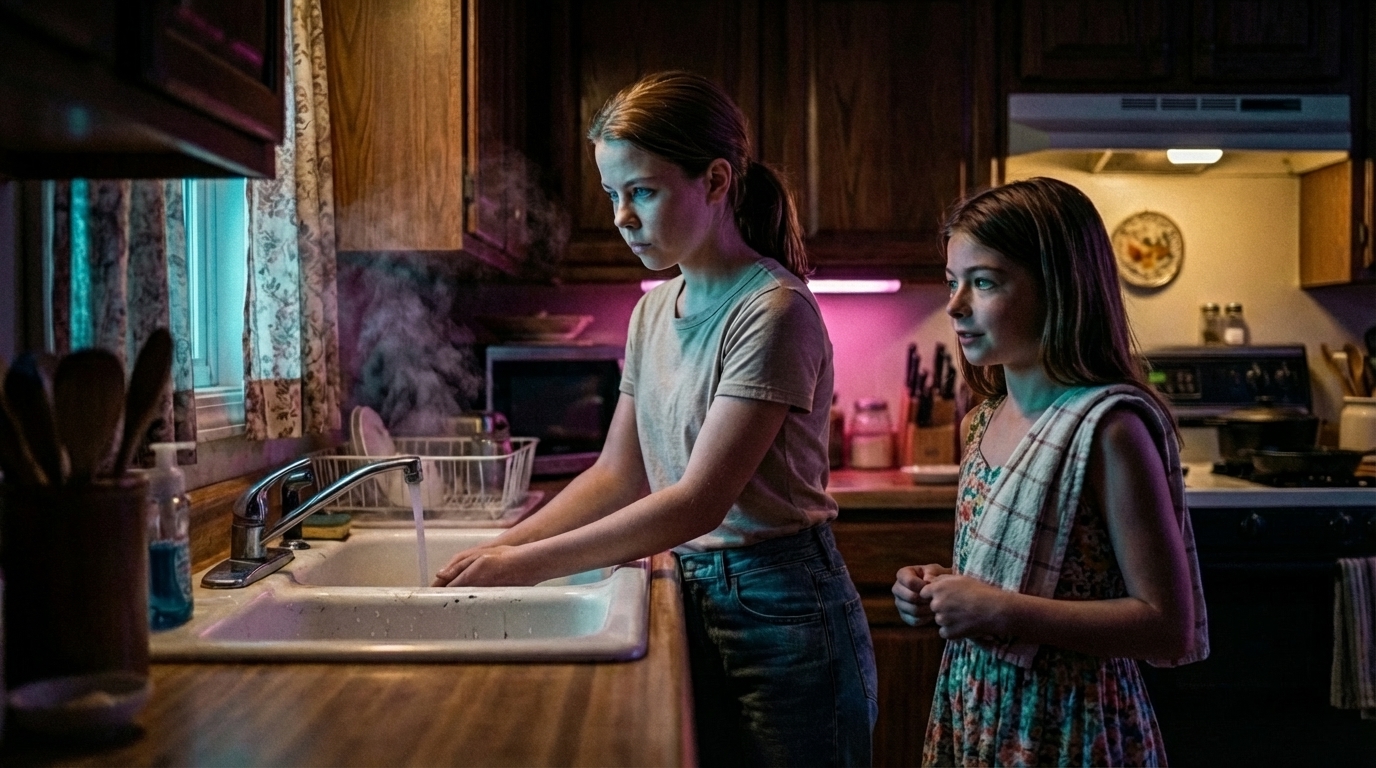
The warm water steamed against the chipped porcelain of the basin, and the scent of lemon soap rose to meet the lingering sweetness of syrup that still clung to the kitchen air. Violet stood at the sink with her sleeves rolled past the elbow, her hands submerged to the wrist, fingers searching for the first plate beneath the suds. Beside her, Jasmine waited with a tea towel draped over her forearm, positioned with the quiet readiness of someone who understood that her role in this particular ritual was to receive, to dry, to restore order to what her sister had cleaned.
They moved without instruction. The choreography of washing up had been established so long ago that neither could have said when it began — only that Violet always washed and Jasmine always dried, that plates came first and cutlery last, that the oilcloth was wiped down before the water was released from the basin. These were not rules anyone had articulated. They were simply the way things were done in the Dallow kitchen, patterns inherited through repetition until they had calcified into something indistinguishable from instinct.
The clink of ceramic against ceramic marked the rhythm. A plate passed from wet hands to dry. The tap dripped its patient metronome into the silence between exchanges. Outside the louvre window, the morning had settled into the particular clarity of early spring in the far west — the sky sharpening from its dawn softness into something harder and bluer, the eucalyptus scent thinning as the dew burned off and the red earth began to reassert its authority over everything that grew from it.
Violet's hands worked through the task with mechanical competence, but her attention had already slipped its domestic leash. The warm water and the repetitive motion freed her mind the way they always did, and it ranged outward from the kitchen, past the scraggly garden and the corrugated fence, toward the people who populated her wider world. She thought of Mandy Glasson's grin — all teeth and provocation, the face of a girl who treated every boundary as a personal insult. She thought of Michelle Richards, whose careful eyes catalogued risk with the precision of someone who had learned early that the world could rearrange itself without warning. And Rebecca Monk, the quietest of them, whose silences contained more observation than most people's conversations, whose watchfulness served as a kind of conscience for the group even when none of them wanted one.
Together the four of them constituted something greater than friendship. They were a compact, an alliance forged in the particular crucible of adolescence in a town where entertainment had to be invented rather than consumed. They had explored abandoned mine workings by torchlight, scaled escarpments that sensible adults avoided, traded secrets in locations chosen specifically for their distance from parental oversight. Violet led, not because she demanded it but because the others recognised in her the particular quality of restlessness that required a forward edge, someone willing to go first into whatever darkness or daylight lay ahead.
Jasmine's voice reached her through the suds and the steam. She asked about the afternoon — whether Violet would be meeting the others, where they might go, what they might do. The questions arrived with the careful casualness that Jasmine employed when she wanted something but had not yet decided whether to ask for it directly. Violet recognised the approach. She had been navigating her sister's oblique methods of communication for fourteen years and could read the trajectory of Jasmine's intent the way their father read geological surveys — noting the surface features, inferring the deposits beneath.
Violet told her about the lookout. The old one, beyond the western edge of town, where the escarpment dropped away and the country opened into distances that defeated the eye. At sunset, the light hit the red earth at an angle that transformed the landscape into something molten, and for a few minutes the world looked as though it had been poured rather than formed. She described it with the unselfconscious vividness that characterised all her accounts of the places she had discovered, her voice carrying the heat and colour of remembered experience.
The tea towel in Jasmine's hands slowed. Her face held the expression Violet had seen many times before — the careful assessment of someone calculating whether hope was worth the risk of refusal. Jasmine wanted to come. She did not say this as a demand or even as a direct request but as a question wrapped in conditional language, hedged with qualifications that would allow her to retreat without loss of dignity if the answer proved unfavourable. The construction was so characteristic of her younger sister that Violet felt a sharp pang of tenderness cut through her distraction.
She turned the invitation over in her mind, weighing it against what she knew of their outings — the risks Mandy courted, the recklessness that sometimes edged past adventure into territory that made even Violet's nerve falter. Jasmine was fourteen, and fourteen was not sixteen, and the difference between those ages felt larger from above than it would from below. But she also remembered thirteen — remembered the particular ache of exclusion, the sense of pressing her face against glass that separated her from a world she could see but not enter.
The answer came measured, not as refusal but as deferral — a promise calibrated to satisfy without committing to a timeline that might prove impossible to honour. Soon, Violet said. She would speak to the others. Jasmine received this with the luminous gratitude of someone for whom soon was sufficient, for whom the promise itself carried more weight than its fulfilment. Her whole face opened, dimples deepening, the tea towel forgotten in her hands. The exchange had cost Violet nothing and given Jasmine something she would carry for the rest of the morning and beyond — the knowledge that her sister's world was not permanently sealed against her, that the boundary between their ages was permeable if not yet dissolved.
The last plate passed between them. Jasmine hung the tea towel over the oven rail with the geometric precision she brought to all domestic tasks, the fabric smoothed flat, the edges aligned. Violet drained the basin and wiped the bench, watching the water spiral away with the particular attention of someone whose mind was not on water at all but on something — someone — else entirely.
Ethan Mitchell arrived in her thoughts the way he always did: unbidden, faintly disorienting, like stepping from bright sunlight into a room whose dimensions the eyes had not yet measured. He occupied a space in her consciousness that she could not quite categorise — not friendship, not romance in the way magazines defined it, but something liminal, something that existed in the territory between what she understood and what she was still learning to name. He was twenty years old to her sixteen, which placed him in a category that required secrecy by its very nature. He claimed to speak with the dead, which placed him in a category that required courage to take seriously. He wore a long dark coat in weather that did not warrant it and spoke in a register that suggested he was addressing an audience larger than the person standing before him.
Their first meeting had occurred at the cemetery — Violet sketching headstones for a school project, Ethan materialising amongst the iron angels and crumbling monuments as though the graves themselves had produced him. His eyes, an unsettling shade of blue, had held hers with an intensity that felt less like attraction and more like recognition, as though they had met before in some context neither could remember. The conversation that followed had moved through local history and folklore and the particular weight that certain places seemed to carry, and by its end something had shifted in Violet's understanding of what was possible between two people who shared the same fascination with the spaces between the living and the dead.
Their meetings had become irregular, conducted at the margins of the day — dusk at the cemetery, late afternoon in the shadow of abandoned buildings, the liminal hours when the light was uncertain and the town's attention was elsewhere. Only Michelle knew, having stumbled upon one such meeting and extracted from Violet a promise of caution that Violet intended to honour and suspected she would not. The secrecy was not merely about the age difference, though that alone would have been sufficient to generate scandal in a town the size of Broken Hill. It was also about the nature of what passed between them — conversations about spirits and hauntings and the persistence of trauma in landscape, subjects that most adults would have dismissed as unhealthy fixation and most teenagers would have found merely strange.
Jasmine's voice, when it came, was so quiet and so precisely aimed that it suggested she had been waiting for exactly this moment — the pause in activity, the shift in her sister's posture, the particular quality of stillness that indicated Violet's thoughts had travelled somewhere she would not voluntarily disclose. Jasmine had not been told about Ethan, not directly. But she possessed the particular intuition of a younger sibling who had spent her entire life studying the person ahead of her, learning to read moods and silences and the subtle changes in expression that preceded important revelations. She had assembled the shape of Ethan from fragments — a name overheard, an absence unexplained, a quality of distraction in her sister that did not match the usual patterns of friendship or schoolwork.
The question hung between them in the warm kitchen air, and Violet felt the heat climb her neck before she could prevent it. The blush was involuntary and therefore more revealing than any verbal confirmation could have been. She offered the minimum — an acknowledgement, hedged with qualifiers, wrapped in the language of someone attempting to describe a phenomenon she did not fully understand to an audience she was not certain should receive it. He was different, she said. He understood what it felt like to be confined by a place whilst simultaneously being shaped by it.
Jasmine listened with the attentive stillness she had learned from years of watching their mother work — the same quality of focused receptivity that Evelyn brought to client consultations, the ability to hear what was being said and simultaneously what was not. She leaned against the bench with her arms folded, her slight frame holding a poise that exceeded her years, and when she responded it was not with the judgement Violet had half expected but with caution delivered so gently it could almost have been mistaken for permission. People who seemed to know everything, Jasmine observed, usually withheld the parts that mattered most.
The wisdom landed with the quiet impact of a stone dropped into deep water. Violet received it with a smile that acknowledged its accuracy without conceding its authority — the particular expression of an older sister who recognised that her younger sibling had said something worth hearing but was not yet prepared to grant that recognition openly. She offered reassurance in return, physical rather than verbal: a hand on Jasmine's shoulder, firm and warm, a gesture that communicated both gratitude and the boundary that separated what Violet would share from what she would keep.
The embrace that followed was sudden and fierce — Violet pulling Jasmine against her with an impulsiveness that bypassed the careful negotiations they had been conducting and arrived at something more fundamental. Jasmine stiffened for a fraction of a second, the instinctive resistance of someone surprised by physical contact, before her body softened and she leaned into her sister's hold. For a moment the kitchen contained nothing but the two of them and the warmth that passed between their bodies, and the morning light that fell through the louvre window illuminated them without commentary.
In the sewing room, Evelyn's hands had stilled. The sky blue cotton lay motionless beneath the presser foot, the brass buttons she had been preparing to attach arranged in a neat row on the table's edge. She had not intended to listen. The walls of the Dallow Residence were thin enough that intention was irrelevant — sound passed through weatherboard and plaster with the indifference of something that recognised no boundaries, and the murmur of her daughters' conversation had reached her in fragments throughout the washing up. She had caught the shape of the exchange without its specifics: the rise and fall of Jasmine's careful questions, the longer cadences of Violet's responses, the particular pitch that Violet's voice adopted when she was speaking about something that mattered to her more than she wanted to admit.
Evelyn did not know who Ethan Mitchell was. She had heard the name once before, in passing, spoken by Violet with a casualness so deliberate it had registered as significant. She had filed it in the same mental cabinet where she stored the other fragments of her eldest daughter's inner life that Violet chose not to share directly — the late returns from outings whose destinations remained vague, the quality of preoccupation that sometimes settled over her at dinner, the way her eyes occasionally fixed on middle distance as though tracking something invisible to everyone else in the room. These observations accumulated without forming a complete picture, and Evelyn had learned — through sixteen years of mothering a girl whose independence could not be compelled into transparency — that pushing for clarity often produced the opposite result.
She worried. This was not an observation but a permanent condition, the background hum of maternal consciousness that never fully quieted regardless of whether the threat was real or imagined. She worried about Violet the way she worried about seams that looked strong but might conceal weakness beneath their surface — with the professional attention of someone who knew that catastrophe lived in details too small for casual inspection. She worried differently about Jasmine, whose risks were interior rather than physical, whose careful nature might calcify into rigidity if not occasionally disrupted by the kind of experiences that Violet seemed to court without effort.
The sewing machine resumed its rhythm. Evelyn guided the blue cotton forward, her foot steady on the treadle, her hands performing the work that her body knew how to do even when her mind was occupied elsewhere. The garment was nearly complete. Another hour, perhaps two, and the brass buttons would be attached, the final seams pressed, the finished article ready for the daughter who would receive it with the offhand gratitude of someone who did not yet understand what it meant to have clothing made specifically for you by hands that loved you.
The sounds from the kitchen shifted. Feet moving with more purpose now, the particular tempo of preparation rather than leisure. The scrape of a chair pushed back. The soft thud of a bag being lifted from the floor — Violet's backpack, scuffed and sun-faded, whose contents Evelyn could have inventoried from memory: textbooks that bore the evidence of reluctant engagement, notebooks filled with handwriting that grew more urgent as it approached the margins, the half-eaten remnants of yesterday's provisions. Jasmine's bag would be packed already, had probably been packed the night before, its contents organised according to a system that reflected its owner's temperament.
Evelyn rose and moved to the threshold. Her daughters were assembling themselves for departure with the practiced efficiency of people who had performed this particular transition hundreds of times — the gathering of bags and shoes and the last-minute retrieval of items forgotten on benches and chairs. Violet's hair remained defiantly untamed, her father's shirt loose over faded jeans, her boots already laced and bearing the dust of previous expeditions. Jasmine stood straighter, tidier, her ponytail precise, her school bag held with both hands against her chest in a posture that suggested she was carrying something more valuable than textbooks.
The front door opened onto the verandah, and beyond it the morning had fully committed to the day. The grapevine's leaves shifted in a breeze that carried the mineral smell of heated earth and the distant mechanical percussion of the mine's operations — Robert's world, conducting its business beneath the surface whilst his family conducted theirs above it. The sky had achieved the hard blue clarity that characterised spring mornings in the far west, the kind of blue that made distances deceptive and horizons feel simultaneously closer and further than they were.
Evelyn offered what mothers offer at doorways: the instruction to have a good day, delivered with the steady warmth that characterised everything she gave her daughters — not effusive, not performative, but consistent in the way that well-constructed seams were consistent, holding firm without drawing attention to themselves. Beneath the farewell lay the deeper current of what she always felt when her children left the house — the small release of breath, the fractional tightening behind the ribs, the knowledge that the world beyond the verandah operated according to rules she could not control and variables she could not anticipate.
The girls departed. Their footsteps crossed the verandah boards and descended the steps to the path, two sets of feet moving at different speeds — Violet's longer stride already pulling ahead, Jasmine's shorter steps maintaining a pace that kept her sister within reach without quite matching her. The sound diminished as they moved along Chloride Street, absorbed into the broader acoustics of a town that was waking around them, and the Dallow Residence settled into the particular quiet that followed the departure of its youngest occupants.
Evelyn stood at the door a moment longer than necessary, watching the space where her daughters had been. The grapevine cast moving shadows across the verandah boards. The corrugated iron roof ticked in the gathering warmth. From inside the house, the Singer waited with the patient mechanical silence of a tool that understood its purpose and was content to fulfil it whenever called upon.
She turned back into the hallway, and the door swung closed behind her on hinges that needed oiling.







