Sienna Alice Blackwood
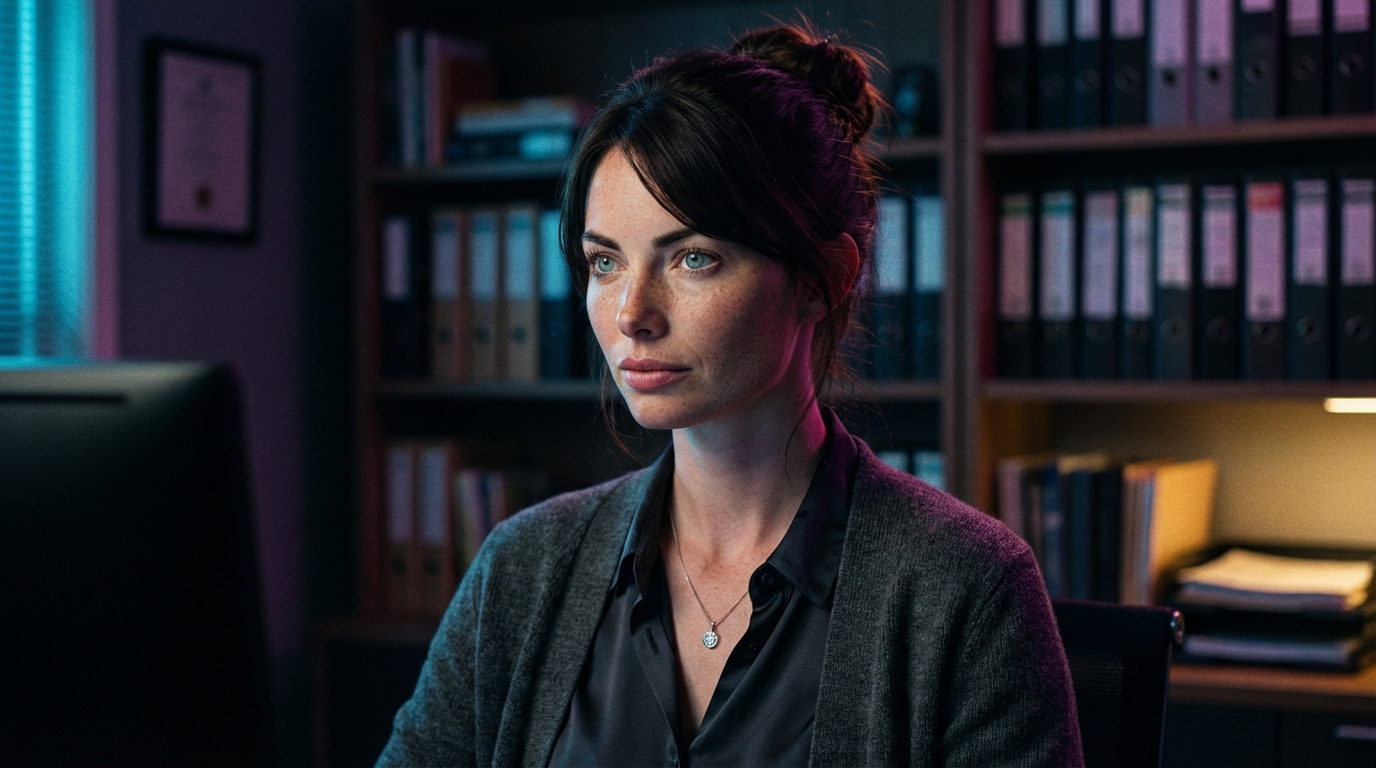
Born in Sandy Bay in 1984 to a cardiologist father and a paediatrician mother, Sienna Alice Blackwood grew up in a household where rigour and compassion were not competing values but the same thing expressed differently. She joined Tasmania Police in 2008, rose to Detective Inspector by thirty-two, and found herself at the centre of the force's most devastating crisis during August 2018 — authorising the surveillance of a colleague, managing the aftermath of a death in service, and carrying the institutional and personal consequences into the years that followed.
Sandy Bay
Sienna Alice Blackwood was born on 14 April 1984 at the Royal Hobart Hospital, the only child of Alexander Edward Blackwood and Alice Jane Blackwood (née Thompson). Her father, then forty-two and already established as one of Australia's most respected cardiologists, had relocated from Brisbane to take up a consulting position at the Royal Hobart Hospital several years earlier. Her mother, a paediatrician specialising in congenital heart defects, had followed a parallel path from Sydney through Brisbane to Hobart, where the couple's professional orbits had converged into a partnership that colleagues described as formidable and that friends described as surprisingly warm.
The family lived in Sandy Bay, in a weatherboard house on a quiet street that sloped towards the Derwent River and caught the afternoon light in a way that Alice, who had grown up in the relentless brightness of Sydney, found endlessly appealing. The house was filled with books — Alexander's medical journals and historical biographies arranged on shelves in his study, Alice's paediatric texts and the novels she read in the evenings stacked on every available surface in the living room. Sienna grew up surrounded by evidence that the world rewarded people who paid close attention to it, and that the discipline required to understand complicated systems — whether cardiac or criminal — began with the willingness to read carefully and ask the right questions.
Alexander was fifty-two when Sienna started school. He was a careful, deliberate man whose emotional register operated within a narrower range than his wife's but whose affection for his daughter expressed itself through the attention he gave to her questions. He answered them seriously, regardless of how trivial they appeared, and treated her curiosity as something to be encouraged rather than managed. His first marriage, to Victoria Hawthorne, had produced Sienna's half-brother Sebastian Charles Blackwood in 1978 — six years before Sienna's birth — and had ended in divorce before Alexander met Alice. Sebastian, raised primarily in Melbourne, visited during school holidays and maintained a relationship with his younger half-sister that was warm without being close, shaped by geography and the particular dynamics of blended families where the gap between siblings encompassed not just years but entirely separate households.
Alice provided the counterbalance. Where Alexander was reserved, she was expressive. Where he approached the world through analysis, she approached it through connection. Her paediatric work placed her alongside children whose conditions demanded both clinical expertise and emotional intelligence, and she carried both home with her — the ability to be simultaneously professional and deeply present, a quality that Sienna absorbed so thoroughly that colleagues, years later, would describe the same combination in her without knowing its source.
St Mary's and the University Years
Sienna attended Sandy Bay Primary School from 1990 to 1996, where she was a capable student with a preference for reading over arithmetic and a tendency towards the kind of quiet leadership that teachers valued without always recognising. She was not the loudest voice in the classroom, but she was frequently the one that others deferred to when disagreements needed resolving or group projects needed organising — a pattern that would repeat itself through every subsequent stage of her life.
She moved to St Mary's College for her secondary education, where the academic environment suited her developing intellect and the debating programme provided the first formal outlet for skills that had been accumulating since childhood. Sienna was good at argument — not in the confrontational sense, but in the structured, evidentiary sense that debating rewarded. She could assemble a position from disparate information, identify the weaknesses in an opposing case, and present her conclusions with a clarity that her teachers noted and her opponents found difficult to counter. She served on the student council and contributed to the school's social justice initiatives with the earnest engagement of a teenager whose parents had modelled public service as a baseline expectation rather than an aspiration.
Her enrolment at the University of Tasmania in 2002 marked the beginning of a sustained period of academic development that would span six years. She completed a Bachelor of Arts in Criminology, followed by a Graduate Diploma of Legal Practice, graduating in 2008 with a comprehensive theoretical foundation in criminal behaviour, legal procedure, and investigative methodology. The combination was deliberate — Sienna had known since her mid-teens that she wanted to work in criminal investigation, and she approached the decision with the same structured reasoning she would later bring to case files. Medicine had been the assumed path, given the family's history, but Sienna had watched her parents diagnose and treat conditions that had already occurred, and found herself drawn instead to the work of understanding why people harmed each other and how institutions might prevent or respond to that harm.
Theodore, and the Early Career
Sienna entered Tasmania Police as a Constable in 2008, joining the force at twenty-four with qualifications that exceeded those of most recruits and a self-awareness that prevented her from advertising the fact. The early years of general duties — patrols, community engagement, the unglamorous foundation that every officer built regardless of their academic credentials — taught her things that the university had not. She learned the difference between understanding crime as a theoretical construct and encountering it as a lived reality, between analysing criminal behaviour in an essay and standing in a room where it had just occurred.
Her transfer to the Criminal Investigation Branch in 2010 as a Detective Constable coincided with two developments that would shape the next decade of her life. The first was professional: the CIB offered the sustained investigative work that her training had prepared her for, and she proved immediately effective — thorough in her evidence-gathering, perceptive in her witness interviews, and willing to do the hours of unrewarding procedural work that successful cases demanded. The second was personal: she married Theodore Arthur Rankin in December 2010, at a ceremony at the Royal Tasmanian Botanical Gardens that drew together the medical, scientific, and policing communities in a combination that reflected the breadth of the couple's social world.
Theodore was a marine biologist at the University of Tasmania's Institute for Marine and Antarctic Studies, a quiet, thoughtful man whose work studying Southern Ocean ecosystems required the same patience and capacity for sustained observation that Sienna's work demanded, expressed in an entirely different medium. They had met through mutual friends in 2008, during Sienna's first year on the force, and the relationship had developed with the steady, unhurried quality that characterised both of them. Theodore understood shift work, irregular hours, and the particular kind of mental absence that accompanied someone whose professional life involved processing difficult material — his own research took him to sea for weeks at a time, and the couple negotiated the rhythms of two demanding careers with a pragmatism that served them well.
They settled in Mount Nelson, in a house with a garden that Theodore maintained with greater enthusiasm than skill and a view towards the river that Sienna appreciated most on the mornings when she arrived home from late shifts and sat on the back deck with a cup of tea, watching the light change over the water while the neighbourhood woke around her.
In 2012, Sienna enrolled in a Master of Criminology and Criminal Justice at the University of Melbourne, completing the degree part-time over two years while continuing her CIB work. The qualification deepened her understanding of forensic methodologies and investigative leadership, and its completion in 2014 coincided with her promotion to Detective Sergeant — a rank that placed her in charge of investigations rather than merely contributing to them. That same year, their daughter Skye Alice Rankin was born on 14 March, and the household in Mount Nelson reorganised itself around the demands of a newborn with the competent imperfection that characterised most new parents whose careers did not pause for the occasion.
Detective Inspector
Sienna's promotion to Detective Inspector came in 2016, when she was thirty-two. It was early — notably so — and reflected both her capability and the particular combination of analytical intelligence, investigative instinct, and interpersonal skill that the role demanded. She was pregnant with Henry at the time of her appointment, a fact she managed with the private irritation of a woman who understood that her pregnancy would be noted by colleagues in ways that a male officer's expanding waistline would not, and that her competence would be measured against her maternity leave in ways that no one would articulate but everyone would calculate.
Henry Theodore Rankin was born on 4 May 2017, and Sienna returned to work after four months with the focused determination of someone who had spent the leave reading case files between feeds and who understood that the CIB had not stopped generating complex investigations in her absence. Theodore, whose research schedule offered more flexibility than policing, adjusted his commitments to accommodate the domestic logistics, and the Mount Nelson household settled into the controlled chaos of two working parents, two children under four, and a garden that Theodore's marine biology expertise did not, as it turned out, translate to.
The years leading up to 2018 saw Sienna managing a portfolio of major investigations — serious assaults, sexual offences, a cold case review that produced new leads in a decade-old missing persons matter — while developing the leadership qualities that would be tested more severely than she could have anticipated. She mentored junior detectives with a combination of high expectations and genuine support that earned her loyalty from those who thrived under the approach and wariness from those who preferred less demanding supervision.
August 2018
On the evening of 2 August 2018, Sienna was called to the residence of Luke Smith in Berriedale, where a scene of extraordinary violence awaited her. The body of Cody Jennings had been discovered, alongside evidence of events that defied conventional investigative frameworks — shattered windows, witness descriptions of an animal that could not be easily classified, and the shooting of Kate Gibbons in circumstances that remained contested. Sienna took command of the scene and initiated the forensic and investigative processes that the situation demanded, applying the structured methodology that had carried her through every previous case to one that resisted structure at every turn.
The days that followed compressed an institutional lifetime into a single week. Evidence linking Detective Sarah Lahey to the Jennings scene emerged, and on 7 August, Sienna authorised a surveillance order on a fellow officer — a decision that required her to place institutional integrity above professional loyalty and that she made with the clear-eyed resolve of someone who understood that the alternative was worse. The operation, led by Detective Sergeant Alexander Stout, tracked Lahey's movements over seventy-two hours and culminated at Myrtle Forest on 8 August, where Sarah Lahey died during a confrontation with Gladys Cramer.
The Aftermath and Alice
The internal reviews and coronial processes that followed August 2018 consumed months of Sienna's professional life, during which she was required to account for every decision made during the crisis while continuing to manage the CIB's ongoing caseload. Her authorisation of the Lahey surveillance was scrutinised, upheld, and filed — a procedural outcome that resolved the institutional question while leaving the personal one entirely open. Sienna had ordered the surveillance of a colleague who had subsequently died, and no formal finding could alter the fact that she would carry that sequence for the rest of her career.
In November 2018, she attended Cody Jennings' memorial service at the family farm in Gawler, South Australia, standing among the mourners as a representative of Tasmania Police and as someone who had been present at the beginning of the investigation and felt an obligation to be present at its commemoration. The service was quiet, the grief unperformative, and Sienna returned to Hobart afterwards with the particular heaviness that attended cases where the resolution did not resolve anything that mattered to the people most affected.
The years that followed brought professional recognition and personal loss in measures that did not balance. In 2020, Sienna led a complex investigation into a series of aggravated sexual assaults across Hobart's southern suburbs that resulted in the conviction of three offenders and a commendation from the Commissioner for the sensitivity and thoroughness of the operation. In 2022, she oversaw a review of evidence-handling protocols within the CIB that drew directly on the lessons of 2018, implementing changes that strengthened chain-of-custody procedures and addressed vulnerabilities in internal access controls.
In March 2023, Alice Jane Blackwood died at the age of seventy-one, following a short illness that had been diagnosed too late and progressed too quickly. Sienna flew to Brisbane, where Alice had been living near Alexander's retirement home on the coast, and spent the final days at her mother's bedside with the quiet attentiveness of a daughter who understood that some departures could not be investigated, only witnessed. Alice's death removed from Sienna's life the person who had most consistently modelled the integration of professional competence and emotional generosity that Sienna had spent her career attempting to replicate, and the loss settled into the architecture of her days in ways that were not dramatic but were permanent.
Alexander, at eighty-one, received the bereavement with the measured composure that had characterised his entire adult life, though Sienna noticed, during the funeral and the weeks that followed, that the steadiness had acquired a fragility it had not previously possessed. She visited more frequently — the flights to Brisbane becoming a regular feature of her schedule — and the relationship between father and daughter, which had always operated through the exchange of ideas rather than the expression of feeling, deepened into something that neither of them named but both of them needed.
Family and Private Life
Skye and Henry grew through the years in the Mount Nelson household with the noisy, complicated energy of children whose parents' careers were simultaneously fascinating and inconvenient. Skye, who had inherited her mother's observational tendencies and her father's patience, attended Sandy Bay Primary — Sienna's old school — and displayed an early aptitude for logic and a fierce protective instinct towards her younger brother that expressed itself in ways both endearing and occasionally alarming to playground supervisors. Henry, quieter and more methodical, built elaborate structures from whatever materials were available and asked questions about how things worked with a persistence that Theodore encouraged and that Sienna recognised, with private amusement, as an inheritance she could not deny.
Theodore's research continued to take him to sea periodically — weeks aboard Southern Ocean survey vessels, returning salt-stained and sunburnt with stories that the children received with more enthusiasm than Sienna's carefully edited accounts of her own working week. The marriage functioned on the understanding that both partners' work mattered, that neither would be permanently available, and that the gaps would be filled by a combination of grandparental support, institutional childcare, and the kind of improvisation that dual-career families with young children perfected through necessity rather than choice.
Sebastian, now approaching fifty and firmly established as CEO of Obsidian Healthcare Group in Melbourne, maintained his relationship with Sienna through periodic visits and the intermittent communication of siblings whose lives had taken them in directions that intersected infrequently but meaningfully. Their father's ageing — and Alice's death — had drawn them closer in the way that shared loss sometimes accomplished what shared geography could not, and Sebastian's visits to Hobart became more frequent after 2023, the half-brother whose childhood visits had once felt like diplomatic missions now arriving with the easy familiarity of family.
Sienna maintained her yoga practice, her membership of the local historical society, and her habit of reading historical novels and true crime accounts with the critical eye of a professional who found in published cases both instructive parallels and instructive failures. She walked the tracks around kunanyi/Mount Wellington on weekends when the children and the caseload permitted, usually with Theodore, occasionally alone, using the physical effort and the perspective that altitude provided to process whatever the preceding days had deposited.
At forty-one, Detective Inspector Sienna Alice Blackwood occupied a position in Tasmania Police that reflected both her ability and the particular trajectory that had brought her to it. She was respected for her judgment, valued for her thoroughness, and regarded by those who worked under her with the combination of admiration and healthy wariness that effective leaders generated. The events of August 2018 remained a defining chapter — not the only one, but the one that had tested her most completely and revealed most clearly the costs of the work she had chosen. She carried those costs alongside everything else — the ongoing cases, the mentoring, the children's school schedules, the flights to Brisbane, the garden that Theodore still could not quite manage — with the steady, unsentimental competence of a woman who had learned early that rigour and compassion were not competing values but the same thing expressed differently, and who had spent her career proving it.







