4135.126 · May 6, 1815 AD
Sheffield Steel and Steady Eyes
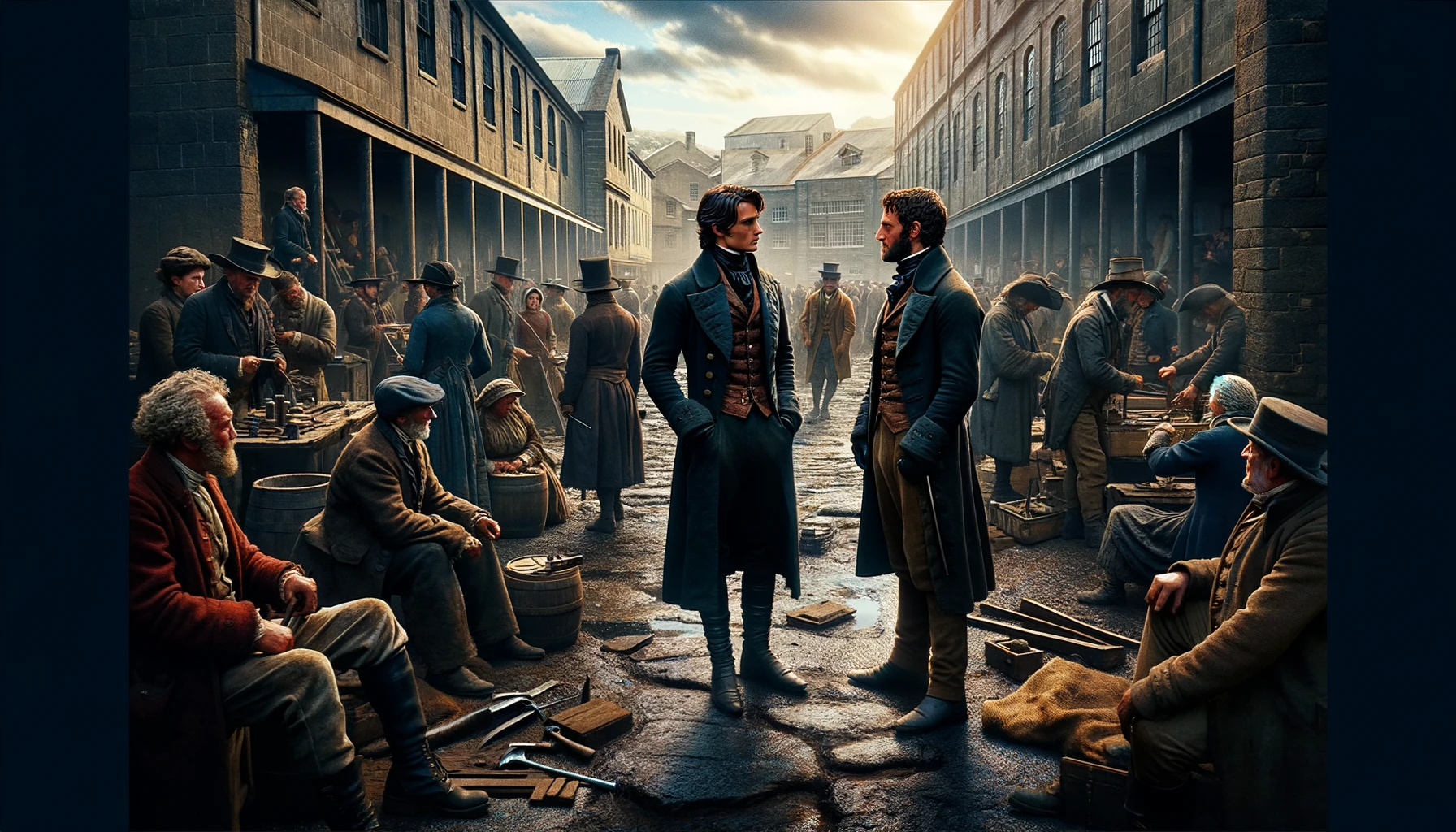
William Jeffries was examining tools at Morton's stall in the Saturday marketplace when he became aware of being watched. The man who approached him was Silas Croft, a merchant of evident success who seemed to know more about the new clerk at Hartley's than a stranger ought to know. Croft invited Jeffries for a drink at the Crown and Anchor, beginning what would become one of the most significant relationships of both men's lives.
The Saturday marketplace had become William Jeffries's refuge in the two months since his arrival in Hobart Town. Each week, when the offices of S. Hartley & Associates closed at noon and the rhythms of commerce gave way to weekend quiet, he would make his way through the muddy streets to the open square where farmers and merchants gathered to sell their wares. The marketplace offered something he found nowhere else in the settlement—a glimpse of ordinary life, of transactions conducted in daylight, of commerce untainted by the shadows that had come to define his working hours.
It was at Morton's stall that the encounter occurred. The toolmaker, a Sheffield-trained craftsman who had emigrated to Van Diemen's Land some years prior, displayed chisels of fine English steel that caught Jeffries's eye. There was pleasure in handling well-made things, in feeling the weight and balance of objects designed with care. The tools reminded him of Portsmouth, of his father's hands shaping wood in the cramped workshop behind their home, of a time before everything had gone wrong.
The sensation of being observed prickled at the back of his neck—that instinct for surveillance he had developed during seven years as a convict. He turned, casually, as though merely taking in the sights of the marketplace, and found himself meeting the gaze of a man standing perhaps twenty feet away.
The stranger was approximately Jeffries's own age, though there was nothing tentative about his bearing. He stood tall and slender, perhaps six feet, with auburn hair swept back from a high forehead and eyes of piercing blue that seemed to take in everything they observed. His clothing spoke of success worn with confidence—a coat of fine wool, impeccably tailored, boots of good leather that had seen honest use but remained well-maintained. There was an air of quiet authority about him that seemed almost incongruous in someone so young, the bearing of a man accustomed to being listened to.
When their eyes met, the stranger smiled and began making his way through the crowd.
Silas Croft introduced himself with the easy manner of a man who expected the world to arrange itself around his preferences. He commented on the quality of Morton's chisels, observed that there was not a finer toolmaker in Van Diemen's Land, and noted with apparent interest that Jeffries seemed to know tools—had worked with them, not merely sold them. The conversation flowed with a naturalness that felt almost rehearsed, each question building upon the last, drawing information from Jeffries before he could consider the wisdom of offering it.
Croft knew who Jeffries was. That much became clear within minutes of their introduction. He knew about the position at Hartley's, knew Jeffries had arrived from Sydney with letters of introduction, knew enough to have formed opinions about Samuel Hartley's decline and Ezekiel Blackwood's management. The knowledge should have raised Jeffries's suspicions higher than it did. In a place like Hobart Town, information about newcomers circulated freely among those who cared to listen, but Croft's awareness seemed more deliberate than casual gossip would account for.
The invitation came as the conversation reached a natural pause. There was a public house around the corner, Croft explained—the Crown and Anchor—that served tolerable ale and had the virtue of being quieter than most. He found himself curious about Jeffries, about how a man of evident quality came to be keeping ledgers for a drunk like Hartley. Perhaps they might continue their conversation somewhere more comfortable.
Every instinct Jeffries had developed through years of convict servitude counselled caution. Friendly strangers usually wanted something. The question was always what price they expected to extract for their apparent kindness.
Yet something in Silas Croft's manner defied easy categorisation. His interest seemed genuine, his bearing that of a man with nothing to hide. Or perhaps Jeffries simply wanted to believe that—wanted so desperately for connection, for conversation with someone outside the shadow world he had entered, that he was willing to ignore warnings that experience should have made him heed.
He accepted the invitation.







