Shadow Panther
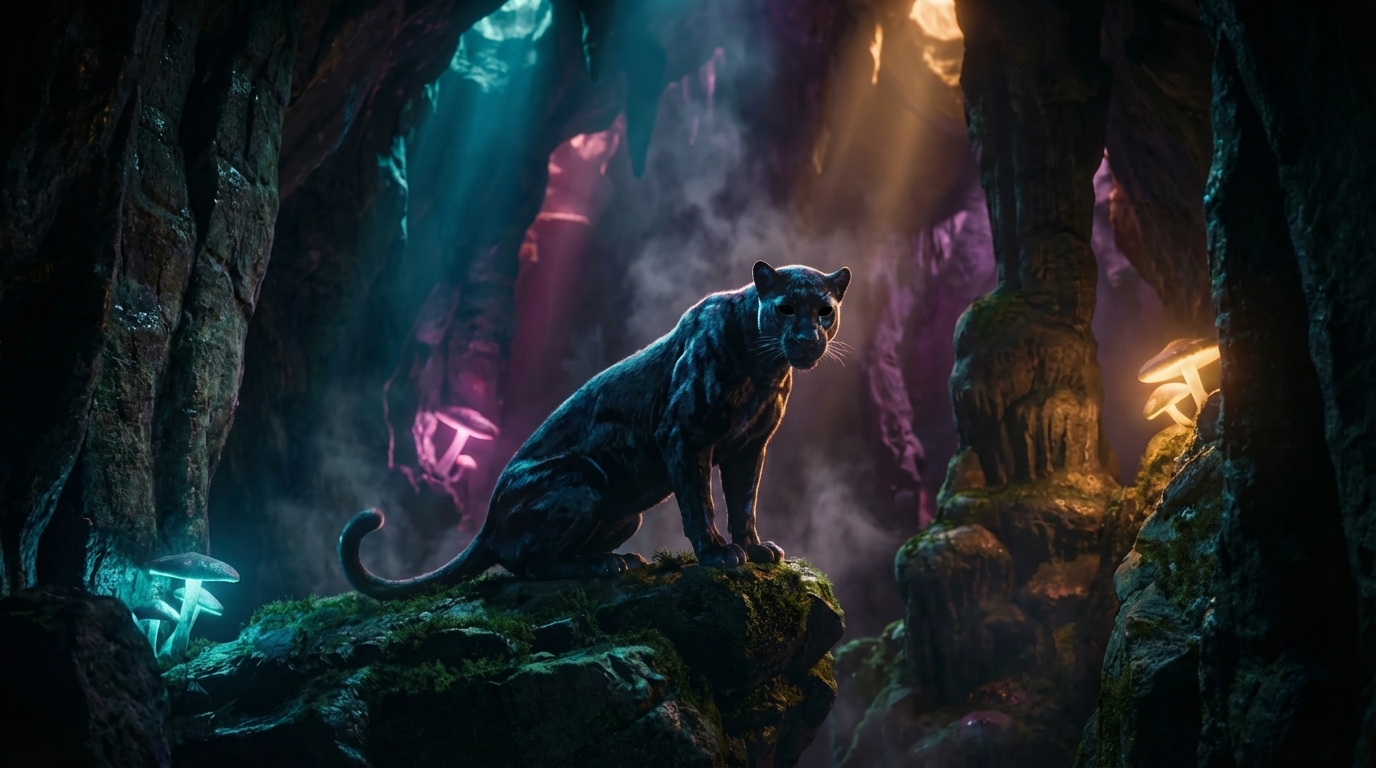
Evolved descendants of melanistic leopards brought to Clivilius in 1287 BCE. After over three thousand years of adaptation to Clivilius's lightless nights, they have become apex predators unlike anything on Earth—pack hunters with black eyes evolved for absolute darkness, targeting isolated settlements where fire and electricity have not yet pushed back against the night.
Origins
Shadow panthers are not native to Clivilius. They are the evolved descendants of four melanistic leopards brought to the dimension in 1287 BCE by the Guardians of Andhakara.
Andhakara was founded that year by a Guardian from the Vedic kingdoms of the Indian subcontinent. Led by Devraj of Magadha, the settlement established itself in a region with natural cave systems and accessible water—rare advantages in Clivilius's harsh landscape. The Guardians intended Andhakara to become a trade hub, leveraging their Earth connection to supply other settlements with resources unavailable in the dimension.
Among the animals Devraj's group transported through the Portal were four melanistic leopard cubs, captured from the dense forests of the Western Ghats. The leopards served two purposes. Trained adults would patrol Andhakara's perimeter, deterring rival settlements from encroaching on claimed territory. More valuable still, the breeding stock represented a trade commodity—melanistic leopards were rare even on Earth, and their offspring could command significant prices from other Clivilius settlements seeking their own territorial guardians.
The strategy worked for sixty years. Andhakara prospered. The leopard population grew under careful management, with cubs traded to at least three other settlements. The breeding programme produced over forty animals before circumstances changed.
In 1224 BCE, the final Guardian of Andhakara—Devraj's grandson Vikram—was killed in a hunting accident. The animal responsible was a six-year-old male leopard that Vikram had raised from a cub. With no surviving Guardians, Andhakara lost its Earth connection. The settlement could no longer receive supplies, could no longer trade with the leverage that Portal access provided. Within two years, the remaining population scattered to other settlements, abandoning Andhakara to the dust.
The leopards were released during the evacuation. Approximately fifteen adults and an unknown number of cubs dispersed into the surrounding wilderness. Sufficient prey already existed in the region—cattle, goats, and horses introduced by Andhakara and acquired through trade—to sustain them. The dimension's nights suited their melanistic colouration perfectly. Clivilius has no moon and no stars; when darkness falls, it is absolute. During daylight hours the leopards retreated to the cave systems that dotted the region. At night, they hunted without competition. No competing apex predators challenged their expansion.
Within a century, the descendants of Andhakara's leopards had spread across hundreds of miles of territory. The adaptation had begun.
Physical Characteristics
Over three thousand years of evolution in Clivilius's unique environment have transformed the original leopards into a distinct subspecies.
The most striking change is the eyes. Earth leopards possess yellow or green irises with vertical pupils that dilate in low light. Shadow panthers have eyes that appear entirely black—iris, sclera, and visible surface presenting as uniform darkness. The eye structure has reorganised to maximise light capture in conditions of absolute blackness, with pupils that expand to occupy nearly the entire visible eye and a modified reflective layer that amplifies even trace illumination. In the total darkness of a Clivilius night, shadow panthers see with clarity that no Earth predator can match.
This adaptation carries a severe trade-off. Shadow panthers are extremely sensitive to light. Daylight causes immediate pain and temporary blindness; prolonged exposure can result in permanent damage. Even firelight at close range causes visible discomfort. The species is strictly nocturnal, retreating to caves, dense cover, or excavated dens at dawn and emerging only after full dark.
Their coats remain the deep black of their melanistic ancestors. Some hunters report that the fur appears to absorb light rather than merely failing to reflect it, though whether this represents physiological adaptation or optical illusion in low-light conditions remains debated.
In size and build, shadow panthers closely resemble Earth leopards—sleek, muscular, built for explosive speed and climbing. Adults range from 60 to 70 kilograms, with females slightly smaller than males. They retain the powerful jaws and retractable claws of their ancestors.
Behavioural Evolution
The most dramatic transformation is behavioural. Earth leopards are solitary hunters. Shadow panthers hunt in coordinated packs.
This change emerged gradually. As the shadow panther population grew and spread, they increasingly encountered human settlements with armed defenders. Solitary hunters attacking guarded camps were killed at unsustainable rates. The selective pressure was stark: panthers that exhibited cooperative behaviour survived; those that hunted alone did not.
The shift began with siblings that failed to disperse upon maturity, hunting together out of familiarity rather than strategy. By 800 BCE, multi-generational pack structures had become common. By 500 BCE, pack hunting was universal among shadow panthers. Solitary individuals—typically juveniles expelled from packs or elderly animals past their prime—rarely survived more than a few months.
Modern shadow panther packs consist of four to five individuals, often but not always blood-related. They coordinate through low vocalisations below human hearing range, body positioning, and synchronised movement that observers describe as almost instinctive. Their hunting strategy exploits this coordination: packs surround prey from multiple angles, remaining motionless until one member initiates the attack. The initial strike draws attention; the killing blow comes from a direction the prey was not watching.
Shadow panthers also exhibit a behavioural pattern that remains poorly understood. They frequently abandon kills without feeding. Carcasses are left untouched, flesh intact. This behaviour has been documented consistently for over two thousand years. Hunters believe the panthers kill to kill—that the hunt itself satisfies some drive independent of hunger. Whether this represents psychological adaptation, territorial marking, or something else entirely remains unknown.
Targeting New Settlements
The same adaptation that made shadow panthers apex predators in Clivilius's lightless nights also created their primary vulnerability: they cannot tolerate daylight.
This has shaped their hunting patterns in ways that make them particularly dangerous to new settlements. Established communities develop infrastructure—permanent lighting that extends the safety of day into the dangerous hours, fortified positions, secured perimeters. The illuminated zones around major settlements like New Edinburgh push back against the night, creating territories where shadow panthers cannot hunt effectively even after dark.
New settlements have none of these advantages. A newly activated Guardian group arrives in Clivilius at a random location, often far from established communities. Their first nights are spent in darkness with minimal shelter, perhaps a campfire casting a small circle of safety against the absolute black that surrounds them. They lack the resources, knowledge, and infrastructure to secure their perimeter against coordinated predators.
Shadow panthers have learned this. Whether through instinct, observation, or some combination, packs actively seek out the signs of new settlement—fresh construction, unfamiliar scents, the sounds of people who do not yet know how to move quietly after dark. A new Guardian group represents ideal prey: isolated, undefended, and ignorant of the threat.
The pattern is consistent enough that experienced settlers speak of a "testing period"—the first weeks after a new settlement appears, when shadow panther activity in the surrounding territory increases dramatically. Packs probe the new arrivals, assessing defences, identifying vulnerabilities. If the settlement survives the testing period and establishes lighting and fortifications, the packs typically withdraw to easier hunting grounds. If not, the settlement often does not survive at all.
The Zarabad Massacre
The event that crystallised understanding of shadow panther capabilities occurred in 185 CE.
Zarabad was a mining settlement founded in 80 BCE by five Guardians from the Parthian Empire. Situated in a valley rich in gold deposits, the settlement had grown to approximately two hundred people by the time of the massacre. It had coexisted with local shadow panther packs for three generations. Individual panthers occasionally took livestock during night raids. A handful of attacks on humans had occurred over the decades, all involving lone animals, all successfully repelled. The relationship was the ordinary tension between predator and civilisation.
On the night of 12 October 185 CE, seven shadow panthers attacked Zarabad in coordinated waves.
The attack began at the settlement's southern perimeter, where two panthers struck the livestock pens. When defenders rushed to protect the animals, their torches bobbing through the darkness, three more panthers breached the northern wall, entering the residential district. The initial casualties—eight people killed in the first minutes—occurred while the majority of armed defenders were positioned at the wrong end of the settlement.
The remaining two panthers waited. When the defenders realised the true threat and began moving north, their torchlight leaving the southern district in darkness, these animals struck the now-undefended area. The settlement's leadership, attempting to coordinate response from the central hall, found themselves cut off as the pack systematically controlled movement between districts.
The attack lasted four hours. The panthers withdrew before dawn, melting into the darkness as the first grey light touched the horizon. They left forty-three dead. They had taken no casualties. They had not fed on any of the bodies. The livestock in the southern pens—the apparent initial target—remained untouched.
Zarabad survived the massacre, but the implications reshaped how Clivilius settlements understood shadow panthers. The attack demonstrated strategic planning, adaptive tactics, and deliberate targeting of armed individuals before unarmed ones. This was not predation. This was warfare.
The cause of the Zarabad attack was never definitively established. The settlement's leadership believed the pack had been tracking human patterns for months, learning routines, identifying the response protocols that defenders would follow. Others suggested Zarabad had unknowingly encroached on a denning site during its expansion the previous year. Whatever the trigger, the result was clear: shadow panthers were capable of organised violence on a scale no one had previously imagined.
Pre-Modern Hunting Efforts
For centuries following the Zarabad Massacre, responses to shadow panthers remained sporadic and disorganised.
Individual settlements maintained their own hunting parties, but these operated in isolation. Knowledge accumulated locally—a technique that worked against one pack, a territorial pattern observed in a specific region—but rarely spread beyond the settlement that discovered it. Hunters died, and their expertise died with them. Settlements collapsed, and whatever they had learned vanished into Clivilius's dust.
Some regions developed informal traditions. Hunters from neighbouring settlements occasionally collaborated against particularly aggressive packs. Trading caravans shared information about panther activity along their routes. But no centralised effort existed. No institution preserved and transmitted knowledge across generations.
The result was a cycle of rediscovery. Each new settlement learned the same lessons—often at the same cost—that dozens of settlements had learned before. The techniques for deterring shadow panthers, for securing perimeters, for surviving the testing period that followed a new arrival: all of this had to be relearned each time a Guardian group appeared in panther territory.
Shadow panthers, meanwhile, continued to adapt. Packs that encountered effective resistance learned from the experience. Tactics that worked against one settlement might fail against the next pack to try them. The species was not static; it evolved in response to human countermeasures, maintaining its position as apex predator despite millennia of human presence in Clivilius.
The Chewbathian Hunters
When the Stewart sisters founded New Edinburgh in 1762 CE, they inherited fragments of accumulated knowledge from the settlements they traded with—enough to understand the threat, not enough to address it systematically.
The military outpost of Chewbathia, established shortly after New Edinburgh itself, became the centre for organised response. The Chewbathian Hunters evolved from earlier, informal hunting traditions into an elite unit dedicated specifically to shadow panther engagement.
The Hunters operate in small groups of three to five individuals, deliberately mirroring the pack structure of their quarry. They train for years before undertaking their first hunt, studying panther behaviour, territorial patterns, pack dynamics, and the physical signs that indicate panther presence. They learn to move in the absolute darkness of Clivilius nights as the panthers do, to read landscapes for ambush points, to anticipate pack tactics.
Their primary weapons are bows designed for accuracy without visual reference. Hunters train to shoot by sound and spatial memory, loosing arrows at targets they cannot see. They carry blades for close combat, though engaging a shadow panther at close range is considered a failure of planning rather than a tactical choice.
The Hunters' most effective tool exploits the panthers' own instincts. A decapitated pack member left at a location's perimeter triggers an avoidance response in surviving pack members. The scent of pack-death can secure an area for days or weeks. Hunters use this strategically, creating safe corridors through panther territory and protecting vulnerable locations.
Beyond direct hunting, the Chewbathian Hunters serve a broader purpose for New Edinburgh. In the modern era, new settlements arrive in Clivilius with technology and knowledge that established communities lack—electrical systems, modern medicine, contemporary engineering techniques. These resources are valuable. But new settlements are also the most vulnerable to shadow panther predation, appearing in random locations without infrastructure or defences.
If a new settlement's Guardians die, its Earth connection dies with them. The settlement becomes isolated, its technological advantages inaccessible to trade partners. New Edinburgh recognised this dynamic early. The Chewbathian Hunters were tasked not only with protecting New Edinburgh's territory but with responding to shadow panther threats against new settlements throughout the region—keeping Guardians alive, maintaining Earth connections, ensuring that new arrivals survived long enough to become valuable trading partners.
This protective role has made the Chewbathian Hunters the primary repository of shadow panther knowledge in the New Edinburgh region. They document pack territories, track population movements, and maintain records of tactics both successful and failed. The accumulated expertise of over two centuries now informs their operations—a continuity of knowledge that earlier, fragmented hunting efforts never achieved.
Current Status
Shadow panther packs range across much of Clivilius, concentrated in regions with suitable denning sites, adequate prey, and limited artificial lighting. They avoid the illuminated perimeters of major settlements and rarely establish territory where Hunter presence is active.
Population estimates remain difficult to establish. The Chewbathian Hunters track known packs and monitor territorial boundaries within the New Edinburgh region, but acknowledge that unobserved packs exist in remote territories. Hunter reports suggest pack numbers have increased over the past century in some areas, possibly due to reduced hunting pressure as certain communities have contracted.
The expansion of electrical lighting represents the most significant change in shadow panther dynamics since the species emerged. Settlements with reliable power can illuminate perimeters through the night, extending the safety of daylight hours into the dangerous dark. The habitable zone for humans expands; the hunting ground for shadow panthers contracts. Whether this pressure will ultimately constrain the species or simply push it toward increasingly desperate attacks on undefended targets remains to be seen.
The balance between human settlement and shadow panther territory has been contested for over three thousand years. The Chewbathian Hunters represent the most organised effort to shift that balance. Whether their methods will prove sufficient as Clivilius continues to change is a question that each new settlement, arriving in the dark, must answer for itself.



