Shadow Ledgers
The ledgers tell one story; the gaps between entries tell another—and when Blackwood invites William to witness what happens in the warehouse after midnight, the price of admission is learning exactly how much of himself he's willing to trade for a future worth having.
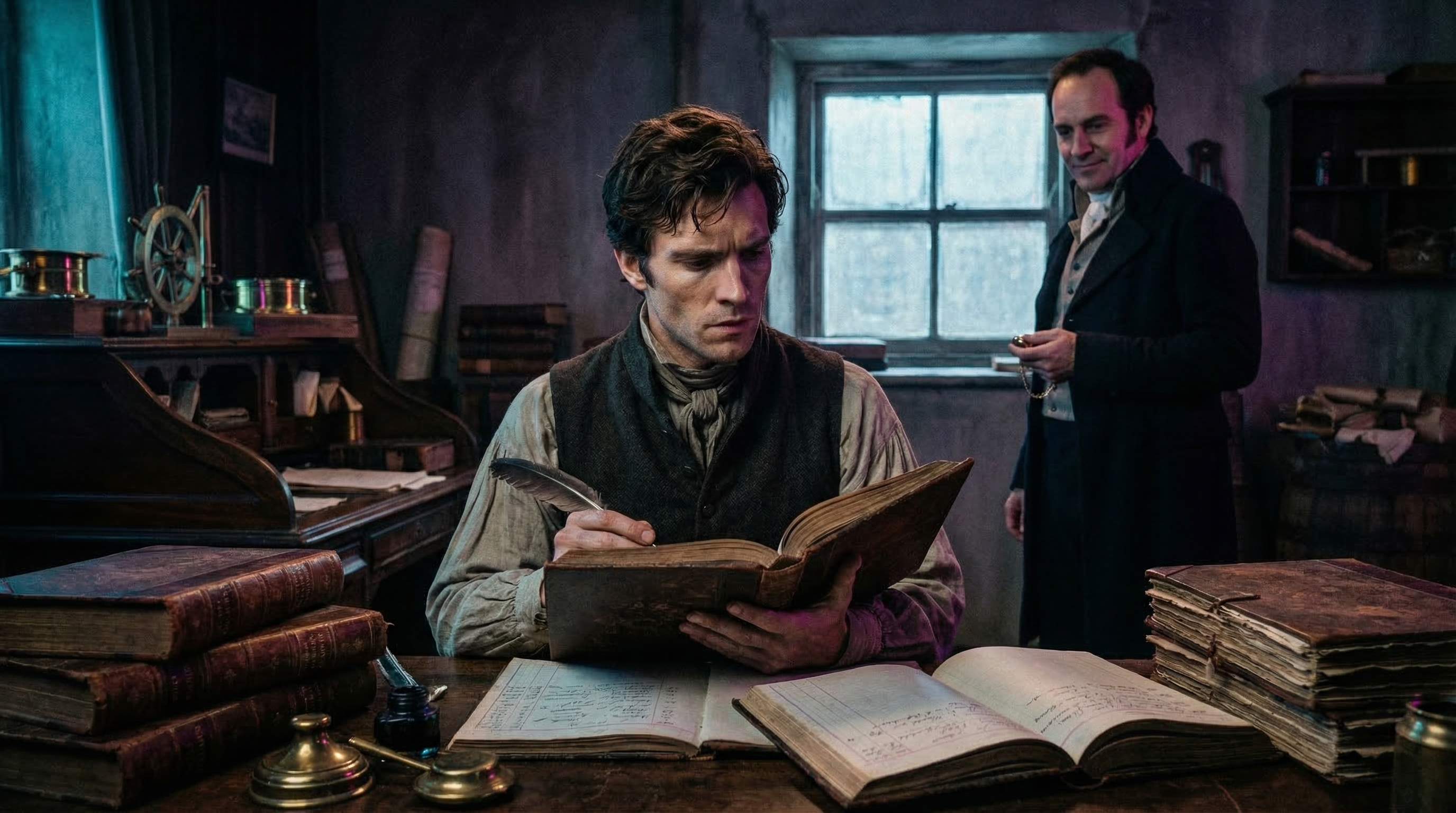
"Honesty is a luxury for men who've never had to choose between their principles and their survival. The rest of us learn to be practical." — Ezekiel Blackwood
William arrived at Hartley's offices at half past six on his first morning, the streets of Hobart Town still wrapped in the grey half-light that preceded dawn. He had barely slept—the unfamiliar sounds of the boarding house, the cold that crept through gaps in the timber walls, and the restless churning of his thoughts had conspired to keep him awake through most of the night. But fatigue was an old companion, and he had long since learned to function through its fog.
The door was locked when he tried it, the building dark and silent. He stood on the muddy street, his breath misting in the cold air, and waited.
Ezekiel Blackwood arrived at precisely seven o'clock, materialising from the morning mist with the unhurried pace of a man who expected the world to arrange itself around his schedule. He wore a dark coat of good quality, a scarf wrapped against the chill, and an expression of faint amusement when he saw William waiting.
"Eager," he observed, producing a key from his pocket. "I appreciate eagerness. It suggests a man who understands that opportunities don't wait for the unprepared."
"I've learned that punctuality costs nothing and buys a great deal," William replied.
"A lesson many never master." Blackwood unlocked the door and stepped inside, leaving William to follow. "Come. There's much to show you, and the day won't stretch itself to accommodate our lessons."
The first week was devoted to the ledgers.
Blackwood set William at a desk in the corner of the main office, surrounded by towers of leather-bound volumes that chronicled the history of Hartley's enterprise. There were accounts receivable and accounts payable, inventory records and shipping manifests, correspondence files and customs declarations. The accumulated paperwork of a decade's commerce, organised—if that word could be applied—according to a system that seemed to exist primarily in Blackwood's head.
"Learn these," Blackwood instructed on that first morning, gesturing at the assembled volumes with a casualness that belied their importance. "Every transaction we've made, every partner we've dealt with, every ship that's carried our goods. By the time you've finished, you'll understand this business better than Hartley himself ever did."
It was tedious work, the kind of labour that made William's eyes ache and his back protest from hours hunched over cramped handwriting. But it was also revealing. As he worked through the records, patterns began to emerge—rhythms of trade and exchange that told stories the individual entries could not.
He noticed, for instance, that certain suppliers appeared repeatedly despite offering prices higher than their competitors. He observed that shipments to particular destinations seemed to generate profits that exceeded reasonable expectations. He saw, too, the gradual decline in Hartley's own handwriting—entries that had once been neat and confident becoming progressively more erratic, more difficult to read, until they ceased altogether perhaps two years past.
And he noticed the gaps.
Small ones, at first—a week here, a month there, where entries that should have existed simply didn't. Inventory that appeared in the warehouse without corresponding purchase records. Payments received that couldn't be traced to any identifiable customer. The discrepancies were subtle, buried in the mass of legitimate transactions, but they were there for anyone who cared to look.
William cared to look. He said nothing.
Blackwood proved to be an attentive teacher, appearing at William's desk throughout each day to answer questions, offer explanations, and provide context that the ledgers alone could not supply. His knowledge of the business was encyclopaedic, his understanding of colonial commerce both broad and deep. He spoke of shipping routes and seasonal variations, of the peculiarities of dealing with government officials and the importance of maintaining relationships with ship captains.
"The written records tell you what happened," he explained one afternoon, perched on the edge of William's desk with the easy familiarity he had adopted almost immediately. "But they can't tell you why. For that, you need to understand people—their motivations, their fears, their ambitions. A merchant who seems to be offering you a bad deal may be desperate for quick payment. A captain who demands premium rates may be the only one willing to carry certain cargoes. Nothing in commerce is as simple as the numbers suggest."
"And the gaps in the records?" William asked, the question emerging before he could weigh the wisdom of asking it. "What do they tell you?"
Blackwood's expression didn't change, but something shifted behind his eyes—a flicker of assessment, of calculation. "You've noticed those, have you? Good. I wondered how long it would take." He paused, as though deciding how much to reveal. "Every business has its... informal arrangements. Transactions that don't appear in the official accounts. It's the nature of colonial commerce, Mr Jeffries. The regulations imposed from London don't always align with the realities of doing business on the frontier."
"Smuggling," William said flatly.
"Such an ugly word." Blackwood's smile held no warmth. "I prefer to think of it as creative interpretation of the rules. The Crown takes its duties and taxes regardless of the burden they impose. A man who finds ways to reduce that burden is simply exercising good business sense." He leaned closer, his voice dropping to a register that felt almost conspiratorial. "You spent seven years as a convict, Mr Jeffries. You know better than most how arbitrary the law can be. Is it really such a great sin to bend rules that were designed by men who've never set foot in these colonies?"
William said nothing. The argument was seductive in its logic, appealing to grievances he had carried for years. But something in him resisted—some instinct that warned him of the ground shifting beneath his feet.
Blackwood watched him for a long moment, then nodded as though William had passed some kind of test. "Think on it. You don't have to decide anything today. But understand that in this place, a man who insists on absolute propriety will find his options severely limited. Flexibility is not merely an advantage here—it's a necessity."
William met Samuel Hartley for the first time on his eighth day in Hobart Town.
The merchant emerged from the private office at the rear of the building shortly before noon, shuffling into the main room with the uncertain gait of a man whose relationship with sobriety had become intermittent at best. He was perhaps fifty years old, though he looked older—his face puffy and florid, his eyes bloodshot, his once-fine clothes hanging loosely on a frame that had clearly diminished from its former bulk.
"Who's this, then?" Hartley demanded, squinting at William as though trying to bring him into focus. His voice was hoarse, roughened by whatever he had been drinking in the solitude of his office.
"William Jeffries, sir." William rose from his desk, uncertain of the protocol. "I arrived last week, with letters from Mr Donnelly in Sydney."
"Donnelly." Hartley pronounced the name as though it tasted sour. "That old fox. Still sending me his strays, is he?" He shuffled closer, peering at William with an intensity that seemed at odds with his general dishevelment. "You've got the look of the transports about you. Spent some time in chains, have you?"
"Seven years, sir. My sentence is complete."
"Complete." Hartley laughed, a bitter sound without mirth. "Nothing's ever complete in this place. The stain follows you, boy. No matter how far you run, no matter how high you climb—it's always there, waiting to drag you back down." His eyes seemed to focus for a moment, sharpening into something that might have been wisdom or might have been despair. "Remember that. Whatever Blackwood tells you, whatever dreams he sells you—remember that we're all of us marked men here. The Crown never truly lets go of what it claims."
Before William could respond, Blackwood appeared at his employer's elbow, his manner solicitous but firm. "Mr Hartley, you have correspondence that requires your attention. Perhaps we should—"
"Yes, yes." Hartley waved a dismissive hand, already retreating toward his office. "Correspondence. Always correspondence. The world drowns in paper whilst the real business happens elsewhere." He paused at the door, looking back at William with an expression that seemed suddenly, startlingly lucid. "Watch yourself, boy. Watch yourself carefully. Not everything in this place is what it appears to be."
The door closed behind him. Blackwood's face betrayed nothing, but William thought he detected a tension in the set of his shoulders, a tightness around his eyes.
"He has his moments of clarity," Blackwood said, his voice carefully neutral. "They become less frequent as time passes. Don't put too much weight on anything he says."
William nodded, but Hartley's words echoed in his mind: Not everything in this place is what it appears to be.
He was beginning to understand just how true that might be.
The invitation came on a Thursday evening, three weeks into William's employment.
"I have some business to attend to tonight," Blackwood said as they were closing the office for the day. "At the warehouse. I thought you might benefit from observing how certain transactions are conducted." His tone was casual, but his eyes held that familiar intensity—watching, assessing, calculating. "It's not required, of course. But a man who wishes to advance in this trade would do well to understand all aspects of its operations."
William understood what was being offered. This was the next step—the invitation to move from the world of legitimate ledgers into whatever darker waters Blackwood navigated after hours. He could decline, plead fatigue or disinterest, maintain the fiction that he was merely a clerk learning his trade. But he knew, with a certainty that settled cold in his stomach, that such a refusal would mark him as unsuitable for advancement. The door that Blackwood was opening would close permanently if William chose not to walk through it.
He thought of Eliza. Of her faith in him, her demand that he build something worthy. Would she want him to compromise himself for the sake of success? Would she understand the calculations he was making, the moral algebra of survival in a place like this?
He thought, too, of the watch against his chest—the watch that marked both his wrongful conviction and his promise of a brighter future. A stolen watch had destroyed his life. What would he become if he now chose to involve himself in theft of a different kind?
"What time?" he heard himself ask.
Blackwood's smile held something that might have been approval. "Midnight. Meet me at the rear entrance. Dress warmly—it will be cold work.”
The warehouse at midnight was a different creature from the dusty, dormant space William had come to know during daylight hours. Lanterns cast pools of amber light across stacked crates and barrels, their flames flickering in the draught that crept through gaps in the timber walls. Shadows moved at the edges of visibility—men whose faces were obscured by darkness and the deliberate anonymity of those engaged in illicit business.
Blackwood stood at the centre of the activity, directing operations with quiet authority. A ship had arrived that evening—William had heard its bell as he'd lain awake in his boarding house—and crates were being offloaded through a rear door that opened onto a small pier hidden from the main harbour by a curve of the shoreline.
"Rum," Blackwood explained, appearing at William's side with the silent tread that seemed characteristic of him. "Caribbean, by way of Sydney. The Crown's duties on spirits are punitive—designed to discourage consumption among the lower orders, supposedly, though the only thing they actually discourage is honest commerce. We bring it in ourselves and save our customers the markup."
"And the customs officials?"
"Have been made to understand that their vigilance is appreciated in certain areas and unnecessary in others." Blackwood's voice carried no hint of shame or hesitation. "It's a arrangement that benefits everyone. They receive compensation for their flexibility; we receive access to goods our customers want; those customers receive fair prices instead of the Crown's extortion. The only loser is a government thousands of miles away that has never set foot in these colonies and cares nothing for the people who live here."
William watched as the crates were unloaded, counted, and stacked in a section of the warehouse he had not previously been permitted to enter. The men doing the work were efficient and silent, their movements suggesting long practice at exactly this kind of nocturnal enterprise. He counted perhaps a dozen of them, faces he did not recognise—labourers brought in specifically for this purpose, he suspected, and dismissed as soon as the work was done.
"Why show me this?" he asked finally. "You barely know me. How do you know I won't report what I've seen?"
Blackwood turned to face him, and in the uncertain light of the lanterns, his expression seemed almost gentle. "Because I know men, Mr Jeffries. I've made something of a study of them. And I know that you—whatever your past, whatever brought you to these shores—are not a man who runs to authority with tales. You've been on the receiving end of that particular betrayal yourself, haven't you? Someone who informed, someone who turned King's evidence to save themselves at your expense?"
Jack Hawley's face flashed through William's mind, unbidden and unwelcome. The copper hair, the easy smile, the careless shrug as he walked free from the courthouse whilst William was led away in chains.
"Yes," he said, the word tasting of old bitterness. "Someone did."
"Then you understand. The law is not justice, Mr Jeffries. It's merely power dressed in robes and ritual. The men who wield it are no better than the men they condemn—often worse, because they've convinced themselves of their own righteousness." Blackwood's voice had taken on an intensity that seemed almost evangelical. "What we do here is not theft. It's commerce, conducted by men who've chosen not to submit to rules designed to keep them in their place. There's a difference, even if the courts don't recognise it."
William returned to his boarding house as dawn was breaking over Mount Wellington, the sky shifting from black to grey to pale gold as the sun crept above the horizon. He had not participated in the night's work—Blackwood had made clear that observation was sufficient for now—but he had been present. He had witnessed. He had, by his silence, made himself complicit.
He sat on the edge of his narrow bed, the watch open in his palm, studying the inscription by the light of a single candle. May your future be as bright as our love. The words seemed to mock him now, their optimism a reproach against the choices he was being asked to make.
What would Eliza think if she could see him now? Would she understand the calculations that governed survival in a place like this? Would she forgive the compromises he was contemplating, or would she see them as betrayals of everything she had believed him capable of becoming?
But Eliza was not here. Eliza was hundreds of miles to the north, living a life that no longer included him, building a future that would never intersect with his own. She had asked him to forget her—had demanded, with tears streaming down her face, that he throw himself into his new life without looking back. She had surrendered her claim on his conscience when she'd surrendered her claim on his heart.
He was alone. He had always been alone, really, since the moment Jack Hawley's betrayal had severed him from the world of ordinary expectations. The colony had merely made that isolation visible, had stripped away the pretences that civilised society used to disguise its fundamental indifference to men like him.
Blackwood was offering him a path forward—a way to rise above the limitations that his convict past would otherwise impose. Yes, that path required moral flexibility. Yes, it meant becoming complicit in activities that the law defined as criminal. But hadn't the law already proven itself arbitrary, unjust, more concerned with maintaining order than achieving justice?
William closed the watch, feeling its familiar weight in his palm. He thought of the years ahead, of the choices that would shape them. He could refuse Blackwood's invitation, cling to principles that had done nothing to protect him from wrongful conviction, and spend the rest of his life as a clerk—honest, respectable, and utterly without prospects. Or he could accept the education being offered, learn the rules that actually governed colonial commerce, and build the future that Eliza had demanded he pursue.
It was not a difficult choice. That was perhaps the most troubling thing of all.
The weeks that followed drew William deeper into Blackwood's world.
He began keeping a second set of records—shadow ledgers that tracked the transactions that never appeared in the official accounts. The work required a kind of careful duplicity: maintaining the fiction of legitimate commerce during daylight hours whilst cataloguing the reality of Hartley's operations in private. William discovered he had a talent for it, for holding two contradictory truths in his mind simultaneously, for navigating the space between what was said and what was done.
Blackwood seemed pleased by his progress, offering praise that felt genuine even as William understood it was also strategic. "You've a gift for this work," he observed one evening, reviewing the shadow ledgers with an appraising eye. "Most men can't keep the two worlds separate—they let details slip, make mistakes that leave traces. You don't. You understand that discretion is as valuable as any other skill."
"I've had practice at keeping secrets," William replied, and was surprised to find it was true. The years of convict servitude had taught him to conceal his thoughts, to present whatever face circumstances required, to survive by revealing nothing that could be used against him. Those lessons were serving him well now, though in ways he had never anticipated.
He met the men who made Blackwood's operations possible—customs officials whose palms had been greased, ship captains who asked no questions about certain cargoes, merchants who served as intermediaries for goods that couldn't be sold through legitimate channels. They were not, William discovered, the villains he might have expected. They were ordinary men, for the most part—family men with wives and children, men who attended church on Sundays and conducted themselves respectably in public. Their involvement in smuggling was simply another aspect of their commercial lives, no more remarkable than any other transaction.
This, more than anything, unsettled William. He had expected the criminal underworld to be populated by obvious rogues, men whose villainy was written on their faces. Instead, he found himself dealing with people who might have been his neighbours, his fellow churchgoers, his friends. The line between legitimate and illegitimate commerce was not a line at all—it was a spectrum, a graduated scale on which everyone found their own comfortable position.
And his own position on that scale was shifting, day by day, choice by choice, toward something he was not certain he could name.
The test, when it came, was almost mundane in its simplicity.
A shipment of wool was due to depart for Sydney, part of the legitimate trade that formed the public face of Hartley's enterprise. William was tasked with preparing the customs declaration—a straightforward piece of paperwork that should have required nothing more than accurate transcription of quantities and values.
Blackwood appeared at his desk as he was completing the form, a sheaf of papers in his hand and that familiar calculating look in his eyes.
"There's been a small adjustment," he said, laying the papers before William. "Some additional items that need to be included in the shipment. They'll be packed within the wool bales, invisible to inspection. The declaration should reflect only the wool itself."
William looked at the papers. They detailed a quantity of rum—the Caribbean rum that had arrived in the midnight shipment weeks ago—destined for Sydney, where it would presumably be sold at prices that undercut the official duties. The customs declaration he was being asked to sign would be false. It would make him personally complicit in smuggling, his name attached to a lie that could, if discovered, result in prosecution.
He understood what was happening. This was the moment of commitment—the point at which observation became participation, knowledge became guilt. Everything before had maintained a fiction of deniability; this would not.
Blackwood watched him, saying nothing, his face a mask of patient expectation.
William thought of the watch against his chest. Of Eliza's faith in him. Of the man he had hoped to become and the man circumstances were shaping him into.
He picked up his pen and signed the declaration.
Blackwood smiled—that rare, genuine smile that William had learned to recognise. "Welcome to the real business, Mr Jeffries. I had a feeling you'd make the right choice."
William said nothing. There was nothing to say. He had crossed a line that could not be uncrossed, made a choice that could not be unmade. Whatever future he built from this moment forward would be constructed on a foundation of compromise.
He told himself it was necessary. He told himself it was the only way forward. He told himself that Eliza would understand, that she would see the larger picture, that she would recognise the impossible position he had been placed in.
He did not entirely believe himself.
That night, alone in his room, William wrote a letter he would never send.
Dearest Eliza,
You asked me to build something. To throw myself into my new life without looking back. I am trying to honour that request, but I find that the building requires materials I did not anticipate.
The world here is different from Sydney, different from anything I knew in Portsmouth. The rules that govern ordinary commerce do not apply. A man who insists on playing by those rules finds himself excluded from the game entirely. I have chosen to play, and the cost of playing is becoming clearer with each passing day.
I tell myself that the ends justify the means. That the man I am becoming will eventually be worthy of your faith, even if the path to that man requires compromises you would not approve of. I tell myself that you would understand, that you would see the necessity, that you would forgive.
I am not certain I believe myself.
The watch you gave me still rests against my heart. I touch it often, feeling its weight, its warmth, its steady pulse. It reminds me of what I promised, of who I intended to become. But it also reminds me of what I have lost, of the distance between who I am and who you believed me to be.
I love you still. That, at least, has not changed. Whatever else I become, whatever compromises I make, that truth remains constant.
Forever yours,
William
He read the letter once, then held it to the candle flame and watched it burn. The words curled and blackened, consumed by fire, leaving nothing but ash that he scattered out the window into the cold Van Diemen's Land night.
She had asked him not to write. He had promised not to look back.
Some promises, it seemed, were easier to keep than others.






