Scholar's Path to the Hermitage
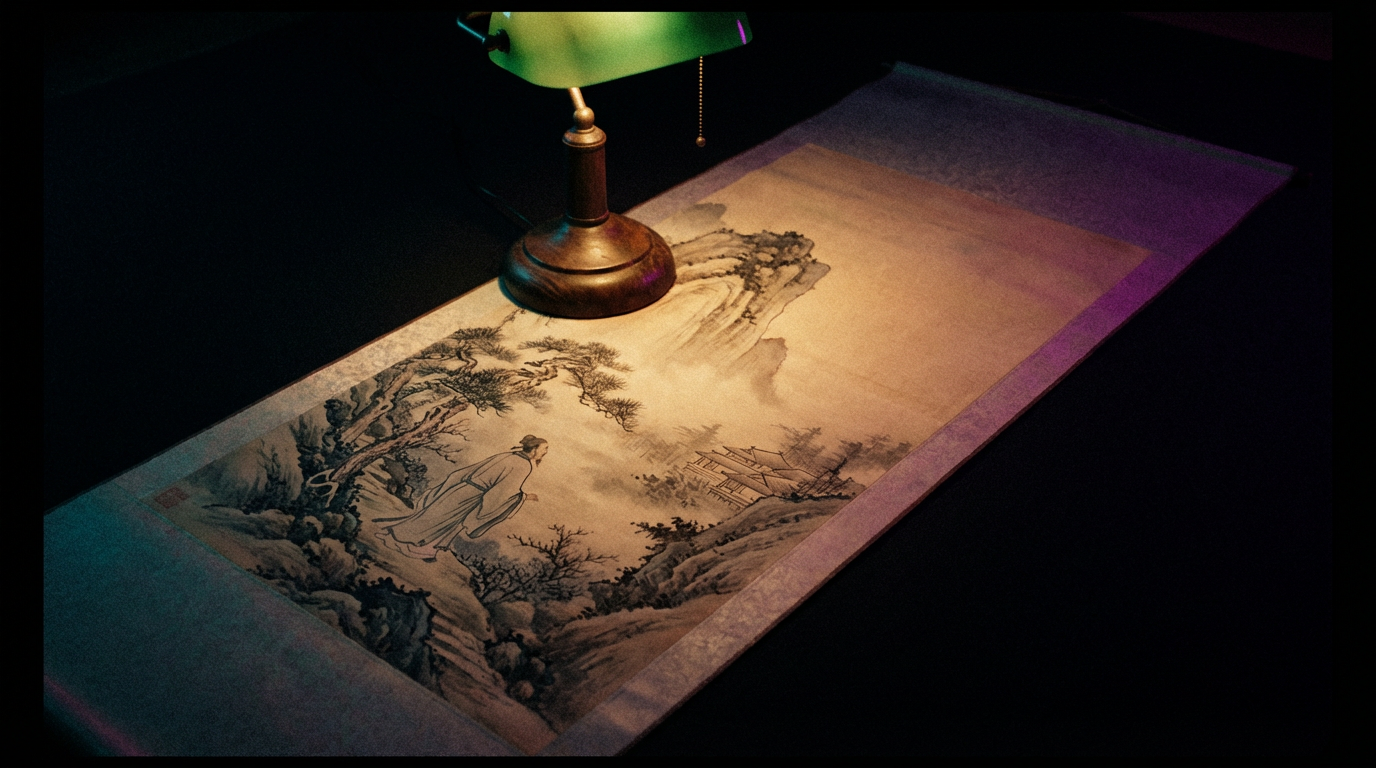
An ink and light colour painting on silk by the Southern Song painter Ma Yuan, completed on the 3rd of October 1205 in Lin'an (Hangzhou). A solitary scholar ascends a winding mountain path toward a hermitage barely visible amongst pines, whilst the composition's famous "one-corner" technique leaves vast expanses of silk empty — suggesting infinite space, mist, and the immensity of nature against which the human figure appears beautifully insignificant.
Description
The painting measures approximately eighty centimetres in height and forty in width, executed in ink and light colour on silk. The composition employs the "one-corner" technique for which Ma Yuan was celebrated — concentrating the landscape elements in the lower left portion of the painting whilst leaving the upper right largely empty, creating an asymmetric balance between substance and void that suggests infinite atmospheric depth.
A solitary scholar, rendered in a few precise brushstrokes, ascends a winding path through a mountainous landscape. Pine trees cling to rocky outcrops above and below the path, their branches extending in the angular, wind-shaped forms characteristic of Ma Yuan's tree painting. In the far distance, barely visible through layers of atmospheric perspective, a small hermitage perches on a clifftop — the scholar's destination, rendered with such economy that it could be mistaken for a natural rock formation.
The empty silk that dominates the upper portion of the composition is not merely blank space but an active element — representing mist, cloud, the vastness of the mountain landscape, and the philosophical concept of xu (emptiness) that was central to Song Dynasty aesthetic theory.
The painting bears Ma Yuan's seal and an imperial collection seal from the reign of Emperor Ningzong.
Historical Setting
The painting was completed on the 3rd of October 1205 (the 1st year of the Kaixi reign era), by the court painter Ma Yuan at the imperial painting academy in Lin'an (present-day Hangzhou). Ma Yuan was the most celebrated painter of his generation and the foremost practitioner of the Southern Song academy style, known to later critics as "One-Corner Ma" for his revolutionary asymmetric compositions that broke decisively with the centred, symmetrical landscape tradition of the Northern Song.
Ma Yuan served as a Painter-in-Attendance at the court of Emperor Ningzong, a position of high honour that placed him at the apex of the Southern Song artistic establishment. His landscape paintings were prized not merely for their technical mastery but for their philosophical resonance — the interplay of presence and absence, solid and void, reflecting Chan (Zen) Buddhist principles of contemplation and the Confucian ideal of the scholar-recluse who withdraws from worldly affairs to seek wisdom in nature.
Emperor Ningzong acquired the painting for the imperial collection upon its completion, and it was displayed during court gatherings as an exemplar of the academy's highest achievement.
Provenance
The painting left the imperial collection during the same dispersal that followed the Mongol conquest of 1279. It was recorded in the collection of a Yuan Dynasty scholar-official in Suzhou in 1315 and passed through several distinguished Chinese private collections during the Ming Dynasty. It entered European circulation through the Dutch East India Company's Canton trade in the late seventeenth century, appearing in a private collection in Amsterdam in 1694. It was subsequently acquired by a London dealer in 1808 and purchased through William Jeffries Sr.'s intermediaries in 1820. It was the last of the three silk paintings to arrive at Jeffries Manor, completing the group that now hangs upon the walls of the Blue Room.






