Sarah Louise Jennings
Sarah Louise Jennings, born on 5 May 1948 in Gawler, South Australia, was the only daughter of the farmer Edward Jennings and his wife Margaret, and the child who most took after her bookish, creative mother. She left the farm at eighteen for Adelaide, trained as an artist and teacher, kept her own name on marrying Peter Hollis, and became a respected botanical illustrator. Her mother's lifelong confidante, she lived openly the creative life Margaret had been denied.
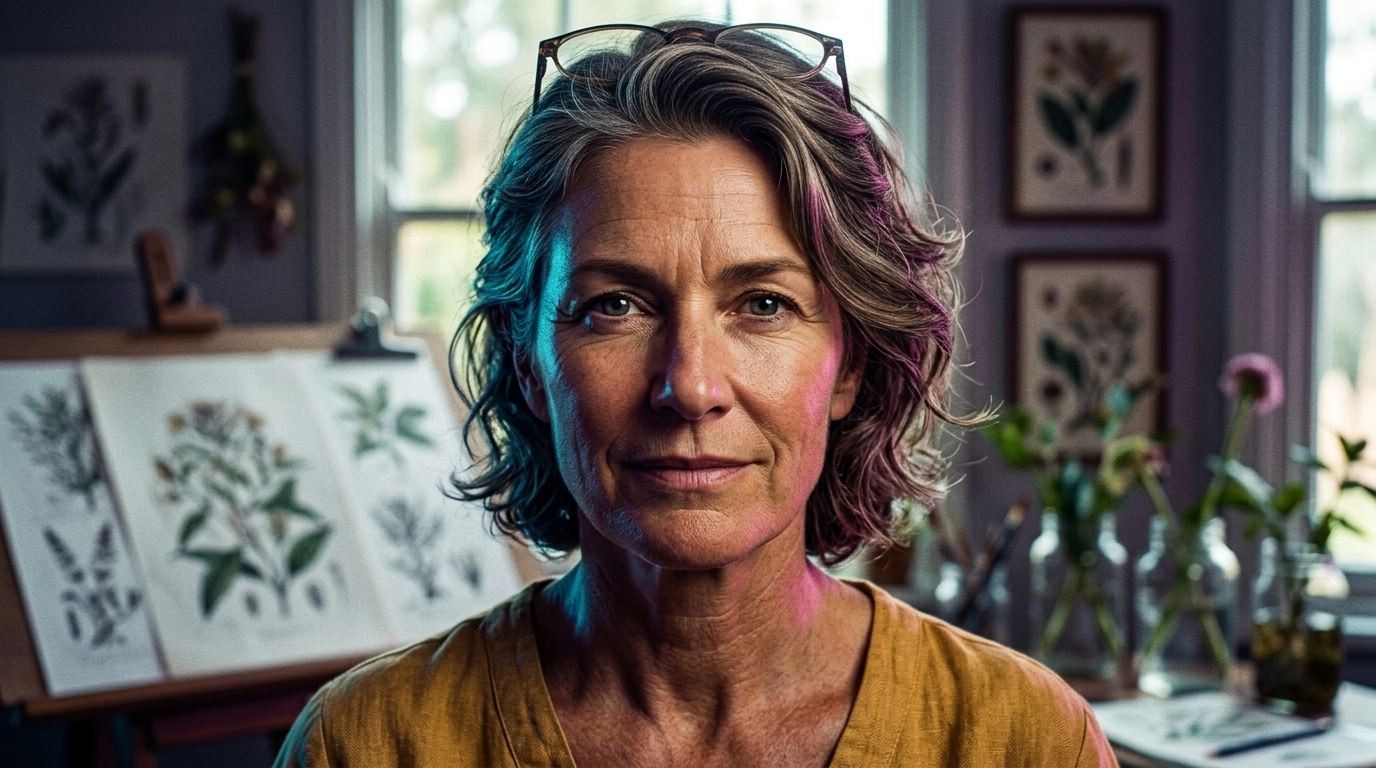
Her Mother's Daughter
Sarah Louise Jennings was born on 5 May 1948 at the Gawler and District Hospital, the second child and only daughter of Edward Charles Jennings, a farmer, and Margaret Fiona Jennings, née Sullivan. She came three years after her brother Brian and three before her brother David, the girl in the middle of a household otherwise given over to men and the land, and from the very beginning she was, unmistakably, her mother's child.
Where Brian had his father's feel for soil and machinery, and David drifted toward the easy margins of family life, Sarah inherited the things in Margaret that the farm had no use for: a quick, bookish mind, a hunger for the world beyond the paddocks, and a deep, instinctive love of growing things. She trailed her mother through the famous rose garden almost as soon as she could walk, learning the names of cultivars and the discipline of pruning, and she read everything in the farmhouse the way Margaret had once read everything in her own father's house — greedily, and as though her life depended on it.
The bond between mother and daughter was the central relationship of Sarah's childhood, closer and more charged than anything either of them had with the men of the family. Margaret, whose own cleverness had been folded young into the demands of a farm, saw in her daughter a second chance — a mind that might yet be let out into the larger life she herself had been denied — and she poured into Sarah an ambition for escape that she had long ago stopped feeling on her own behalf.
It made Sarah, in the family's quiet reckoning, the favourite, and she carried the small privileges and the small isolations of the role. Her brothers knew it and mostly forgave it; her father, who had no particular language for daughters, regarded his clever, restless girl with a baffled and undemonstrative pride. But Edward's traditionalism and his temper grated on Sarah as they never quite did on her brothers, and by the time she was a teenager she had decided, with her mother's silent encouragement, that whatever her life was going to be, it would not be lived in Gawler.
Family Tree
Adelaide
In 1966, at eighteen, Sarah left the farm for Adelaide, and the leaving felt less like a departure than a release. She enrolled at the South Australian School of Art and worked her way through teachers' training, drawn to the one combination that united everything she was: the making of pictures and the teaching that her grandfather Albert had given his life to and her mother had been refused. For a country girl raised among undemonstrative men, the city was a kind of awakening.
She had arrived, as it happened, at the perfect moment. Adelaide in the late 1960s and into the Dunstan years was remaking itself into the most progressive and culturally alive city in the country — a place of galleries and festivals and loosened collars, of new ideas about how a life, and a woman's life in particular, might be arranged. Sarah took to it completely. She found her people among artists and teachers and the mildly bohemian, discovered politics and exhibitions and late arguments over cask wine, and became, within a few years, a confident and fully realised version of the girl who had chafed against the farm.
The change in her was visible to anyone who had known her before. She came home to the farm in those first years subtly altered — sharper in her opinions, freer in her dress, full of names and ideas that meant nothing to Edward and everything to Margaret, who devoured every detail of her daughter's new life as though taking notes on a country she would never visit. Sarah felt the difference keenly each time she returned: the farm grew smaller and quieter with every visit, and she grew surer that she had been right to go. Margaret, for her part, never once suggested she come back.
She qualified as an art teacher and began work in the Adelaide secondary schools, good at it in the way her mother and grandfather had been good at it, but she never once mistook the classroom for the centre of her life. The centre was her own work, and the work, increasingly, was plants.
Peter, and the Name She Kept
It was through Adelaide's tangle of young teachers that Sarah met Peter Hollis, a history master with a dry wit, a wall of books, and the same appetite for argument and ideas that she had lately discovered in herself. They were well matched — two clever, bookish people who had each, in their own way, escaped somewhere smaller — and they married in 1971 in a relaxed Adelaide ceremony that bore no resemblance to anything that had ever taken place at St Peter's in Gawler.
Sarah did not take Peter's name. In 1971 the choice was still mildly scandalous, and she made it without much fuss and without ever fully explaining it, beyond saying that she had spent eighteen years becoming Sarah Jennings and saw no reason to stop. Beneath the lightness of it there was something pointed. Her mother had become Margaret Jennings and vanished, for fifteen years, into another woman's farmhouse and another man's name; Sarah, who loved her mother and had watched the cost of that vanishing at close quarters, was determined that whatever she became, she would remain visibly herself.
The household the two of them built was bookish, companionable, and quietly progressive — the Dunstan-era Adelaide professional life in miniature. Peter taught and marked and argued politics; Sarah taught and painted and gardened; and between them they made a home that was the precise opposite of the silent, exacting one Sarah had grown up in.
Drawing the Living World
Sarah's true vocation announced itself slowly, and then unmistakably. The love of growing things she had absorbed in her mother's rose garden and the eye and hand she had trained at art school fused, across the 1970s, into a single pursuit: botanical illustration. She began by drawing the plants she grew, with the patient precision the form demanded — the exact architecture of a seed-head, the particular curl of a leaf — and she found that she was unusually good at it.
Over the following decades she built a quiet but genuine reputation. Her plates appeared in gardening books and journals, she exhibited, she contributed work connected with the State's botanical collections, and among the people who cared about such things the name Sarah Jennings came to stand for a certain unhurried accuracy and grace on the page. It was never a famous career and never a lucrative one, but it was wholly hers, and it was the thing her mother had been unable to have — a creative life lived out in the open, under her own name, for the world to see.
She kept teaching for most of her working life, shaping a generation of Adelaide schoolchildren with the same brisk, exacting generosity her mother had brought to the district women of Gawler, and she was, by the accounts of her old pupils, the kind of teacher people remembered. But it was the illustration that held her. The work was slow and solitary and asked of her a stillness the rest of her busy life rarely allowed, and she came to treasure the hours at the drawing board above almost any others — the one place where her eye, her hand, and the living thing in front of her were the only things that existed.
In the 1980s Sarah and Peter left the inner suburbs for the Adelaide Hills, settling at Aldgate among the cool-climate gardens and the artists and academics who favoured them. There Sarah made the garden of her life — not her mother's disciplined beds of show roses, but something looser, wilder, and more painterly, a living studio of the plants she drew. In time it became locally celebrated, opened for charity on spring weekends, and stood, for those who knew the family, as the daughter's answer to the mother's roses: the same love, set free.
Claire and Simon
Sarah and Peter had two children. Claire Hollis was born in 1973 and Simon Hollis in 1976, and they were raised in a household that could hardly have been more different from the one Sarah had known — full of books and music and talk, where opinions were expected at the dinner table and the children were treated, from early on, as people whose minds were worth engaging.
Sarah was a warmer and more present mother than Margaret had ever managed to be, though she brought to it the same fierce investment in who her children might become. Claire grew up to study and then to write, settling into an academic life; Simon went into music and the arts, restless and gifted. Both inherited a portion of the family's creative streak, and both, in the easy way of their generation, took the wider world their mother had fought to reach entirely for granted — which was, Sarah understood, precisely the point.
She watched her children grow with a satisfaction edged by a private irony. She had spent her own youth desperate to escape a family that expected her to stay; her children had grown up free to go anywhere and be anyone, and the freedom she had won at such cost was, for them, simply the air they breathed. It was, she thought, the best thing a parent could give and the easiest thing in the world to take for granted, and she did not begrudge them the taking.
Letters to Gawler
Through all of it, the thread that never broke was Margaret. Mother and daughter wrote to each other constantly and telephoned between the letters, and the correspondence — running to hundreds of letters across forty years — became the truest record either of them kept. To her mother Sarah described the exhibitions and the garden and the children; from her mother came the news of Gawler, the weather and the roses and the slow grind of the farm, and, between the lines, the lifelong ache of a clever woman who had never been let out.
There was a quiet guilt threaded through Sarah's devotion. She had escaped and her mother had not; she was, in a real and inescapable sense, living the life Margaret had been denied, and both women knew it and neither ever quite said it. Their closeness was partly that — a daughter carrying, with love, the unlived life of her mother, and sending it back to Gawler in instalments so that Margaret might live a little of it at a distance.
With her brothers Sarah kept warmer and lighter ties. She and David, the two who had left, were natural allies, easy in each other's company and quietly conspiratorial about the family they had both escaped; with Brian, rooted on the farm, she was affectionate but more distant, the gap between her cultured Hills life and his life on the land too wide to cross more than a few times a year. With her father she made a kind of peace, late and incomplete — Edward never understood what his daughter did or why it should matter, but in his old age the baffled pride softened into something she could almost accept as love.
The Cost of Being Closest
The catastrophe of 1997 fell on Sarah as it fell on all of them, but being the closest meant that she carried the most. Her father died at the farmhouse on 15 August, aged seventy-nine; her brother Brian, the steady centre of the family's farming life, died of a heart attack barely three months later, on 18 November, at just fifty-two. Sarah drove the familiar road up to Gawler twice that season for funerals at St Peter's, and watched her mother — widowed, and then bereaved of her eldest child within fourteen weeks — absorb a double blow that would have broken most people.
It was Sarah who carried the greater part of what came after. Across the fifteen years of Margaret's widowhood she was the one who came most often, who telephoned most nights, who managed the slow administration of an old woman's decline from eighty kilometres away — the daughter's labour that fell, as it so often did, to the favourite and the female. She did it with love and without complaint, but it cost her years and a great deal of herself, and it drew the two women, in Margaret's last decade, closer than they had ever been.
Her sister-in-law Patricia died in 2002. And on 20 September 2012 Margaret died, at the age of eighty-nine, and the loss undid Sarah more completely than any other in her life. Her mother had been her first reader, her closest confidante, the source of much of what she was and the recipient of nearly everything she made; for sixty-four years there had been no version of Sarah that did not include Margaret at the other end of a letter. When the letters stopped, a silence opened in her that nothing ever entirely filled.
Late Light
Peter died in 2016, after a marriage of forty-five years, and Sarah found herself, in her late sixties, alone in the Hills house with her garden and her work. She had watched her mother survive a long widowhood and had taken something from it about how a person goes on; she went on. She kept drawing, kept the garden, kept the wide circle of friends that a long and generous life had earned her, and let her children and grandchildren fill the house at the weekends.
Her grandchildren — Claire's and Simon's children — became one of the late delights of her life, and she drew them into the garden as her own mother had once drawn her, teaching them the names of plants and putting pencils into their hands. It was the double inheritance of art and growing things, handed down now into a fourth generation that would carry it who knew where, and watching it take in them was as close as Sarah came, in her old age, to a sense of the line continuing.
Her relationship to the farm settled, in old age, into a fond and unburdened distance. She drove up to Gawler to see her niece Anne, who had taken the property and kept it whole, and she walked the paddocks of her childhood with none of the old need to flee them — they were simply, now, the place she had come from, neither a prison nor a home, and she had made her peace with having left. She and David, the last two of Edward and Margaret's three children, grew if anything closer in old age, two survivors comparing notes on a vanished family across the suburbs that lay between them.
In the long account of it, Sarah had done the thing her mother never could: she had taken the gifts the two of them shared and lived them fully and openly, out in the world, under her own name. She had a body of work, a garden that strangers travelled to see, children who had inherited her freedom, and the hard-won, quietly held knowledge that the restless girl who had fled Gawler in 1966 had been right about herself all along. By any measure she cared about, it had been a life entirely her own.







