Sarah Francine Ironbach
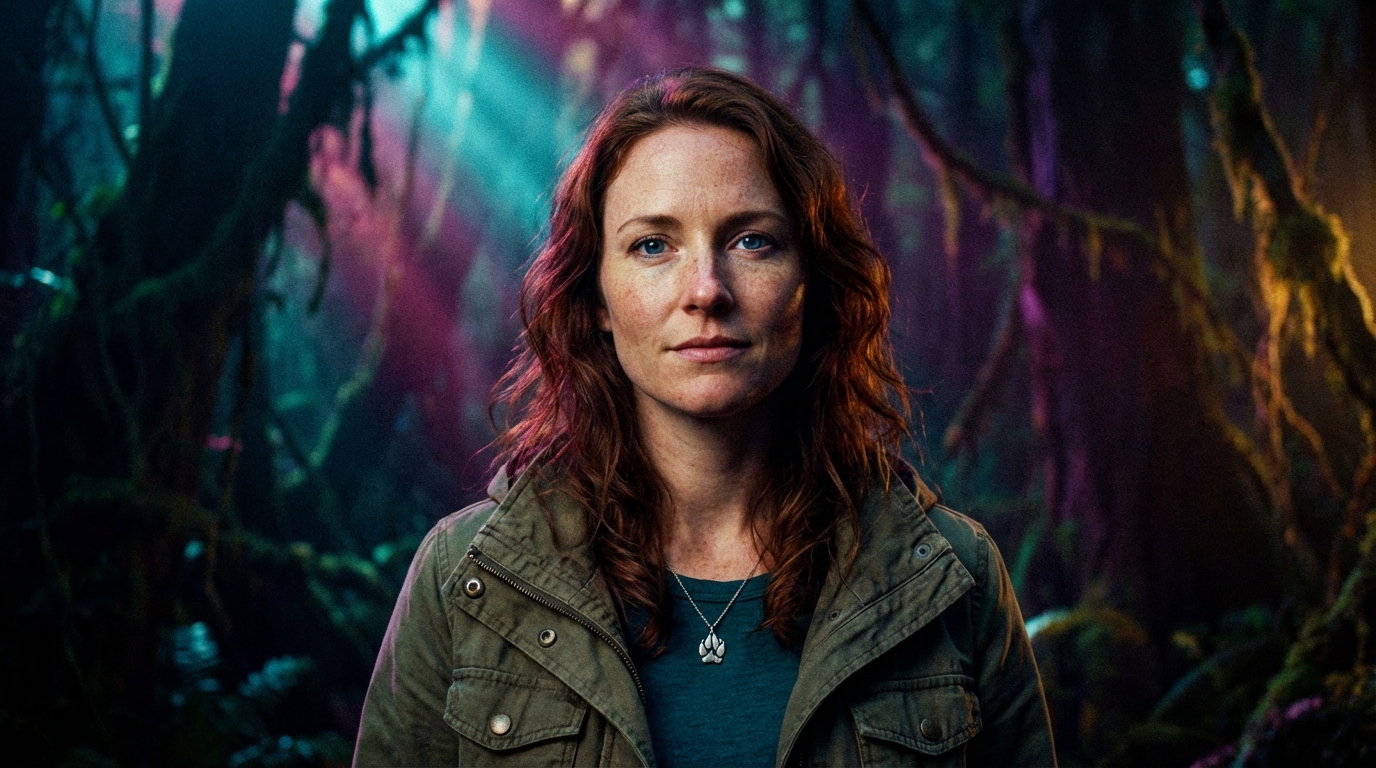
Sarah Francine Ironbach, born 22 June 1985 in Hobart, Tasmania, is a wildlife conservationist who served as Assistant Director of Bonorong Wildlife Sanctuary from 2016. Her career included roles with Tasmania Parks and Wildlife Service, Australian Wildlife Conservancy, and Zoos Victoria. In July 2018, a case of mistaken identity led Sarah and her brother Grant through a Portal to Clivilius, where she now contributes to the Bixbus Wildlife Sanctuary.
Birth and Family Origins
Sarah Francine Ironbach was born on 22 June 1985 in Hobart, Tasmania, the second child of Thomas and Margaret Ironbach. From her earliest days, she occupied a particular position in the family constellation—the younger sibling trailing two years behind a brother who had already claimed the role of nature enthusiast before she could walk. Grant had established the template; Sarah would spend much of her life navigating between following his path and forging her own.
Thomas and Margaret Ironbach created a household where environmental passion was assumed rather than cultivated, where weekend hikes and wildlife observation formed the unremarkable fabric of ordinary life. For Sarah, this meant growing up in her brother's wake, joining expeditions he had already pioneered, learning species names he had already memorised. The dynamic shaped her in ways she would only later recognise—fostering both deep connection with Grant and a quiet determination to be more than his echo.
The family home sat within reach of Tasmania's forests and coastlines, landscapes that became Sarah's classroom long before formal education began. Yet where Grant approached nature with cataloguing precision, Sarah developed a different relationship with the wilderness. She noticed not just species but moods—the way light changed a forest's character, how weather altered animal behaviour, the emotional resonance of places that scientific observation could not capture. This sensitivity would eventually find expression in creative pursuits that distinguished her from her more analytically oriented brother.
Childhood and Early Education
Growing up in Hobart during the late 1980s and early 1990s, Sarah learned early that being second meant working harder to be noticed. Grant's exceptional interest in environmental studies had already impressed teachers and parents alike; Sarah's similar inclinations, though genuine, inevitably drew comparisons. She responded not with resentment but with a characteristic strategy that would define her adult life: she found her own angle, her own way of engaging with the same material that made her contributions distinctly hers.
Where Grant observed and recorded, Sarah felt and connected. She would often accompany her parents on field excursions, but her attention wandered from the scientific objectives toward the stories she imagined animals living, the personalities she attributed to creatures her brother classified with Latin names. Teachers at St Michael's Primary School noted her dedication to environmental topics, but also observed something her brother lacked—an ability to make other children care about wildlife through the enthusiasm of her explanations rather than the weight of her facts.
By the time Sarah reached Hobart High School, she had developed the social instincts that would characterise her professional life. She excelled in biology and environmental science, but she also discovered talents Grant had never pursued. A secondhand guitar, purchased with birthday money when she was fourteen, became her private refuge—a space where she could process experiences through melody rather than analysis. She wrote her first songs about the Tasmanian wilderness, clumsy compositions that nonetheless revealed a mind seeking expression beyond scientific frameworks.
Her teachers recognised intellectual capability alongside something harder to quantify: a warmth that drew people toward her causes. Sarah learned that conservation required not just knowledge but persuasion, not just data but emotional connection. This insight would shape her career trajectory, distinguishing her approach from Grant's more research-oriented path even as they pursued parallel professions.
University Education
In 2002, Sarah enrolled at the University of Tasmania to pursue a Bachelor of Environmental Science. The choice felt inevitable—Grant had graduated from the same programme three years earlier with honours, and the path lay clearly marked. Yet Sarah brought her own preoccupations to the familiar curriculum. While her brother had studied Tasmanian devil habitat preferences, Sarah found herself drawn to messier questions about the boundaries between human and wild spaces.
Her undergraduate years at the Sandy Bay campus combined academic rigour with growing awareness that her interests diverged from the pristine wilderness focus dominating conservation discourse. She noticed the birds adapting to suburban gardens, the possums colonising roof spaces, the complex negotiations occurring wherever human development pressed against native habitat. These observations germinated into research questions that would define her scholarly contribution.
Her honours thesis examined the impact of urban development on local bird populations—work that earned significant praise but also revealed her particular perspective. Where traditional conservation often treated human presence as contamination to be minimised, Sarah's research acknowledged the reality of coexistence. The project demanded patience and methodical observation, qualities she possessed, but also required her to sit with uncomfortable ambiguities rather than clear conclusions. Some species thrived in altered landscapes; others vanished. The patterns resisted simple narratives of loss or adaptation.
Sarah graduated with honours in 2005, her academic performance matching her brother's whilst her intellectual focus carved distinct territory. She continued to Charles Sturt University in New South Wales for a Master of Wildlife Conservation, expanding her examination of urban conservation challenges. Her postgraduate research pushed further into the compromised landscapes where most Australians actually encountered wildlife—not remote wilderness but backyards, parks, and the ragged edges where suburbs met bush.
The thesis earned distinction upon graduation in 2008, establishing Sarah's scholarly credentials whilst confirming her orientation toward the practical complexities that pure research often avoided. She returned to Tasmania equipped for professional work, though uncertain whether her path would forever parallel Grant's or eventually diverge toward something entirely her own.
Specialised Training and Early Career
In 2009, Sarah made a choice that reflected her particular understanding of conservation. While academic credentials opened doors to research positions, she enrolled at the Taronga Training Institute in Sydney for a Certificate in Wildlife Rehabilitation. The decision prioritised hands-on healing over theoretical advancement—learning to splint broken wings and formula-feed orphaned possums rather than publishing papers about population dynamics.
The training transformed her relationship with conservation work. Academic study had taught her to think about wildlife in aggregate—populations, habitats, statistical trends. Rehabilitation taught her to focus on individuals: this particular possum with this specific injury requiring this precise intervention. The intimacy of the work suited her temperament, satisfying emotional needs that research alone could not address. She discovered she possessed steady hands and unusual patience for the repetitive, often heartbreaking labour of helping creatures that frequently died despite her best efforts.
Following certification, Sarah began professional work as a Wildlife Conservation Officer with the Tasmania Parks and Wildlife Service, a position she held from 2009 to 2012. The role demanded versatility—conducting surveys, monitoring endangered species, developing management plans—but Sarah distinguished herself through community engagement. She possessed a gift for translating complex ecological concepts into language that moved people to action, for making suburban residents care about species they had never noticed in their own gardens.
Her next position, as Senior Wildlife Officer with the Australian Wildlife Conservancy from 2012 to 2014, expanded her responsibilities to include leading field teams and coordinating habitat restoration. The leadership role revealed both capabilities and limitations. Sarah could inspire colleagues and build team cohesion, but she sometimes struggled with the administrative demands that accompanied authority. Paperwork accumulated on her desk while she prioritised field time; deadlines occasionally slipped while she attended to the immediate needs of animals or team members in difficulty.
Throughout these years, she continued professional development—Advanced Field Research Techniques in 2010, Leadership in Conservation training in 2013—whilst maintaining the creative practices that kept her emotionally grounded. Her guitar travelled with her to field stations; her photography captured not just species documentation but the aesthetic qualities of landscapes she feared might not survive the pressures she studied daily.
Zoos Victoria and Return to Tasmania
In 2014, Sarah joined Zoos Victoria as a Conservation Programme Coordinator, a position that tested her adaptability. The institutional scale dwarfed anything she had previously experienced—international partnerships, captive breeding programmes for critically endangered species, educational initiatives reaching hundreds of thousands of visitors annually. The orange-bellied parrot programme demanded her attention alongside numerous other threatened species, each with its own constituency of supporters, researchers, and institutional stakeholders.
The role stretched her capabilities in directions she had not anticipated. Sarah excelled at the work's emotional dimensions—connecting with volunteers, inspiring donors, crafting messages that made distant species feel urgent and personal. She struggled more with the political navigation that large institutions required, the careful management of competing interests and egos that consumed energy she would rather have directed toward animals. Two years at Zoos Victoria taught her that she thrived in settings where she could build direct relationships rather than manage abstract systems.
When the opportunity arose in 2016 to return to Tasmania as Assistant Director of Bonorong Wildlife Sanctuary, Sarah accepted with relief that surprised her. The position meant working alongside Grant, who had become Director the previous year—a return to the sibling dynamic she had spent her career both embracing and resisting. Yet Bonorong's scale suited her gifts. The sanctuary was large enough to matter, small enough to know every animal individually, intimate enough to build the personal connections that gave her work meaning.
The title—Assistant Director—carried implications she tried not to examine too closely. Once again she occupied the supporting role, the second position, the capable complement to her brother's leadership. She told herself the designation reflected timing and experience rather than capability, that the work mattered more than the hierarchy, that she preferred operational engagement to strategic abstraction anyway. These rationalisations were mostly true, which made the residual discomfort easier to suppress than resolve.
At Bonorong, Sarah oversaw daily operations with the attention to individual needs that characterised her rehabilitation training. She managed staff and volunteers, developing training programmes that transmitted not just technical skills but the emotional resilience required for work involving constant exposure to suffering and loss. Her community outreach initiatives reflected years of learning what moved people—stories rather than statistics, individual animals rather than population data, invitation rather than guilt.
The Portal and the Unravelling
July 2018 began unremarkably. A visitor named Luke arrived at Bonorong for a guided tour, and Sarah thought nothing of the encounter until its aftermath upended everything she understood about her life.
The sequence of events that followed still carried the quality of nightmare when she later reconstructed it. Grant had mistaken Luke for someone named Brad, and rather than clarifying the confusion, the conversation had escalated into discussions of a new sanctuary project requiring immediate assessment. Sarah's enthusiasm—her characteristic eagerness to embrace opportunities, her readiness to trust—had helped propel the misunderstanding forward. She had packed bags, reviewed preliminary designs, radiated excitement that in retrospect seemed painfully naive.
The Portal itself defied the categories her scientific training provided. One moment she stood in familiar Tasmanian landscape; the next, she and Grant had stepped into somewhere that should not exist. Her first response was wonder rather than fear—the same openness that had served her well in fieldwork, the willingness to encounter the unexpected without defensive withdrawal. Only later would she recognise how that very openness had made her vulnerable to manipulation she could not have anticipated.
They arrived in Clivilius believing themselves participants in an extraordinary professional opportunity. A two-week site assessment, they understood. Then home to Bonorong, to Tasmania, to the life they had built and the parents who expected their return. Sarah discussed timelines and species requirements with genuine passion, her expertise lending credibility to an arrangement constructed entirely on deception. The irony would later seem almost cruel: her professional competence had helped legitimise the fiction that trapped her.
The Shattering and Its Aftermath
The truth emerged in fragments rather than revelation. Sarah noticed inconsistencies before she understood their significance—the way conversations shifted when she mentioned returning home, the careful management of information that in retrospect formed a pattern of concealment. When full understanding finally arrived, it came not as single blow but as accumulating weight that eventually became impossible to deny.
She could not go home. The Portal that had brought her to Clivilius would not return her to Earth. The two-week assessment had become permanent exile. Everything she had known—her position at Bonorong, her rehabilitation work, her parents who would never learn what had become of their children, her guitar students in Hobart, her morning walks along the Derwent—existed now only in memory, inaccessible as the past always is but with the particular cruelty of severance rather than natural conclusion.
Grant processed the revelation through action, channelling shock into productive engagement with Bixbus's development. Sarah's response followed a different pattern. She withdrew into the creative practices that had always provided refuge, spending hours with the guitar she had somehow thought to pack for a two-week trip. The songs she wrote during those early weeks were too raw to share—grief made musical, rage finding melody, the particular anguish of trust betrayed by people who believed themselves kind.
The adjustment came unevenly. Some days Sarah functioned with apparent normalcy, contributing her expertise to sanctuary planning discussions, building relationships with Bixbus residents who had experienced their own dislocations. Other days the loss overwhelmed her, and she retreated to whatever privacy the small settlement afforded. Karen Owen, tasked with helping the Ironbachs integrate, witnessed both modes—the luminous warmth Sarah could project and the darker passages she tried to conceal.
What complicated Sarah's grief was her own complicity in the deception that had trapped her. Her enthusiasm had helped make the impossible seem plausible. Her trust had enabled manipulation. The guilt tangled with anger in ways she struggled to separate, leaving her uncertain whether to blame Luke and Paul and the settlement's other knowing participants, or herself for the credulity that had made her such easy prey.
Finding Ground in Bixbus
Recovery, when it came, arrived through the same channels that had always sustained her. Sarah began photographing Clivilius's alien landscapes, finding in the unfamiliar terrain a strange echo of the wonder that had first drawn her to conservation. She started writing songs again—different from the grief compositions, these pieces attempted to capture the peculiar beauty of a world she had not chosen but could not escape. Around campfires, she shared stories of Bonorong that transformed painful memories into gifts she could offer the community that had become her only home.
Her expertise proved genuinely valuable to the sanctuary development taking shape in late 2018. Where Grant provided strategic direction, Sarah contributed the operational knowledge that translated vision into functional systems. Her understanding of animal care informed enclosure designs; her experience with volunteer management shaped staffing approaches; her community engagement skills helped build support for conservation work among settlers preoccupied with more immediate survival concerns.
The Bixbus Wildlife Sanctuary groundbreaking ceremony in late August 2018 marked a turning point she had not anticipated. Standing beside Grant as construction began, Sarah felt something shift in her relationship with circumstance. The sanctuary would not replace Bonorong—nothing could—but it represented genuine purpose in a situation that had initially seemed to offer only loss. Her skills would serve life in this dimension as they had on Earth, perhaps reaching species and ecosystems that no other conservationist would ever encounter.
Project Terra Nova, the covert operation connecting Earth expertise to Clivilius conservation, gave her work dimensions she could not fully comprehend. The larger strategic considerations remained abstract to her, but the immediate reality was concrete enough: animals needed care, habitats needed protection, and she possessed capabilities directly applicable to both. The meaning she found was personal rather than ideological, grounded in individual creatures rather than grand narratives about dimensional relations.
Character and the Shape of a Life
Those who know Sarah in Bixbus describe someone whose warmth feels earned rather than performed—the quality of presence that emerges from having survived genuine difficulty and chosen connection anyway. Her openness, once naive, now carries awareness of its costs. She still trusts more readily than caution might advise, but the trust comes accompanied by clear-eyed recognition of vulnerability rather than innocent assumption of safety.
Her creative practices remain central to her identity. The guitar appears at community gatherings, her songs providing soundtrack for a settlement building its own traditions. Her photography documents Bixbus's development with an eye for beauty that scientific records cannot capture. These artistic expressions serve functions beyond personal satisfaction—they help create the emotional texture of community life, offering settlers access to feelings that practical concerns might otherwise suppress.
The relationship with Grant has evolved through shared displacement. The sibling dynamic that once carried subtle tensions has transformed into partnership grounded in mutual dependence and hard-won appreciation. Sarah no longer measures herself against her brother's achievements; the comparison seems irrelevant when both have lost everything except each other. Working alongside him at the Bixbus sanctuary, she has found peace with the supporting role that once chafed, recognising that her contributions matter regardless of whose name appears first on organisational charts.
She maintains the sustainable practices that characterised her Earth life, though their meaning has shifted. Eco-friendly habits once oriented toward planetary conservation now serve community resilience in a settlement where resources remain precious. Her advocacy for environmental stewardship finds new context in Bixbus, where human presence is recent enough that choices made now will shape ecosystems for generations.
The 2020s and Continuing Work
By the mid-2020s, Sarah had grown into her Bixbus identity in ways she could not have imagined during the raw early months. The sanctuary she helped establish had developed beyond improvised beginnings into genuine conservation facility, her operational expertise evident in systems functioning smoothly enough to become invisible. The animals in her care—species unlike anything her Tasmanian training had prepared her to encounter—received attention informed by decades of rehabilitation experience adapted to entirely new circumstances.
Her photography had begun documenting not just landscapes but the community itself—portraits of settlers, images of celebrations and mourning, visual records of a society taking shape in real time. The work served historical purposes, but also reflected her characteristic orientation toward individuals rather than abstractions. Each photograph captured specific persons in particular moments, countering the anonymity that survival pressures might otherwise impose.
The grief for Earth never fully resolved, but it transformed into something she could carry rather than something that carried her. She thought of Thomas and Margaret Ironbach, her parents who would grow old and eventually die without knowing what had become of their children. She thought of the guitar students she had abandoned without farewell, the rehabilitation cases left to other hands, the particular Tasmanian light she would never see again. These losses remained, but they no longer paralysed. They had become part of who she was rather than obstacles to becoming anyone at all.







