Sarah Agnes Baker (née Parsons)
Sarah Parsons, born 11 January 1802 near Sydney, New South Wales, served as kitchen maid at Jeffries Manor, Van Diemen's Land, from 1821. Though naturally timid, her remarkable diligence and keen observational skills made her indispensable to the household's daily operations. Her testimony about the heated argument between William Jeffries Sr. and Nathaniel Blackburn on 9 August 1821 provided crucial evidence in the investigation of William's mysterious disappearance, establishing her as an unlikely yet vital witness to one of colonial Tasmania's greatest mysteries.
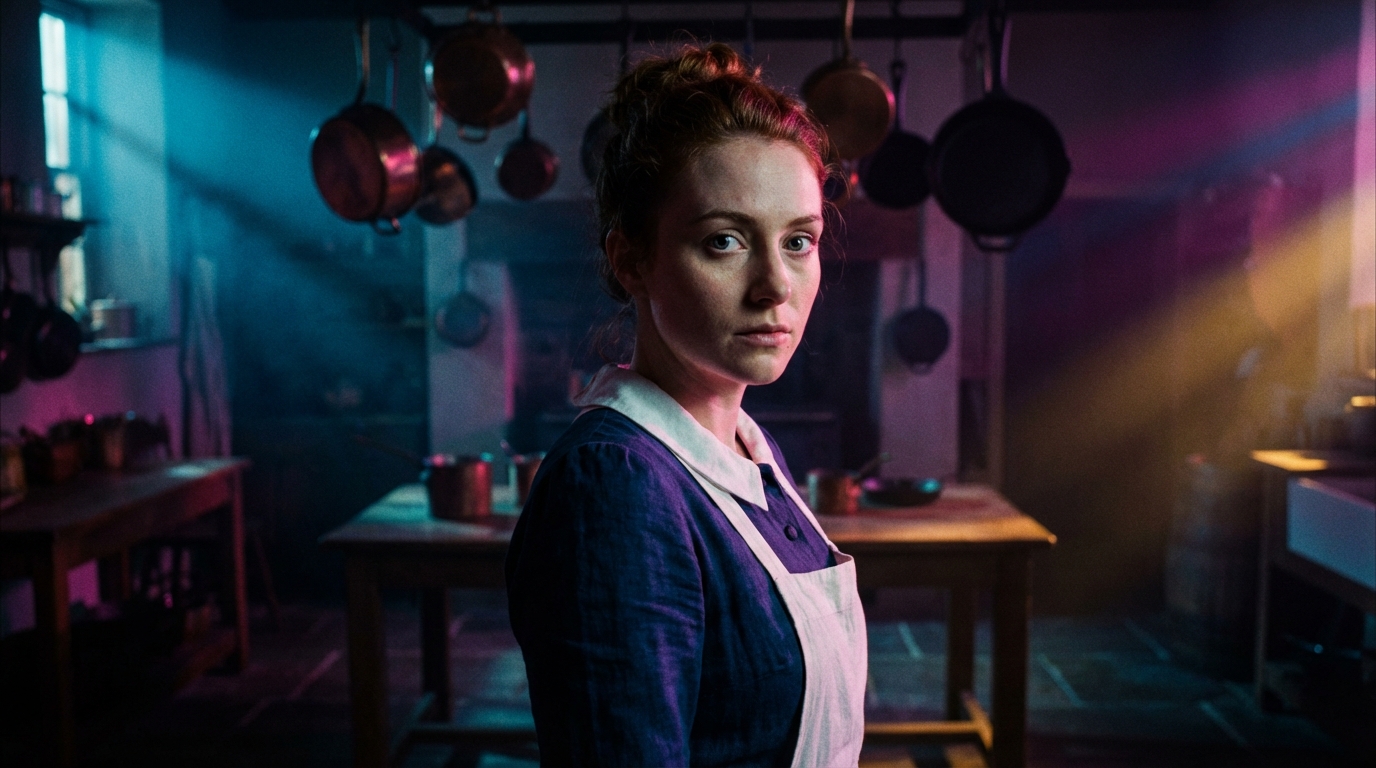
Sydney Beginnings
The settlement of Sydney in the early 1800s existed in that peculiar state between penal colony and emerging city, its population a volatile mixture of convicts, ex-convicts, free settlers, and the native-born currency lads and lasses who knew no other home. Into this world, on the 11th of January 1802, Sarah Agnes Parsons was born in a modest dwelling near the harbour where her father, Henry Parsons, worked as a labourer loading and unloading the ships that constituted Sydney's lifeline to the wider world.
Henry's work was brutally physical—hauling cargo from ships' holds, manhandling barrels and crates across wharves slick with seawater and fish scales, earning wages that never quite stretched far enough to provide security against the unemployment that struck unpredictably whenever shipping slowed. His body bore the accumulated injuries of his trade—a permanently damaged shoulder from when a barrel had slipped its rope and crashed into him, a limp from the time a dropped crate had crushed his foot, scars and aches that multiplied with each passing year.
Agnes Parsons, Sarah's mother, managed their household with the resourcefulness that working-class survival demanded. She took in washing and mending, tended a small kitchen garden behind their dwelling, and stretched Henry's uncertain wages across the needs of four children—Sarah, her elder brother Thomas, and younger sisters Mary and Catherine. The family occupied three rooms in a building that housed five other families, their lives unfolding in close proximity to neighbours whose struggles mirrored their own.
Sarah, as the eldest daughter, assumed responsibilities from an age when more fortunate children were still playing with dolls. By six years of age, she was helping Agnes with the washing, minding her younger sisters, and learning the domestic skills that would eventually provide her escape from Sydney's overcrowded poverty. She possessed a quiet nature that her parents initially worried marked timidity but that revealed itself as careful observation—Sarah watched, listened, learned, and remembered everything with a precision that would later prove invaluable.
The family's connection to the Methodist chapel near the Rocks district provided both spiritual sustenance and practical benefits. The congregation included several free settlers whose households occasionally required domestic help, creating opportunities for working-class girls who demonstrated reliability and competence. Agnes ensured that Sarah attended chapel regularly, understanding that such connections might prove Sarah's pathway to better circumstances than the Parsons family's hand-to-mouth existence offered.
Sarah's education consisted of sporadic attendance at a dame school run by a widow who charged minimal fees for basic literacy instruction. Sarah absorbed reading and writing skills quickly, her careful mind grasping concepts that eluded other students. Yet her education remained rudimentary—enough to read the Bible and write simple letters, but nothing approaching the accomplishments expected of young ladies from prosperous families. What Sarah possessed instead was practical intelligence combined with work ethic inherited from parents who had survived through sheer determination.
Early Service
At sixteen years of age, Sarah secured her first position in domestic service through chapel connections. Mrs Beatrice Whitmore, a merchant's wife whose household occupied a substantial residence in Sydney's better neighbourhoods, sought a maid willing to work hard for modest wages. Sarah's interview with Mrs Whitmore revealed the gulf separating her world from that of her prospective employer—furnishings whose cost exceeded the Parsons family's annual income, rooms dedicated to single purposes, servants whose numbers seemed extravagant to someone raised in three-room quarters shared with nine people.
Mrs Whitmore's assessment focused less on Sarah's limited experience than on her character and potential. The girl presented herself neatly despite shabby clothing, answered questions directly without false modesty or exaggeration, and demonstrated through small gestures the careful attention to detail that suggested capability beyond her years. Mrs Whitmore, herself risen from modest circumstances, recognised in Sarah qualities worth cultivating—natural tidiness, willingness to learn, and the quiet determination visible in someone who understood that service offered opportunities unavailable otherwise.
The Whitmore household operated according to standards that initially overwhelmed Sarah. Mrs Whitmore demanded excellence without compromise—floors scrubbed until no trace of dirt remained, silver polished to brilliant shine, meals served punctually according to strict schedule, every task completed thoroughly regardless of the time required. The work exhausted Sarah utterly, her days beginning before dawn and extending late into evening, her hands developing calluses and her back aching from constant labour.
Yet Sarah thrived under Mrs Whitmore's demanding tutelage. The structure and clear expectations suited her temperament, whilst the recognition earned through competent performance provided satisfaction her family's desperate circumstances had never allowed. Mrs Whitmore noticed Sarah's potential, teaching her skills beyond basic maid duties—how to preserve foods properly, how to manage linens to maximum longevity, how to detect and prevent household waste, how to anticipate rather than merely react to needs.
The three years Sarah spent in the Whitmore household transformed her from inexperienced girl into capable domestic servant. She learned to move through rooms almost invisibly, completing necessary work without disrupting the family's routines. She developed the servant's crucial skill of observing everything whilst appearing to notice nothing, absorbing information about the household's rhythms and its members' preferences that allowed her to serve more effectively. And she saved her wages with disciplined frugality, sending portions to her parents whilst accumulating modest reserve against future uncertainty.
The Tasmanian Opportunity
In early 1821, Mrs Whitmore received correspondence from Elizabeth Harrington, a distant cousin who served as housekeeper at a grand colonial estate in Van Diemen's Land. Elizabeth's letter mentioned that the household required a kitchen maid, someone young and willing to adapt to colonial circumstances, someone whose capabilities exceeded mere physical labour. Mrs Whitmore immediately thought of Sarah, recognising that the nineteen-year-old possessed exactly the qualities Elizabeth sought.
The proposition that Mrs Whitmore presented to Sarah carried both opportunity and risk. Van Diemen's Land remained rougher than Sydney, its penal settlement character more pronounced, its social structures less established. Yet the wages Elizabeth offered exceeded what Sarah could earn in Sydney, the position promised exposure to household management at higher levels than Sydney service typically provided, and the very remoteness that made others hesitate appealed to Sarah's desire for genuine change in her circumstances.
Sarah consulted her parents, understanding that accepting meant separation that might prove permanent. Agnes wept at the prospect of losing her eldest daughter yet urged acceptance, recognising that opportunities like this arrived rarely for working-class girls. Henry, more pragmatic, calculated that Sarah's increased wages would allow her to send home more substantial sums whilst establishing herself in ways Sydney would never permit. Her siblings regarded the prospect with mingled envy and concern—Sarah had always been their steady presence, and her departure would create void difficult to fill.
The decision took Sarah little time. She accepted Mrs Whitmore's recommendation and Elizabeth's offer, arranging passage aboard a merchant vessel sailing to Hobart Town in May 1821. Mrs Whitmore provided glowing references attesting to Sarah's character and capabilities, practical advice about colonial service, and small gifts that acknowledged the affection their three years together had generated despite class boundaries. Sarah departed Sydney with a single trunk containing her modest possessions, a heart full of hope tempered by realistic understanding that the future remained fundamentally uncertain.
The voyage across Bass Strait proved mercifully brief compared to longer ocean crossings, yet even short sea journeys tested passengers unused to maritime travel. Sarah endured seasickness with stoic resignation, remaining below decks except when fresh air became absolutely necessary, grateful when the ship finally anchored in Hobart's harbour after several days of uncomfortable passage.
Jeffries Manor
Sarah's first sight of Jeffries Manor struck her with awe bordering on intimidation. The Georgian sandstone structure announced wealth and ambition beyond anything she had encountered in Sydney's merchant households. The estate's grounds sprawled across acres of carefully maintained lawns and gardens, the house itself contained more rooms than Sarah could initially comprehend, and the domestic operations required coordinating efforts of staff whose numbers exceeded entire families she had known.
Elizabeth Harrington interviewed Sarah within hours of her arrival, assessing the young woman whom Mrs Whitmore had recommended so warmly. Elizabeth's reputation as Van Diemen's Land's finest housekeeper preceded her, and Sarah approached the interview with nervousness that made her stammer slightly when answering questions. Yet Elizabeth recognised beneath Sarah's timidity the qualities that Mrs Whitmore had praised—genuine capability, willingness to work without complaint, and the careful attention to detail that distinguished superior servants from merely adequate ones.
Elizabeth's decision to hire Sarah came swiftly. The housekeeper had learned to trust her own assessments of character, and Sarah's earnest responses combined with Mrs Whitmore's references satisfied her that this girl would integrate successfully into Jeffries Manor's demanding household operations. Sarah received immediate assignment to kitchen duties under the supervision of the cook, a formidable woman named Mrs Dorothy Vale who ruled her domain with iron discipline tempered by genuine expertise.
The manor's kitchen operated on a scale that initially overwhelmed Sarah completely. The enormous fireplace could accommodate multiple pots simultaneously, the larder contained provisions sufficient to feed dozens of people, and the daily meals required coordinating complex preparations that transformed raw ingredients into elaborate dishes suitable for the Jeffries family's elevated expectations. Mrs Vale expected perfection without compromise, her standards matching Elizabeth Harrington's own exacting requirements.
Sarah's duties began at the lowest level—scrubbing pots until her hands turned raw, peeling endless mountains of vegetables, maintaining fires at precise temperatures, fetching water and supplies, cleaning work surfaces and floors until they gleamed. The work demanded stamina she hadn't known she possessed, her days extending from before dawn until well past dusk, her brief rest periods barely sufficient to recover before the next shift's demands began. Yet she endured through sheer determination, understanding that she had gambled everything on this position and that failure was unconscionable.
Finding Her Place
Through the summer months of 1821, Sarah gradually established herself within Jeffries Manor's household hierarchy. Her natural timidity meant she spoke little unless addressed directly, preferring observation to conversation, yet this very quietness made her nearly invisible in ways that senior staff appreciated. She moved through the kitchen with practiced efficiency, anticipating needs before they were voiced, completing assigned tasks thoroughly and punctually, never complaining despite the exhausting demands.
Her relationship with Elizabeth Harrington developed slowly but positively. The housekeeper noticed Sarah's competence, her reliability, and her capacity to absorb instruction quickly. When Elizabeth occasionally visited the kitchen to discuss meal planning with Mrs Vale, she observed Sarah's careful work, noting the attention to detail that characterised even simple vegetable preparation. These observations reinforced Elizabeth's initial assessment—here was a girl who would serve the household well if given opportunity and proper guidance.
With the other servants, Sarah maintained cordial but somewhat distant relationships. Her quiet nature and youth made her seem almost childlike to some of the senior staff, yet her consistent competence earned respect that mere friendliness could never have generated. She learned the household's complex social dynamics—who held real authority versus who merely claimed it, which servants could be trusted versus which gossiped maliciously, how to navigate relationships without becoming entangled in the petty conflicts that inevitably arose when people lived and worked in close proximity.
The Jeffries family itself remained largely abstract to Sarah. As kitchen maid, she rarely encountered Madelyn Jeffries or young William Jr. directly, her contact with the family limited to preparations for meals she never served and cleaning spaces she occupied only when the family was absent. Yet she absorbed information about them through the servants' network—Madelyn's increasing strain as William Sr.'s behaviour grew more troubling, the household's mounting tensions, the sense that something indefinable but deeply wrong was occurring behind the manor's elegant façade.
The Fateful Afternoon
On the afternoon of 9 August 1821, Sarah was performing her usual duties in the manor's large kitchen—preparing vegetables for the evening meal, a task that required hours of careful peeling and chopping to produce sufficient quantities for the household's needs. The kitchen's location in the manor's east wing meant that sounds from other parts of the house sometimes carried faintly, particularly when voices were raised in anger or distress.
Near 3:00 PM, whilst Sarah worked at the large preparation table, she heard raised voices emanating from William Sr.'s study on the floor above. The argument was distinctive enough to penetrate even the kitchen's usual bustle, its intensity arresting Sarah mid-task. She paused, knife hovering over the turnip she was peeling, instinctively alert to sounds that suggested household disturbance beyond ordinary irritation.
Though Sarah could not distinguish specific words through the kitchen's thick ceiling and the distance separating her from the study, she recognised the voices' character—one belonged unmistakably to William Sr., whose distinctive cadence Sarah had heard often enough to identify. The other voice possessed a rougher quality, tinged with anger barely contained, and Sarah's immediate instinct identified it as belonging to Nathaniel Blackburn, the convict blacksmith whose fierce temper had become known throughout the household staff.
The argument continued for several minutes before ceasing abruptly, leaving silence that seemed almost louder than the previous shouting. Sarah stood frozen, uncertain whether to mention what she had heard to Mrs Vale or Elizabeth Harrington, torn between natural reluctance to insert herself into matters beyond her station and vague sense that this argument carried implications extending beyond typical household disputes.
She ultimately said nothing, returning to her vegetable preparation whilst the overheard argument troubled her thoughts. Her natural timidity combined with reasonable uncertainty about what the argument signified—masters and servants argued occasionally, even convict labourers sometimes had legitimate grievances requiring heated discussion, and Sarah possessed no context for judging whether this particular argument represented genuine crisis or merely routine tension.
The Investigation
The discovery of William Sr.'s disappearance the following morning transformed Sarah's overheard argument from potentially insignificant detail into crucial evidence. When Constable Broadmoor began systematically interviewing household staff, Elizabeth Harrington ensured that every servant, regardless of seniority, provided testimony about the days preceding William's vanishing. Sarah found herself summoned to the morning room where Broadmoor conducted his methodical questioning.
The constable's presence intimidated Sarah profoundly. She had never directly interacted with law enforcement authorities, her working-class background instilling deep wariness of police whose primary encounters with people of her station typically involved suspicion rather than protection. Broadmoor's tall frame, piercing blue eyes, and naval bearing suggested authority Sarah found overwhelming, her natural shyness intensifying until her voice emerged as barely audible whisper.
Yet Broadmoor possessed skills refined through decades of investigation. He recognised Sarah's genuine timidity and adjusted his approach accordingly, speaking gently and encouraging rather than demanding answers. He asked about her duties, her observations over recent days, whether she had noticed anything unusual about the household's rhythms or the master's behaviour. Sarah answered haltingly, describing her kitchen work and admitting that she observed little beyond her immediate duties.
Then Broadmoor asked specifically about Saturday afternoon, whether Sarah had noticed any disturbances or overheard anything significant. The question unlocked Sarah's reluctant testimony. She described the heated argument she had heard emanating from William's study, her certainty that one voice belonged to William Sr. whilst the other seemed to be Nathaniel Blackburn's, though she cautioned that she couldn't be absolutely certain given the distance and intervening structures.
Broadmoor's interest sharpened immediately. He questioned Sarah closely about the timing, the argument's duration, her level of certainty about the voices' identification. Sarah answered as honestly as she could, acknowledging her limitations whilst maintaining that she had indeed heard the argument and believed strongly that Nathaniel had been involved. Her voice trembled throughout the interview, her hands twisted nervously in her lap, yet she provided her testimony with determination born from understanding its potential importance.
The aftermath of Sarah's testimony proved uncomfortable in ways she hadn't anticipated. Other servants questioned whether she had truly heard what she claimed—several mentioned that they had been present in various parts of the manor during Saturday afternoon yet had heard nothing. The implicit suggestion that Sarah had either misheard or fabricated her account stung deeply, her natural sensitivity to criticism making the doubt particularly painful.
Elizabeth Harrington, however, defended Sarah's testimony with characteristic firmness. The housekeeper understood acoustics and household geography sufficiently to recognise that Sarah's position in the kitchen could have allowed her to hear sounds inaudible elsewhere. More importantly, Elizabeth had observed Sarah long enough to assess her character—this was not a girl prone to invention or exaggeration, not someone seeking attention through false claims. If Sarah said she heard the argument, then she almost certainly had.
Quiet Strength Endures
The scandal and investigation surrounding William Sr.'s disappearance disrupted Jeffries Manor's operations for months. Staff members became subjects of suspicion and scrutiny, the household's normal rhythms fractured by constant questioning and the uncomfortable awareness that one of them might know more than they admitted. Through it all, Sarah maintained her duties with the same quiet competence that had always characterised her service.
She found solace in work's familiar patterns—the vegetables that still required preparation, the pots that needed scrubbing, the fires that demanded constant attention. These tasks provided anchor when everything else seemed uncertain, their unchanging nature reassuring in ways that conversation or speculation could never match. Mrs Vale noticed Sarah's dedication during the crisis, commenting to Elizabeth that the girl possessed backbone that her timid manner initially disguised.
Sarah remained at Jeffries Manor through the investigation's immediate aftermath and beyond. She witnessed Madelyn's transformation from dependent wife to capable estate manager, observed young William Jr.'s growth from infant to child, and continued serving the household with unwavering diligence. Her testimony about the overheard argument became part of the disappearance's official record, preserved in Constable Broadmoor's meticulous documentation even though it never led to definitive conclusions about William Sr.'s fate.
Through the 1820s and into the early 1830s, Sarah progressed within the household hierarchy. Her consistent reliability earned promotions to more responsible kitchen duties, eventually achieving position just below Mrs Vale in the kitchen's command structure. She learned advanced culinary techniques, developed expertise in preserving foods and managing supplies, and demonstrated the leadership capabilities that emerged when her natural timidity was balanced by genuine competence.
In 1835, at thirty-three years of age, Sarah married Thomas Baker, a free settler who worked as a carpenter in Hobart Town. The marriage ended her service at Jeffries Manor, domestic service's usual requirement that married women leave their positions making her departure inevitable despite Elizabeth Harrington's genuine regret at losing such capable staff. Sarah left the manor with excellent references, warm regards from Madelyn Jeffries herself, and memories of the extraordinary events she had witnessed during her years of service.
Her life with Thomas proved modestly prosperous—he possessed steady work and skills that colonial Tasmania valued highly, whilst Sarah's domestic capabilities ensured their household ran smoothly despite limited resources. They raised four children, Sarah imparting to them the same values of diligence and careful attention that had served her so well. She occasionally visited Jeffries Manor, maintaining friendship with Elizabeth Harrington that transcended their former mistress-servant relationship, the two women united by shared memories of the household's most tumultuous period.
Sarah Parsons Baker died on 18 November 1862, aged sixty, her passing recorded in Hobart's registers with minimal detail—"Sarah Baker, wife of Thomas Baker, carpenter." The notice made no mention of her service at Jeffries Manor, said nothing about her testimony in colonial Tasmania's most notorious disappearance case, provided no acknowledgement of the quiet strength that had sustained her through decades of labour and motherhood.







