Saqqara Anubis
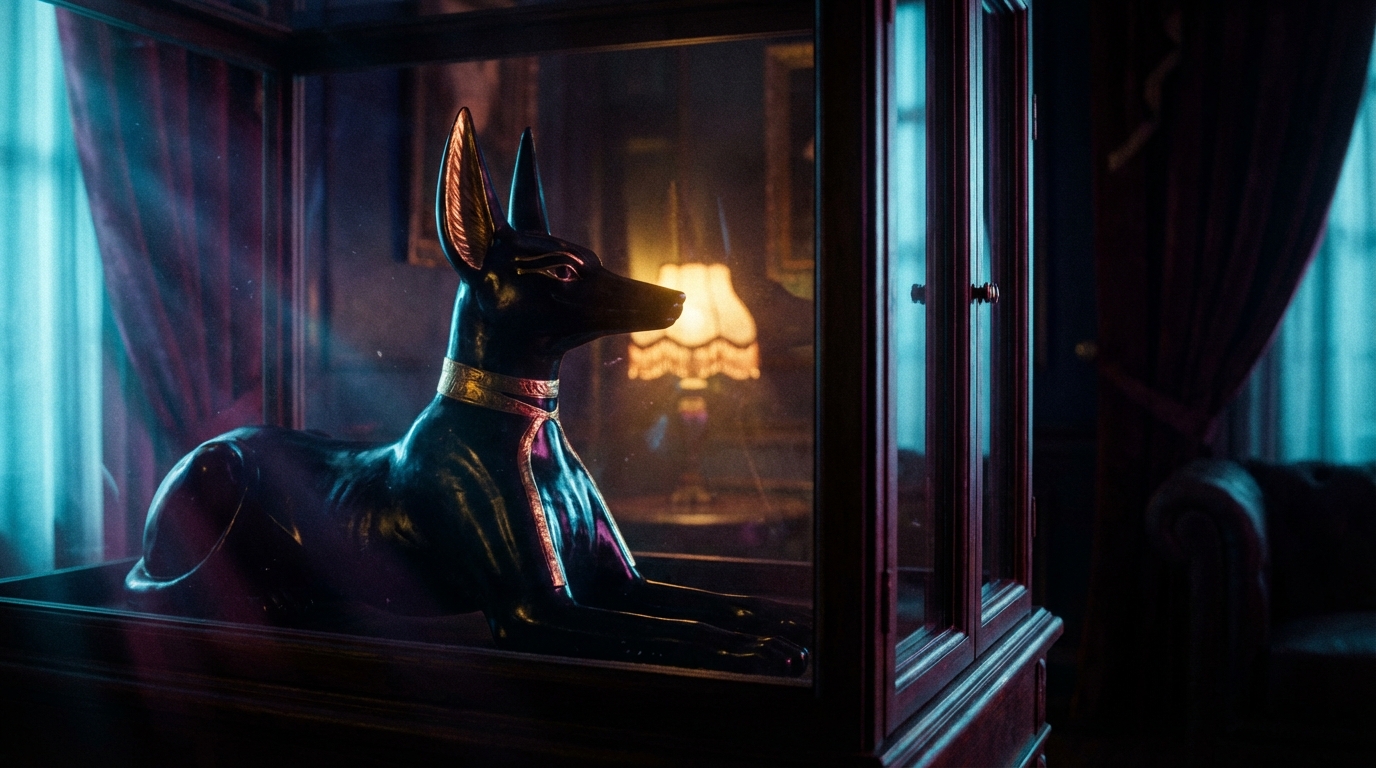
A recumbent jackal carved from Ethiopian obsidian, this statuette of the god Anubis was commissioned by the priest Djedhor for the funerary workshops adjoining the Serapeum at Saqqara in 594 BC. Polished to a mirror finish and inlaid with gold-leaf detailing at the ears and collar, the piece represents the finest surviving example of Late Period obsidian sculpture. It rests within a glass-fronted cabinet in the Blue Room of Jeffries Manor.
Description
The statuette depicts Anubis in his traditional form as a recumbent jackal, ears erect, forelegs extended, tail curving along the right haunch. Carved from a single block of Ethiopian obsidian — a volcanic glass prized in ancient Egypt for its association with the underworld and rebirth — the piece measures approximately thirty centimetres in length and fifteen in height. The obsidian has been polished to such a degree that the surface reflects ambient light, giving the animal an appearance of liquid darkness solidified into form.
Gold leaf has been applied to the interior of the ears, the band encircling the neck, and the ridges above the eyes, following the established convention for Anubis representations from the Late Period. The eyes are inlaid with calcite for the whites and smaller pieces of obsidian for the pupils, creating the disconcerting impression of a gaze that follows the observer. The claws, barely visible beneath the extended forelegs, are tipped with silver — a metal associated in Egyptian funerary tradition with the moon and purification.
The underside of the base bears a hieroglyphic inscription identifying both the commissioning priest and the purpose of the piece.
Historical Setting
The statuette was commissioned on the 14th of Mesore, year 16 of the reign of Pharaoh Psamtik II (594 BC), by the wab-priest Djedhor, son of Padibastet, who served at the funerary workshops adjoining the Serapeum complex at Saqqara. Djedhor oversaw the preparation of votive offerings for the Apis bull burials conducted in the Greater Vaults beneath the necropolis, a role that placed him among the most senior religious artisans at Memphis.
The obsidian was sourced from quarries in the Ethiopian highlands and transported via the Nile trade routes to Memphis, where it was worked by a specialist sculptor whose name is recorded in the base inscription as Hor-sa-Aset. Obsidian carving required extraordinary skill, as the volcanic glass is brittle and prone to fracturing under imprecise tool work. Hor-sa-Aset was one of fewer than a dozen master sculptors in Memphis capable of working the material at this scale, and the Anubis statuette is considered the finest piece attributed to his hand.
The piece was originally placed within a small shrine in the preparation chambers of the Serapeum, where it served as a protective guardian during the embalming of the sacred Apis bulls. It remained in situ for approximately four centuries, surviving the Persian conquest and the transition to Ptolemaic rule, before being removed — likely during the period of Roman neglect when the Serapeum fell into disuse and its contents were dispersed through looting and informal trade.
Provenance
The statuette's journey from the Serapeum at Saqqara to a guest chamber in Van Diemen's Land spans over two millennia. Following its removal from the Serapeum during the early Roman period (approximately first century AD), the piece entered the private antiquities market of Alexandria. Its subsequent history remains fragmentary — it surfaced briefly in a Venetian merchant's inventory in 1438, was recorded in a private Ottoman collection in Constantinople in 1671, and appeared in the catalogue of a London antiquities dealer in 1803. By 1819, it had been acquired through intermediaries connected to William Jeffries Sr.'s trading network in Van Diemen's Land, arriving at Jeffries Manor as payment for services rendered through channels that remain undocumented in any official record.






