Sandra Elizabeth Claiborne (née Harris)
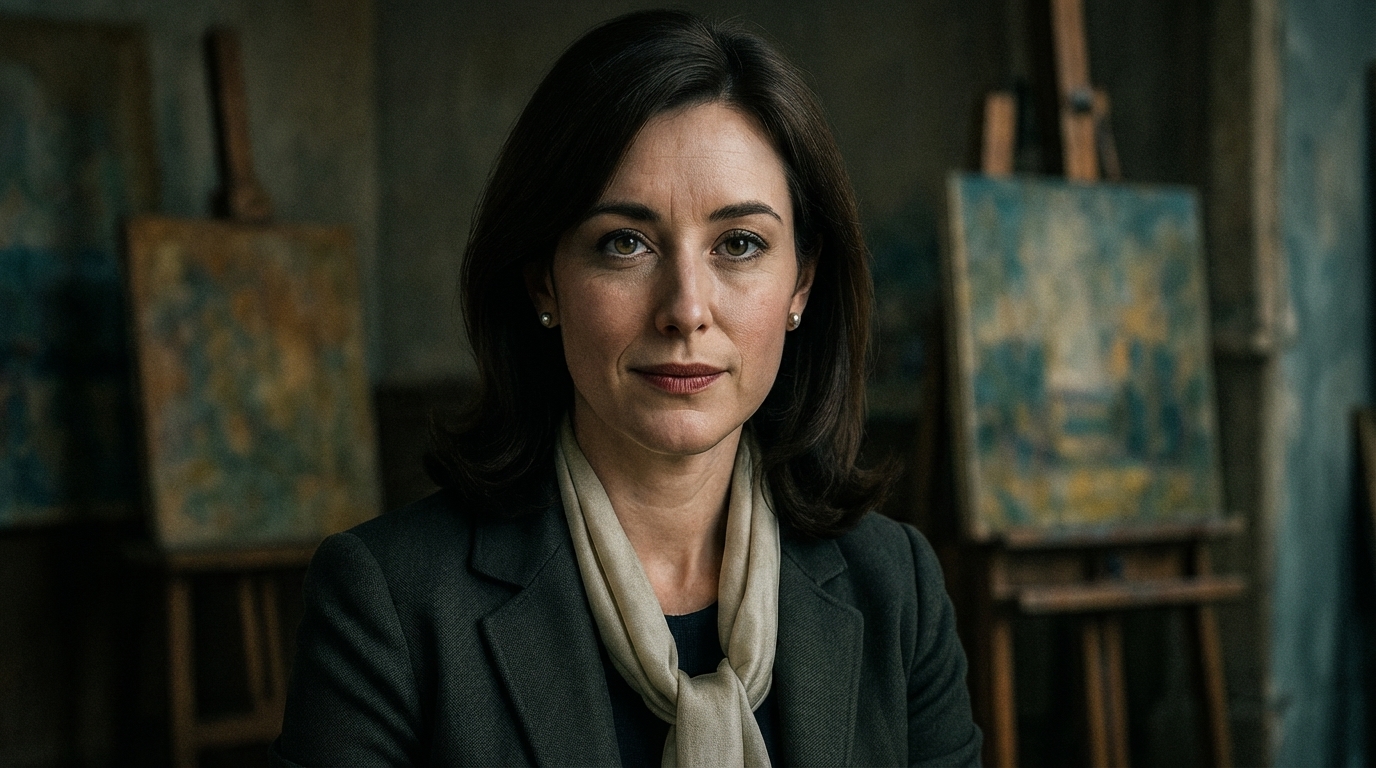
Sandra Elizabeth Claiborne emerged from Hobart's artistic elite to become one of Tasmania's most influential cultural bridge-builders—a woman who transformed personal creativity into public advocacy, balancing the demands of a law enforcement marriage with an unwavering commitment to expanding arts access across the island state. Born into privilege yet choosing purpose, she navigated the complex terrain between tradition and innovation with a grace that masked the steel beneath.
Birth and the Harris Heritage
Sandra Elizabeth Harris arrived at Calvary Hospital in West Hobart at 9:07 AM on 22 March 1975, a mild autumn Saturday when the Derwent River shimmered grey beyond the rooftops. The delivery had begun unexpectedly the previous evening whilst her mother, Margaret Harris, marked Year 11 essays at their Sandy Bay kitchen table. Robert Harris, her father, had rushed his wife to hospital with characteristic absent-mindedness—remembering his sketchbook and mints but forgetting her dressing gown, forcing Margaret to labour in an institutional garment marked 'Property of Matron.'
The birth itself was straightforward but early, Sandra arriving two weeks ahead of schedule with a full-bodied cry that echoed off the delivery suite's tiled floors. Margaret wept from exhaustion more than joy, whilst Robert stood frozen until the moment passed, then kissed his wife's temple without words. He would later sketch not his newborn daughter but the hospital blanket's creases, finding meaning in the ordinary folds—a trait Sandra would inherit, this ability to locate profound beauty in quotidian moments.
The Harris household at 47 Fitzroy Place, Sandy Bay, represented Hobart's cultured bourgeoisie at its most refined. The Federation-style home, with its broad verandahs and leadlight windows, functioned as both domestic space and cultural salon. Robert Harris, born in 1943, had trained as a classical violinist at the Sydney Conservatorium before returning to Tasmania to compose and teach. His work with the Tasmanian Symphony Orchestra brought international musicians through their dining room, where impromptu performances accompanied Margaret's carefully prepared dinners.
Margaret Harris (née Whitfield), born in 1945, descended from one of Hobart's established families—her father a Supreme Court judge, her mother a patron of the arts. Margaret had studied painting at the National Art School in Sydney, where she met Robert at a gallery opening in 1968. Her landscapes, influenced by Lloyd Rees and Grace Cossington Smith, captured Tasmania's moody light with a sensitivity that earned national recognition. By Sandra's birth, Margaret had exhibited in Sydney, Melbourne, and Adelaide, with works held in several state collections.
Siblings and Early Childhood Dynamics
Sandra's position as middle child shaped her mediating nature. Her older brother, Daniel James Harris, born 17 November 1972, showed prodigious musical talent from age four, when Robert discovered him picking out Mozart melodies on the family's Steinway. Daniel's intensity—practising scales before dawn, weeping over imperfect performances—created household tensions that Sandra learned to navigate with quiet diplomacy.
Rebecca Louise Harris arrived on 9 July 1977, completing the family with an exuberance that contrasted with her siblings' more measured temperaments. Where Daniel pursued perfection and Sandra sought harmony, Rebecca embraced chaos, transforming Margaret's fabric scraps into wild costumes, staging elaborate performances that commandeered the entire ground floor. Sandra often served as Rebecca's audience and defender, protecting her younger sister's creative experiments from Daniel's critical assessments.
The Harris children grew up surrounded by creativity as daily necessity. Breakfast conversations covered Mahler's symphonies and Rothko's colour fields with equal fluency. Margaret's studio, a converted coach house behind the main residence, remained off-limits during working hours, but Sandra would slip in during her mother's afternoon walks, studying the canvases' evolution, learning how layers built meaning. Robert's music room, soundproofed at considerable expense, leaked Brahms and Bartók through the walls, providing the household's constant soundtrack.
Financial comfort cushioned but didn't eliminate struggle. Margaret's lupus-like condition, though less severe than Charlie's mother's, meant periodic retreats to bed with swollen joints and fatigue. During these episodes, Sandra assumed household management, preparing simple meals, ensuring Rebecca completed homework, mediating between Daniel's practising schedule and their mother's need for quiet. These early responsibilities developed her capacity for graceful burden-bearing that would define her adult life.
St. Michael's Collegiate and Artistic Formation
Sandra entered St. Michael's Collegiate School in 1981, the Anglican girls' institution where Hobart's establishment educated their daughters. The school, founded in 1892, occupied grand sandstone buildings in central Hobart, its traditions including Latin mottoes, house competitions, and expectations of excellence that Sandra met with apparent ease whilst harbouring private ambivalence.
Her academic record reflected capability without obsession—consistently achieving Distinctions in English, Art, and History whilst maintaining Credits in Mathematics and Sciences. Teachers noted her unusual ability to synthesise disparate concepts, finding connections between seemingly unrelated subjects. Her Year 8 history project linked Tasmania's convict architecture to Foucault's theories of surveillance, demonstrating intellectual sophistication that surprised even progressive faculty.
Ballet consumed Sandra's extracurricular hours. She'd begun at age five with Madame Petrova at the Hobart School of Classical Ballet, her natural grace compensating for late start. By secondary school, she trained four afternoons weekly, her body learning discipline through barre work and répétition. The physical rigour appealed less than the wordless expression—communicating through gesture what couldn't be spoken. Her 1989 performance as Giselle in the school's production earned standing ovations and scholarship offers from mainland academies she quietly declined.
Visual art provided private solace. Unlike ballet's public performance or academic achievement's external validation, painting offered Sandra autonomous space. She worked primarily in oils, developing a style that merged her mother's landscape tradition with abstract expressionism. Her Year 11 self-portrait, featuring her face dissolving into Tasmania's coastline, won the state's Young Artist Prize and revealed psychological complexity her family hadn't suspected.
Theatre involvement began accidentally when illness forced the lead's withdrawal from the 1990 production of 'The Crucible.' Sandra, recruited for her stage presence, discovered acting's appeal—inhabiting others' emotions whilst maintaining personal distance. Her Abigail Williams was noted for its restraint, finding the character's desperation without melodrama. Drama teacher Patricia Ashwood encouraged university theatre studies, but Sandra had already decided on visual arts.
University Years and Meeting Charlie
The Tasmanian College of the Arts occupied a former warehouse in Salamanca, its industrial bones barely concealed by fresh paint and track lighting. Sandra enrolled in March 1993, choosing the dual major in Painting and Contemporary Dance that puzzled advisors expecting her to specialise. She wanted both—the solitary studio practice and collaborative performance, the permanent canvas and ephemeral movement.
Her cohort included aspiring artists from across Tasmania and mainland refugees seeking cheaper living and authentic experience. Sandra navigated the social dynamics carefully, avoiding both the wealthy dilettantes and aggressively bohemian factions. She found allies in serious practitioners like Helena Chen, whose ceramic installations explored cultural displacement, and Marcus Wilde, a mature-age student whose photography documented Tasmania's vanishing industries.
The curriculum challenged previous training's formality. Life drawing sessions employed models with non-traditional bodies—elderly, disabled, scarred—forcing students to confront beauty's conventions. Contemporary dance workshops led by visiting artists introduced contact improvisation, Butoh, and physical theatre techniques that dismantled ballet's rigid structures. Sandra initially struggled with the deliberate ugliness some instructors encouraged, her aesthetic sense resisting work that privileged concept over craft.
Her breakthrough came second year when instructor James Thornton suggested she stop fighting her inclinations toward beauty. "Prettiness isn't your problem," he observed, reviewing her landscapes that resembled her mother's work. "Safety is. Make something beautiful that disturbs." This permission transformed Sandra's practice. She began painting Tasmanian landscapes that initially appeared serene but revealed, upon closer inspection, evidence of violence—clear-cut forests regenerating, beaches littered with specific debris, mountains scarred by mining.
The Burnie Regional Art Gallery opening on 14 December 1996 was obligatory attendance for arts students, funded by a education grant. Sandra drove north with Helena and Marcus, expecting provincial amateur work. Instead, she encountered Charlie Claiborne attempting to understand contemporary art with endearing earnestness. His observation about her painting technique was completely incorrect—he'd confused impasto with glazing—but his genuine effort to engage touched something she hadn't expected.
Their conversation continued at the all-night truckers' café on Bass Highway, where Charlie's stories of police work provided counterpoint to her artistic theories. He spoke of finding beauty in broken lives' reconstruction, of patterns emerging from chaos, of truth's elusiveness—themes that resonated with her evolving practice. When he admitted knowing nothing about art but wanting to learn, his vulnerability disarmed her cultivated defences. They talked until dawn, when Charlie's shift began and Sandra's long drive home awaited.
Courtship and Cultural Convergence
The relationship developed through weekend visits and lengthy phone conversations that stretched Charlie's police station's patience. Sandra would drive to Burnie after Friday lectures, bringing paintings to work on whilst Charlie completed paperwork. She established a temporary studio in his sparse constable's quarters, transforming the kitchenette into workspace, oils and turpentine competing with instant coffee's aroma.
Charlie's introduction to Sandra's world required careful orchestration. She began with accessible exhibitions—landscape painters, traditional portraitists—before introducing contemporary work. His responses surprised her with their insight once he abandoned art-speak attempts. Viewing an abstract expressionist canvas, Charlie observed, "It feels like interrogating someone who's lying—you know something's hidden but can't quite grasp it." Such observations revealed an aesthetic sense developed through different channels.
Meeting the Harris family tested Charlie's social navigation. The Sunday lunch invitation for Easter 1997 placed him at their Fitzroy Place dining table amongst Margaret's collected artist friends and Robert's musician colleagues. Charlie's working-class Melbourne background stood in sharp contrast, yet he held his ground through genuine interest rather than pretence. When renowned painter Maxwell Davies pontificated about art's spiritual necessity, Charlie quietly asked, "But what about people who find spirituality elsewhere—in service, or nature, or family?" The question's sincerity shifted the conversation's dynamics, earning Margaret's approval.
Sandra met Charlie's family during a Melbourne visit in July 1997. The Coburg household's chaos—Anthony's addiction visible in his gaunt frame, Louise wrangling three young children, Rick's grease-stained hands, Margaret's wheelchair-bound fragility—initially overwhelmed Sandra's composed sensibilities. Yet she recognised something familiar in their fierce loyalty, their determination despite circumstances. When Margaret Claiborne asked about her paintings, Sandra described them in simple terms that honoured the older woman's intelligence without condescension. They spent the afternoon reviewing photo albums whilst Charlie helped Rick with engine repairs, two women from different worlds finding common ground in their sons' happiness.
The proposal on 21 December 1996 at Cradle Mountain reflected Charlie's understanding of Sandra's nature. He'd planned sunrise at Dove Lake, nature providing the grandeur their relationship deserved. When torrential rain confined them to their tent, Charlie abandoned the script, proposing amongst sleeping bags and camp stoves. "I know we don't match on paper," he said. "But we work in practice." Sandra's immediate acceptance came with laughter that Charlie would treasure—not mocking but delighted by life's refusal to follow plans.
Marriage and Establishing Home
The wedding on 15 May 1997 at St David's Cathedral merged two Tasmanias—establishment tradition and working-class authenticity. Sandra wore her grandmother Whitfield's 1920s silk gown, altered to accommodate modern movement. Charlie's dress uniform bore medals already accumulating from his brief but distinguished service. The ceremony itself remained traditional Anglican, though Sandra had negotiated readings from Rumi alongside Corinthians, beauty transcending denominational boundaries.
The reception at Hobart's Grand Chancellor revealed both families' warmth beneath surface differences. Thomas Claiborne's best man speech, delivered despite advancing frailty, spoke of Charlie's protection of siblings with such raw emotion that Margaret Harris wept openly. Robert Harris's classical quartet provided sophisticated entertainment, but the evening's highlight came when Rick Claiborne borrowed a guitar, leading Charlie in Irish songs learned from their mother, their rough harmonies filling the ballroom with unexpected poignancy.
The Battery Point cottage they purchased with combined savings and discrete Harris family assistance became Sandra's first autonomous domestic space. The 1890s worker's cottage, originally housing dock labourers, had been partially renovated but retained period features—pressed tin ceilings, Baltic pine floors, iron lacework. Sandra transformed each room into what she called "emotional weather," painting walls in colours that shifted with light's angle. The living room's deep ochre warmed winter evenings; the bedroom's pale blue-green suggested underwater dreams.
Charlie initially struggled with the cottage's aesthetic intensity. His previous quarters had been functional, unadorned. Living within Sandra's creative vision required adjustment—learning to see familiar objects transformed by coloured light, accepting that furniture might be rearranged following inspiration, understanding that some corners were sacred to ongoing artworks. He adapted by claiming the small second bedroom as study, maintaining police files' order amongst Sandra's beautiful chaos.
Motherhood and Career Evolution
Sandra's pregnancy with Liam, discovered in January 2001, coincided with her first solo exhibition's planning. The timing seemed impossible—morning sickness competing with oil paint's fumes, exhaustion undermining creative focus. Yet pregnancy transformed her work in unexpected ways. The landscapes grew more visceral, earth tones deepening toward blood and ochre. Her artist's statement for the May exhibition referenced "creation's violence," though viewers assumed metaphor rather than literal gestation.
Liam's birth on 3 September 2001 was complicated—breech position requiring emergency caesarean after twelve hours' labour. Sandra haemorrhaged post-delivery, requiring transfusions that left her weakened for months. The planned immediate return to painting proved impossible. Instead, she spent autumn's days holding Liam whilst he struggled with colic, their Battery Point cottage's walls absorbing his cries and her exhausted tears. Charlie took unprecedented leave, managing household whilst Sandra recovered, their relationship deepening through shared vulnerability.
Postnatal depression arrived insidiously. Sandra initially attributed her numbness to physical recovery, but by November, she couldn't look at canvases without weeping. Her mother, recognising symptoms from her own post-Daniel struggles, arranged psychiatric consultation without judgment. Dr. Elisabeth Manning prescribed antidepressants whilst recommending modified artistic practice—small watercolours instead of major oils, gestural sketches rather than completed works. This gentle re-engagement with creativity proved therapeutic, Sandra slowly reclaiming herself through incremental marks on paper.
The Salamanca Arts Centre position, advertised in March 2002, offered structure Sandra craved. The part-time Programme Coordinator role—three days weekly, flexible hours—provided professional identity beyond motherhood whilst accommodating Liam's needs. Her interview, conducted whilst Liam slept in a pram beside her, impressed Director Jonathan Morse with its combination of artistic knowledge and pragmatic planning. She began in April, establishing patterns that would define the next decade—Monday/Wednesday/Friday at Salamanca, Tuesday/Thursday in her studio whilst Liam attended family daycare.
Amelia's conception in July 2002 was planned but sooner than expected. Sandra approached this pregnancy with hard-won wisdom, adjusting medication under psychiatric supervision, maintaining modest artistic practice throughout, accepting help without shame. Amelia's straightforward birth on 15 March 2003 felt like redemption. The baby's early contentment—sleeping through nights from six weeks, nursing without difficulty—allowed Sandra recovery that Liam's infancy had denied.
Building Cultural Infrastructure
Sandra's work at Salamanca Arts Centre evolved from programme coordination to cultural advocacy. She developed initiatives connecting established artists with emerging practitioners, creating mentorship networks that transcended traditional hierarchies. Her "Studio Saturdays" programme, launched in 2004, opened working artists' spaces to public viewing, demystifying creative process whilst generating income for struggling practitioners.
The youth outreach programmes reflected Sandra's belief in arts access as social justice. Working with Goulburn Street Primary School, serving Hobart's most disadvantaged population, she established weekly art workshops that provided materials, instruction, and rare praise for children accustomed to institutional neglect. When education department funding was threatened in 2006, Sandra organised a benefit exhibition featuring works by students alongside established artists, raising enough to sustain the programme independently.
Her curatorial projects challenged Hobart's conservative aesthetic preferences. The 2007 "Bodily Territories" exhibition, featuring feminist artists exploring corporeality, generated protest from religious groups and supportive counter-protests from progressive communities. Sandra navigated the controversy with diplomatic skill, organising public forums that transformed conflict into dialogue. The exhibition's attendance records validated her belief that Hobart hungered for challenging content presented accessibly.
The MONA Community Satellite Project invitation in 2013 recognised Sandra's reputation for bridging high art and community engagement. David Walsh's museum, with its provocative collections and elite architecture, sought connection with broader Tasmanian society. Sandra proposed exhibiting local artists within MONA's spaces, creating dialogue between international masterworks and regional responses. The project's success led to permanent community gallery space, Sandra serving as consulting curator whilst maintaining Salamanca position.
Navigating Charlie's Darkness
The 2010 hostage crisis that triggered Charlie's PTSD transformed their marriage's dynamics. Sandra first noticed changes through small disruptions—Charlie checking locks repeatedly, startling at sudden movements, sitting with his back to walls. When she discovered him guarding Liam's room with his service weapon at 3 AM, she recognised crisis requiring intervention beyond spousal support.
Her research into first responder trauma revealed systemic patterns—the accumulation of witnessed horror, survivor guilt, hypervigilance becoming pathology. She contacted Dr. Raymond Kirkpatrick through professional networks, his expertise with police trauma offering specific understanding Charlie needed. Presenting Charlie with treatment ultimatum required careful orchestration. She arranged the children's absence, chose neutral morning timing, prepared specific examples without accusation. Her words—"I need my husband back, and you need yourself back"—cut through Charlie's defensive mechanisms.
Supporting Charlie through treatment whilst maintaining family stability tested Sandra's resilience. She managed his professional responsibilities' communication, fielding calls from colleagues with gracious deflection. The children received age-appropriate explanations for their father's absence and behavioural changes. Sandra attended family therapy sessions, learning to distinguish support from enabling, boundaries from abandonment.
Her own therapy, begun during this period, revealed suppressed anger at Charlie's emotional unavailability, their marriage's imbalanced emotional labour. Dr. Manning helped Sandra recognise her pattern of aesthetic containment—making everything beautiful to avoid confronting ugliness. This insight transformed both her personal relationships and artistic practice, introducing deliberate discord into previously harmonious compositions.
Charlie's gradual recovery through 2011 required constant recalibration. Sandra learned to read his triggers' warning signs, creating household routines that provided stability without rigidity. She accepted that certain aspects of their previous life—spontaneous outings, loud celebrations, surprise gestures—might never return. Yet the marriage that emerged from crisis possessed deeper honesty, their mutual vulnerability creating intimacy that success hadn't achieved.
Artistic Maturity
Sandra's painting practice, maintained despite professional and domestic demands, evolved toward confident complexity. The 2015 solo exhibition at Long Gallery, titled "Beautiful Disturbances," presented twenty years of artistic development. Early landscapes' prettiness had transformed into powerful meditations on environmental degradation and regeneration. Her palette had darkened, earth tones complicated by industrial greys and toxic greens, beauty persisting despite damage.
The exhibition's centrepiece, "Self-Portrait as Landscape III," showed Sandra's face merged with Tasmania's Gordon River, her features dissolving into water reflecting logged forests and mining scars. The work's technical mastery—oils layered with encaustic, creating depth suggesting geological time—matched its emotional sophistication. Reviews praised Sandra's ability to address political themes through personal lens, avoiding didacticism through genuine ambiguity.
Teaching at Tasmanian College of the Arts (2016-2018) as sessional lecturer provided unexpected satisfaction. Her course, "Expressive Techniques: Finding Your Visual Voice," attracted students struggling with academic art's conceptual demands. Sandra encouraged them to embrace their instincts whilst developing technical skills, beauty and meaning coexisting rather than competing. Her critiques, gentle but precise, helped students identify their work's strengths without false praise.
The dance instruction, maintained at small studios throughout Hobart, served different purposes. Teaching children ballet connected Sandra to her own youth's discipline and grace. Contemporary dance workshops for adults, particularly women returning to movement after illness or trauma, provided community Sandra hadn't expected. These sessions, combining technique with therapeutic movement, created space for expression beyond words—something Sandra understood intimately.
Community Leadership and Cultural Politics
Sandra's 2016 appointment to the Hobart Arts and Culture Development Trust board placed her within Tasmania's cultural power structure. Monthly meetings in the Town Hall's oak-panelled chambers brought together business leaders, politicians, and artists navigating competing agendas. Sandra's contribution lay in translation—explaining artists' needs in economic terms businesspeople understood, articulating community benefit in politically viable language.
The Trust's major initiative during Sandra's tenure, the "Art for All" programme, reflected her longtime advocacy for cultural democratisation. The programme provided free arts education in underserved communities, funded through percentage allocation from major developments' approval processes. Sandra negotiated between developers resenting additional costs and activists demanding greater contributions, finding compromise that satisfied neither completely but achieved practical results.
Her charity work extended beyond formal positions. Annual artwork donations to Royal Hobart Hospital's fundraising auctions generated significant income whilst maintaining Sandra's public profile. The pieces selected—usually smaller landscapes with broad appeal—balanced commercial viability with artistic integrity. She privately donated more experimental works to women's shelters and community centres, believing challenging art belonged in unexpected spaces.
The volunteer teaching at Hobart Women's Shelter proved most personally meaningful. Working with women escaping domestic violence, Sandra recognised trauma's varied expressions. She never pushed participants toward disclosure, letting paint and movement carry what words couldn't. When one woman, silent through six sessions, suddenly painted her bruises' purple-green palette across canvas, Sandra simply provided more paint, understanding breakthrough's fragility.
The Unravelling Marriage
By 2018, the Claiborne marriage operated through careful choreography rather than spontaneous connection. Sandra managed household logistics with efficiency that masked emotional absence. Her daily routine—studio work whilst Charlie slept off night shifts, Salamanca responsibilities whilst he processed cases, evening meals eaten separately more often than together—maintained surface functionality whilst intimacy eroded.
The July 2018 theatre death investigation marked a turning point. Sandra noticed Charlie's behavioural changes—the paranoid checking, mysterious meetings, lies about whereabouts—but initially attributed them to case stress. When she discovered surveillance equipment Charlie had installed without consent, violation overwhelmed understanding. The man recording their home wasn't the protector she'd married but stranger whose motivations she couldn't fathom.
Their October 2021 confrontation, after Sandra found financial decisions hidden and appointments falsified, stripped away remaining pretence. Her words—"I don't recognise you anymore, Charlie. And I don't think you recognise yourself"—emerged from exhausted clarity rather than anger. She wasn't threatening divorce but acknowledging a death that had already occurred, their marriage's vital force extinguished by accumulation of secrets and distance.
Charlie's December 2022 retirement brought relief rather than renewal. Sandra watched him clear his desk with characteristic pre-dawn timing, avoiding ceremony that might require emotional acknowledgment. His subsequent drift—abandoned projects, aimless walks, vacant presence at family dinners—confirmed what Sandra suspected: without professional identity, Charlie had no self to return to. She maintained household routines around his absence, protecting children from their father's psychological dissolution whilst managing her own grief for the man she'd loved.
Present Circumstances and Future Uncertainties
In 2025, Sandra Elizabeth Claiborne inhabits a life of accomplished loneliness. Her professional success continues—recent curatorial projects receiving national attention, teaching positions offered at mainland institutions she declines for family stability. The Battery Point cottage remains beautiful, its walls' colours deepening with age, though Charlie's study stands unused, door closed against absence too present to ignore.
Her relationship with adult children provides partial compensation for marital emptiness. Liam, pursuing Environmental Science at university, shares Sandra's aesthetic sensitivity translated through scientific lens. Their conversations about system patterns and emergence theory remind her of early discussions with Charlie, before complexity became pathology. Amelia's artistic development, following Sandra's path through St. Michael's toward formal training, offers both pride and concern—watching her daughter navigate similar pressures with greater confidence but equal vulnerability.
The painting practice, sustained through decades of competing demands, has reached mature power. Current works explore themes of persistence and dissolution, landscapes that regenerate through destruction, portraits where faces emerge from and return to earth. Gallery representation brings financial security and critical recognition, though Sandra creates now from necessity rather than ambition, art providing structure when other meanings fail.
Her community involvement continues through established patterns—board meetings, exhibition openings, charity galas—performed with grace that conceals effort. Colleagues admire Sandra's apparent equilibrium, her ability to balance multiple responsibilities whilst maintaining elegance. They don't see pre-dawn hours spent journaling, trying to understand how careful construction became beautiful imprisonment, how aesthetic success coincided with emotional failure.
The future remains deliberately unconsidered. Sandra maintains present responsibilities whilst avoiding long-term planning, understanding that Charlie's psychological state might deteriorate further, requiring decisions she's not prepared to make. She continues teaching, painting, advocating for arts access, these activities providing rhythm if not meaning. The woman who bridged worlds now stands between them, belonging fully to neither, sustained by discipline learned in childhood ballet classes—maintaining position despite pain, creating beauty from difficult balance, performing grace whilst muscles scream protest.
Some mornings, Sandra stands in her converted coach house studio, surrounded by canvases documenting twenty-five years of artistic evolution, and recognises her mother's pattern repeated—aesthetic achievement compensating for private disappointment, culture providing structure when intimacy fails. Yet she continues painting, each brushstroke an act of faith that beauty matters even when—especially when—it cannot heal what's broken. The landscape emerges slowly on canvas, Tasmania's wounded magnificence rendered with technical mastery and emotional truth, the artist disappearing into her creation, finding temporary peace in colours that transform but cannot transcend the facts of damage and persistence.







