Samuel Henry Thornton
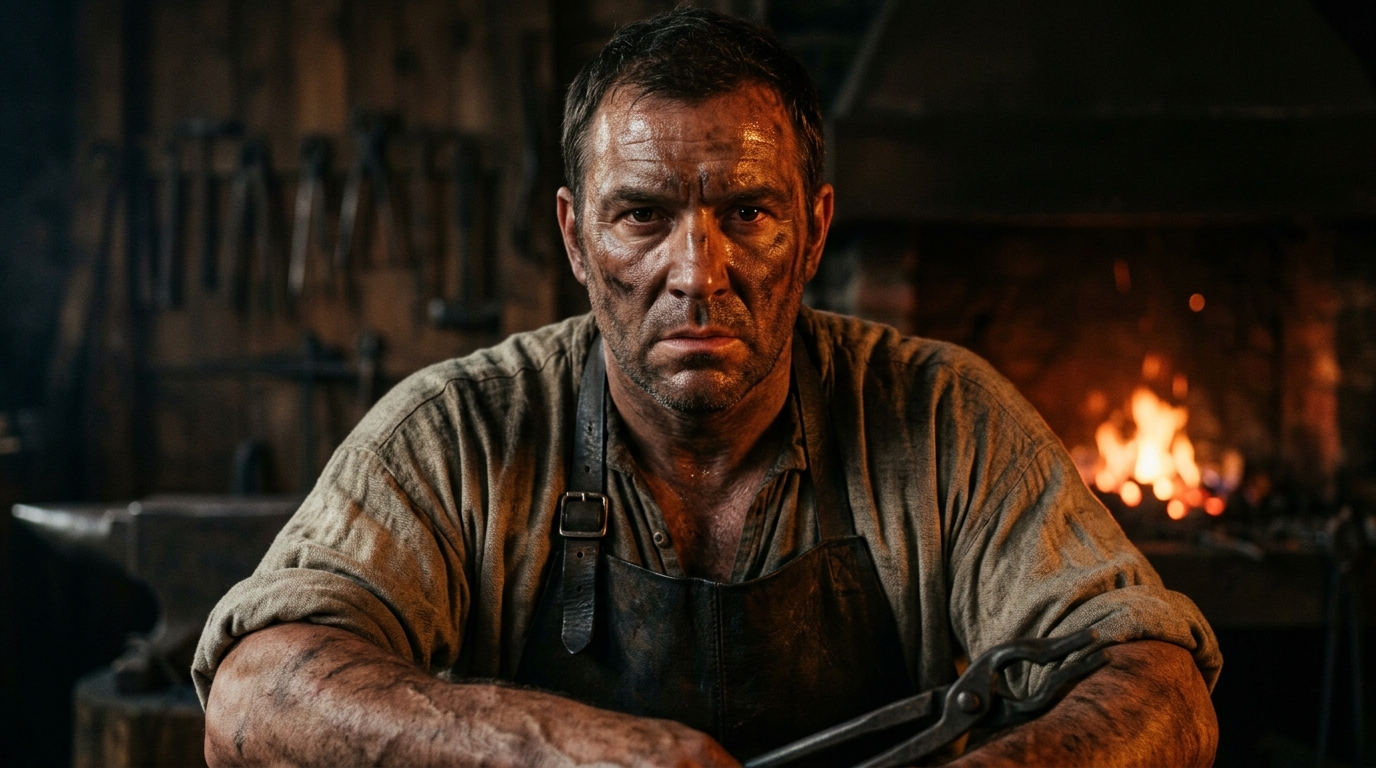
Samuel Henry Thornton (1780–1861) was a master blacksmith, born above a Shepton Mallet smithy and motherless from birth, who crossed to Clivilius among Brierly's first settlers in 1810. For half a century his forge was the settlement's only source of tools, and his improvisations — working without coal or iron ore, coaxing metal from Clivilian stone — kept the colony equipped. A gifted and difficult man, prone to drink and temper but steadied by his wife Lucy, he died at his cold anvil with a horseshoe nail in his hand.
Born Above the Forge
Samuel Henry Thornton entered the world on 30 January 1780, during one of Somerset's harshest winters, in the cramped quarters above James Clark's smithy in Shepton Mallet, where the forge's banked warmth was the only real defence against the cold. His mother, Margaret Thornton, died of childbed fever when he was three days old, and so he never knew her at all — a fact that shaped him more by its silence than anything a memory could have. His father, William Thornton, a journeyman smith working under Clark, was left to raise the boy alone amongst the tools and the flame.
The smithy became Samuel's nursery, his schoolroom, and his playground all at once. James Clark, who had not long before lost his own infant son, took an unusual interest in the motherless child, and something in that quiet kindness ran alongside the harder lessons of the forge for the whole of Samuel's boyhood. By five he could name every tool by the note it gave when struck, sort nails by size without counting them, and work the bellows in a rhythm steady enough to hold the fire at an even heat.
William Thornton was not a gentle father. His grief had set hard into a relentless demand for perfection, and a badly formed horseshoe nail earned a cuff to the ear, a carelessly tended fire a night without supper. Yet between the father's severity and Clark's patience, the boy was forged into something beyond mere competence. Samuel learned young that metalwork forgave nothing — that the wrong heat, the wrong carbon, a hammer blow a half-second late could ruin hours of labour — and the knowledge went into him so deep it became a kind of temperament.
The Scar and the Smith's Daughter
At fourteen, an accident that might have ended his trade instead defined it. He was distracted at the anvil by Emma Clark, James's daughter and three years his junior, and missed the colour change in a heated bar, striking too late so that the iron shattered. A fragment opened his left forearm to the bone, leaving a pale scar he carried to his grave and a lesson he never afterwards forgot: that the forge demanded the whole of a man's attention or it took its price in blood.
The same accident drew his first real words with Emma, who dressed the wound with a steadiness surprising in a girl her age. She had grown up as he had, in the ring of hammer on iron, and understood metal and edges as instinctively as she understood the growing things her father's pruning tools were made to serve. Clark's smithy was known across the district for that fine agricultural work, and its blades and secateurs found their way onto the better estates of Somerset — among them, in years to come, the vineyards near Shepton Mallet where the Whitmore family made their wine.
The Wandering Trade
Following the custom of his craft, Samuel set out on his journeyman wanderings at sixteen, carrying his tools and a letter of recommendation from Clark. In the shipyards of Bristol he learned to forge anchors heavy enough to hold a merchantman and navigational instruments fine enough to guide one; in Bath he took up decorative ironwork for the wealthy and discovered that beauty and strength need not be enemies. Each post added to his repertoire and, at the same time, showed him plainly the social ceiling that hung over every blacksmith, however gifted.
The summer of 1798 carried him to Winchester and the workshop of Thomas Hartley, a master smith known for his agricultural innovations. There Samuel devised modifications to the ploughshare that made it both lighter and more durable, work that caught the eye of the district's more progressive farmers. And there he began to court Lucy Elizabeth Hartley, Thomas's eldest daughter, whose quick tongue and unsentimental good sense were a counterweight to his own brooding, inward temperament.
Lucy did not make herself easy to win. She had watched her own mother's life — the endless labour behind a smith's dangerous trade, the constant dread of an injury that would end the family's income, the loneliness of a station that was neither gentry nor common labour — and she had no wish to repeat it. Samuel's answer was to show her he offered more than the ordinary journeyman's lot: his innovations, his carefully hoarded savings, his plans for a forge of his own. Their unofficial engagement came in 1799.
That same year drew him back to Shepton Mallet a master in his own right, and to a grief. His father had died of the slow lung disease that was the smith's particular curse, a lifetime of coal dust and metal filings settling at last into the chest. William left his son a fine set of tools but no business to use them in. James Clark offered a partnership, which Samuel accepted while privately holding to a hope of independence that the hard economics of the trade made look more distant each year.
A Smith for a New World
The thing that changed his life arrived in February 1810, in the person of Emma — Emma Whitmore now, these eleven years, having married the Somerset vintner George Whitmore in 1799. She came to Shepton Mallet to see her father, and she came with a purpose: a venture she could say little about needed a blacksmith, a man skilled enough to keep an entire settlement in metal with almost nothing to make it from. James Clark named Samuel without hesitation — the son of his old journeyman, the boy he had half-raised at his own anvil.
The proposal terrified and thrilled him in equal measure. A blacksmith with no iron mine, no coal seam, no chain of supply behind him faced something close to impossibility. Yet to be a settlement's only smith — needed, valued, indispensable rather than merely tolerated — was an elevation no forge in England could offer him, and the promise of land of his own, a thing utterly beyond a smith's reach in Somerset, tipped the scale at last toward yes.
Winning Lucy took more delicate work. Thomas Hartley opposed the match outright, calling the whole scheme a madness that would deliver his daughter to a wilderness; Lucy herself swung between the pull of the adventure and a plain terror of the unknown. What finally secured her was Samuel's promise that she might return if the life proved unbearable — a promise he had no real power to keep, and knew it, for the crossing he was being offered ran one way only and would close behind them for good.
They married on 2 April 1810, the ceremony hurried so that Lucy might travel as his wife rather than face the scandal of an unwed emigration. It was a small affair in a Winchester Methodist chapel, attended only by close family, Lucy's mother weeping throughout and her father refusing to come at all. Samuel's wedding gift was a set of cooking implements he had forged with his own hands — a gift that would prove, in the years ahead, worth more than any coin either of them then imagined.
The Forge Without Iron
The passage through the portal on 10 May 1810 set him down into circumstances that tested every skill at once. Brierly's region offered no coal, forcing him onto charcoal burned from the settlers' finite stock of Earth wood, a resource to be hoarded and stretched. There was no local iron ore worth the name, so that every nail, every broken blade, every bent hinge became a thing of value, to be saved and softened and beaten back into use. Nothing could be thrown away. Nothing could be wasted.
His first Brierly forge was a simple pit furnace beside the anvil he had brought through at the cost of other men's supplies, a sacrifice the founding party had argued over and finally allowed. He set it near the centre of the settlement, understanding that a smithy was always a gathering place, and gave his first weeks to the unglamorous work of survival: cataloguing every scrap of metal the colony possessed, setting rules for its rationing, and teaching settlers unused to scarcity to bring him their broken things rather than discard them.
His ingenuity went to work at once. Short of fuel, he built bellows that wrung the most heat from the least charcoal. He learned to cold-forge operations he had once been taught to scorn, and refined the despised technique until it became, in his hands, something near to an art. And he began the long experiment that would occupy the rest of his life: alloying the few workable metals with the Clivilian minerals that the naturalist Charles Sinclair identified for him, producing tools whose properties were no longer quite those of Earth.
Lucy's settling-in ran in step with his. She kept their household with an almost mathematical economy, and her great innovation was to establish a communal kitchen hard against the forge, so that the women might cook while their men waited on repairs, the children be minded together, and the forge's waste heat be turned to the boiling of pots. It was an arrangement so sensible that it quietly reorganised the social life of the early settlement around the two of them.
Grief Beside the Forge
Their first child, a daughter, came in December 1811 and lived only a few hours. They named her Margaret, after the mother Samuel had never known, and buried her in ground that had held no human dead before her. The loss very nearly broke the marriage. Samuel blamed the alien country, Lucy the want of proper medical care, and each, in the privacy of their grief, blamed themselves.
He threw himself at his work with a destructive fury, taking every commission regardless of his own exhaustion; she retreated into a brittle, silent efficiency, and their home turned cold and merely functional. What healed them was not talk but necessity. A plough that failed in the middle of the spring planting forced Samuel to forty unbroken hours at the anvil, Lucy bringing him food he ate between hammer blows and holding water to his lips, until exhaustion finally broke down the wall he had built, and he wept for their daughter in her arms beside the cooling fire. The grief, shared at last, began to mend.
Their son William James arrived on 15 March 1813, healthy and loud, and Samuel's relief showed in the increasingly elaborate metal toys he made him — articulated knights, miniature tools, a tiny anvil that rang true when struck. Lucy feared he would spoil the boy, though she understood the need beneath it: that he was giving this living child everything the dead one had never had the chance to receive.
Margaret Anne followed in September 1814, given the name they had laid in the ground three years before, as families of that age so often did. Thomas Henry came in 1816. Each new mouth pressed harder on Samuel to keep an expanding settlement in tools, and he began to take apprentices, though it galled him that none of them showed the aptitude that had been bred into his own hands. The frustration of teaching men who would never match him bred a temper that only Lucy's patience kept from doing real harm.
Iron from Stone
As the founding Guardians aged and their supply runs to Earth grew fewer and smaller, the settlement leaned ever harder on what Clivilius itself could be made to yield, and the burden of that fell on Samuel as much as anyone. He developed methods for drawing trace iron from Clivilian minerals — a process that demanded enormous labour for a meagre return, but a return all the same. With Emma Whitmore, whose smith's upbringing had never left her, he worked out ceramic-edged tools for tasks where metal could be spared, though they never quite matched true steel for endurance.
His finest discovery came in 1832, out of an experiment with the crystalline formations native to the region. Worked into traditional forging, the crystals yielded tools that held an edge far longer than any steel he could make, and though the process stayed stubbornly inconsistent — more intuition than method, never twice quite the same — the implements that came right were treasured, passed between households with something close to reverence.
In 1835 Charles Sinclair's geological surveys suggested deep iron deposits beneath the hills, and Brierly opened its first mine in the hope of an end to the long scarcity. Samuel oversaw the making of the mining tools, weighing what the work needed now against what it might need later. When the seam gave up only trace quantities of poor and brittle ore, the disappointment landed on him hardest of all, and it opened the bleakest chapter of his life.
The Bottle and the Burn
Samuel had always drunk, in the manageable way of a working man; in prosperity it stayed within bounds, but setback loosened it. The failed mine, falling in the same season as his eldest son's flat declaration that he meant to farm rather than take up the forge, drove him to seek his comfort in George Whitmore's wine. Lucy covered for his absences, his apprentices quietly finished the work he was too far gone to attempt, and the settlement, dependent on him, looked politely past the weakness of the man it could not do without.
His quarrel with William cut deepest. The boy had the hands for metalwork and none of the love for it, seeing the forge as a sentence rather than a calling, and Samuel's efforts to compel an interest only hardened the refusal. When William announced his engagement to a farmer's daughter in 1834, Samuel's response — "At least your children might inherit sense" — opened a rift between them that took years to close.
The reckoning came in the winter of 1837. Drunk at the anvil, attempting a run of ploughshares, Samuel let his right hand stray into the work and burned it badly — an injury that should by rights have finished his career. Confined to his bed and unable to lay hands on wine, he was forced sober, and Alice Turner's careful treatment saved the hand's use, though it never recovered its full feeling and fine work was beyond it from then on. He never drank again. The very ease of his giving it up suggested the drink had always been an escape more than a need.
The Indispensable Man
For all that the settlement could not have lived without him, Samuel never held an easy place in it. The Guardians valued his skill and never quite forgot his common origins; the other settlers chafed at the power his control of the tools gave him, and at the favouritism they suspected in his decisions — favouritism that, in truth, often enough existed. Who waited and who was served first, which project earned a portion of precious metal and which did not: these were his to decide, and he decided them with a diplomacy that thinned as the years wore on.
The founding of a settlement council in 1840 struck directly at the autonomy he had always taken for granted. Where once he had ruled the forge's resources by his own judgement alone, now a committee questioned every allocation and asked for its reasons. Samuel's response — a threat to lay down his hammer altogether unless his independence was restored — exposed both the depth of his pride and the depth of the settlement's reliance on him. The compromise that followed, granting him authority over technical matters but requiring a monthly account of his stores, left no one entirely satisfied.
Through all of it, Lucy was the hinge on which his standing turned. She smoothed the offence his bluntness gave, kept up the friendships his temper damaged, and built through small kindnesses a web of obligation that kept resentment of her husband's high-handedness from ever quite boiling over. How much of his place in Brierly was in fact her doing, neither the settlement nor Samuel himself fully grasped until it was taken away.
After Lucy
Lucy Elizabeth Thornton died of pneumonia on 8 January 1848, and the moderating hand of nearly forty years was gone. Without her, Samuel's roughness slid into something harder to manage. He kept irregular hours, refused commissions from men who had offended him decades before, and laboured on projects no one needed while necessary repairs went wanting. His apprentices, masters now in their own right, quietly saw to the work that mattered and let the old man keep the fiction of command.
His children had made their own lives by then. William James worked a good holding at the edge of the Plains with his wife and a growing brood, his rift with his father long since worn down to a wary peace. Margaret Anne had married into one of the founding families and kept a household of her own. And Thomas Henry, the youngest and the only one of the three to have taken up the anvil, worked at his father's side — a sound, careful journeyman if never the natural his father had been, and the one through whom the Thornton forge would carry on.
In 1855 the last of Mary Fairchild's supply runs from Earth came through with iron enough to ease the constraint that had defined his whole working life, and Samuel wept openly at the anvil at the sight of it, a measure of how heavily the want had pressed on him across the decades. He grew freer with his knowledge after that, setting down in careful detail the techniques he had once guarded like secrets, as though he had begun to make his peace with the forge continuing once his own hands had stopped.
The Cold Forge
A stroke in September 1858 ended his working life. He could still walk and speak, but the coordination the anvil demanded had left him, and at first the sight of other men at his forge was a torment. In time he found a use for himself in instruction, standing at the edge of the heat and directing the work by voice; his critiques, growing ever more colourful as his patience shortened, became a settlement entertainment that softened, a little, the tragedy of a craftsman who could no longer ply his craft.
Samuel Henry Thornton died on 15 February 1861. He was found at dawn beside his cold forge, having walked there alone in the night despite his infirmity, and in his hand was a single horseshoe nail — the first object he had ever been taught to make, the foundation of everything that came after. The settlement's doctor judged that he had died hours before, and yet had remained sitting upright, as though unwilling to leave his post even in death.
His funeral drew every soul in Brierly, and each came carrying something his hands had made or mended — ploughshares and hinges, knives and wedding rings, the whole apparatus of a civilisation rendered in worked metal. They buried him with his hammer, with Lucy's worn cookbook, found tucked in his coat where he must long have carried it, and with a horseshoe nail laid in by each mourner in turn: iron for the craft, paper for the love, and the nails for the difficult, indispensable devotion with which he had served them all.







