Samuel Elias Holloway
Samuel Elias Holloway (5 January 1845 – 10 October 1925) was a civil engineer from Lowell, Massachusetts, who served as Treasurer and Chief Engineer of Killerton Enterprises from its founding on 15 June 1874 until his retirement in 1910. Educated at Phillips Exeter Academy and Harvard University, he was the most experienced professional among Killerton Enterprises' four founding partners, the man Francis Killerton trusted with both the structural integrity and the financial discipline of every project the firm undertook, and the last of the founders to die.
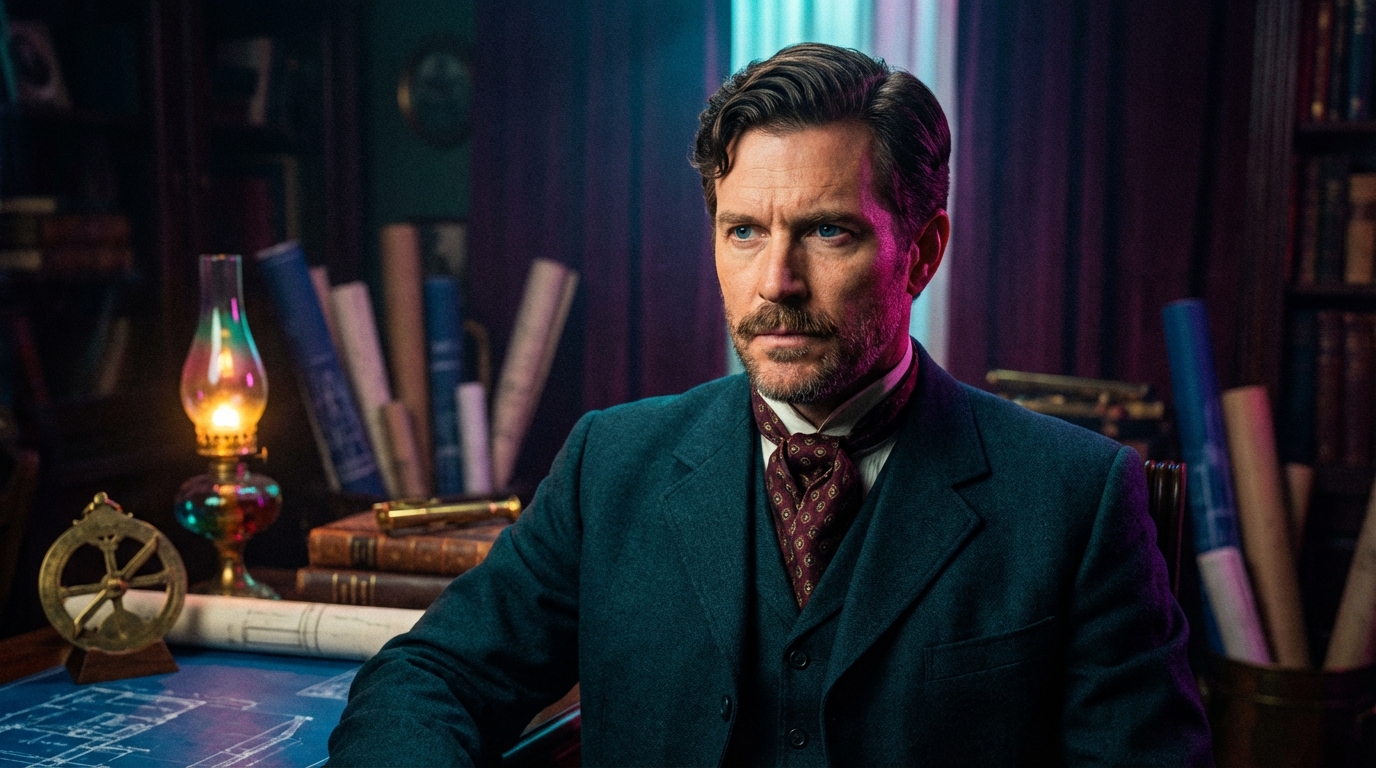
Lowell: The Holloway Household
Samuel Elias Holloway was born on 5 January 1845 in Lowell, Massachusetts — a city whose identity in the mid-nineteenth century was inseparable from the cotton mills along the Merrimack River that had made it, since the 1820s, the most visible demonstration in America of what industrial organisation could do with water, machinery, and concentrated labour. He was the eldest son of Benjamin Holloway, a civil engineer whose practice was shaped entirely by the demands of an industrial city — the canals, the mill foundations, the bridges across fast-running channels, the water management infrastructure that kept Lowell functioning as the industrial engine it was — and Sarah Holloway, a schoolteacher at one of the city's public institutions, whose professional life gave the household its second steady income and its habits of intellectual rigour.
The Holloway household was comfortable rather than prosperous, shaped by the self-reliant professionalism of two people who had built their circumstances through their own capabilities rather than inherited position. Benjamin's engineering work took him regularly to construction sites across Lowell and the Merrimack Valley, and Samuel accompanied him from an early age — scrambling over half-built mill foundations, watching survey work being carried out along canal banks, learning, from the ground up and literally so, what civil engineering looked like when it was being done rather than when it was being explained. It was a formation quite different from the draughting-room education that Charles Killerton gave his son in Beacon Hill, or the musical and architectural household in which Theodore Cartwright grew up. Samuel's education in engineering was tactile and physical before it was theoretical, rooted in the particular intelligence of a boy who understood what a river's force could do to a poorly built pier before he could have explained why in mathematical terms.
Lowell itself was a formative environment in ways that went beyond his father's professional world. He grew up in a city whose entire reason for existence was the productive application of engineering intelligence to natural resources, where the relationship between human ingenuity and the physical world was expressed in the machinery that turned every morning and the canals that fed them. The men who built and maintained Lowell's industrial infrastructure were not distant figures of public eminence but working professionals whose names and methods were known to anyone paying attention, and Samuel paid attention. The Industrial Revolution, which transformed the world in the decades of his childhood and youth, was not an abstraction in Lowell but the daily reality of a city whose growth and prosperity depended entirely on the continued practical application of engineering principles to every dimension of civic and commercial life.
Phillips Exeter Academy: 1860–1864
Samuel enrolled at Phillips Exeter Academy in New Hampshire in 1860, at fifteen — the choice of a boarding school rather than a day school reflecting both the family's ambition and Benjamin's assessment that his eldest son's abilities warranted an education more rigorous than Lowell's local institutions could provide. Phillips Exeter was, and remains, one of the most demanding secondary schools in the country, and Samuel's mathematical aptitude — developed through his years on construction sites and sharpened by Sarah's patient domestic instruction in the disciplines of precise thinking — made him well suited to its expectations.
He excelled in mathematics and natural philosophy, was a competent classical scholar without particular enthusiasm for Latin or Greek, and developed through the Academy's science club a habit of experimental enquiry that complemented the practical intelligence his Lowell formation had provided. His analytical mind — the capacity to hold a complex problem in view whilst working through its components systematically, to resist the temptation of premature conclusions, to remain patient with the slow accumulation of evidence — was already his most distinctive intellectual quality at Exeter, and his teachers recognised it. He was not the most obviously brilliant student in his year, but he was consistently the most thorough, and thoroughness in an engineer is worth more than brilliance over any sustained period of professional practice.
He graduated in 1864, the summer of Gettysburg's aftermath, when the war's demands were reshaping every American institution and the question of what came next was one that every young man of his generation was navigating with whatever materials he had. Samuel had the materials: a strong mathematical education, a practical formation in civil engineering from his father's work, and a clear sense of what he was going to do with both.
Harvard University School of Engineering: 1864–1868
He enrolled at Harvard University's School of Engineering in the autumn of 1864, at nineteen, and spent four years acquiring the formal theoretical grounding that his practical Lowell formation had prepared him to absorb with unusual speed. Harvard's engineering programme in the 1860s was practically oriented and demanding, with coursework in structural analysis, hydraulics, materials science, and surveying supplemented by design projects of real complexity. Samuel was a serious and methodical student — not the kind whose intelligence announces itself in tutorial wit or examination fireworks, but the kind whose work is always complete, always accurate, and always reveals, on close reading, a depth of understanding that is more impressive than the performance of it.
His senior thesis on the optimisation of bridge design — the structural and material conditions under which bridge spans could be maximised without proportionate increases in material cost or risk of failure — drew commendation from his examining panel and established, within the limited professional world that knew of it, his reputation as a young engineer of genuine analytical rigour. He graduated in 1868 with high honours, twenty-three years old, and secured a position almost immediately with one of Boston's better-established engineering firms.
It was also at Harvard that Samuel developed the private intellectual passion that would quietly accompany his professional life for the next six decades: the study of ancient engineering. His reading in the evenings, once his coursework was done, ran toward the great construction achievements of the classical world — Roman aqueducts, Egyptian hydraulic systems, the load-bearing calculations implicit in medieval cathedral construction, the Mesopotamian irrigation infrastructure that had supported urban civilisation for millennia before either Greece or Rome existed. He was drawn to these subjects not as a humanist but as an engineer — what he found in them was not historical romance but technical intelligence, the accumulated practical knowledge of builders who had solved, without modern materials or modern mathematics, the same fundamental problems of load and water and structural endurance that his own profession confronted daily. The reading was, at this stage, a private enthusiasm without practical application. It would not remain so.
Winslow & Parker: 1868–1873
Samuel joined the engineering firm of Winslow & Parker in Boston in 1868, entering as a junior engineer and rising within three years to a senior position through the consistent quality of his technical work. The firm was engaged in the large-scale urban engineering that a growing nineteenth-century city continuously required — bridge construction, sewer systems, drainage infrastructure, the unglamorous but essential work of keeping a city functional beneath the surface of its visible life. Samuel worked on the construction of the Longfellow Bridge across the Charles River and the expansion of the Boston sewer system, both substantial commissions that placed him in charge of teams of labourers and subcontractors and required the full range of his analytical and managerial capabilities.
He was a respected colleague but not a particularly easy one. His standards for accuracy were high, his tolerance for cut corners was low, and his willingness to say so directly when he believed a technical decision had been made for reasons of cost or convenience rather than sound engineering occasionally generated friction with seniors who valued professional harmony over professional rectitude. He was not quarrelsome — he was constitutionally disinclined to quarrel, preferring the deliberate pressure of patient, well-documented argument to the less predictable dynamics of open conflict — but his opinions, once formed on the basis of evidence he trusted, were not easily moved, and this quality, however admirable in an engineer, is not invariably convenient in an institutional context.
He married Anna Whittaker in the spring of 1870, the year after his promotion to senior engineer. Anna was the daughter of Thomas Whittaker, a Boston merchant of solid standing, and had grown up in the kind of Boston commercial household where practicality and intellectual engagement were not considered opposing values. She was curious, warm, and possessed of the particular social intelligence that her husband notably lacked — an ability to move through a room of strangers and leave them feeling that they had been genuinely attended to, which complemented Samuel's more reserved quality of concentrated attention on whatever he had decided mattered. They settled in a Beacon Hill brownstone and built, in their first decade of marriage, a household that was modest in ostentation and considerable in substance — the books accumulating on every available surface, the chess board in permanent occupation of a corner of the parlour, the children arriving at intervals of two years: Benjamin Jr. in 1872, Elizabeth in 1874, and Charles in 1876.
Samuel was a devoted if often distracted father. His capacity for absorption in a technical problem was such that his children learned early that the particular quality of stillness which descended on him when he was working through something difficult was a signal that conversation was unlikely to be rewarding, and that the rather different quality of attention he gave when a problem had been resolved was the better time to approach him. He read to the children on Sunday evenings — history and natural philosophy rather than fiction, which reflected his own tastes more than theirs — and took Benjamin with him to construction sites from the age of eight, repeating, with conscious intent, the formation his own father had provided.
The Meeting with Francis Killerton: 5 July 1873
Francis Killerton came to find Samuel at a Winslow & Parker bridge inspection on the Charles River on 25 July 1873, introduced through mutual professional contacts in the Boston engineering world. He arrived carrying a business plan and the particular kind of focused persuasion that characterises people who have thought very carefully about something and are now testing whether other careful thinkers will reach the same conclusions.
Samuel was twenty-eight, a senior engineer of five years' standing, with a reputation in Boston's professional circles for both technical rigour and a certain impatience with institutional conservatism. Francis was twenty-two, recently returned from Mesopotamia, and proposing to build a construction company in San Francisco around the integration of ancient knowledge and modern engineering.
The meeting took most of a morning on a muddy riverbank, which Francis had chosen deliberately. Samuel recognised it as a deliberate choice without commenting on it. He was not a man easily moved by atmosphere, but he was a man who respected the intelligence behind a well-chosen environment — and the environment Francis had chosen, with its active construction work and its particular questions of load and stone and the behaviour of water against engineered structures, was not a poor one for the conversation he had come to have.
Samuel did not commit that day.
The Gathering at Ashwood Manor: 30 July 1873
He thought carefully for several days and discussed the matter with Anna, whose judgement he trusted on questions involving risk and character as well as on questions of social navigation. He attended the gathering at Ashwood Manor on 30 July, where the founding partners met together for the first time and where Miriam Ashcroft was formally introduced as the Guardian Order's representative within Killerton Enterprises.
Samuel received this information with the same quality of careful attention he brought to everything, and with less visible perturbation than might have been expected of a man whose professional formation was in the practical mechanics of the physical world. His years of evening reading about ancient civilisations had given him a greater familiarity with the idea that significant knowledge might be preserved in forms and institutions the contemporary professional world did not recognise or understand.
He was not credulous — he was constitutionally incapable of credulity — but he was not dismissive either. What the Guardian Order's connection to Killerton Enterprises meant for his own obligations he worked out for himself in the subsequent weeks, and it shaped, quietly and permanently, his understanding of what the firm he was joining was actually for.
San Francisco and the Founding of Killerton Enterprises: 1874
Samuel arrived in San Francisco in the spring of 1874, leaving Anna and the children in Boston temporarily whilst he established himself and assessed the practical logistics of a permanent move. Anna followed with Benjamin Jr. and infant Elizabeth in September of that year, and the family installed itself in a house on California Street in Nob Hill — a more substantial residence than the Beacon Hill brownstone, reflecting both the firm's early success and the higher cost of established San Francisco society, which Samuel navigated with less ease than Anna but with the stoic willingness of a man who understood that the social architecture of business was as much an engineering challenge as anything else.
His signature appeared fourth and last on the Articles of Co-Partnership of Killerton Enterprises, executed at San Francisco City Hall on 15 June 1874. The founding documents appointed him Treasurer — the title that defined his financial responsibilities — but his concurrent role as Chief Engineer, responsible for the structural integrity of every project the firm undertook, meant that his authority within the organisation was as broad as anyone's save Francis's own. It was an unusual combination of responsibilities, reflecting Francis's particular trust in a man whose competence and honesty he had assessed in months of increasingly close collaboration and found equal to the weight he was placing on them.
The dual role suited Samuel's own understanding of what a construction firm's health depended on. He had seen, at Winslow & Parker, how engineering decisions and financial decisions were made in parallel but often without adequate communication between the people making them, with the result that projects which were structurally sound were financially precarious, or vice versa. At Killerton Enterprises, with both sets of decisions in the same hands, that gap was closed, and the quality of the integration — the discipline that kept Francis's visionary ambitions tethered to the material realities of what the firm could afford to build and what the ground could afford to bear — was substantially Samuel's work.
The Civic Center and the Summer of 1874
The San Francisco Civic Center was the firm's first major commission and the project that established its reputation, and Samuel's contribution to it was the unglamorous complement to Theodore's architectural vision and Francis's philosophical ambition. He oversaw the structural engineering of the foundations and load-bearing systems, managed the project accounts with the particular vigilance of a man who had seen what happened to construction firms whose financial controls were inadequate, and conducted the routine audit of the Civic Center accounts on 3 August 1874 that revealed significant irregularities — sums inflated across multiple line items in a pattern that his trained eye identified immediately as deliberate rather than accidental.
He brought the findings to Francis that evening and spent the following two days working through the ledgers methodically, documenting the full scope of what had been done and attempting to identify its origin. He was still carrying the weight of this private knowledge on the morning of 5 August when the groundbreaking ceremony took place, and it was at the ceremony itself that he took Francis aside to report a further complication: journalists were asking pointed questions about the company's funding sources, hints at financial irregularities circulating in a way that suggested someone had been speaking to the press with intent. The two pieces of information together — the internal fraud and the external scrutiny — meant that the groundbreaking, which should have been the firm's most unambiguously triumphant public moment, was conducted by Samuel under a degree of private pressure that the newspaper accounts of the occasion, with their descriptions of the founding partners turning earth ceremonially before San Francisco's assembled civic leadership, entirely failed to capture.
That evening's celebratory dinner at the Nob Hill Mansion was worse. Samuel moved through it carrying concerns about the Civic Center's foundation that he had not yet been able to fully resolve — a geological complication in the site's soil conditions that his surveys had identified and that the project's timeline was not comfortably accommodating — and the financial investigation was still open. When Mayor Alvord rose to deliver his toast and collapsed before it was complete, poisoned with strychnine, Samuel was standing near the room's edge and watched with the particular quality of attention of a man who had already been observing the evening's social architecture with more than usual care. The poisoning added a dimension of crisis to an already seriously complicated situation, and his subsequent cooperation with Chief Inspector Wallace's investigation was characterised by the same methodical precision he brought to everything — complete, accurate, and containing no more speculation than the evidence warranted.
The Character of Samuel's Engineering
What distinguished Samuel's professional contribution to Killerton Enterprises, across the thirty-six years of his active service, was not innovation in the sense that Francis understood it — the recovery and application of ancient knowledge — nor aesthetic originality in the sense that Theodore practised it, but the quality that both of these required if they were to be expressed in structures that actually stood: a mastery of structural analysis so thorough and so consistently applied that the buildings Killerton Enterprises produced were as sound as they were ambitious.
He had a particular interest, which deepened throughout his career, in the relationship between Roman engineering principles and the structural challenges of nineteenth-century construction — the ways in which ancient builders had solved load distribution problems with natural materials that anticipated, in their underlying logic, the solutions that modern materials made more easily available. This interest, which had begun in Harvard reading rooms and been nourished by evening study through decades of professional practice, gave his structural work at Killerton a dimension that pure modern training could not have provided, and aligned him with Francis's founding philosophy more deeply than his original meeting with Francis had made immediately apparent. He was not a romantic about the ancient world — he was too good an engineer for that — but he was a genuine scholar of it, and the scholarship informed his practice in ways that his colleagues came to recognise and rely on.
His approach to the dual financial and engineering responsibilities of his role was shaped by the same underlying discipline: the conviction that both financial and structural integrity depended on the same fundamental habit of honest accounting, the refusal to allow the wish for a particular result to distort the assessment of what the evidence actually showed. He was harder on subordinates who produced optimistic estimates than on those who produced pessimistic ones, on the grounds that optimism in engineering was a more dangerous vice than caution, and he applied the same standard to his own financial projections. Investors found him, in consequence, reassuring in a way that more enthusiastic financial presenters were not — his numbers were known to be his actual assessment rather than a performance of confidence, and the Annual General Meetings at which he presented the firm's financial position were, through the 1870s and 1880s, among the more credible such occasions in San Francisco's commercial calendar.
Marriage and Later Life in San Francisco
Anna Whittaker Holloway proved as suited to San Francisco as Samuel proved temperamentally unsuited to its social expectations. She established the California Street household as a gathering place for the city's professional and intellectual community with the same naturalness that had made the Beacon Hill brownstone a comfortable house to visit, and her warmth provided the social counterweight to Samuel's reserve that allowed the Holloway household to function as the kind of place where useful people wanted to spend an evening. Samuel participated in these gatherings with the cooperative good will of a man who understood their professional necessity without sharing his wife's instinctive pleasure in them, contributed to the conversation when he had something worth saying, and retreated to his study when he had not — a division of social labour that Anna managed with affectionate patience and that their children observed as one of the defining constants of family life.
Benjamin Jr., the eldest, followed his father into engineering, studying at MIT in the early 1890s and joining Killerton Enterprises as a junior engineer in 1895 — completing a professional lineage from Benjamin Sr. through Samuel to Benjamin Jr. that spanned three generations of civil engineering practice. Elizabeth married in 1898 and settled in Sacramento. Charles, the youngest, became a physician and established a practice in San Francisco's Mission District, remaining close to his parents through the remainder of their lives.
The 1906 earthquake was, for Samuel, the most personally confronting professional event of his career. He had spent thirty-two years building structures in a city whose seismic character he had been studying since his first surveys in 1874, and the April morning's destruction was both a professional reckoning and a human catastrophe that he experienced with the sober directness of a man who had always been more concerned with honest assessment of structural reality than with comfortable assurances about it. The rebuilding work absorbed him for the better part of five years and was, in several respects, the most technically demanding work of his professional life — the combination of speed, scale, and the need to apply the seismic resilience lessons of the disaster in real time to an enormous number of simultaneous construction decisions tested every dimension of his capabilities.
Retirement and Final Years
Samuel retired from his active roles at Killerton Enterprises in 1910, at sixty-five, after thirty-six years of continuous service. He remained available as an adviser to the firm through the subsequent decade and a half — attending occasional board meetings, reviewing structural proposals on particularly complex commissions, offering the kind of counsel that can only come from a man who has been present for every significant decision a company has made across four decades — but the day-to-day work passed to younger engineers, and he relinquished it without apparent difficulty. He had, characteristically, spent several years before his retirement ensuring that the technical knowledge he carried was systematically documented and transferred rather than simply withdrawing and leaving its absence to be discovered.
Anna died in March 1919, aged seventy, from the complications of a chest infection that had weakened her through the preceding winter. She had been in good health until her final year and her death, when it came, was swift enough that Samuel had little time to adjust to the possibility of it before it became a fact. He was seventy-four, and the California Street house, which had been shaped by Anna's presence for forty-five years, became a different kind of place without her. Benjamin Jr. and his wife moved in with Samuel in 1920, an arrangement that suited all parties and that gave the household a renewed vitality that Samuel found, to his mild surprise, genuinely sustaining.
He continued reading — the ancient engineering histories that had occupied his evenings since Harvard, supplemented now by the growing technical literature on seismic design that his post-earthquake work had made professionally relevant, and by a late-developing interest in the economic history of industrial development that connected, in his mind, to the Lowell of his childhood in ways he had not previously thought to examine. He played chess with Benjamin Jr. on Sunday evenings and attended, less frequently than before, the board meetings at Killerton Enterprises that now involved people who had been children when he joined the firm.
Francis Killerton died on 27 January 1925. Samuel attended the funeral at Cypress Lawn and sat with George and Edward Killerton in the front pew, three of the four men who remained from the first generation of the firm's leadership. He was eighty years old and had known Francis for fifty-two years.
Death: 10 October 1925
Samuel Elias Holloway died on 10 October 1925 at the California Street house, of heart failure, at the age of eighty. He had been in declining health through the late summer, the tiredness accumulating in a way that his physician and Benjamin Jr. had both noted but that Samuel himself had declined to treat as a matter requiring particular alteration to his daily routine. He died at home, in his study, on a Friday morning, with Benjamin Jr. in the house. Theodore Cartwright had preceded him in February 1923, Francis Killerton in January 1925. Samuel was the last of the four founding partners of Killerton Enterprises to die, surviving the founding of the company by fifty-one years.
He was buried beside Anna in Cypress Lawn Memorial Park in Colma, a few rows from Francis and Eleanor Killerton. Benjamin Jr. continued his engineering career at Killerton Enterprises into the 1930s. The chess board remained on the corner table in the California Street house for several years after Samuel's death, the pieces in the mid-game position of the last Sunday evening's play, until Benjamin Jr.'s wife put them away one autumn afternoon and the table became a surface for other things.







